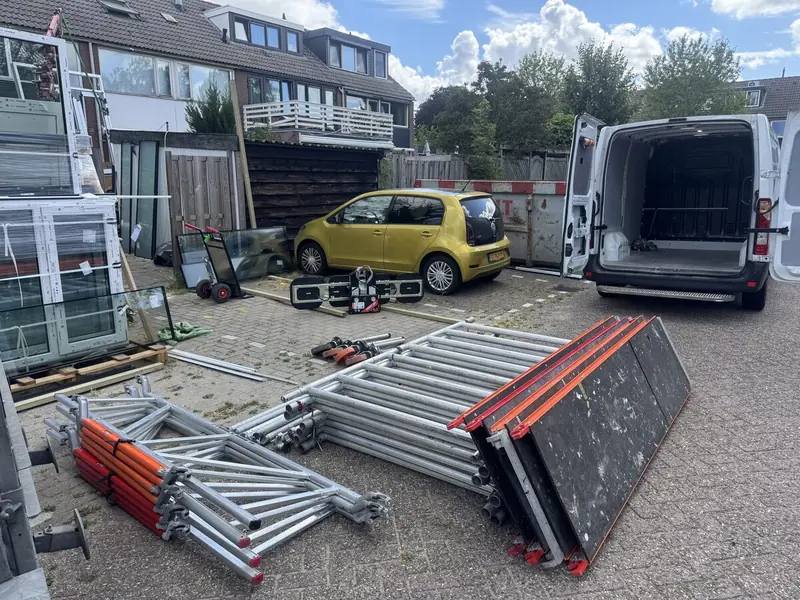

What do you use a mobile scaffold for?
From painting to roof work: every job calls for a different scaffold and working height. Choose your application below for advice, prices and practical tips.
This page lists the jobs people rent a mobile scaffold tower for, from painting and replacing a gutter to cleaning a facade, fitting solar panels, changing window frames and working indoors. Find the job closest to yours. Below you can read why the job is a better starting point than a number in metres, and what to check before you book.
Start with the job, not the height
A job tells you far more than a figure in metres. It decides how long you stand up there, how much material has to go up with you, and how far sideways you need to reach from the platform. Cleaning a gutter leaves your hands almost empty and is done in a morning. Painting a facade means brushes, tins and sandpaper going up and two full days on the platform. That difference never shows up in the height.
So two jobs at exactly the same height can call for a different tower. Checking a roof edge at 4 metres is best done narrow and manoeuvrable, because you mainly want to move around the house quickly. Rendering that same 4 metre wall means buckets, a second person and half a day in one spot, and then you want room on the platform. Pick the job first and let the height follow from it.
Three things every job decides
The first is height. Always work with working height, which is platform height plus roughly 2 metres of reach. Standing on a platform at 4 metres, your hands comfortably reach about 6 metres. Measure the highest point you genuinely have to get to, taken from the spot where the tower will stand, and compare that directly with the working height. The range runs from 4.2 to 14.2 metres, in steps of roughly 1 metre.
The second is width. The RS51 is 75 cm wide and fits down a side path, through a gate or between a hedge and the wall. The RS52 is 135 cm wide and gives you working room for tools, material or a second person; on both models the platform is 245 cm long. The third is indoors or outdoors. For interior work there is the RS44 room scaffold, which passes through an internal door from about 70 cm. The MiTower is a one person tower up to 6 metres working height.
Estimating the job and booking rental days
Allow more time for your job than you hope to need. Paint has to dry, pointing is done in sections, and roof work or solar panels depend on the weather. Add the build up and the take down to your own estimate, plus the day the tower is delivered. A job that finishes on Saturday on paper often runs into Sunday afternoon in practice, and that is no problem at all as long as you allow for it when you book.
Extra days cost almost nothing. The first twenty four hours are charged at the full rate and every day after that carries a 95% discount, so a week is close to a single day. That is far more comfortable than stopping halfway through because the tower is being collected. Order before 15:00 on a working day and delivery follows the next working day. When you book you choose the delivery date and the collection date yourself.
What stays the same on every job
Whatever the job, the basics never change. The ground under the wheels has to be flat and firm across the whole area the tower occupies. You need clear space around the base for the stabilisers, so move bikes, planters and building material out of the way first. Lock every wheel before you climb. Never move the tower with someone on it or with loose tools or material still on the platform, not even over a short distance.
All towers are built to load class 3 under EN 1004, which works out at 200 kg per square metre of platform. That is enough for two people with tools, as long as you spread the weight and do not stack everything in one spot. The tower arrives as a complete, counted set of parts and is collected again afterwards. You assemble it yourself, using the manual and the video that come with it.
More frequently asked questions
My job is not on the list, what now?
Pick the job that comes closest in terms of the work involved. Painting a dormer is much like painting a facade, and mounting a dish or camera resembles gutter work. Then simply run through the three points: what working height you need, how much width you want on the platform, and whether you are working indoors or outdoors. You will end up with the same tower.
Can I use one tower for several jobs?
Yes, and it is usually the smartest approach. If you are up there anyway, do the gutter, the roof edge and the paintwork in one go. Choose the tower on the heaviest job in the list: the greatest working height you need and the width that suits the bulkiest material. Just book extra days, because after the first twenty four hours they are cheap.
I am torn between two heights, which do I take?
Take the taller of the two. On a tower that is too tall you can simply work from a lower platform level, but on one that is too short you can do nothing at all. You only build it up to the level you actually need. Doubt often comes from the ground: a sloping garden or a raised terrace easily shifts your measurement by half a metre.
Can I move the tower during the job?
Yes, moving it is fine, and along a long wall you simply shift it one 245 cm section at a time. Just do it with nobody on board and no loose tools or material left on the platform. Release the wheel brakes, push the tower along at the bottom over flat ground, then lock the wheels again and check the stabilisers before climbing back up.
Can the same tower be used indoors and outdoors?
It can, as long as the dimensions work out. A tower 75 cm wide gets through many gates and passages, but an internal door is often the pinch point. If you really need to move from room to room, choose the RS44 room scaffold, which passes through an internal door from about 70 cm. Indoors, check the floor: it must be flat and able to carry the weight.