
See your price
Application

Maintaining a facade? Choose the right scaffold.

Facade maintenance that works is a round you repeat. You divide the wall into numbered bays, walk them in the same order and do the same list on each one: check the sealant, touch up paintwork, look over pointing, brush growth away. Not yet knowing what ails the facade means picking a scaffold on the wall itself; this page covers the fixed, recurring round. On a three storey building you hire the wide mobile scaffold, put up somewhere between 8 and 12 metres, and the service goes in the same season each year.

  • Order before 3 pm, delivered tomorrow
  • Professional Altrex scaffolds
  • Up to 14.2 metres working height
  • Easy to assemble yourself
4,2 tot 14,2 mWorking heights available
12Provinces served
7Days a week
200 kg/m²Load class 3
In short
  • For maintaining a facade we recommend the Wide mobile scaffold.
  • For a recurring maintenance round on a three storey wall take the wide RS52, built between 8 and 12 metres.
  • Number the bays and keep a note per bay of what you did, and next season you know exactly where to start.
  • Plan the round for spring or autumn and book your rental period well ahead, because those weeks are the busy ones.
  • First 24 hours from €175 incl. VAT and delivery; every day after that 95% off.
Key facts for this job
FeatureValue
Recommended scaffoldWide mobile scaffold (Altrex RS TOWER 52)
Working height for this job8 to 12 metres
Available working heights4.2 to 14.2 metres
StandardEN 1004, load class 3 (200 kg per m²)
DeliveryOrdered before 3 pm, delivered next working day
Each extra day95% off, from €8.75 a day
Why a mobile scaffold for maintaining a facade?

Safe, stable and professional work at height

A service on the facade is not one job but a string of small operations in dozens of places. On one bay you renew a sealant joint, on the next you rub down a weathered rail, and three metres along a gutter bracket has worked loose. So you go up with mixed tools and you stay longer per standing position than you would for a single continuous treatment. A ladder cannot keep up with that, because nothing can be set down on it and every aid means another trip to the ground. Hire a mobile scaffold for a facade service and what you are buying is a roomy deck, a fixed route, and a rental period that spans the whole round.

  • Mixed tools for sealant, paint and pointing
  • A fixed route past numbered bays on the wall
  • A build between 8 and 12 metres
  • The same service and the same positions each season
Read more about working safely →

Which mobile scaffold to hire for a recurring facade service

The RS52 out of the Altrex range measures 135 cm across and runs on to 14.2 metres of working height in its heaviest form. For a service round along three storeys you settle on 8 to 12 metres out of that range. On this job the width is no luxury, because you do not take a single tool up but very nearly half a workbench: a sealant gun with cartridges, a tin of paint and a brush, abrasive paper, a brush, cloths, screwdrivers and a bucket for waste.

Anything left lying below costs you a climb. On a bay two metres wide you often carry out four or five different operations during a service, and whoever goes down for each of them loses a quarter of an hour per bay. On a deck 245 cm long you can spread that whole list out and still keep a walkway. Working as a pair, one can seal while the other touches up the paintwork. Over a full round that easily saves a working day.
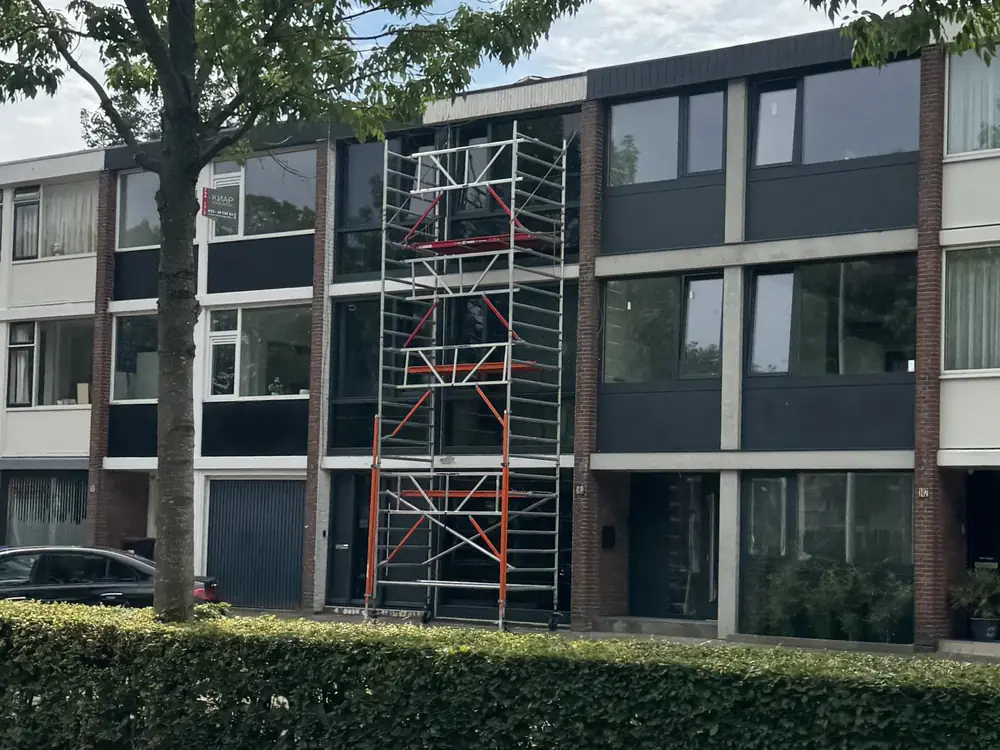
Wide mobile scaffold standing against a building, the build with which you work through the service bay by bay

For the side the wide build cannot reach you hire the slim RS51 at 75 cm as well. On a mid terrace or a building with an alley beside it that is usually the back. Managing agents therefore often split the round in two: the street side on the wide build, the rear on the narrow one. Note down at which bay you change over. What else to arrange beforehand is listed in the checklist for hiring a mobile scaffold.
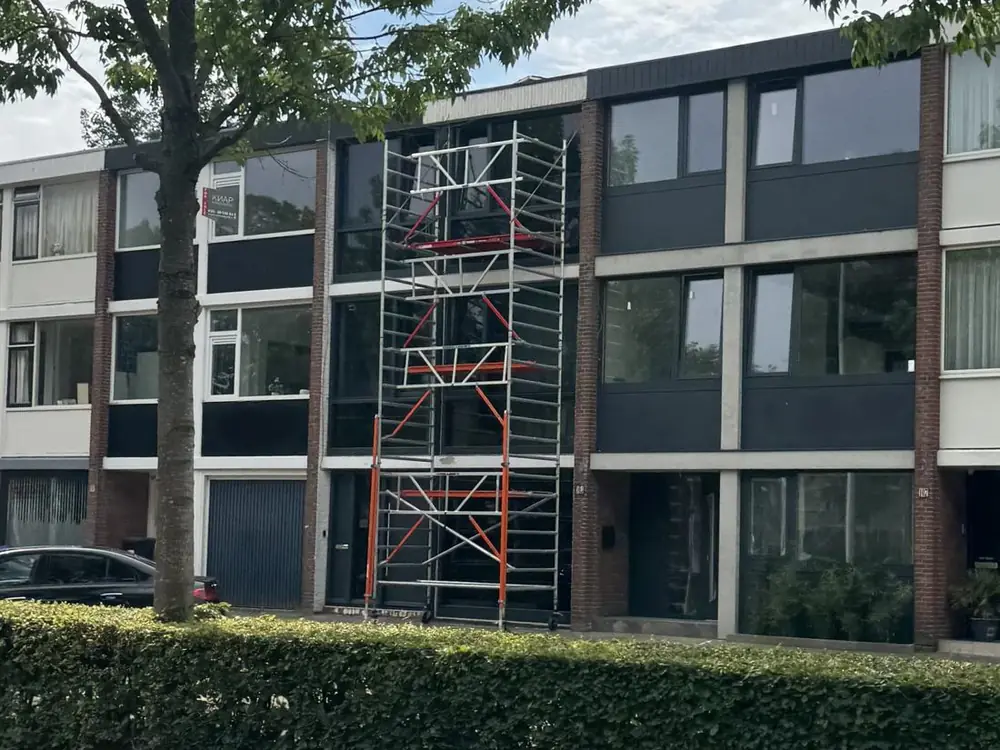
Working height to hire for a service round along the bays

On a maintenance round the highest point rarely sits in the masonry itself. It is the gutter brackets, the end grain of the fascia and the top window junction that you have to reach, and those lie just below or right on the roof edge. From the deck you stand on your arms take you about two metres higher, so subtract that and you know the platform height this round needs. With the gutter at ten metres you want a deck at around eight.

Put your tape on the paving where the wheels will end up, and write the answer in your log. That saves you half a morning next season, because you then know at once which build to reserve and how many frames will be brought. If the back garden sits lower than the pavement, note both values separately and hire on the lower of the two. The build that goes with it is drawn out at ten metres of working height.

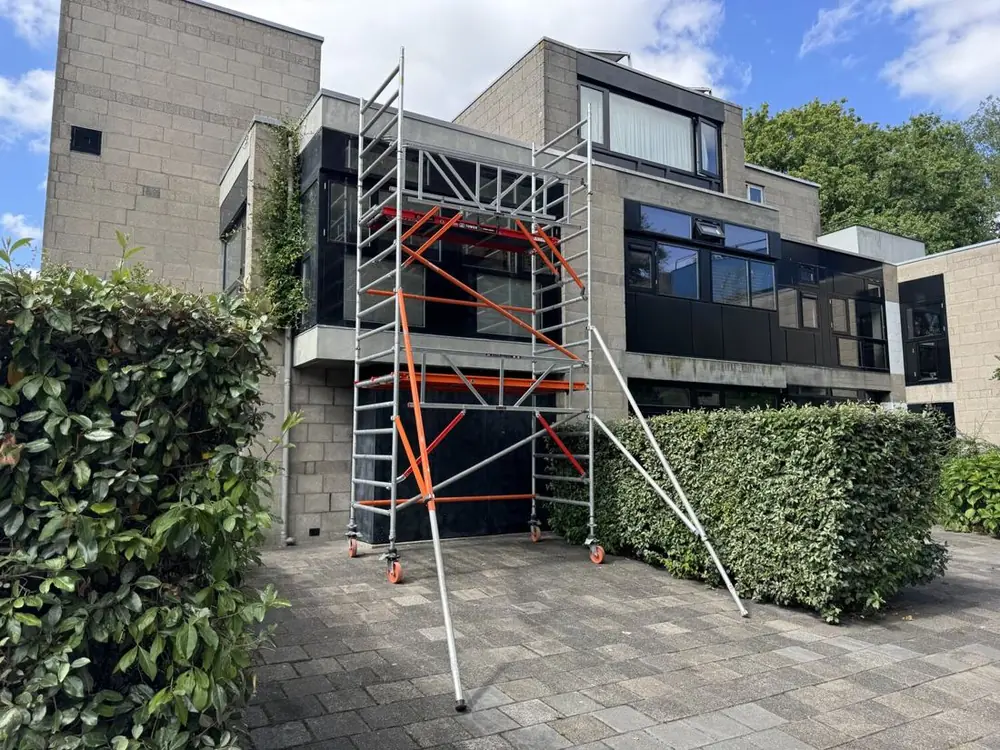
Mobile scaffold set up in front of a front elevation, in the range your service round needs at gutter level

Pick too low and you skip exactly the part where maintenance is needed most. Rainwater runs down past the roof edge, so that is where the decay in sealant, timber and pointing begins. A round in which the top metre is missing gives you double work next year, and sometimes a repair that timely attention would have prevented. Hesitating on a facade of three storeys, go a build higher and leave the top deck unused if you must.

Hiring a scaffold with fixed standing positions per numbered bay

Anyone who goes over a wall every year gains time by fixing the standing positions. On the first round decide where the build goes for each bay, mark those points with a slab, a peg or a chalk line and put them in your log. At the next service you simply roll the tower back to position three without measuring again, and you know in advance which bays you will finish in a day. That also makes your rental period far easier to predict.

At every standing position all four stabilisers need to open out completely, and that spread runs wider than the base itself. Go along the row of positions first and see what is in the way: a wheelie bin, a patio table, the outside tap, a rainwater pipe with a leaf trap, or a shed built against the wall. Whatever you move once you only have to put back next time round. Write those obstacles into the log as well, by position number.

Stabilisers swung out under a mobile scaffold, the room each fixed position on your service round demands

The season decides how those spots behave. In autumn the lawn under the back wall is soft and wet leaves lie on the slabs; in spring the borders are just filling out. On soft ground put stout boards under the wheels of the scaffold and note per position whether that was needed. A year later you then know which spot asks for extra preparation. Ground that falls away is dealt with in the guidance on an uneven surface.

How many rental days a complete service round takes

Work the round out in bays rather than in square metres. A wall twelve metres wide yields about six standing positions at bays of a good two metres, and per position you are easily half a day checking and touching up over three storeys. Add the building and the dismantling to that, and a complete service on one elevation comes out at four to six rental days. On a building with two sides that all but doubles.

Inside those days sit pauses you cannot make up. Fresh sealant wants to cure before you paint over it, touched up paint has to be dry before the second coat, and a brushed clean patch has to dry off before you judge whether more is needed. The season comes on top: with night frost or steady rain a service slides a few days without apology, even though the tower stands ready. Plan therefore in whole weeks rather than in loose working days.

Erected mobile scaffold along a side elevation, as it stands on one position through a whole service week

The tariff helps you there. That first twenty four hours is the day you really pay for; after it ninety five per cent comes off each rental day, so a round that slips from four days to six hardly changes your budget. Hiring too tightly means stopping halfway through bay four and pushing the rest to next year. How to size such a period up beforehand is set out in the article on the length of your rental period.

Which mobile scaffold suits maintaining a facade?

Kamersteiger RS44
  • Working height up to 4 metres
  • Compact and narrow
  • Great for indoor and small jobs
View and calculate →
Smalle rolsteiger RS51
  • Working height up to 14.2 metres
  • Narrow (75 cm)
  • Ideal for narrow passages
View and calculate →
Most chosen
Brede rolsteiger RS52
  • Working height up to 14.2 metres
  • Wide platform (135 cm)
  • Extra stability and workspace
View and calculate →
1-persoons steiger MiTower
  • Working height up to 6.2 metres
  • Very compact
  • Quick and easy to assemble
View and calculate →

The fixed route past numbered bays from the working deck

A deck 245 cm long corresponds exactly to one bay on your route, and that division carries your whole plan. Number the bays from left to right, tape the list of operations to the guard rail and work the same order on every bay: first look from top to bottom, then the sealant, then the rubbing down and painting, then the gutter and the brackets. Reverse the order each time and by the sixth position you forget what happened on the first.

Moving belongs at the end of a bay, not halfway through. Take the trays, the sealant gun and the loose tins off the deck, drop the build to its lowest setting if you have time for that, and only then roll on to the next number. Set the brakes afterwards and swing the stabilisers out again before anyone climbs. Cross the finished bay off in your log straight away, or on a long round you lose count of where you are.

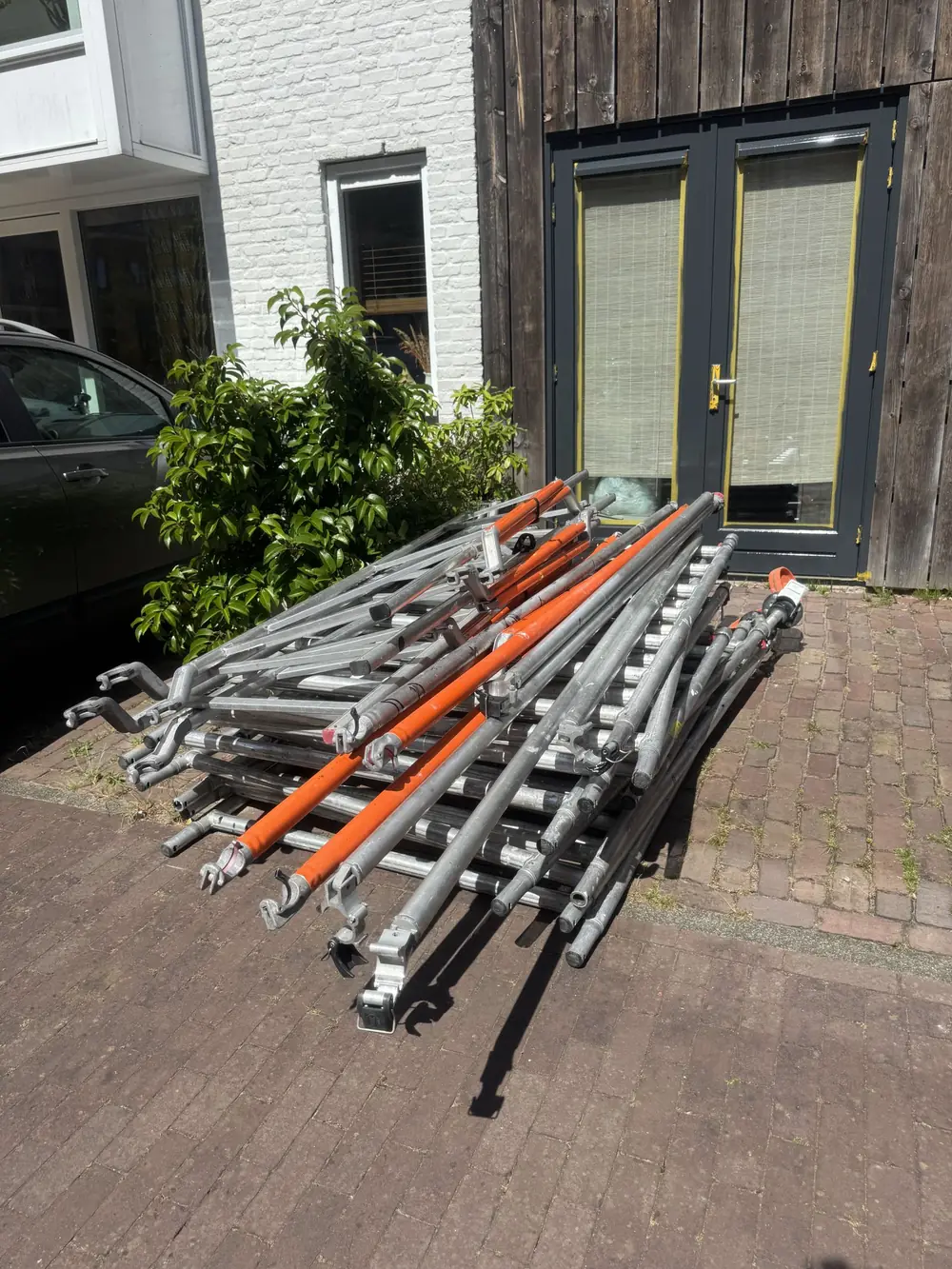
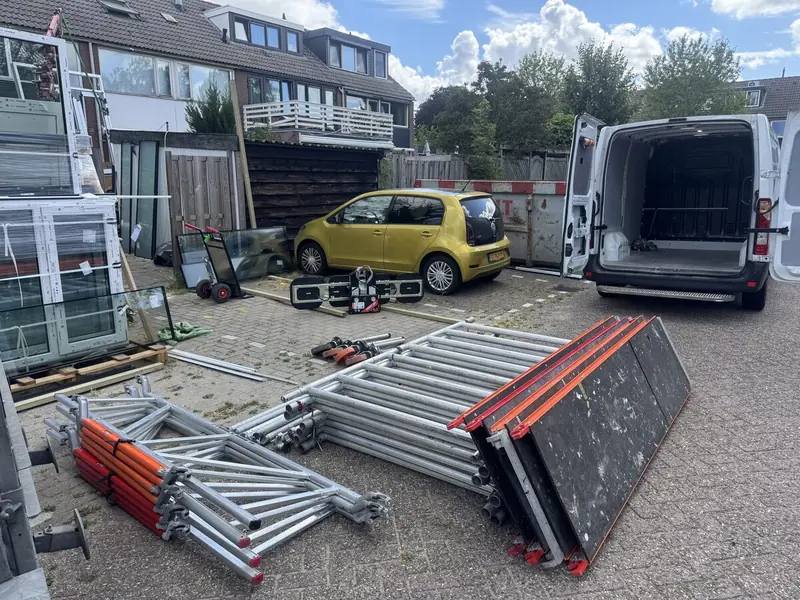
Loose scaffold parts on a drive by a white wall, the set that gives you bays of 245 cm along a facade

What people misjudge is the temptation to push small defects forward. A hairline crack in a sealant joint or a bare patch on a window sill looks trivial, yet those are exactly the places that ask for real repair next season. The strength of a fixed service lies in being consistent rather than fast, which is also why you hire a day longer rather than skip a bay. If one bay is clearly out of step, plan it as a separate job, for example repairing the facade.

Hiring a mobile scaffold with delivery in your service week

What pulls up is a set of loose parts, counted and complete. Point out a fixed unloading spot on your ground, preferably the same one as last year, so the driver knows where to be and the parts do not land on the route to your first position. A reservation that is complete on a working day and beats 15:00 puts those parts with you the working day after. A service week you almost forgot to plan is therefore still rescuable.

You give the arrival day and the return day yourself, and on a recurring service that is the heart of your planning. Put the delivery on the Friday before your service week, then you build calmly over the weekend and start on bay one on Monday. Because spring and early autumn are the busiest periods, fixing things early matters more here than on a rush job. Erecting is your task; the manual and the video show you the order.

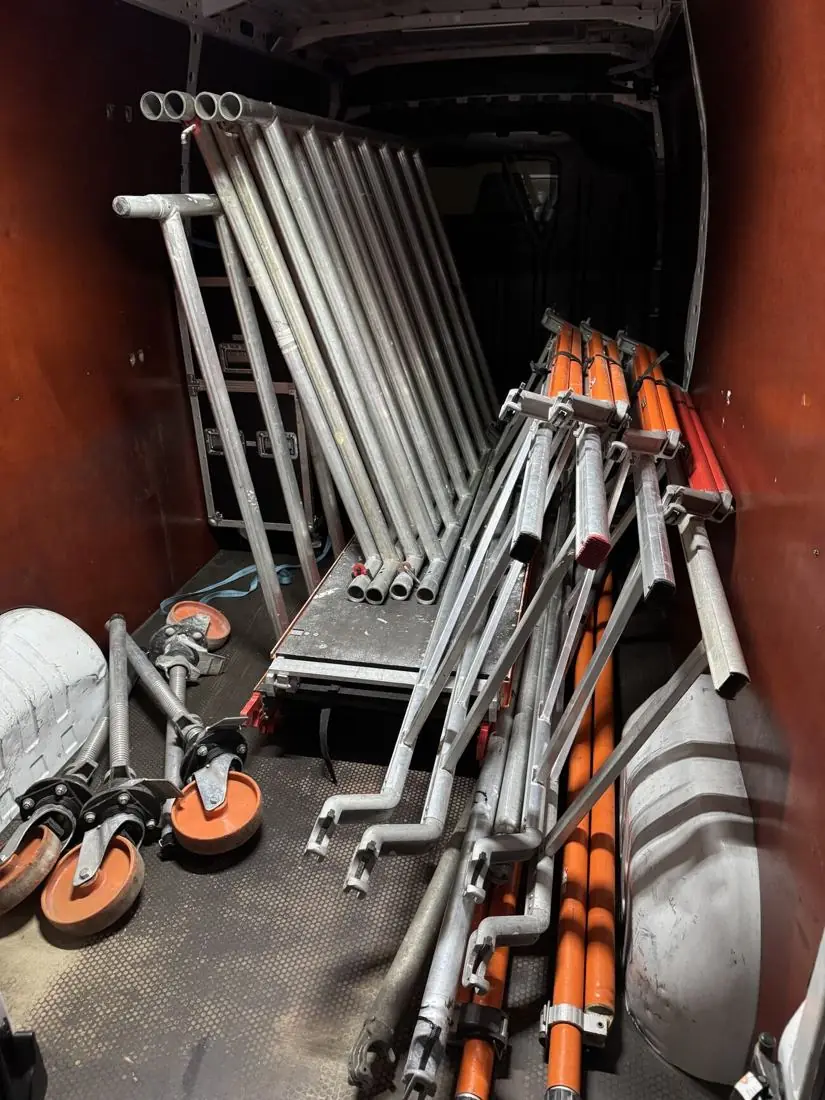
Stacked scaffold parts ready for transport, as you leave them on the fixed unloading spot after your service week

After the last standing position we collect the set again, once you have dismantled it and stacked it complete on the unloading spot. Count the parts while you take it apart and you need not think about that on collection day. Note in your log how long the dismantling took, so your next round adds up better. What bringing and collecting costs depends on your province and is found at the charges for delivery and collection.

Working safely on the scaffold during the annual facade service

The deck carries 200 kg per square metre, the limit load class 3 holds to within EN 1004. On a service round you come closer to it than you think, because you stand there as a pair, with a tool box, a few tins of paint, a bucket of stripped out old sealant and sometimes a can of cleaning fluid. Add that up once before you begin, and spread the heaviest items along the length of the deck. What that figure rests on is looked up in the note on the scaffold standard.

The standing agreements hold on routine work too. Brakes on the wheels before the first foot touches the rung, no person and no material aboard while the build rolls, and stop when the wind gets up. Check at every new bay that the stabilisers stand firm again. With six positions in a day that is the same action six times, and it is precisely there that sloppiness creeps in. Let one person take that check on permanently.

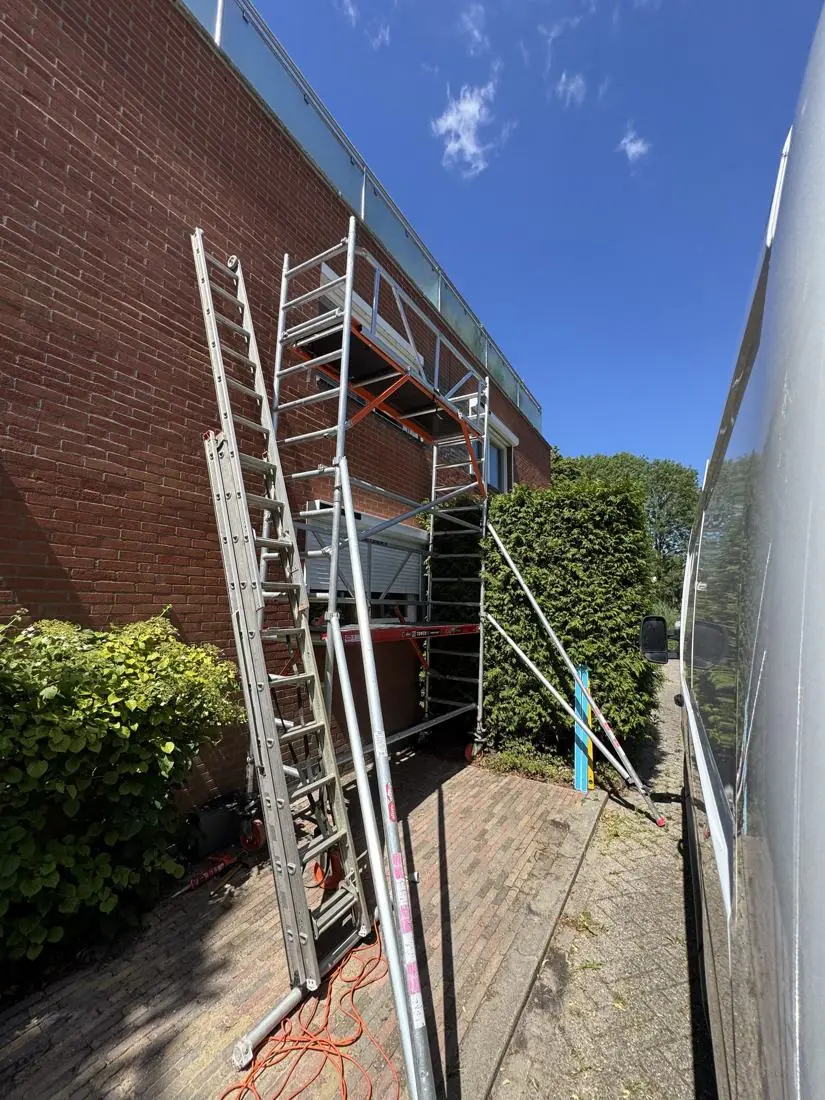
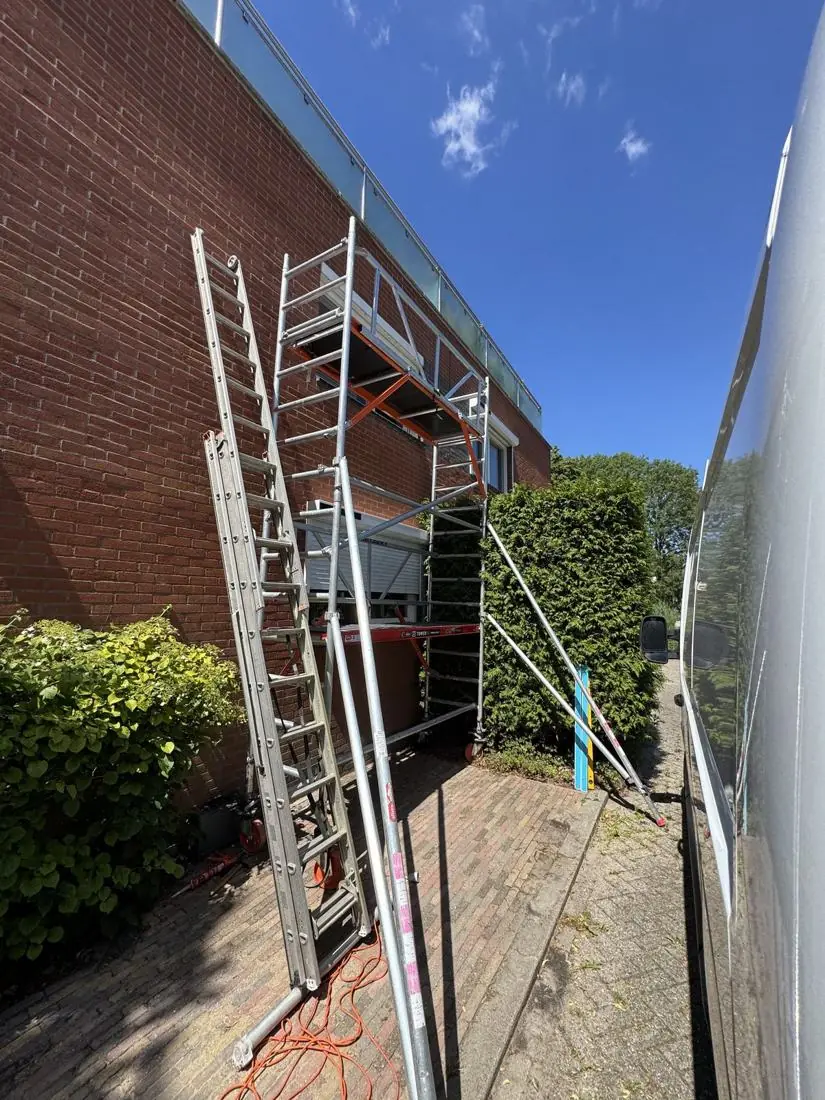
Mobile scaffold built along a brick side wall, an extension ladder set apart against the same wall, deck limit 200 kg

The particular risk of a recurring service is familiarity. You know the wall, you know where the awkward corner is, and you therefore work faster than you would on an unfamiliar building. On top of that a maintenance deck is full of loose items your foot can catch. Tidy up per bay and keep the zone under the build clear, certainly when residents or colleagues pass along the wall. The wider rules sit at working at height.

In 5 steps

How hiring a mobile scaffold works

1
Choose working height

Pick the height that suits your job.

2
Book online

Sorted in 60 seconds, price shown instantly.

3
We deliver

At the agreed spot the next working day.

4
Assemble safely

Assembled by you, with a manual.

5
We collect

One call and we collect the scaffold.

Good to know

Practical tips for maintaining a facade

1

Make a drawing of the wall on your first round with the bays numbered and the standing positions marked. That one drawing saves you half a day of measuring and discussion at every later service.

2

Hang a list of the fixed operations on the guard rail of your platform. On bay six you have otherwise forgotten that on bay one you also cleaned and checked the ventilation grilles.

3

Note per bay not only what you did but also what you left. That list is your starting point next season and the basis for the rental period you are about to book.

4

Take one tray up per standing position holding the complete run of tools. Loose items you carry up separately are precisely the items you mislay on the platform or leave behind at the bay below.

5

Set the service in the same weeks every year, late April or the middle of September for instance. You then know what the weather does and can fix your period a season ahead.

6

Photograph every bay before and after your service from the platform. On the next round you see at a glance which spots come back faster than the rest of the wall.

Frequently asked questions

Frequently asked questions about maintaining a facade

Which mobile scaffold should you hire for a recurring service on the wall?+

Over three storeys you are best off hiring the RS52 at 135 cm. A maintenance round asks for mixed tools, and on a wide deck the complete run lies spread out while you can still walk. Two people often work at once as well. If you reach the back along a narrow alley, add the slim 75 cm tower for that stretch to your reservation. Measure the tightest opening on your route before fixing a model.

How do you go about hiring a mobile scaffold for the service round?+

You fix the model and the build online and enter when everything should come and when it may be collected again. Prices are fixed, with VAT already in them. On the chosen day the loose parts lie ready, you erect the tower and work through your bays, and after the last standing position you hand it all back complete. For a yearly service you would rather book that period a season ahead.

How many rental days does a maintenance round along the wall take?+

For one elevation of three storeys a maintenance round usually lands on four to six days, building and dismantling included. Take the side and the rear as well and it soon becomes a week and a half to two weeks. What decides it is the number of standing positions on your route, not the square metres of wall. Reserve the tower in whole weeks, because sealant and paint need time in between and that splits badly into loose rental days.

What does hiring a scaffold for a whole maintenance week cost?+

The rental price has two parts: the rate for the model with the scaffold height you choose, and the fixed charge for the trip out and back in your province. You find it all, VAT included, at the rates per model. For a week long service that falls out kindly, since the weight sits on the first day and the days after it count for little. One continuous period is cheaper than two loose blocks.

Which working height should you hire for maintaining a three storey wall?+

As a rule you end up between 8 and 12 metres; how much exactly depends on the storey height and on the piece of wall running above the top windows. What decides it are the gutter brackets and the fascia, since those are the parts you want to reach on a service. Measure from the paving to that point and hire on the answer. The page with the working heights shows the matching build.

Can the hired scaffold be delivered on the first day of the service week?+

It can, though the day before is usually smarter. You choose the arrival date yourself, so have the parts come on the Friday and use the weekend to erect the mobile scaffold; on Monday you then start straight on the first bay. Collecting is possible too: by appointment your set stands ready at no charge at Zeeburgerpad in Amsterdam. For a service of several days most people still choose delivery on site.

Do you erect the tower as part of the hire, or is that mine to do?+

Erecting and dismantling is your work. A manual travels with the set, and a video demonstrates the sequence step by step; two people have this height standing in a morning. Take that morning into the planning of your service week. We do not hire out cherry pickers, system scaffolds or facade scaffolds, which leaves the mobile scaffold as the means for a recurring round on a house or a small commercial building.

What if the maintenance round overruns and I want to hire for longer?+

Let us know as soon as you see that bays five and six will not fit, and the return day moves along, provided no next customer is waiting on the tower. On a service that happens often: you find more sealant work or loose timber along the way than you expected. Anyone wanting to avoid it plans two spare days at the end of the hire week from the start, since returning early is always allowed.

How much room must be free per standing position round the hired scaffold?+

Count on the width of the base plus what the stabilisers claim left and right, and keep working room on top of that to set things down. On a maintenance round that applies to every numbered bay on your route, so walk the whole line beforehand. Move the obstacles away before the mobile scaffold is delivered and note down which ones they were, and the next service round through those bays takes half the time.

Which season suits best for hiring a scaffold for facade maintenance?+

Spring and early autumn work best. Sealant and paint need a reasonable temperature and want neither night frost nor fierce midday sun, and in those two periods your chances are highest. Bear in mind that they are also the busiest weeks in the hire trade, so fix your period early. Rain in between costs you a working day rather than a whole hire week, because the build simply stays standing and waits for you.

How does the deposit work on a scaffold you hire again every year?+

You settle a deposit per rental period, and the money is with you again a single working day after the return run, once every part has been counted off. On a service round you watch above all for paint spatter and for sealant residue that beds itself into the profiles of the decks. Keep a cloth in your tool tray and wipe the deck boards per bay. More about that is in the explanation about settling up after the return.

Can I use the same rental period to touch up the window frames too?+

Yes, and that is the advantage of a service with a fixed route. Because you are standing still at each bay anyway, you take the frames, the window sills and the ventilation grilles along in the same round. Do bear in mind that paintwork needs drying time and so lengthens your hire. If it is not yet settled what has to happen, start at the general page on facade maintenance on a house.

Hire a mobile scaffold for maintaining a facade today?

Calculate your rental price now or ask for free advice.

Rolsteiger van SteigerTaxi geleverd op locatie
Book it online

Your scaffold sorted in 2 minutes.

Choose your scaffold and working height, see the price instantly and book online.