
Knowledge base · reading time 11 min
Hiring a mobile scaffold: the complete checklist
Hiring a mobile scaffold goes wrong at two moments: when you order, if you pick the wrong height or the wrong model, and on the day itself, if the scaffold cannot reach the place it has to stand. This checklist covers both, in the order you meet them, from the first measurement to the moment your deposit is back in your account.
- From measuring your working height to dismantling and getting your deposit back: the full checklist for hiring and using a mobile scaffold, in order.
- Use the facade as a rule: brick courses, the underside of a window sill or the height of a door put you within half a metre.
- Measure the narrowest opening on the route to your work area.
- Orders placed before 15:00 are delivered the next working day.
Step 1: measure your working height
Everything starts with one number. Working height is platform height plus two metres, because that is how far an adult reaches upwards from the platform. So measure from the ground to the highest point you have to work on, for example the top of the gutter or the ridge of your dormer, and subtract two metres. What remains is the platform height, and that is the figure you carry through the rest of the process.
If you cannot get close enough to measure, use the facade itself as a rule. A run of brick courses, the underside of a window sill or the height of a door are all references that put you within half a metre. If you are still unsure, take the next build height up. Standing too low costs you more than an extra frame, because you end up stretching and leaning over the guardrail.
The range covers working heights from 4.2 to 14.2 metres, from a low extension to the top storey of a tall building. The working height page walks through the heights one by one, and if your job sits on a particular floor, the page on the second floor is a useful check on what you measured with your own tape.
| Platform height | Working height | Roughly what you can reach |
|---|---|---|
| 2.2 metres | 4.2 metres | Garage, extension, low roof edge |
| 4 metres | 6 metres | Gutter of a low house, carport, canopy |
| 6 metres | 8 metres | Facade of an average house up to the gutter |
| 8 metres | 10 metres | Higher dormer or roof edge |
| 12.2 metres | 14.2 metres | Tall facade, upper storeys |
Key facts
| Feature | Value |
|---|---|
| Core answer | Check height, width, ground, hire days and delivery address before booking |
| Working height | Platform height + 2 metres |
| Delivery | Ordered before 3 pm, delivered next working day |
| Deposit | Refunded within 1 working day of return |
| Each extra day | 95% off: €2.50 to €16.25 a day |
Step 2: look at the site and the route to it
Go outside and look at where the scaffold will stand. Is the ground flat and firm enough, or is there grass, gravel or loose paving? Is there a manhole cover exactly where a castor goes? Does the pavement slope? These are the things you cannot solve on the day of delivery without losing time, whereas right now you can still put a few planks or sole boards ready.
Then measure the narrowest opening between the street and that spot: the gate, the garden path, the gap beside the garage. Allow for a corner, because the longest parts have to come round it. Do not forget the stabilisers either, because they project on every side and need a flat, load bearing place to stand. An alley exactly as wide as the scaffold is therefore too narrow in practice.
Finally, look up. Are there cables, an awning or branches above the spot where the scaffold goes? Does the roof edge or a bay window project, so that the top of the build runs into something? Obstacles like those often decide which model fits. If the ground is the problem, the guide on a mobile scaffold on uneven ground gives you the solutions.
Step 3: choose the model that suits the job
With your platform height and the narrowest opening you know enough to choose. The mobile scaffold comes in two widths: the RS51 is 75 cm wide and fits along a garden path or through a gate, the RS52 is 135 cm and gives you a roomier working area for materials. Both have a platform length of 245 cm, so along the wall you cover the same distance.
If the work is indoors, the RS44 room scaffold is the answer. It fits through a standard internal door from about 70 cm, so you can take it to a stairwell, a tall wall or a ceiling without damaging the frames on the way. For short solo jobs there is the MiTower, a one person scaffold reaching up to 6 metres working height.
If you are still torn, the guide on a mobile scaffold or a room scaffold settles the indoor and outdoor question, and the guide on dimensions and sizes lists every measurement side by side. The equipment is Altrex and meets EN 1004 in load class 3, which means 200 kg per square metre distributed, whichever model you end up choosing.
Step 4: work out how many days you need
The first hire day costs the full day rate, every following day counts as 5 percent of that rate. Carrying on is therefore a much smaller step than the first day, which is exactly why you book generously rather than tightly. Count your working days, plus the time for building and dismantling, plus a day of margin for rain or for a coat of paint that takes longer to dry than you hoped.
Think about the weekend as well. If you want to work Saturday and Sunday, a period from Friday to Monday is calmer than exactly those two days, because delivery and collection happen on working days. How to judge the period per type of job is covered in the guide on how many days you need a scaffold, and whether to think in days or weeks is set out under hiring per day or per week.
Step 5: delivery or collecting it yourself
Order before 15:00 and the scaffold is delivered the next working day, anywhere in the Netherlands. Delivery and collection are covered by a fixed amount per province, so you know beforehand what it is and nothing is added afterwards. What it comes to for your address is shown on the delivery costs page, so you can weigh it up before booking.
Collecting the scaffold yourself is free by appointment at Zeeburgerpad 89 in Amsterdam. That saves the delivery charge, but you need transport for it and the deposit on collection is higher than on delivery. On delivery the deposit is 500 euro for the RS51, the RS52 and the MiTower and 150 euro for the room scaffold; on self collection it is 1000 euro for the RS51 and RS52, 750 euro for the MiTower and 150 euro for the room scaffold.
The deposit is back in your account within one working day after the return, provided everything comes back complete and undamaged. If you have no van or trailer, delivery is almost always the practical choice; the guide on hiring without a trailer runs through the options. More on how the amount works is on the page about the deposit on a scaffold hire.
Step 6: book and see your total in advance
Booking happens online. In the configurator you enter your model, your working height, your period and your postcode, and the total appears immediately, including delivery and deposit. That is the figure you are committing to; it does not change unless you adjust the period or the model yourself. If you would rather compare the models first without filling anything in, look at the pricing page.
It helps to gather these details together before you start filling anything in. Then filling everything in takes two minutes, and you avoid having to go back outside halfway through in order to measure something you forgot. Especially when a second person is involved in the job, it is easier to agree the dates together before you order rather than afterwards.
- Your platform height, or the highest work point in metres.
- The width of the narrowest opening to your work area.
- The start date and the number of days you want.
- Your address and postcode for the delivery.
- The choice between delivery and self collection in Amsterdam.
The day of delivery
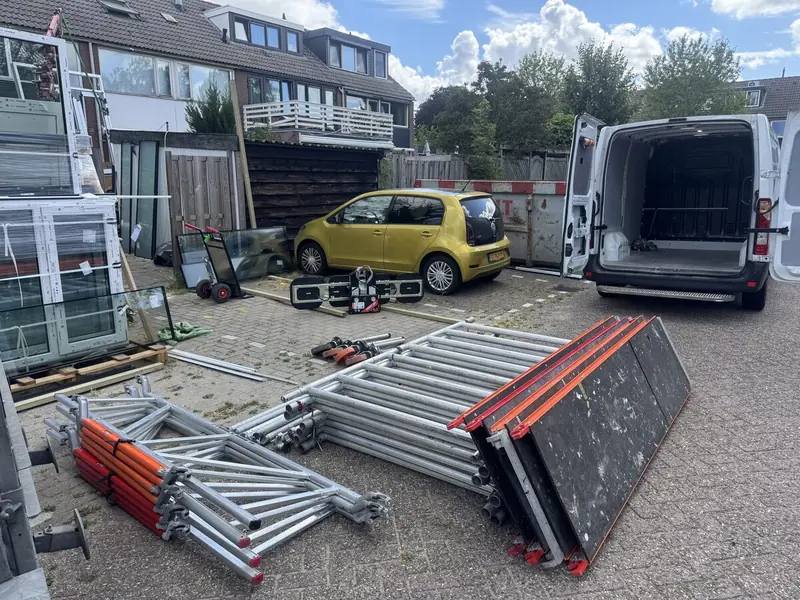
Make sure the place where the parts are unloaded is clear and that the driver can reach it. A locked gate, a car parked in front of the door or a full driveway cost everyone time. Put the sole boards, planks or panels you plan to use ready in advance, and set out a broom and a spirit level as well, because you will need both within half an hour.
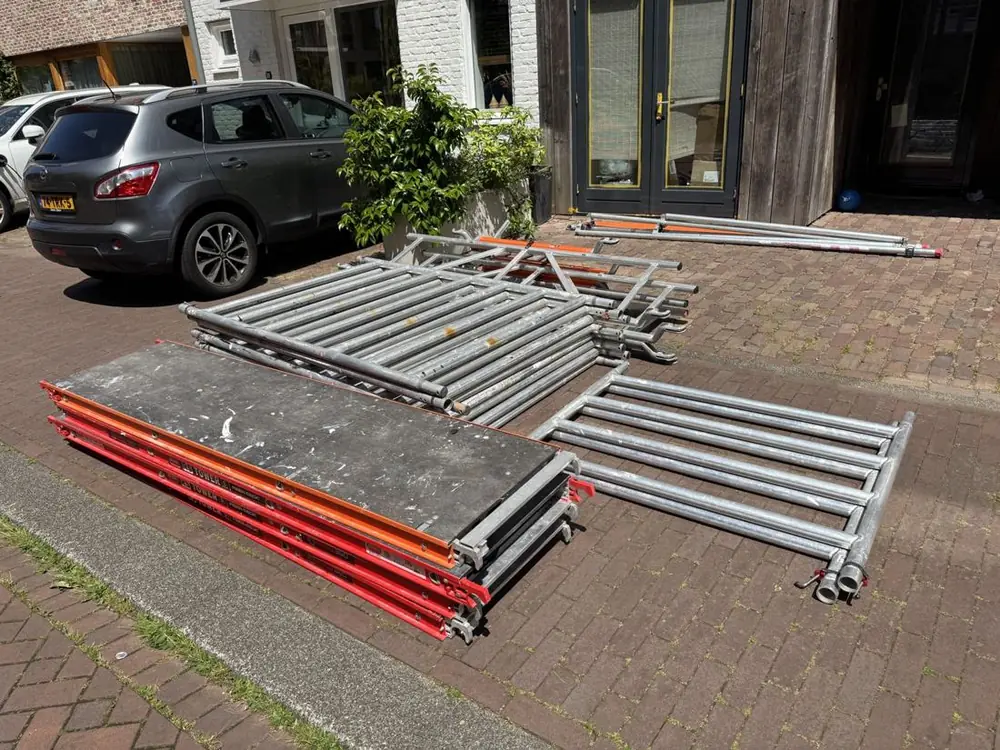
On receipt, check that everything is there: frames, platforms, guardrails, toe boards, braces and stabilisers, plus the locking pins. If something is missing or a part is damaged, report it to us straight away and do not start building. You do not half build a scaffold with a missing brace or guardrail just to see whether it works out anyway.
Then set aside time for the assembly. Steigertaxi does not build the scaffold for you and does not deliver it ready built; you receive the parts with the manual and an instruction video, and you build it yourself. Expect the first time to take longer than you think, and count that time against your first working day rather than against the job itself.
The build and the check before you climb
Build with two people and follow the order in the manual. Set down the base frame with the castors, brake the castors, level up with the adjustable feet, fit the stabilisers, and only then go higher. Anyone who builds high first and wants to add the stabilisers afterwards ends up working at the base of something that can already move, which is exactly when things go wrong.
Then work through these points, and repeat that same round every morning before the first person climbs up. More changes overnight than you would expect: a foot sinks after rain, somebody leans a bicycle against a stabiliser, or a brake gets released so a wheelie bin can be pushed past. The full sequence is set out in the step-by-step assembly guide.
- All castors braked and the locking pins in place.
- Scaffold level in both directions.
- Stabilisers fitted and the feet bearing on the ground.
- Guardrails, toe boards and hatch in position.
- Platform clear of loose items and not slippery.
- Today's wind checked: at force 6 or higher you do not work.
During the job: moving it and loading it
Move the scaffold with an empty platform and nobody on board. Take off your tools and paint, wind the stabiliser feet just clear of the ground, and push low down in the lengthways direction. Pushing at eye level produces exactly the tipping movement you want to avoid. Look ahead for thresholds, garden hoses and loose slabs, and level up and brake again in the new position.
With 200 kg per square metre distributed, a good deal fits on the platform, but it remains a distributed load. Do not put heavy bags in one corner, and count your own weight and your tools in the total. Take material up in batches and keep one hand free while climbing; there is more on that under loading and weight.
If the scaffold stays up overnight or over the weekend, clear the platform completely, brake all of the castors and check the forecast before you go back inside. When a storm is forecast, take the scaffold down altogether or reduce it to a lower build. How to keep it stable and anchored is covered in the guide on stabilising and anchoring.
Dismantling, returning and your deposit
Dismantling runs in the reverse order and is quicker than building, provided you work systematically and do not rush the last hour. Start at the top, pass parts down rather than dropping them, and group identical parts in one place. Take the stabilisers off last of all, once the height has already gone, rather than first simply because they are in the way.
Put everything ready at the agreed spot, within reach of the driver and not behind a locked gate. Check that the small items are there too: locking pins, toe boards and the manual. After the return, the deposit is back in your account within one working day. The steps are set out in the guide on taking down and returning a scaffold.
If you get stuck along the way, a quick message for advice is the fastest route. That applies to the choice beforehand just as much as to a frame that refuses to fit the way you expected during the build. Carrying on with the same house? The page on painting a facade will help you plan the next job on the list.
Frequently asked questions
How do I measure my working height if I cannot reach the gutter?
Use the facade as a rule: brick courses, the underside of a window sill or the height of a door put you within half a metre. Subtract two metres from your highest work point to find the platform height. If you land between two build heights, take the higher one.
How do I know whether I need the narrow or the wide scaffold?
Measure the narrowest opening on the route to your work area. If an RS52 at 135 cm will not pass, it becomes the RS51 at 75 cm. If you do have the room, the wider version is more comfortable because more material fits on the platform.
Can I get a scaffold today?
Orders placed before 15:00 are delivered the next working day. If you need it sooner, look at collecting it yourself in Amsterdam or at the options under hiring a scaffold urgently.
Do I need experience to build a mobile scaffold?
No, but you do have to follow the manual and not do it alone. The delivery includes the manual and an instruction video with the sequence. Work with two people so somebody is always checking that everything is level, locked and stabilised.
What do I do if a part is missing on delivery?
Report it before you start building, and never carry on with a missing brace or guardrail. A message on WhatsApp is enough to get it sorted quickly. In the meantime, do not improvise with material you happen to have in the shed.
May I move the scaffold while standing on it?
Never. Moving happens with an empty platform and nobody on board, after which you level up and brake again in the new position. Push low down rather than halfway up the height, and look ahead for thresholds and loose slabs.
Do I get my deposit back in full?
On a complete and undamaged return you get the whole amount back, within one working day of collection. So group all the parts together, including locking pins and toe boards. If something is missing, report it before the driver arrives.