
Knowledge base · reading time 11 min
Dismantling and returning a mobile scaffold
Dismantling is assembly in reverse, with one difference: you are tired, the job is finished and you want to go indoors. That is exactly where parts go missing and the dents appear that hold up the deposit. With a fixed order and ten minutes of checking, everything is stacked ready and the deposit comes back within one working day.
- Job done? Here is how to dismantle a mobile scaffold safely, return it complete and get your deposit back within one working day.
- Two is safer and faster.
- Less time than assembly, because you already know the sequence.
- Remove coarse dirt, paint and mud, but no more than that.
Pick the moment you start dismantling
Take the scaffold down while you are still sharp and there is daylight. Dismantling by torchlight is slower, and that is precisely when a toe board ends up left in the hedge. So plan the dismantling for late afternoon rather than after you have packed away your tools. Starting an hour earlier costs nothing and gets you a set that goes back complete.
Watch the weather as well. Taking a scaffold down in a strong wind is needlessly awkward because loose platforms and toe boards can be pulled out of your hands. Rain makes the rungs slippery and the components heavier to handle. Waiting half a day costs less than an accident or damage to the facade. Watch for gusts in particular, since they occur on otherwise calm days and catch you exactly when a platform is above your head.
If you doubt whether you will finish today, extend by a day instead. How many days makes sense is covered in how many days to hire a scaffold. Every day after the first costs only five percent of the day rate, so rushing to save a day gains you little. It also avoids an extra delivery run, because the scaffold is already there and you simply keep it a little longer.
Key facts
| Feature | Value |
|---|---|
| Core answer | Dismantle in reverse assembly order; we collect the set on site |
| Assembly time | 15 to 45 minutes, no tools needed |
| Deposit | Refunded within 1 working day of return |
| Delivery | Ordered before 3 pm, delivered next working day |
| Collection | Free by appointment, Zeeburgerpad 89 Amsterdam |
Clear the platform completely first
The first move is not undoing a guardrail but emptying the platform. Paint, tools, screws, cloths and a half-coiled extension lead all go down before anything on the structure changes. As long as material is up there, every part you release is a risk to whatever stands below. Close paint and adhesive tins before they go down, too, because a spilt tin on the stairs costs more time than the whole dismantling.
Do not drop things over the edge; hand them down or use a bucket on a rope. A screwdriver falling four metres arrives at considerable speed. Put something on the ground to mark the area as well, so nobody walks through it while you are working. Put tools straight into the box or bag they belong in, so you are not walking a second lap across the lawn at the end of the day.
Then run your hand along the platform edges. Loose screws, caps and clips like to roll into a corner. What you find now is what you will not be searching for in the grass later. What else belongs to working at height is set out in fall protection on a mobile scaffold. Look underneath the platform as well, where caps and small clips sometimes lodge between the profiles.
Dismantling happens in reverse order
The order of dismantling is the assembly order backwards: top guardrails and toe boards first, then the platform, then the braces and the frames, and so on downwards. Every layer you remove has to leave the layer below intact. Never skip a step because a component looks loose anyway. Work layer by layer and pass the released parts straight down rather than collecting them up top, otherwise you end up with a stack on the platform you cannot get round.
Keep the castors locked throughout and leave the stabilisers in place until the scaffold is only one frame high. That feels excessive, but a scaffold halfway through dismantling is less stable than an assembled one. The centre of gravity shifts with every move you make. Stand on the inside of the structure while releasing parts, never on the outer edge, so you never have to reach across a guardrail you have just removed.
The reverse order follows the assembly step plan read backwards. If you only need to work at height in a different spot, the rules that apply throughout are gathered in safe working at height rules. Do not mix the two routines: moving a scaffold does not require full dismantling, while returning one means going down to the last set of castors.
- Take all material and tools off the platform
- Remove the top guardrails and toe boards
- Lift out the platform and hand it down
- Release the diagonal braces, working downwards
- Lift off the frames layer by layer, with two people
- Remove the stabilisers and the castors last
Stacking on the ground without damage
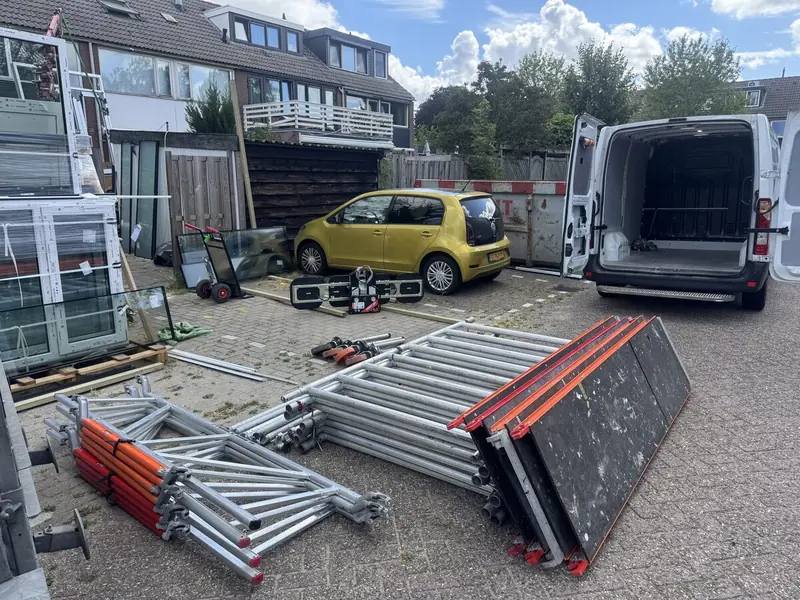
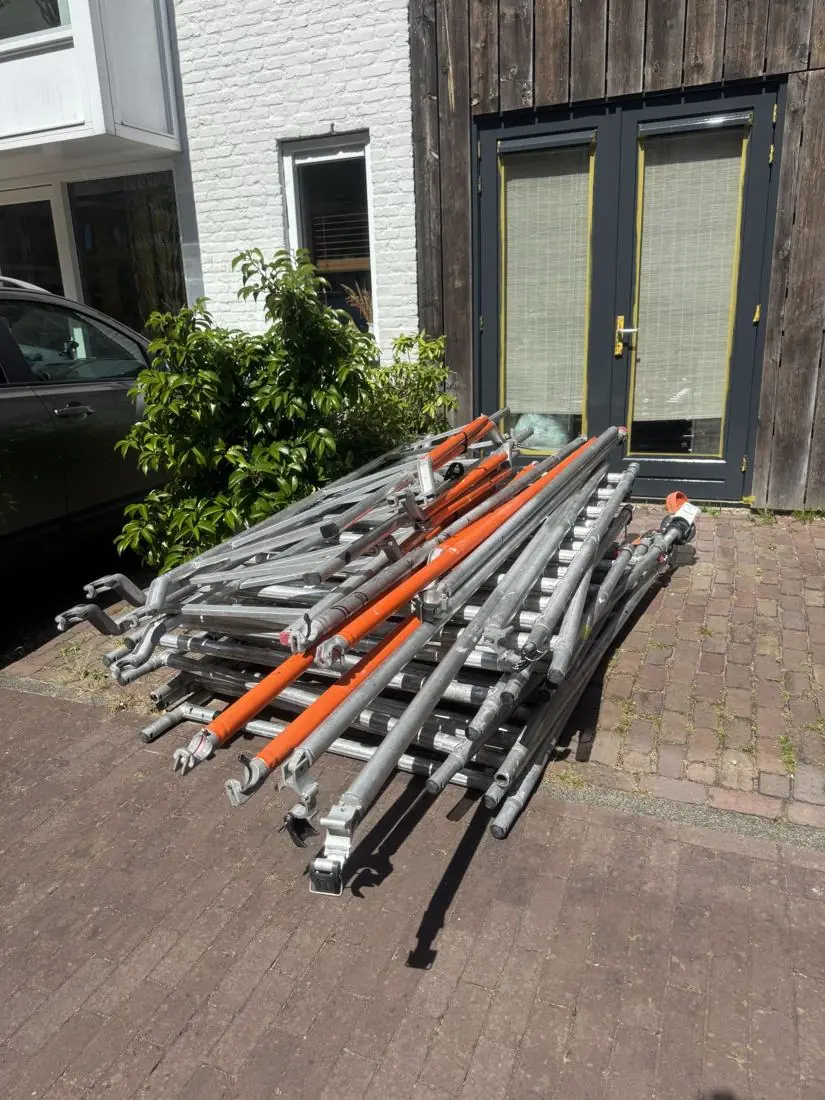
Do not scatter the parts across the garden; build stacks by type straight away: frames with frames, guardrails with guardrails, toe boards apart. That saves counting at return time and stops something disappearing under a tarpaulin or behind a fence. Choose a flat spot the driver will be able to reach. Lay a tarpaulin or a sheet of plastic over the stack if it stays outside overnight, so it is dry at collection.
Lay platforms flat, not on edge against a wall. On edge they fall over, and the hatch or the hinge takes the impact. Do not lay them straight onto gravel either, because that presses into the surface. A couple of battens or a sheet of cardboard underneath is enough. Stack the frames with the open side all facing the same way, then they will not slide and you can count them at a glance.
The platforms are 245 centimetres long, so allow a strip of at least three metres to lay everything out. The other measurements you are returning are listed at mobile scaffold dimensions and sizes, useful if the stack has to go into a van. Measure that strip before you start, because a drive looks longer than it is once a car is parked on it.
Getting the set complete before you report it ready
Returning complete is the single most important condition for a quick deposit refund. So go through the set the way you received it, component by component, and compare against the manual that came with it. A missing brace or toe board is a small thing, but it does hold up the handling. Count by type and note the numbers on your phone, so you do not have to go back into the garden when you report the set ready.
The table shows, per component, what to look at on return and which slip happens most often. Work through it while you stack rather than afterwards from memory. What belongs to each set is shown on mobile scaffold hire and, for indoor work, on room scaffold hire. Work through the table in pairs if you can: one counts, the other stacks, so nothing gets counted twice or missed entirely.
| Component | What to check on return | Common slip |
|---|---|---|
| Frames | Straight uprights, no bent tubes | One is left standing behind the fence |
| Platforms | Hatch closes, surface clean | Stood on edge and fallen over |
| Guardrails | All present and straight | Used as a lever and bent |
| Toe boards | Complete, counted per side | Left in the hedge or behind the bench |
| Diagonal braces | Claws work, no paint on the hooks | Mixed up with a guardrail while stacking |
| Stabilisers and castors | Spindles clean, brakes working | Sand and soil left in the castor housing |
Checking for paint, dirt and damage
Paint spots on a platform after a decorating job are normal, a layer of dried emulsion or render is not. Wipe the platform down while the job is fresh; drying mortar or adhesive is nearly impossible to remove later. The same goes for moss and mud in the castor housings after days of work in a garden. A bucket of water and a sponge is enough; aggressive cleaners are unnecessary and attack the surface instead.
Look at the structural parts as well. A dent in a tube, a claw that no longer closes or a hinge that binds should be reported when you say the set is ready. That is not a problem, but it is something we want to know before the set goes to the next hirer. Add a photo if it is hard to describe, and it is immediately clear which component is involved and how bad the damage is.
The equipment is Altrex and complies with EN 1004 in load class 3, meaning 200 kilos per square metre. Every component is checked between hires, and your report makes that process quicker. The background to the standard is in EN 1004 explained. That saves the next hirer a surprise and saves you a discussion afterwards about something that was already known.
Need another day? Extend rather than rush
If the job overruns, hiring on is almost always wiser than dismantling in the dark and ordering again next week. The first hire day carries the full rate and each day after that costs five percent of that day rate, so one more day is a small item on the whole. The alternative is hauling parts about in the dark and ordering again the next day anyway, with another delivery run on top.
Do let us know you are extending, so the collection run is adjusted and no driver turns up at a closed gate. What hiring per day and per week means is set out on price per day and price per week. One message is enough; there is no need to place a new order and the existing hire period simply continues.
If you are already doubtful midway through the job, extend then and there. Calling back later to shorten is easier than arranging an extra day at the last minute once the planning is fixed. On a facade job that depends on the weather, planning a day of slack up front is nearly always cheaper than improvising later.
Collection or returning it yourself
If it was delivered, we collect it too. Delivery and collection sit together in a fixed amount per province, so the return adds nothing. Make sure the stack is ready on the agreed day in a spot the driver can reach, and that somebody is present. Lay the parts out the evening before where you can, so you are not rushing in the morning if the driver arrives early.
Put the parts near the street or just inside the gate where possible. A driver who first has to cross a garden with 245 centimetre platforms takes longer than necessary. What applies per region is on the delivery cost page and on the delivery page. Say whether the stack sits behind a gate and whether that gate is locked, which saves phone calls on the collection day.
If you collected the set yourself, you return it yourself to Zeeburgerpad 89 in Amsterdam, by appointment. Make that appointment before you get in the van; it saves waiting. Contact details are on the contact page. Bring the same straps you used to transport the parts, because loose in the load space the frames will slide against each other anyway.
Deposit: amounts, conditions and timing
The deposit comes back to your account within one working day after return, provided the set is complete and undamaged. On delivery the deposit is 500 euro for the RS51, the RS52 and the MiTower and 150 euro for the room scaffold. If you collect yourself it is 1000 euro for the RS51 and the RS52, 750 euro for the MiTower and 150 euro for the room scaffold.
That one working day starts when the set is back and checked, not when you stack it up in the garden. Return on a Friday afternoon and the refund typically lands on Monday. That is not a delay, that is the normal course of things. Bear in mind too that a bank does not always process the credit the same day, even once the amount has been released at our end.
All the deposit conditions are on the deposit page. If you want to know what happens when something is missing or damaged after all, getting your deposit back describes the handling per situation. In the great majority of cases none of that applies and the return is a matter of counting, loading and done. It also covers what happens when a set comes back only partly complete.
What actually holds up the refund
Almost all delay comes from the same handful of things, and every one of them is avoidable with ten minutes of attention. The points below are the classics we meet most often on a return that does not settle in one go. Each of them takes less time to prevent than to put right afterwards, which is precisely why they keep coming back.
If you are stuck or something is missing, simply say so. Via WhatsApp that takes one message and you know where you stand straight away. Other common questions about hiring and returning are answered at the frequently asked questions. Reporting before the driver arrives always beats waiting for the depot check to bring it to light.
- A toe board or brace still lying in the garden
- Parts spread over front garden, back garden and shed
- Dried paint or mortar on the platform
- A stack the driver cannot reach
- Nobody present on the agreed collection day
- Damage that only surfaces during the depot check
Frequently asked questions
How many people should dismantle a mobile scaffold?
Two is safer and faster. Frames and platforms are manageable, but you want someone taking hold while the other releases. On taller set-ups a second person is a necessity rather than a luxury.
How long does dismantling a mobile scaffold take?
Less time than assembly, because you already know the sequence. Reckon on less than the assembly took, plus ten minutes for counting and stacking. Do not rush the last frames, that is usually where it goes wrong.
Do I have to clean the scaffold before returning it?
Remove coarse dirt, paint and mud, but no more than that. A scaffold that has stood outside is allowed to be dusty. Dried mortar, adhesive or emulsion is something you remove yourself while it is still fresh.
What if a component has been damaged?
Report it when you say the set is ready, before collection. Then it is clear what happened and the part can be replaced for the next hirer. Saying nothing only causes delay at the depot check.
Can I return the scaffold earlier than agreed?
Yes, let us know and the collection run is adjusted. Returning early still means the first hire day applies, because that day carries the full rate. The deposit follows the normal timing after return.
Should I count the components myself?
It is wise to, even though the set is checked on receipt. Counting while you stack takes a few minutes and stops something being left in the garden. Use the manual as your checklist.
What happens if nobody is home at collection?
The run cannot be completed and collection is pushed back. So arrange for someone to be there on the agreed day. If that is not possible, leave the stack somewhere freely accessible and tell us in advance.