
See your price
Application

Replacing roof tiles? Choose the right scaffold.

Replacing roof tiles is heavy lifting at height. A whole course or a full slope comes off and as much new material has to go back up, all of it over the roof edge in both directions. The choice therefore falls on the wide RS52 at 135 cm, taken up to a working height in the 8 to 12 metre band. On a deck that size you can stack tiles and still walk past them. This page sets out how many days you need to hire a mobile scaffold and where it stands best.

  • Order before 3 pm, delivered tomorrow
  • Professional Altrex scaffolds
  • Up to 14.2 metres working height
  • Easy to assemble yourself
4,2 tot 14,2 mWorking heights available
12Provinces served
7Days a week
200 kg/m²Load class 3
In short
  • For replacing roof tiles we recommend the Wide mobile scaffold.
  • Taking off a full course of roof tiles calls for the wide RS52: 135 cm across, built to 8 to 12 metres.
  • On the wide platform the tiles you have lifted out stand on one side and the new stacks stand on the other.
  • Reckon on three to five hire days, because each position only brings a good two metres of roof edge within arm's reach.
  • First 24 hours from €175 incl. VAT and delivery; every day after that 95% off.
Key facts for this job
FeatureValue
Recommended scaffoldWide mobile scaffold (Altrex RS TOWER 52)
Working height for this job8 to 12 metres
Available working heights4.2 to 14.2 metres
StandardEN 1004, load class 3 (200 kg per m²)
DeliveryOrdered before 3 pm, delivered next working day
Each extra day95% off, from €8.75 a day
Why a mobile scaffold for replacing roof tiles?

Safe, stable and professional work at height

Anyone replacing a single cracked tile climbs up once and is done. With a whole course or an entire slope the character of the job changes: you spend the day moving material back and forth over the roof edge. That turns the mobile scaffold from a step up into a working deck with a staging area on it. You want to stand wide, you want stacking room beside your feet and you do not want to descend every ten tiles. A ladder falls away on both counts, because nothing can be put down on it. Hiring a scaffold for replacing roof tiles therefore comes down to width, to load capacity and to the number of days.

  • Heavy weight in tiles crossing the roof edge
  • Wide working deck of 135 cm for stacks
  • Working height measured to the edge you reach over
  • Several positions along the whole roof slope
Read more about working safely →

Which mobile scaffold to hire for replacing roof tiles

For a whole course of roof tiles you hire the wide mobile scaffold, the Altrex RS TOWER 52 at 135 cm across. That width is not a luxury on this job. Every tile you lift out has to go somewhere before its replacement goes in, and that somewhere is the deck beside your feet. On a narrow platform you end up wedged between two stacks within the hour and cannot turn round. In the range of mobile scaffolds you can hire the RS52 is the model this work needs.

After the width comes the length of the deck, 245 cm. That is how much roof edge you serve from one position, and it decides how often you have to move before the whole slope is renewed. The slim RS51 at 75 cm goes through a side gate more easily, but on that deck you cannot keep old and new material apart. If the only route to the roof is a narrow passage, measure the opening before you book the wide tower. Under a metre and a half the wide build usually becomes too tight.

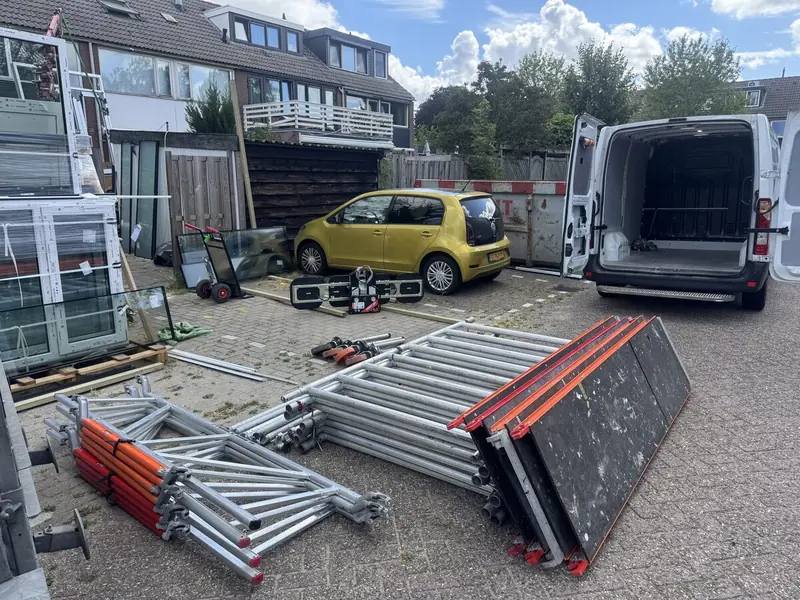
Frames of the wide RS52 by a front wall, the hire set dropped at the door for you to build

The difference with a repair job is the volume. For a broken tile or two you climb up with the replacement under your arm and are back down within the hour; a narrower build and a single hire day cover that. For a full course or an entire slope, hundreds of kilos travel over the roof edge in two directions. That is a different job, with a different model, more days and a working strip below that has to stay clear. Repairing single cracked roof tiles is covered separately.
Working height to hire when you replace roof tiles

When replacing roof tiles you measure not to the ridge but to the roof edge you work over. You stand alongside the slope and take the tiles across the gutter, so the gutter is your reference point. A house of two full storeys with a pitched roof puts you in the band of 8 to 12 metres. What a build to ten metres of working height needs in parts is listed on that page. If the roof of an extension sits in between, you still measure from ground level upwards.

Work back from that roof edge to the deck you will stand on. On top of your platform height comes roughly 2 metres of reach, because you take in a fair strip of slope over the guard rail. To work at ten metres, your top deck sits at around eight. Measure from the paving under the wheels and not from a raised terrace or a doorstep, particularly where the ground falls away towards the street. Half a metre of difference at the foot is half a metre short at the top.

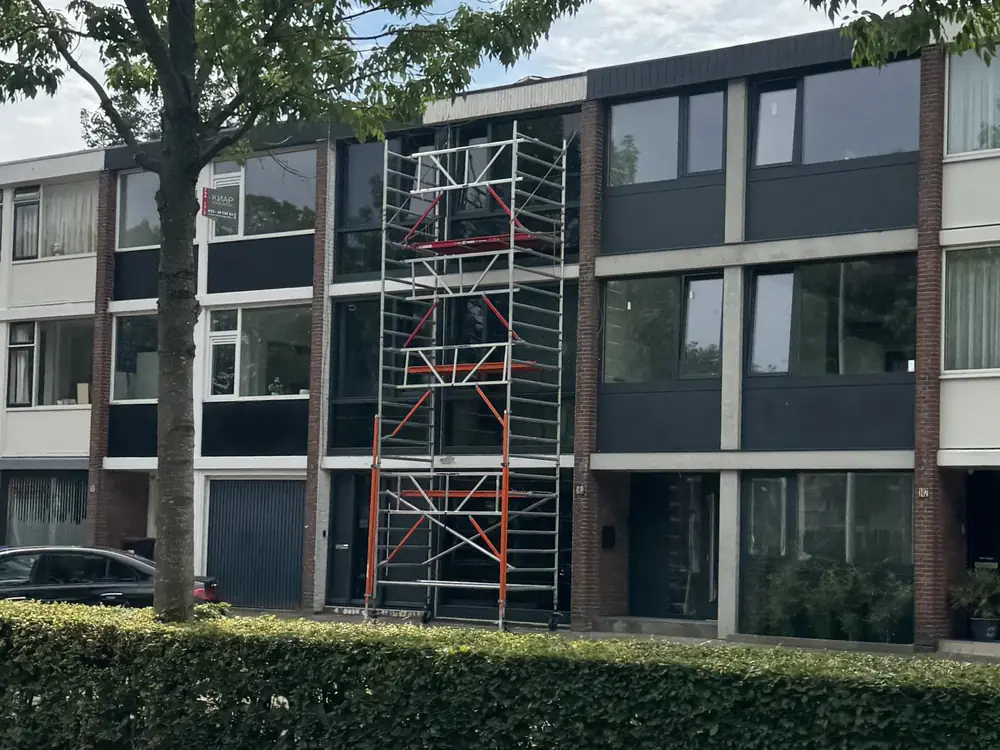
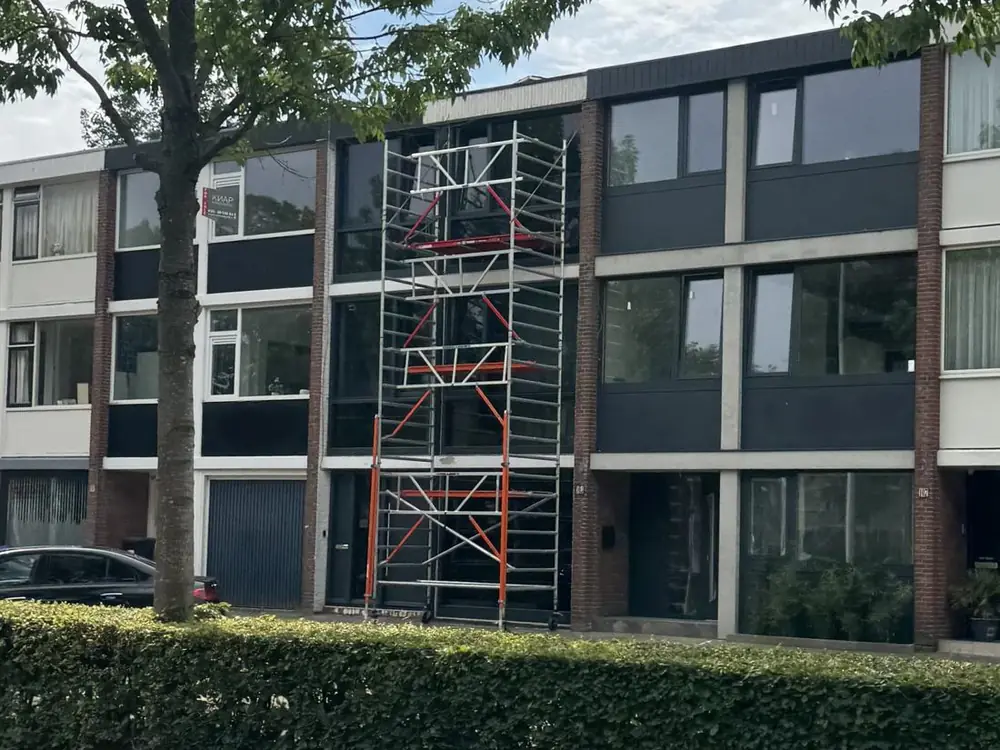
Mobile scaffold built along a front elevation with the top deck level with the gutter, the height used for tile work

Hiring too low shows up immediately on this job. With your chest under the gutter you lift every tile up instead of drawing it towards you, and with an armful of tiles you will not keep that going for half a day. You want the platform just under the roof edge so the material slides towards you. When in doubt take the taller build, because at hire that costs you less than a day of carrying at the wrong reach.

Where the mobile scaffold stands while you replace roof tiles

The wide tower goes as close to the gutter line as it can, and in most gardens that is precisely the strip with the most in the way. Think of a downpipe with a gully under it, a shed roof that oversails by half a metre, or a hedge grown hard against the brickwork. Clear that strip before delivery, because shuffling an erected tower loaded with tiles is not an option. Half a day of clearing pays for itself twice over when the build has to move four or five times.

The ground has to carry the build plus your material. Under every wheel belongs a flat, hard spot: paving, block setts or firmly trodden gravel. A lawn that sinks after rain is extra risky here, because you are stacking weight up top as well. The four stabilisers splay outwards and want room on each side, including the spot where your skip bag was going to stand. On sloping ground, read the notes on uneven ground before you begin.

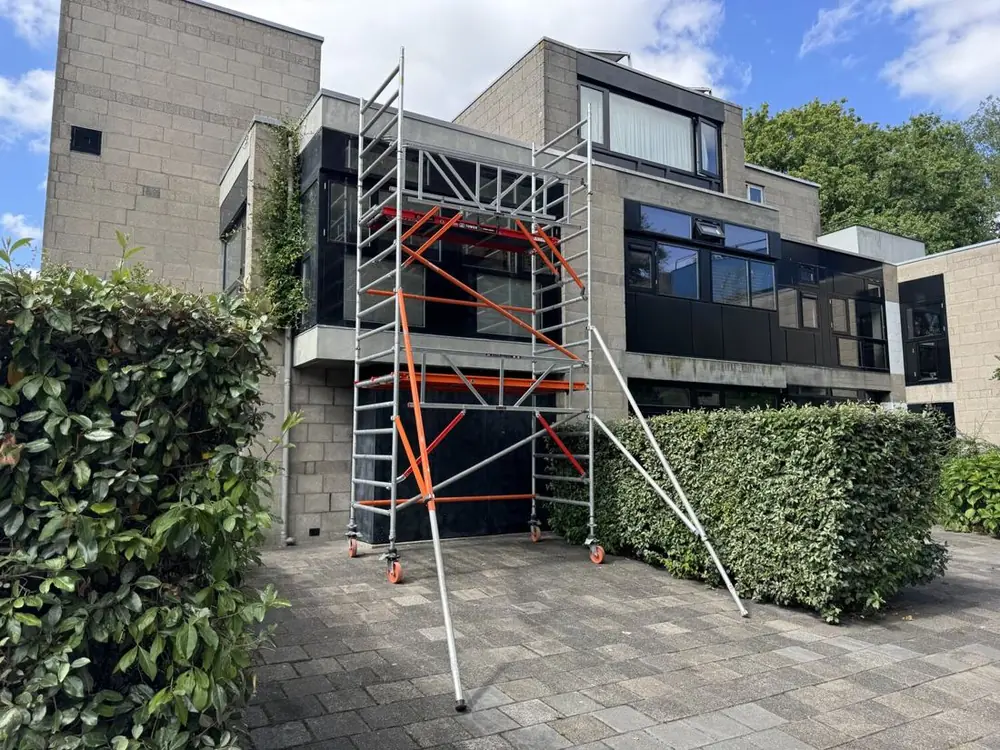
Mobile scaffold with its stabilisers splayed out, exactly the strip along the gutter line that must stay clear

Think about where the tiles you take off will end up. You want a fenced off spot beside the build below, a bulk bag or a skip, so you can unload in one movement. Do not put it directly under the platform, because nobody may stand there while you are working above. The pallet of new material goes on the other side. Together that is a working strip a few metres wide along the house, plus a path that stays clear for residents and neighbours.

Hire days needed to replace roof tiles course by course

Replacing a whole course along one elevation usually takes a day or two. For a complete slope you are quickly at four to five days, because you divide the work into positions along the wall and have to move the tower between them. Count the build day in, since on that first morning the scaffold is not standing yet. Carting the old material away and clearing the working strip take another half day at the very end.

The weather decides more than you would like. Tiles are slippery on a wet slope and on a frosty day you leave them alone; in strong wind the work stops anyway. Your hire period therefore has to be longer than the sum of your working hours. Look at the forecast for the whole week and set your collection date a day behind it, not on the date you would finish in the best case. Two dry days back to back are worth more here than four scattered ones.

Erected mobile scaffold against a side elevation, the position you leave standing for hire days on end

Reserving with room to spare is inexpensive on a job like this. Only the opening 24 hours are charged at the full rate; each hire day that follows carries 95 per cent off it. A spare day in hand therefore costs almost nothing, while booking again with another delivery and another build costs both money and time. Let the collection date fall after the day the last section is closed. To judge that period for a large slope, see the guide to estimating hire days.

Which mobile scaffold suits replacing roof tiles?

Kamersteiger RS44
  • Working height up to 4 metres
  • Compact and narrow
  • Great for indoor and small jobs
View and calculate →
Smalle rolsteiger RS51
  • Working height up to 14.2 metres
  • Narrow (75 cm)
  • Ideal for narrow passages
View and calculate →
Most chosen
Brede rolsteiger RS52
  • Working height up to 14.2 metres
  • Wide platform (135 cm)
  • Extra stability and workspace
View and calculate →
1-persoons steiger MiTower
  • Working height up to 6.2 metres
  • Very compact
  • Quick and easy to assemble
View and calculate →

Replacing roof tiles from the platform: one course per position

With a deck of 245 cm you serve a good two metres of roof edge per position. In practice you work upwards through the slope: you take out the bottom course, lay the new tiles in, and only then move along. That keeps the live work within arm's reach of the guard rail and saves you walking over the roof itself, which is unwise on old battens anyway. It also spares the battens under your knees a great deal.

Moving is the real time loss here. Before you roll the tower the deck has to be completely empty: no loose tiles, no tools, no bucket of hooks. Then the wheels go back on the brake and the four stabilisers come out again. Reckon on a quarter of an hour per move and add that to your planning. Anyone working along a ten metre elevation does that four times per lift and loses a good hour a day to it.

Erected mobile scaffold with deck and guard rails against a house, the workplace you move along course by course

What people misjudge on this work is the weight that has to go up. New tiles arrive on a pallet and that pallet never goes up in one go. You take them in small stacks of five or six, or somebody passes them to you from the deck below. Always keep a clear route open on the platform between the ladder hatch and the spot where you are actually working, or you end up stepping over your own supply with a tile in both hands.

Hiring a mobile scaffold delivered beside the pallet of tiles

The mobile scaffold arrives as a complete, counted set of loose parts. The parts come out on the next working day when your reservation is in before 15:00, and you fix that date yourself. Plan the delivery for the day before your first roof day, so building it does not clash with the tile work. Let the pallet of new tiles follow after that, not before. The delivery charges per province are listed including VAT, so the figure can go straight into your budget.

Putting it up is your part of the job; a manual and an instruction video come with the set. Tackle it with two people, because the parts of a wide build to 12 metres are too unwieldy to work up on your own. Point out in advance where the parts may be laid down, and keep that away from the spot the pallet will occupy. A drive or a stretch of pavement works better than a border, because you have to walk round the parts while you assemble.

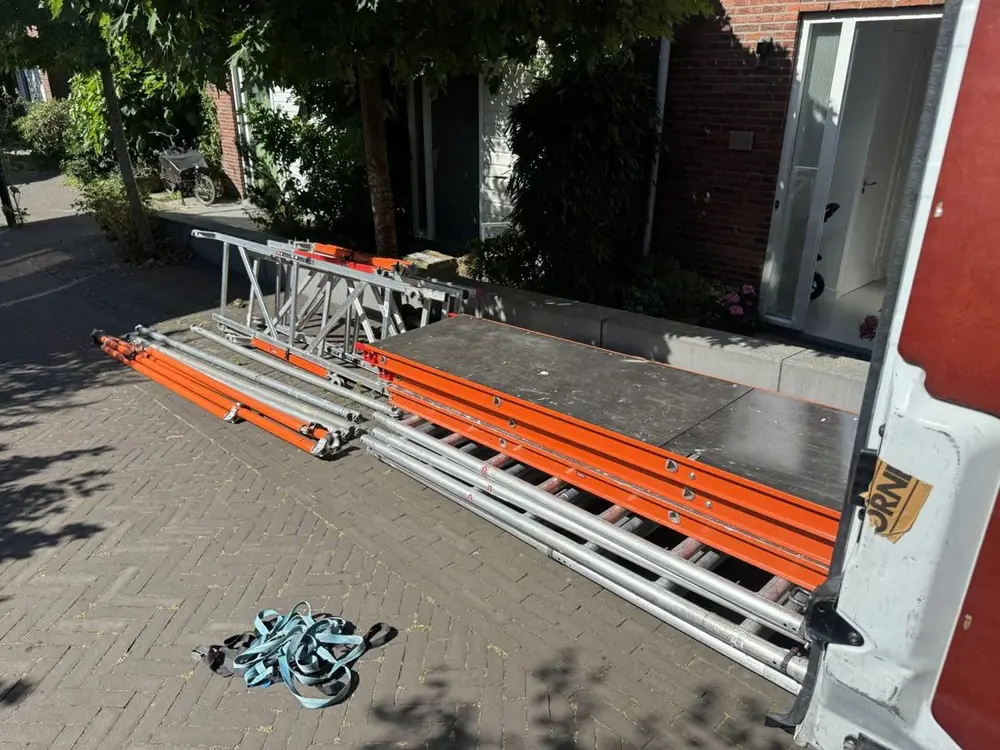
Counted set of scaffold parts on the pavement in front of a house, ready to be built the day before

Afterwards we collect the tower again, on the date you picked at booking. You dismantle it and lay the parts out complete, somewhere the driver can reach with a sack truck. Count them through as you strip down, so that no brace, coupler or deck panel stays behind in the garden or behind the skip. Sweep grit and moss off the platforms as well; roof work always leaves a layer of it and that does not belong in the van.

Working safely on a hired scaffold when replacing roof tiles

Load class 3 within EN 1004 means that each square metre of decking may take 200 kg. That sounds generous, but on this job you reach it faster than on most: you, a second person and two stacks of material add up quickly. Spread that weight over the whole deck rather than piling it against the guard rail, and never have the contents of a full pallet up there at once. Two manageable stacks work better than one tall one.

The fixed rules weigh heavily here. The moment you step on, the wheels go on the brake, and you never move the tower with material or a person on it, not even that one metre. In strong wind you stop, because a slope stripped of tiles catches wind quite differently from a closed roof. After every move, check the stabilisers and the couplers before the first tile goes up, and see that the deck hatches are properly shut.

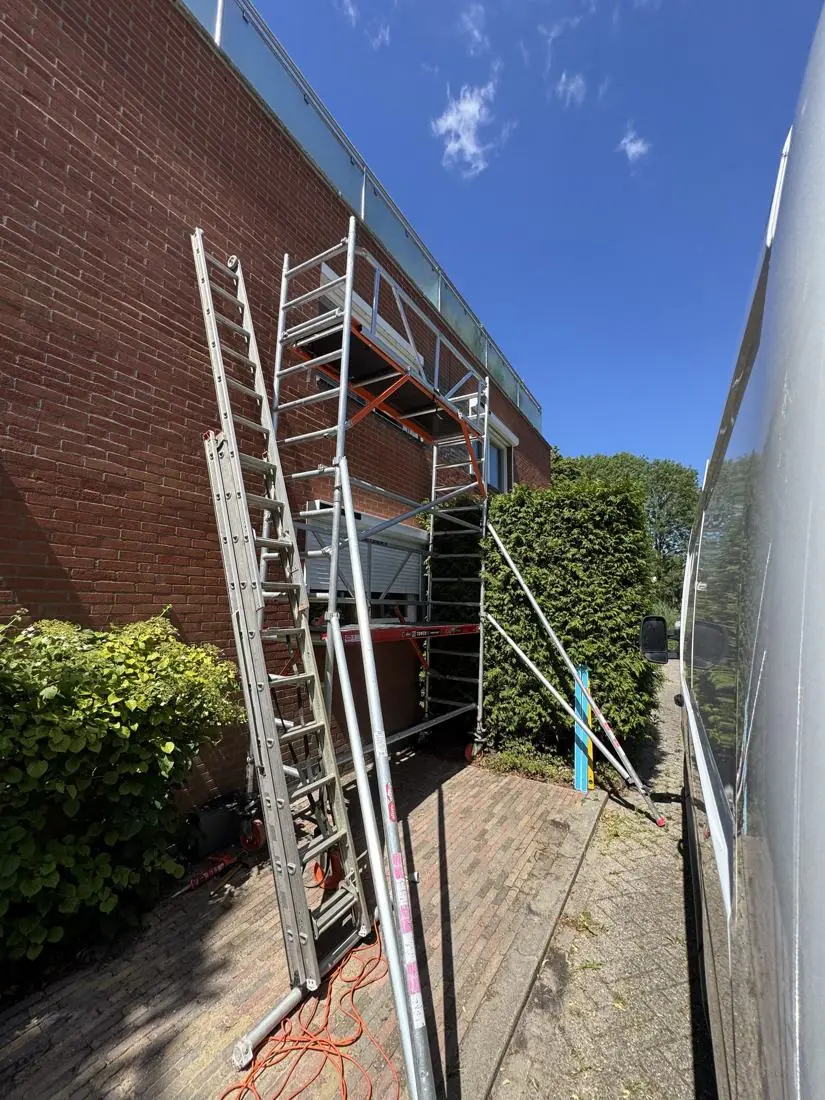
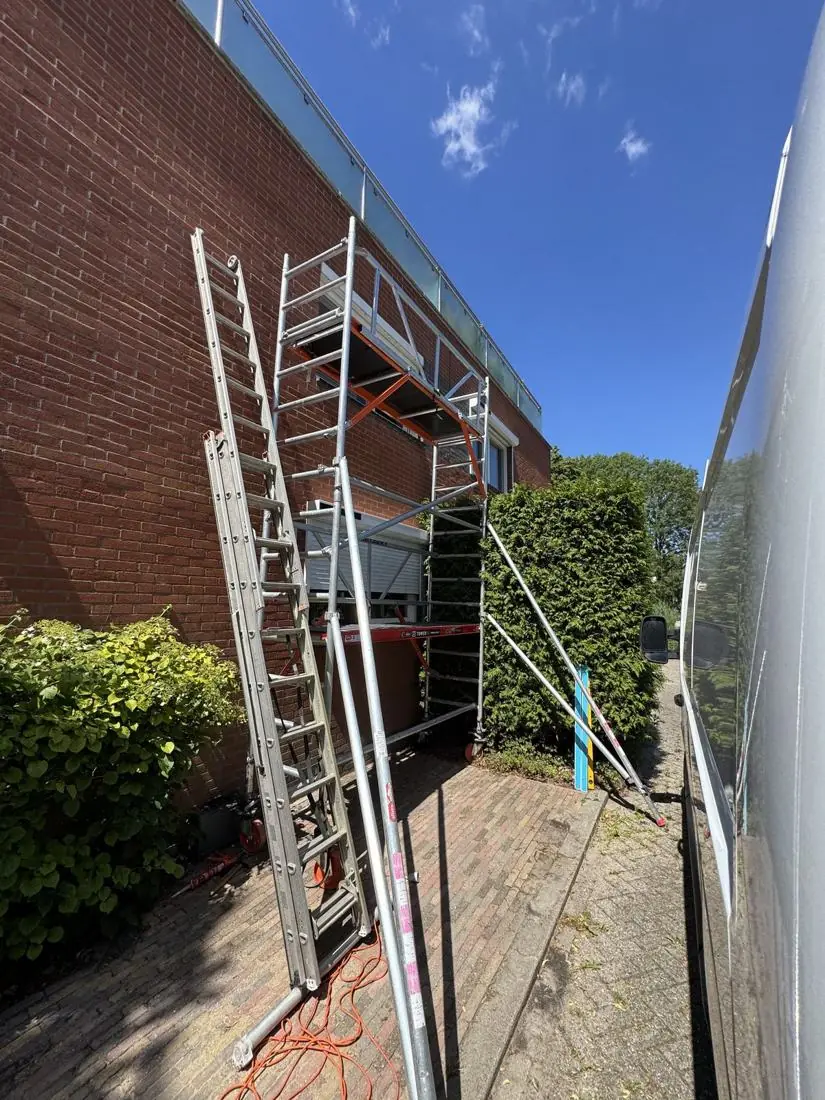
Mobile scaffold assembled along a brick wall, stabilisers set out over the paving to hold the footprint steady

The hazard that belongs to this particular roof work is falling material. A tile that slides off the edge arrives below with real force, so keep the zone under the platform empty and fence it off if neighbours or children pass by. Do not work hanging over the rail; move the tower one extra time rather than reach half a metre too far for a tile. You will find the rest under the rules for working at height.

In 5 steps

How hiring a mobile scaffold works

1
Choose working height

Pick the height that suits your job.

2
Book online

Sorted in 60 seconds, price shown instantly.

3
We deliver

At the agreed spot the next working day.

4
Assemble safely

Assembled by you, with a manual.

5
We collect

One call and we collect the scaffold.

Good to know

Practical tips for replacing roof tiles

1

Lay a board or an old sheet down where the tiles you take off are going to stand before you start. It saves scratches on the deck and the stack slides towards the edge more easily.

2

Chalk a cross beside each wheel before you roll the tower on to the next position. After a wet day you set it back on exactly the same spot and your new course lines up with the last one.

3

Ask the supplier to drop the pallet as close to the scaffold as possible. Every metre you carry a stack of roof tiles across the lawn costs you more time than an extra hire day ever does.

4

Count the tiles in a course before you take the first one off. You then know how many to lift per position and you avoid going down halfway for two loose pieces.

5

Keep the gutter clear while you work. Grit and shards fall into it by themselves, and if you have to fish them out at the end the tower is no longer standing in the right place.

6

Set your collection date a day after your last roof day. That leaves you a morning to tidy the working strip and take the scaffold down calmly without the van waiting at the kerb.

Frequently asked questions

Frequently asked questions about replacing roof tiles

Which mobile scaffold should you hire for replacing roof tiles?+

For a whole course or a complete slope you hire the wide RS52 at 135 cm. You need room on that deck for two stacks at once: the material coming out and the material going in. A slim 75 cm tower is only worth hiring if you are dealing with a few loose tiles or if the passage to the back garden really is too narrow. Measure that passage before you book, because that is usually where the choice between the two models is settled.

How does hiring a mobile scaffold for tile work actually go?+

You put the booking together online: model, working height, the day the set is delivered and the day it may go again. The amount is fixed, VAT included. We drop off the counted parts, you build and work the slope in positions, and on the last day everything stands dismantled ready for the van. What you plan alongside it is the arrival of the new tiles, so the pallet is there once the tower is up.

How many days do you need to hire a tower to replace roof tiles?+

For one course along an elevation two hire days often do it. For a whole slope reckon on four to five, including the morning you spend building the tower and the day you clear the working strip. Every move costs a quarter of an hour, and along a long wall that mounts up. Better to hire a day over than to leave an opened slope lying while you book a second period.

What does the rental price come to and what happens from day two?+

What you pay as a rental price depends on the build you pick and the height you work at; bringing and collecting is added per province. The rates including VAT are all listed online. For roof work the sliding scale is what matters: the first day counts in full and everything after it barely registers. Hiring generously once therefore works out better than two separate periods, not least because delivery is paid for only once.

What working height should you hire to replace tiles along the gutter?+

On a terraced house or a semi with a pitched roof you come out at 8 to 12 metres, measured to the roof edge you reach over. Your platform then stands a good deal lower, because you still reach across it. If the slope is shallow and you have to get further up towards the ridge, you hire higher or work from a second position. The page on choosing the right working height shows the build per height.

Do you have the tower brought to you, or fetch it yourself?+

Both are open to you. Have it brought and we drop the tower on your own date and take it away after the last roof day, at a fixed price per province. Anyone who would rather drive can pick a set up free of charge by appointment at Zeeburgerpad in Amsterdam. On tile work almost everybody chooses the van anyway, because the car is needed those days for the new material.

Is putting it up included in the hire, or is that yours on roof work?+

Building it yourself is part of the deal. We drop the mobile scaffold as a complete set and come back for it later, but assembling, moving and dismantling are your task. With two people that is about half a working day, and the video walks you through the order calmly. We have no cherry pickers and no facade or system scaffolds on the books, so on a slope at this height the wide tower stays the right tool.

Can I hire the tower for longer if the roof work overruns?+

Tell us in good time and your collection date moves with the work, unless that particular tower has already been promised elsewhere. Roof tiles overrun regularly, because under the old layer you sometimes find rotten timber or a broken batten. Anyone wanting to soften that risk puts an extra day into the booking straight away and hands back early if need be. You then never leave a half renewed slope open because the van is at the door.

How much clear space does the foot of the tower need for this work?+

Reckon on the width of the build, then add how far the four stabilisers reach out at each side, and add the spot for the pallet and the waste container. What you actually want is several metres of level ground running along the house. If a water butt, a bike rack or a border is in the way, clear it before the scaffold is delivered. Shuffling an erected tower along in between does not work and easily costs you half a session.

Can you keep hiring if it is too windy to lay tiles?+

The tower may stay standing; it is the roof work you postpone. An opened slope catches wind and loose tiles blow or slide away, so those hours cannot be made up safely. Use such a day to set out material, check battens or empty the gutter, and carry on the next morning. Because the end date of your hire period is in your hands, a shift like that costs you a day at most.

When is your deposit back in your account after hiring?+

You pay a deposit along with the booking of the mobile scaffold. Once the set has been counted after collection and found complete, that amount is back within one working day. On roof work watch two things: leave no part lying in the garden, and leave no shards, moss or mortar on the decks. A brush over them before you strip down saves trouble later. There is more in the article on the deposit.

Can you hire one tower for both the tiles and the gutter?+

Yes, and on a tile job that combination is exactly the sensible one. You are standing along the gutter line anyway, so while the course is out you can flush the gutter, check the brackets and look over the rainwater downpipe. That saves you hiring a second time later in the year. Do put half a day extra into the booking for it. How to go about it is on the page about cleaning out the gutter.

Hire a mobile scaffold for replacing roof tiles today?

Calculate your rental price now or ask for free advice.

Rolsteiger van SteigerTaxi geleverd op locatie
Book it online

Your scaffold sorted in 2 minutes.

Choose your scaffold and working height, see the price instantly and book online.