
See your price
Application

Plumbing work? Choose the right scaffold.

Plumbing work on a house is seldom done high up. The connection of a rainwater downpipe, a length of lead along a wall, a run out to the outside tap: most of it sits at gutter level or below. So you do not build a ten metre tower here, but a low set-up reaching 4.2 or at most 6.2 metres. The 75 cm RS51 also fits the narrow side path that pipes and drains happen to follow. What that means for the build, the standing place and your rental days follows below.

  • Order before 3 pm, delivered tomorrow
  • Professional Altrex scaffolds
  • Up to 14.2 metres working height
  • Easy to assemble yourself
4,2 tot 14,2 mWorking heights available
12Provinces served
7Days a week
200 kg/m²Load class 3
In short
  • For plumbing work we recommend the Narrow mobile scaffold.
  • For plumbing work on the facade a low build is enough: you usually end up between 4.2 and 6.2 metres.
  • The RS51 is 75 cm wide and so passes the side path where the drain, the tap and the pipes sit.
  • Working with a torch or a soldering iron, keep the bottle down below and the ground under the platform clear.
  • First 24 hours from €150 incl. VAT and delivery; every day after that 95% off.
Key facts for this job
FeatureValue
Recommended scaffoldNarrow mobile scaffold (Altrex RS TOWER 51)
Working height for this job4.2 to 6.2 metres
Available working heights4.2 to 14.2 metres
StandardEN 1004, load class 3 (200 kg per m²)
DeliveryOrdered before 3 pm, delivered next working day
Each extra day95% off, from €7.50 a day
Why a mobile scaffold for plumbing work?

Safe, stable and professional work at height

In this trade it is not about metres but about standing still. You need both hands for a pair of grips, a soldering iron or a piece of zinc that has to be cut to size, and you have to be able to put tools down beside you without them falling. On a ladder that does not work. On top of that you are often busy for hours in exactly the same place: cutting in, offering up, soldering, testing, offering up again. A fixed deck with guardrails then saves more time than height ever does. Hiring a scaffold for plumbing work is therefore about a stable, low build with room to work, and not about getting as high as possible.

  • Flame and solder work demands both hands free
  • Most of the work sits at gutter level
  • Gas bottle below, hose running up to you
  • Four to just over six metres usually suffices
Read more about working safely →

Which mobile scaffold to hire for plumbing work on a facade

Pipes, drains and zinc work sit almost always where the house is hardest to reach: the path between two houses, the corner behind the shed, the strip along the bay. That is why the Altrex RS51 is the logical model here, at a width of 75 cm. That model can go a good deal higher than you need now, but you simply build it up with fewer parts. Which versions exist otherwise you see in the overview of mobile scaffolds for hire.

On the deck what counts most in plumbing work is somewhere to put things. A pair of tin snips, a folding clamp, a soldering iron, a reel of solder, a length of pipe cut to size: all of it is up there at once and you do not want to hunt for it. The 245 cm platform length offers room for that, as long as you keep everything to one side and leave the other side free to work. Lay heavy material against an upright and never loose in the middle of the deck.
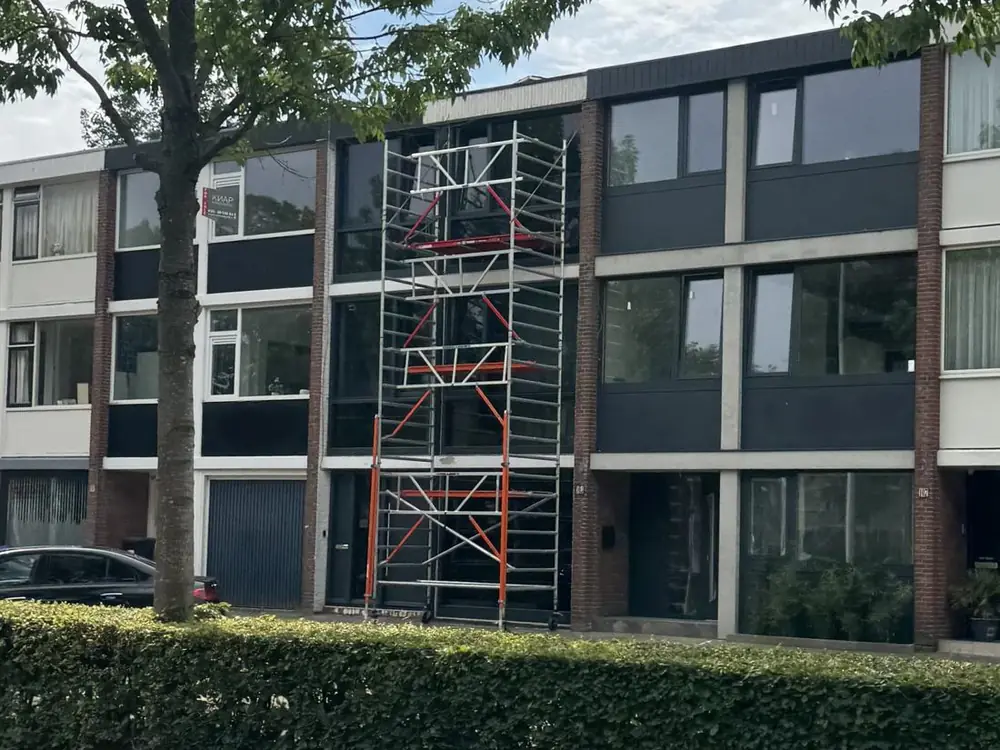
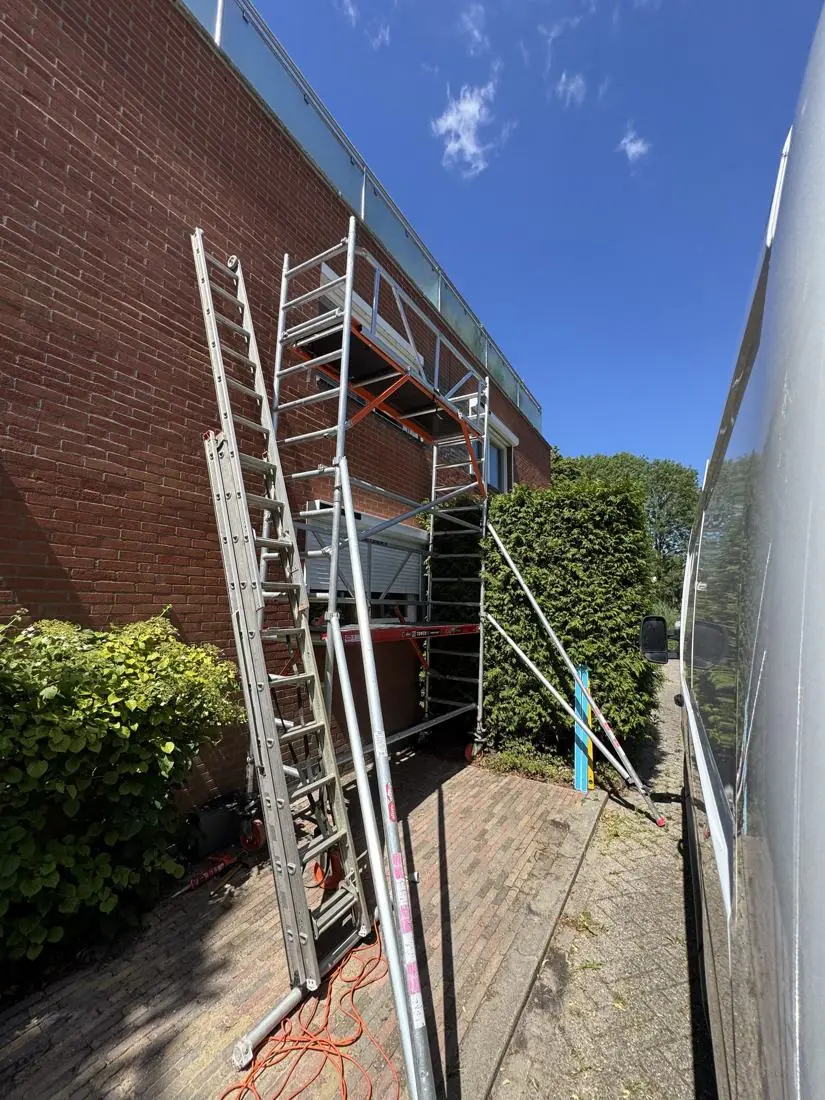
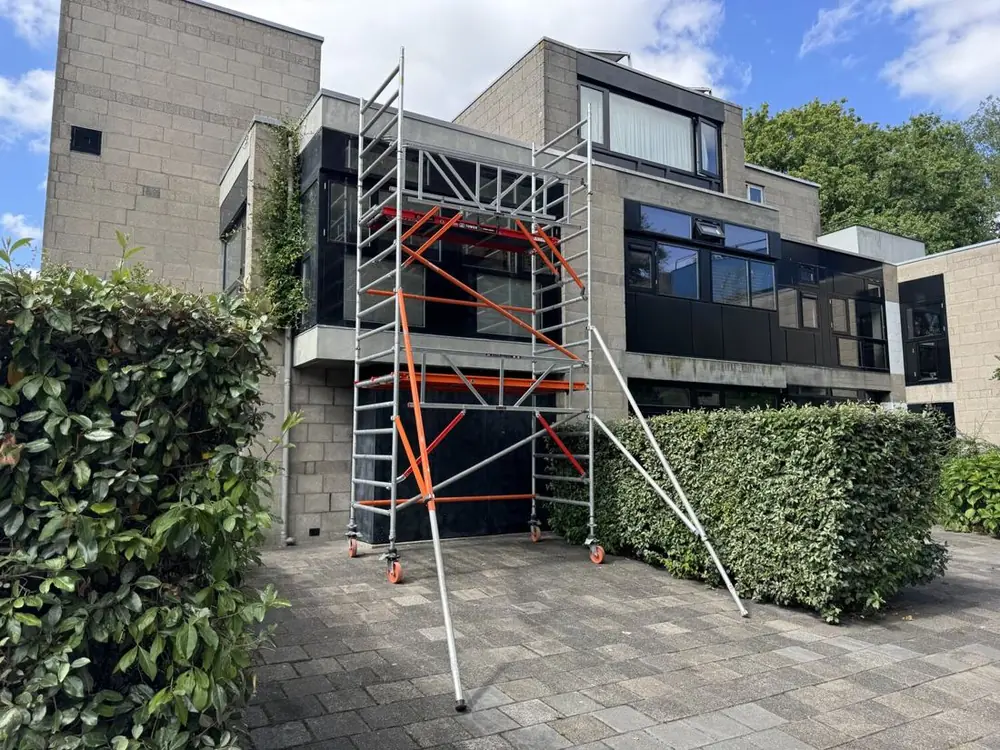
Low tower standing against a front elevation, the build height that suits work on pipework and zinc

Working with two of you, or taking a whole sheet of zinc or a long roll of lead up, makes the 135 cm RS52 more comfortable. That extra deck width does mean getting it through the same gateway, and that is exactly where this job often comes unstuck. Measure that gap with a tape, and look while you are at it for a projecting downpipe or a window sill halfway along the path. A summary of the dimensions shows what both models ask for in space.
Which working height to hire for plumbing work outside

Find the highest point of your job first. On this work that is usually where the downpipe meets the gutter, the topmost bracket or the edge where the lead runs under the tiles. On an ordinary family house that sits somewhere between three and four metres, which puts you on a build with 4.2 to 6.2 metres of reach. What exists in that range is set out clearly at six metres of reach, which is worth reading before you book.

Those figures are not a platform height. Your deck ends up at roughly 2.2 to 4.2 metres and on top of that you count a shade under 2 metres of reach, because that is how far your hands get above the deck. For plumbing work you actually want to stand a little lower than you would for painting: you would rather have the connection at chest height than over your head, because otherwise you cannot put any force on grips, a folding iron or a pipe cutter.

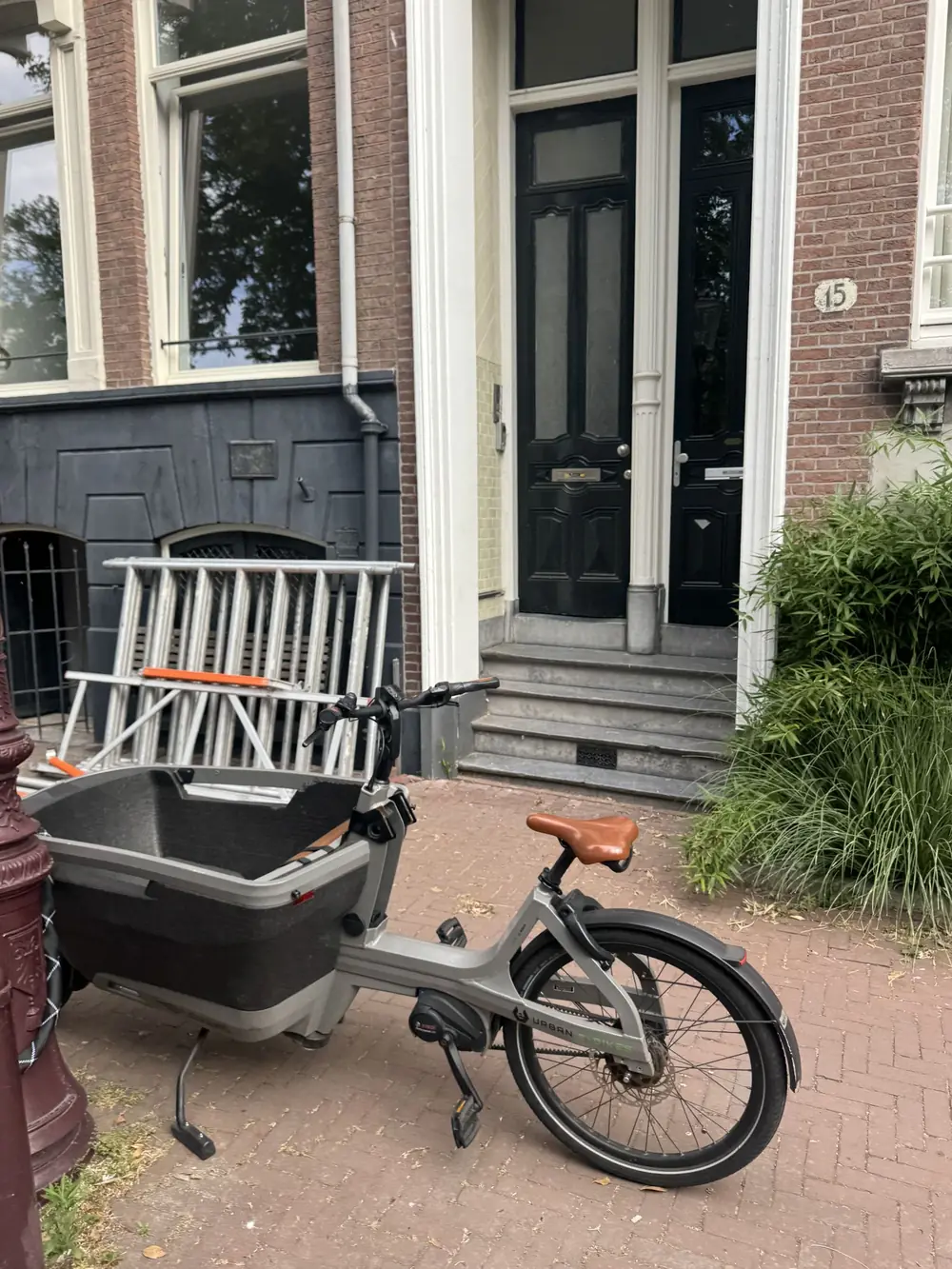
Scaffold frames propped against a townhouse front, the hire set you choose by reach, four to six metres for plumbing

Choosing too high is therefore just as awkward here as choosing too low. Stand half a metre too high and you spend the whole day bent forward over the guardrail towards your work, and nobody keeps that up for an afternoon. Come up short and you work with stretched arms and cannot see what you are doing. So count back from the height your hands want to be at, and count from the ground where the wheels land. On a connection at ground floor level you often stay under five metres.

Where to stand the mobile scaffold you hire for plumbing

The spot is usually fixed on this job, because you have to be at the pipe or the drain and that sits where it sits. Often that is a side path barely a metre and a half wide, with a fence on the other side. Measure that width and bear in mind that the stabilisers stick out on both sides. If the path is a dead end, work out how you get the parts along it before the first upright goes up.

Underfoot there are surprisingly many obstacles in plumbing work. An inspection chamber where the soil stack comes out, a gully, an outside tap with a slab round it, a crawl space vent. A stabiliser resting on a manhole cover is resting on something that can tip, so shift the build half a metre instead. Where the paving falls away from the facade you correct that as you build; how to go about it is at setting up on a sloping surface.

Stabilisers of a mobile scaffold folded out on paving, beside the spot where inspection chambers and gullies lie

Finally set aside a place for your gas bottle or soldering set, and do that at ground level. It does not belong on your deck but beside the build on a flat patch, with the hose running up in a generous curve and not tight against an upright. Make sure you can shut it off there without climbing up first. Clear that zone of cardboard, cloths and dry planting as well, because sparks and drips of solder come down exactly there.

How many rental days to hire a tower for plumbing

The real work on a connection is often done in half a day, but a great deal hangs around it. Shutting off the water and draining down, taking out the old work, offering up, soldering or folding, putting it back, refilling and leaving it a while to see whether it stays dry. Meet a surprise along the way, such as a rotted bracket or a pipe that runs differently from how you thought, and half a day has gone. For an average job on the facade you therefore hire one to two days.

There are waiting moments in it as well that you cannot speed up. A glued joint has to cure before you put pressure on it, a soldered seam has to cool before you load it, and you only do a leak check once everything is back under pressure. Rain plays a part too: wet zinc and a wet torch go badly together, and you do not want to handle hot parts on a slippery platform. So book a day extra rather than having to stop with the pipe open.

Tower against a side elevation left standing between two working days on a job at the downpipe

That extra day hardly shows in the rental price. In your period only the opening 24 hours carry the whole rate; on every day you add to your period after that you get 95% off. A second order for the same job, on the other hand, costs the full rate again plus a run. Anyone taking a roomy period also keeps the option of climbing back up the next day for a last check on the connection. How to make that judgement is at working out the number of rental days.

Which mobile scaffold suits plumbing work?

Kamersteiger RS44
  • Working height up to 4 metres
  • Compact and narrow
  • Great for indoor and small jobs
View and calculate →
Most chosen
Smalle rolsteiger RS51
  • Working height up to 14.2 metres
  • Narrow (75 cm)
  • Ideal for narrow passages
View and calculate →
Brede rolsteiger RS52
  • Working height up to 14.2 metres
  • Wide platform (135 cm)
  • Extra stability and workspace
View and calculate →
1-persoons steiger MiTower
  • Working height up to 6.2 metres
  • Very compact
  • Quick and easy to assemble
View and calculate →

Plumbing work from the 245 cm scaffold platform

Unlike painting, you move very little here. You work on a point, or on a short line: the gutter outlet, a row of brackets, a connection at the through-wall fitting. With a deck of 245 cm you often stand across the whole width of that working area, so your tools lie at one end and the work happens at the other. Only when you drop from the gutter to ground level do you take a level off rather than rolling the build sideways.

Think carefully about what you take up in one go. A full tool box, a length of pipe, brackets, screws, the torch and a bucket to put old parts in: that is more weight than it looks and you do not want to go down for it three times. Haul heavy things up on a rope along the outside instead of carrying them up the ladder in your hand. That way you keep two hands for the rungs while you climb.

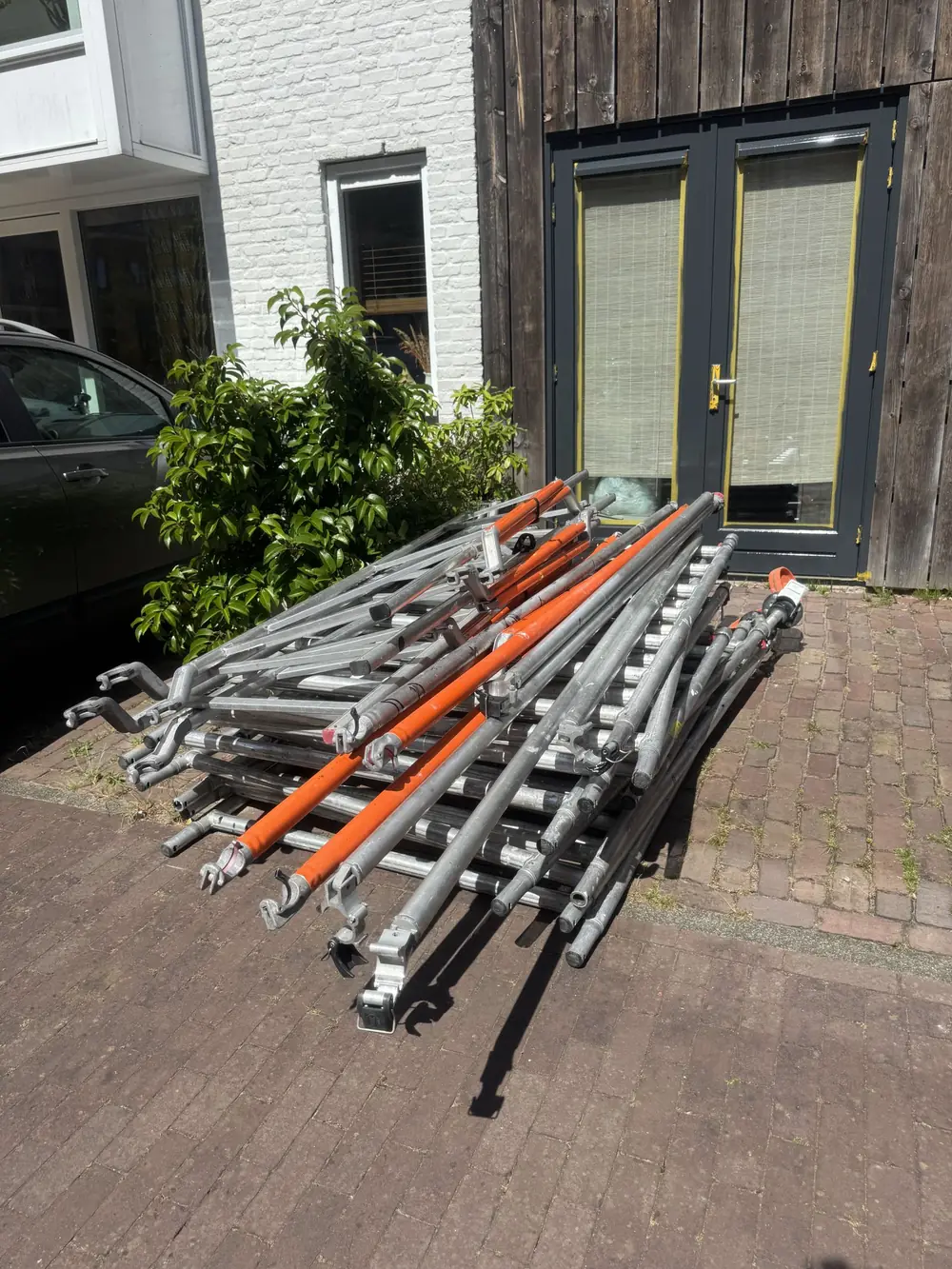
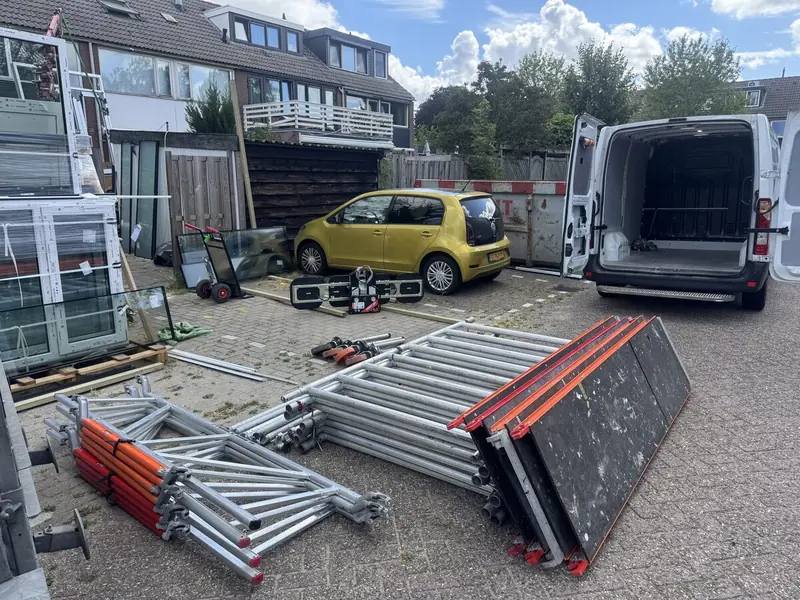
Scaffold parts piled on a brick drive by a timber clad front, the hire set that builds a 245 cm platform

What people underestimate is the time the taking apart costs. Seized brackets, paint over a clamp band, a pipe stuck fast in the outlet: those are the minutes that eat your day, not the soldering itself. Count those minutes in, because they decide whether you are finished by the end of the day or have to leave the pipe open. If you follow on by renewing the whole downpipe, work from top to bottom and leave the build in place as long as you can.

Delivery when you hire a mobile scaffold for plumbing

What arrives with you is a counted package of loose parts: uprights, braces, deck boards, guardrails and wheels. Choose a corner for that stack in advance and think about the narrow route to the rear. On a side path you cannot lay the parts out beside one another, so leave them on the drive or at the street end and carry them through in batches. Think while you are at it about where the old pipe sections and brackets go while the job runs.

At booking you give two dates: a delivery date and a collection date. Beat 15:00 on a weekday with your order and the parts stand in the side path the following working day. For this trade that is welcome, because a leak or a connection that has come loose can rarely wait a week. Building up you arrange yourself, preferably together with somebody else, and the manual with the video that goes with it takes you calmly through the steps.

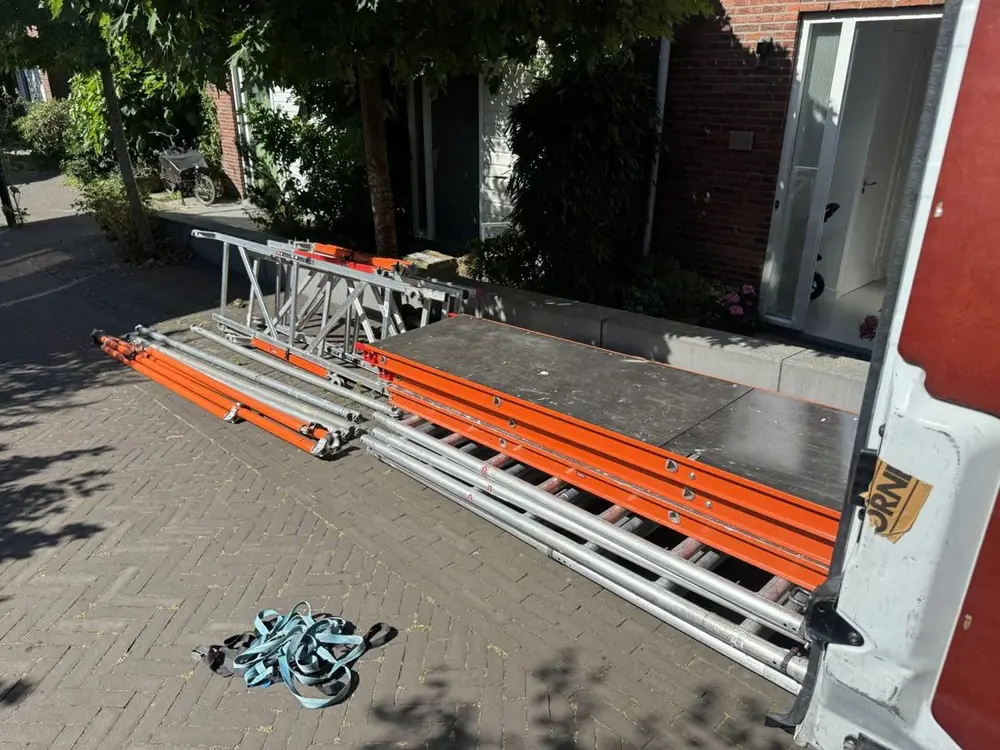
Scaffold parts set out in the street ready for building up, as a set is delivered at a house

Finished and everything tested, you dismantle the build and stack the parts somewhere the driver can reach; we take them back with us. Leave no solder residue or sawn-off bits of pipe among them, because those do not count and only cause confusion while everything is tallied. What it costs to bring the set to your province and fetch it again is listed with VAT under rates for delivery, so nothing surfaces later on in your budget.

Working safely with flame and solder on a mobile scaffold

Every square metre of your deck takes 200 kg, the load class 3 that EN 1004 describes. In plumbing work you get closer to that than in painting, because a box of tools, a roll of lead and a second person add up quickly. Beyond that the standing agreements apply: wheels on the brake first and only then step aboard, no person and no material on board while you roll, and down you come as the wind picks up.

The risk at the top of the list here is fire. Working with a torch, lay a flame-resistant cloth behind your workpiece, keep an extinguisher within reach and make sure nothing beneath you can catch. A spark travels further than you think and can still be smouldering hours later in dry leaves or in insulation behind a panel. Walk the spot under your platform and the area round your gas bottle once more before you clear up.

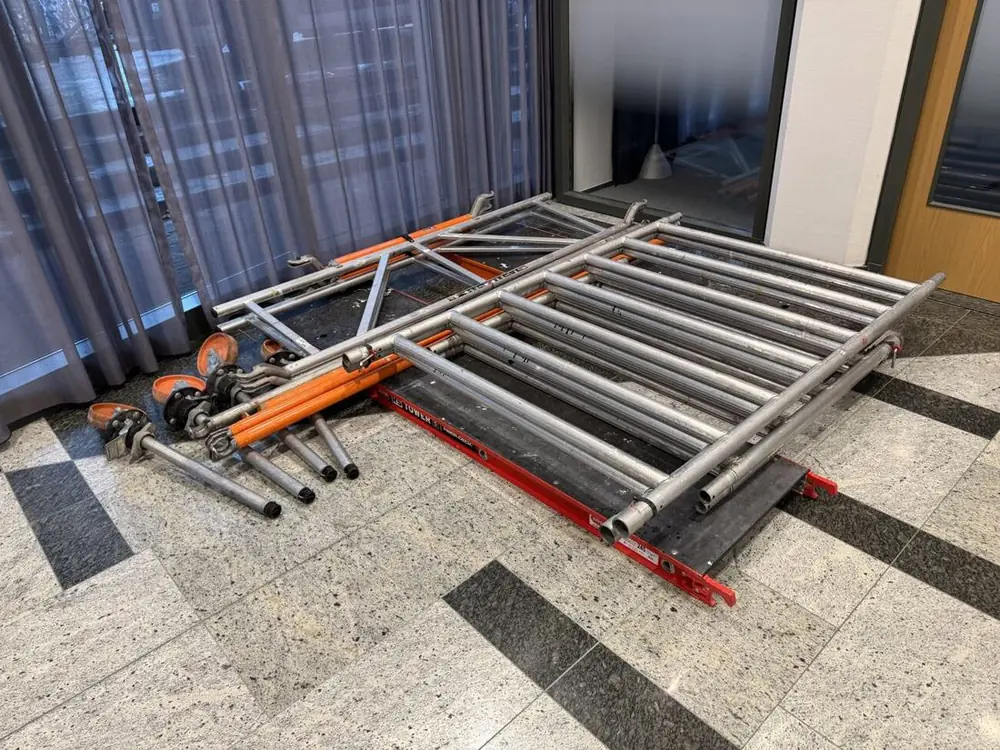
Inspected scaffold parts set out complete, the material from which you build the low set-up for this work

Watch as well what is hot and what can fall. A freshly soldered length of pipe feels warm for a long time and burns straight through a plastic deck board or through your hose. Lay such pieces on a brick or in a metal tray, not loose on the deck. Keep the zone below free of people, because a pair of grips falling from 4 metres is dangerous. At the rules for working at height the rest is listed.

In 5 steps

How hiring a mobile scaffold works

1
Choose working height

Pick the height that suits your job.

2
Book online

Sorted in 60 seconds, price shown instantly.

3
We deliver

At the agreed spot the next working day.

4
Assemble safely

Assembled by you, with a manual.

5
We collect

One call and we collect the scaffold.

Good to know

Practical tips for plumbing work

1

Shut off the water supply and drain down before the scaffold is standing there. Otherwise you wait in front of the facade with a built tower while somebody indoors hunts for the stopcock.

2

Lay an old tile batten or a piece of sheet steel behind the spot where you solder. That saves scorch marks on timber and stops you having to climb down suddenly to put something out.

3

Take two buckets up with you: one for clean material and one for what you strip out. Old brackets and lengths of pipe left loose on the deck roll between your feet while you work.

4

Put the gas bottle outside the zone where the stabilisers land. Then you can shut it off or move it away without shifting the build first, and it never blocks you while you are putting it up.

5

Photograph the connection before you take it apart. Standing up there with a new length of pipe in your hand, you then know exactly how the old brackets sat and how much fall the run had.

6

On your last rental day check the connection once more under full pressure before you break the tower down. A drip you cannot see from the ground shows up at once from the platform.

Frequently asked questions

Frequently asked questions about plumbing work

Which mobile scaffold should I hire for plumbing work on my facade?+

Nearly always the RS51, which is 75 cm wide, because pipes and drains simply tend to sit in a narrow side path. That model can go a good deal higher than you need here; you just build the mobile scaffold up with fewer parts, since above six metres or so you rarely end up in this trade. Working with two of you, or taking a large roll of lead up, the wider RS52 gives you more room to move. Measure the gap first.

How does hiring a scaffold for plumbing work go in practice?+

Booking is done online: model, reach and two dates, with the amount including VAT shown alongside. On the first date the parts are delivered to you, after which you build the mobile scaffold, work on the pipe or the zinc and test everything through. At the end you break it down and we drive the material away. With a leak you naturally put that first date as early as the schedule allows, because waiting is not an option.

How many rental days does plumbing work on a facade take?+

For a single connection or a length of zinc work you hire a mobile scaffold for one day, but two days is more realistic as soon as something has to come apart. Undoing seized brackets, waiting for a joint to cure and the leak check afterwards together take more time than the soldering itself. Because such an extra day is barely traceable in the total, booking roomy nearly always pays here. You can always hand the tower back a day early.

What is the rental price for a tower for plumbing work?+

The amount hangs on two choices: the model and the height you build it to. On top of that comes the run to your address, which is set per province. All the rates stand together with VAT on the page of hire prices. For plumbing the shape of that tariff works out well: the first 24 hours are the real cost and every day you stick on after that hardly weighs in. An extra day for a proper leak check therefore costs you little.

Which working height do people hire for a drain or an outside tap?+

For work at gutter level on a family house and everything below it you come out between 4.2 and 6.2 metres. Your deck then hangs somewhere between just over two and just over four metres above the paving. Measure from the slabs under the wheels to the highest point of your job, and feel free to take something off if you would rather work at chest height than over your head. The matching build you look up in the overview of working heights, before any tower is booked.

Is the tower delivered to my address or do I have to fetch it?+

You decide that yourself. Choose delivery and the driver appears on the date you picked and pulls up once more afterwards; a fixed amount per province goes with it. Would you rather start today, then Zeeburgerpad in Amsterdam has a complete tower ready for you on appointment, without charge. With a sudden leak that sometimes saves a day, as long as your van or trailer copes with uprights of that length.

Do I put the hired scaffold up myself or do you do that?+

Those hours are on your account. We drive the parts to you and take them back later, but assembling, moving and breaking down fall under your side of the job, best done together with somebody. For a low build like this you are not busy a whole day; two hours is usual. There are no system scaffolds, facade scaffolds or cherry pickers on our list, so for plumbing on a facade a tower of this size is the normal answer, even for a one-off repair.

Can I hire for longer if the repair disappoints?+

Certainly. Let us know as soon as it becomes clear more time is needed and we push the collection day back, unless that same mobile scaffold is already down for another hirer. In plumbing that happens more often than average, because behind an old connection there is quite often a second problem hidden that you could not see in advance. The other way round you may hand it in earlier, so you are never tied to the period you gave at booking.

How much space must be free to hire a tower here?+

Besides the build itself you need the swing of the four stabilisers, plus a free spot for your gas bottle and your tools. In a side path that often means a bike, a wheelie bin or a water butt has to go first. Watch the chamber or grating under you as well: no bearing point may rest on it. Walk the strip once from end to end before you reserve the scaffold, and then you know the build will fit.

May I work outside with a hired mobile scaffold when it rains?+

Standing is fine, but soldering and folding you would rather not do in the rain. Wet zinc and a wet surface work badly together, and a slippery platform with hot parts on it is a combination to avoid. Use a morning like that to strip out, measure up or cut material to size, and solder as soon as it dries. Because you choose the end date yourself, such a shift adds a day to the hire at worst.

What about the deposit when you hire a low tower for this?+

You pay a deposit when you book the mobile scaffold, and once the returned parts have been checked it is repaid, within 1 working day. In this trade we look above all at burn damage and missing parts: a scorch mark from a torch on a deck board stands out, as does a brace still lying in the side path. Always lay something non-combustible between your flame and the parts. More on that in the explanation of deposit and return.

I am working on pipes indoors, is this then the right scaffold?+

Indoors a mobile scaffold of 75 cm is often still too big. For work on pipework inside a house you look sooner at a room scaffold for indoor work, which goes through an internal door from roughly 70 cm and gets to about four metres of working height. For plumbing on the outside of the house the RS51 remains the standard choice. Unsure about combining inside and outside? Then you sometimes hire two different builds in the same period.

Hire a mobile scaffold for plumbing work today?

Calculate your rental price now or ask for free advice.

Rolsteiger van SteigerTaxi geleverd op locatie
Book it online

Your scaffold sorted in 2 minutes.

Choose your scaffold and working height, see the price instantly and book online.