
See your price
Application

Facade maintenance? Choose the right scaffold.

Facade maintenance is a catch-all name. Sometimes it stops at a wash and a few touch-ups; other times there is loose pointing or soft timber behind it that you only spot from close up. This page is for the moment when you do not yet know what the facade needs and still want to hire a scaffold. On an ordinary house that usually means a wide mobile scaffold of 135 cm, built to somewhere between 5.2 and 10.2 metres of working height.

  • Order before 3 pm, delivered tomorrow
  • Professional Altrex scaffolds
  • Up to 14.2 metres working height
  • Easy to assemble yourself
4,2 tot 14,2 mWorking heights available
12Provinces served
7Days a week
200 kg/m²Load class 3
In short
  • For facade maintenance we recommend the Wide mobile scaffold.
  • If it is still unclear what ails the facade, hire the RS52: 135 cm deep, floor enough to look and work.
  • Measure up to the roof edge or the ridge, not to the one crack you happened to notice from the garden path.
  • Walking the same fixed round past numbered bays every year? Then the page on maintaining a facade suits you better.
  • First 24 hours from €175 incl. VAT and delivery; every day after that 95% off.
Key facts for this job
FeatureValue
Recommended scaffoldWide mobile scaffold (Altrex RS TOWER 52)
Working height for this job5.2 to 10.2 metres
Available working heights4.2 to 14.2 metres
StandardEN 1004, load class 3 (200 kg per m²)
DeliveryOrdered before 3 pm, delivered next working day
Each extra day95% off, from €8.75 a day
Why a mobile scaffold for facade maintenance?

Safe, stable and professional work at height

With facade maintenance the outcome is not fixed at the moment you book. You go up to look, and what you find up there decides whether you spend the afternoon washing, renewing sealant, or ringing a painter after all. Hiring a mobile scaffold for facade maintenance therefore means choosing on the facade rather than on the job: on the full height, on the route right round the house, and on a floor you can stand on with a few tools beside you. Go by the one patch you can see from the garden path and within a day you are standing too low or too cramped. This page helps with that first choice.

  • Still unclear what the facade actually needs
  • Roomy platform to inspect and work straight away
  • Working height 5.2 to 10.2 metres along the facade
  • Shifting right round the house over changing ground
Read more about working safely →

Which mobile scaffold to hire for facade maintenance on a house

While the job still has no name, the RS52 is the safest bet for facade maintenance: the wide build, 135 centimetres deep. You are buying that depth deliberately. You climb up to look, and the moment you find something you want to deal with it without descending the full height first. A bucket of suds, a brush, a sealant gun and a length of batten stand side by side on a floor like that. The whole range sits under the mobile scaffolds we hire out.

If that deep build will not reach behind the house, the narrow RS51 of 75 centimetres wins anyway. So measure the tightest gap on your route first: a gate, the alley between two houses, a fence that opens no further, or a carport you have to pass under. Checking only a low extension or a garden wall? Then the MiTower is often enough; that one-person model reaches 6.2 metres of working height and one pair of hands shifts it. Every size sits side by side in this overview of scaffold dimensions.
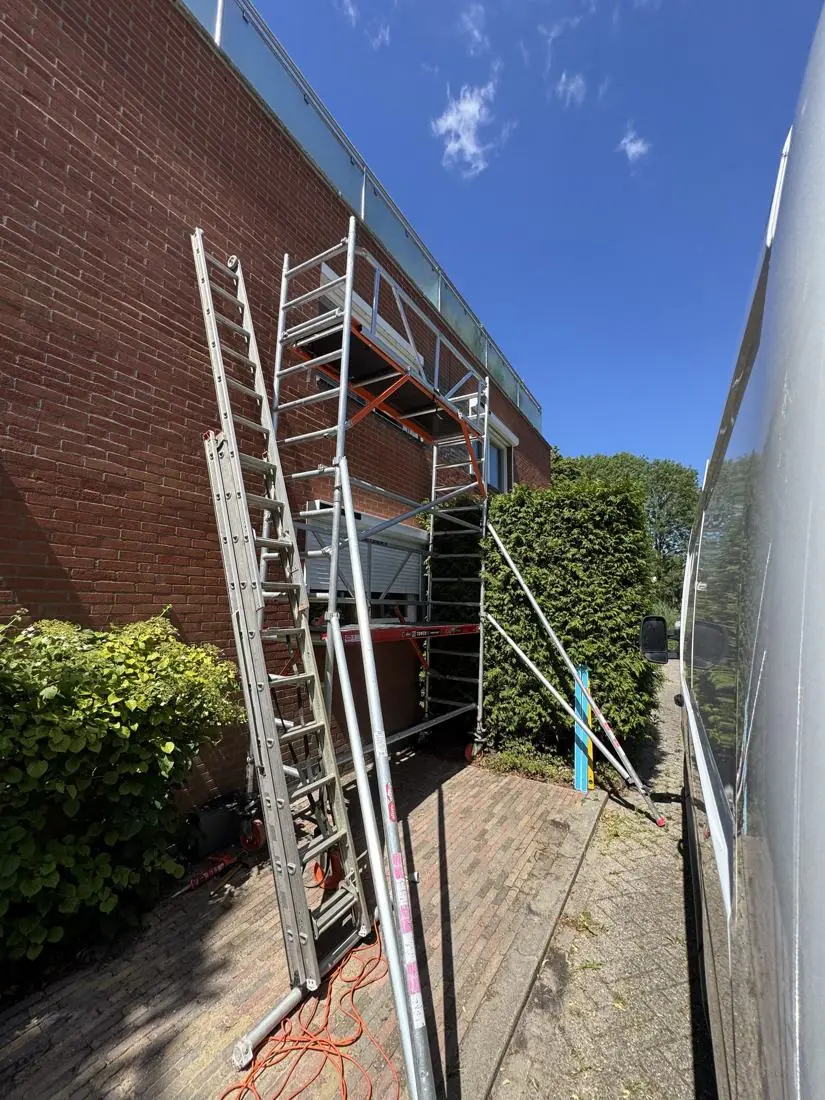
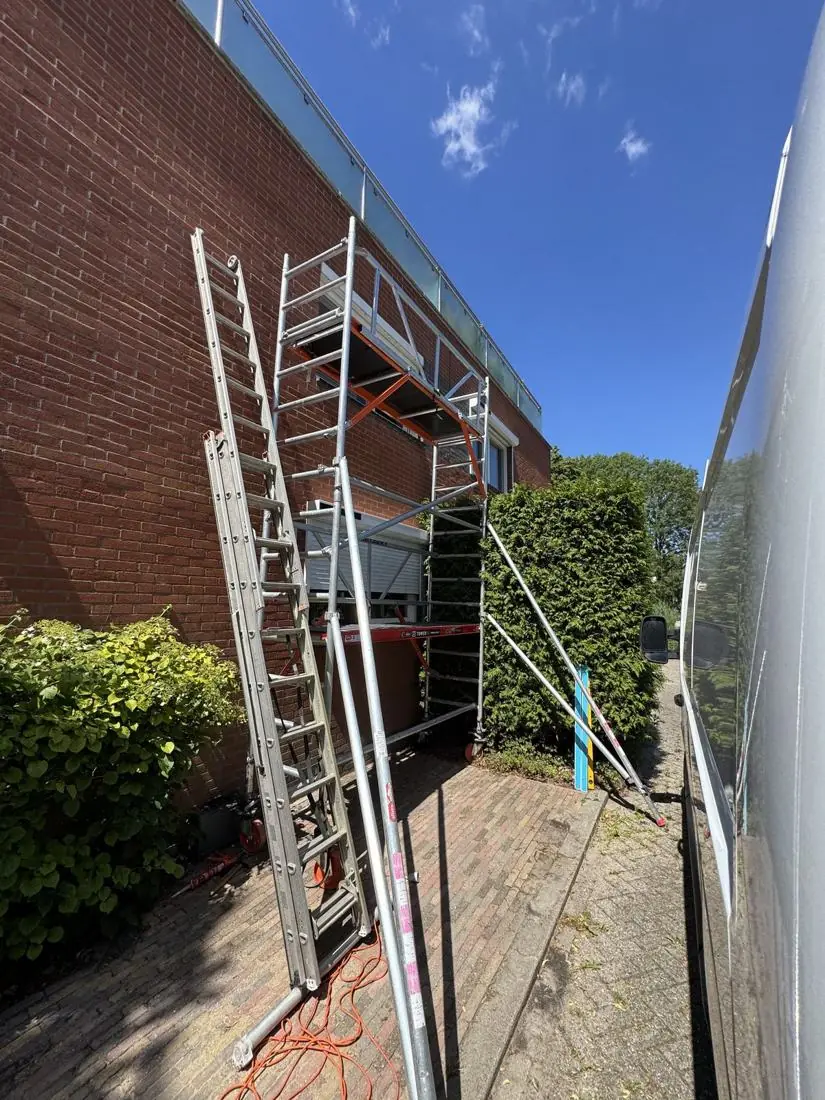
Mobile scaffold built up along a facade, the wide stand from which you inspect and then carry straight on working

The floor you stand on is 245 centimetres long at either width; the difference is the depth, and so what you can put down and whether two of you fit alongside each other without treading on toes. On facade maintenance that could still go any way, that is what settles it. A room scaffold drops out here, because it is meant for indoor work and does not go into the garden. If you do not know, assume the heaviest scenario the facade can hand you.
Choosing the working height to hire for facade maintenance

Working height means something other than the height your floor will end up at. Add roughly two metres of reach to that platform height and together they give the figure you hire a mobile scaffold on. For facade maintenance on a family house that lands between 5.2 and 10.2 metres: at the bottom end it covers a bungalow or a flat-roofed extension, at the top a three-storey elevation with a gable above it. Which build belongs to which figure you can walk through calmly at the various working heights.

Aim at the highest point of the elevation and not at the defect you happened to notice. That is exactly what separates this from a job already pinned down. From the pavement you pick out green growth at two metres and a split sealant line by the bedroom window, but the roof edge, the top courses and the junction with the gutter cannot be judged from below. Those are the things you want to find this year rather than next, so reckon all the way to the top.

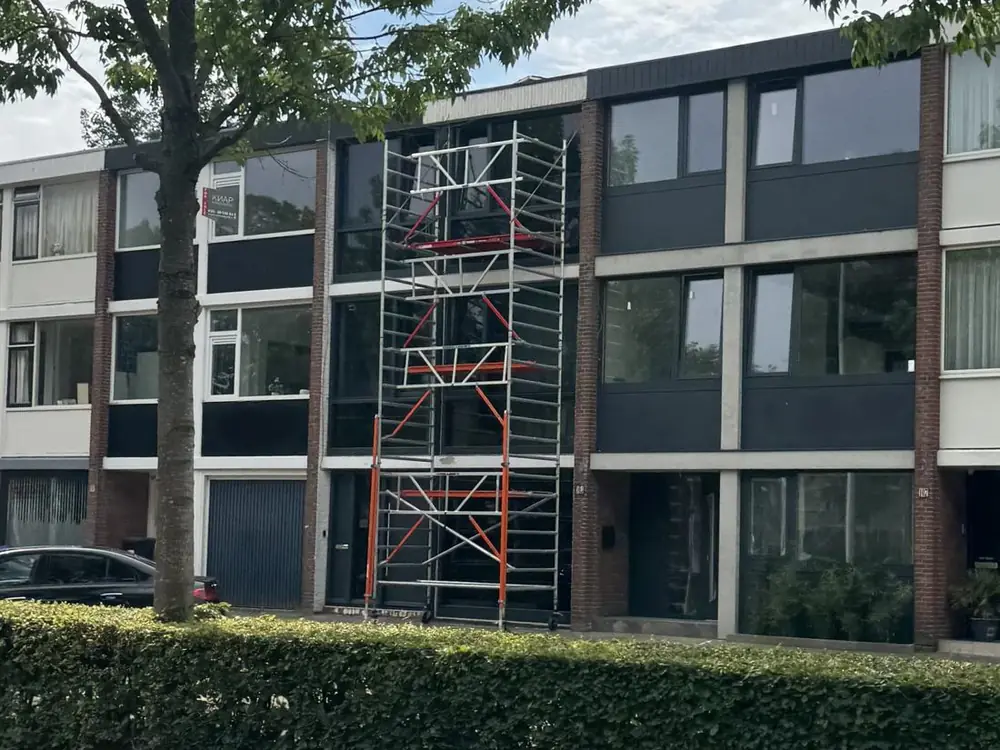
Tower standing against a front elevation right up under the roof edge, the full height facade maintenance is judged from

Start your measurement under the castors, moreover, and not at the front door. A back garden often sits a step lower than the threshold, and you may then reckon from that lower level, which can save you half a build. Hire too tight and the facade is half assessed before you have to build a second time for the upper part, which costs you half a day of climbing. If your house falls between two ranges, take the height of a second floor as your marker.

Where the tower stands during a round of facade maintenance

On facade maintenance you usually go right round the house, and every side sets its own conditions. The front you do from the pavement or the drive: hard and level, but with the public walking past and sometimes a parked car in the way. The side elevation is often a strip barely a metre wide. Round the back you end up on grass, on block paving, or on a terrace with a fall on it. Look at every side before you book, because the awkward one decides which model you hire.

Round the feet you need more room than the build itself takes up. The stabilisers splay outwards and want a clear run at all four corners, even where the wall itself looks straight and friendly. Alongside a house that is precisely where everything stands: a water butt, an outside tap, a sloping cellar hatch, planters, the bike rack and a drain cover that catches a foot. Empty that strip before the parts arrive. For a terrace that falls away, the approach on uneven ground takes you further.

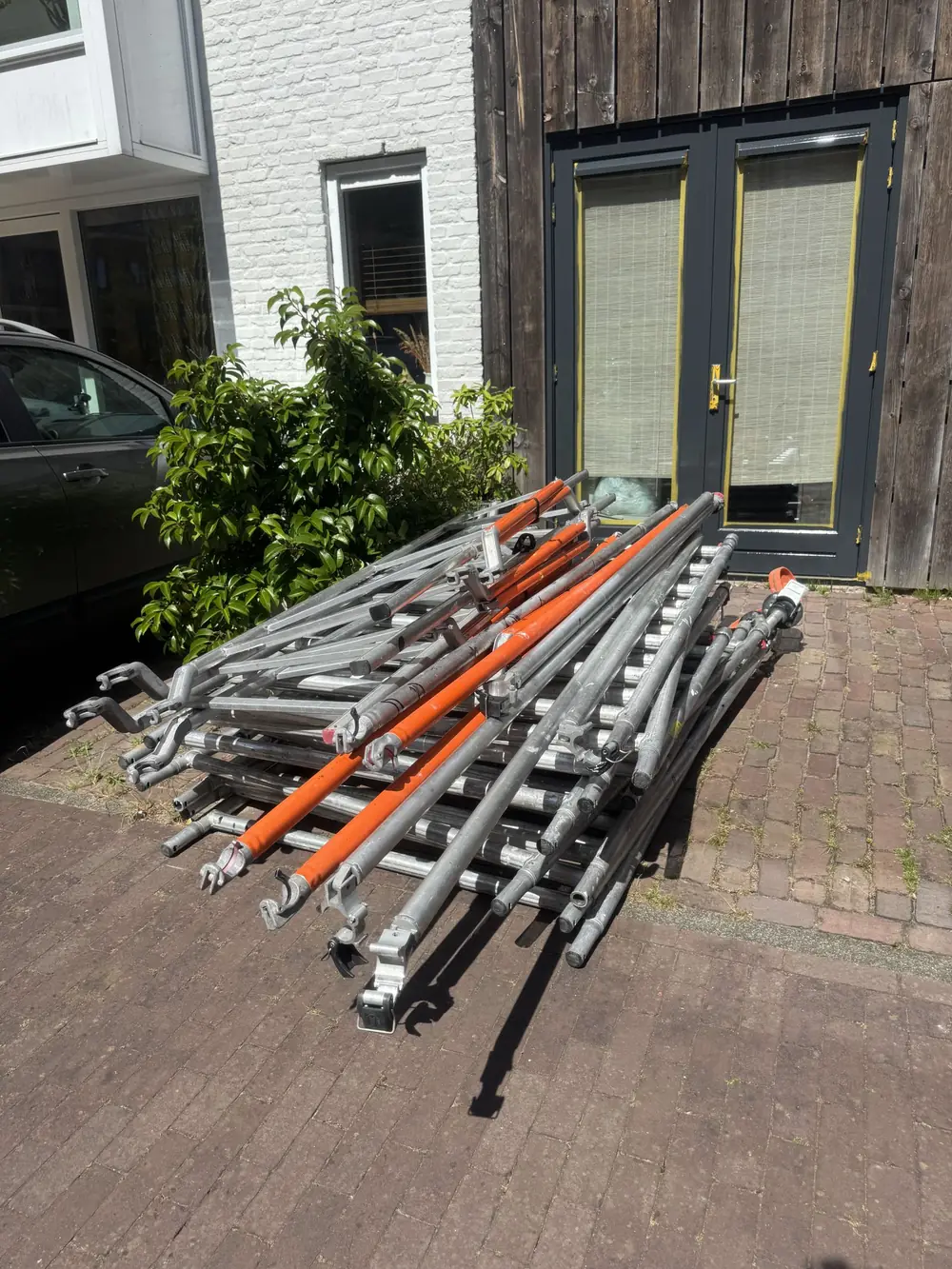
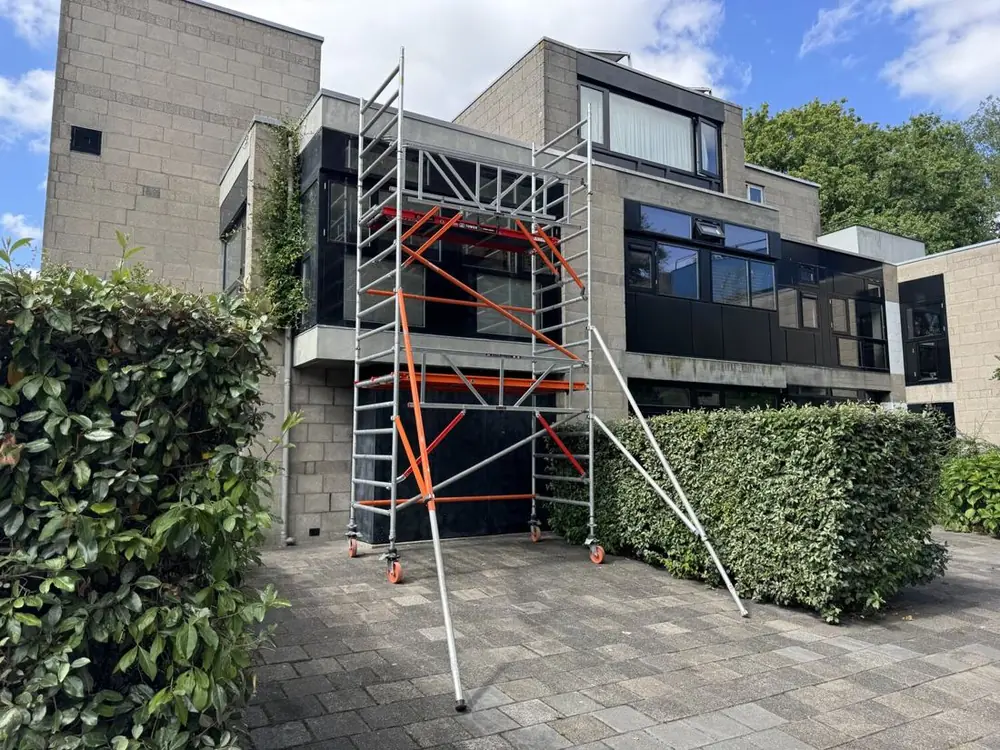
Stabiliser legs splayed out under a mobile scaffold, exactly the ground clearance every side of a house has to offer

Think in advance about the changeover from one side to the next as well, because on this job that is where most of the time goes. Rolling round a corner rarely works; usually you take a section apart, carry the pieces round the house and set it all up again. Reckon half a day per side for that. If the build stands partly on public ground, keep a walkway clear for pedestrians and check with the council which part of your pavement you may occupy.

Hire days for a mobile scaffold right around the house

For an exploratory round along a detached house you are best booking three to five days. The first stand costs half a day of building and half a day of looking; only then do you know what is going on and the real work begins: cleaning, renewing sealant lines, swapping a weathered board, or simply recording what is due next season. Each side of the house asks for its own stand as well, and that adds up sharply in your hire period.

There are waiting moments in this you cannot compress. A cleaned area has to dry before paint goes on, fresh sealant needs time, and an elevation rained on all night does not let itself be assessed. Do this in autumn and a morning regularly disappears into mist or into frost on the north side. So plan for the moment you are certain of being through, not for the moment you would be finished if everything went entirely your way.

Mobile scaffold standing built up along a side elevation, the stand you make afresh for every side of the house

The rental price is put together so that booking generously barely hurts. We charge the first twenty-four hours in full; every day you tack on after that goes in with ninety-five per cent off. A spare day costs you almost nothing that way, while booking too short leaves you standing beside the van with a half-inspected facade on your hands. How long other people keep such a period, you can read at the length of a hire period.

Which mobile scaffold suits facade maintenance?

Kamersteiger RS44
  • Working height up to 4 metres
  • Compact and narrow
  • Great for indoor and small jobs
View and calculate →
Smalle rolsteiger RS51
  • Working height up to 14.2 metres
  • Narrow (75 cm)
  • Ideal for narrow passages
View and calculate →
Most chosen
Brede rolsteiger RS52
  • Working height up to 14.2 metres
  • Wide platform (135 cm)
  • Extra stability and workspace
View and calculate →
1-persoons steiger MiTower
  • Working height up to 6.2 metres
  • Very compact
  • Quick and easy to assemble
View and calculate →

What facade work you can do from a mobile scaffold

From a mobile scaffold you can do anything that goes by hand and with light tools: looking round and photographing, brushing clean, taking off green growth, making good the odd joint, replacing sealant lines, swapping a fascia board, painting and touching in. With a floor of 245 centimetres you have some two and a half metres of wall within reach per stand. For facade maintenance on a house that is ample, and it is why this type suits the work.

There is also work you should not tackle this way. Repointing or rendering a complete elevation, where you stand in the same place for weeks and material has to go up continuously, calls for a fixed structure we do not supply and that you do not put up in a day either. The same goes for heavy elements you want to winch up and for work where you must reach far outside the guardrail. We hire out mobile scaffolds only, so no facade scaffolds, system scaffolds or cherry pickers.

Mobile scaffold built up beside a house, the floor of 245 centimetres that covers a stretch of wall per stand

Note what this page does and does not cover. Here it turns on the choice beforehand, at the moment the job has no name yet and you mainly want to know which model and which height to hire. If you already know exactly what has to happen and you do the same recurring service every year along a fixed route past numbered bays, then the page about maintaining a facade fits better. Is the wall still a riddle? Then you are in the right place.

Hiring a mobile scaffold with delivery for a facade round

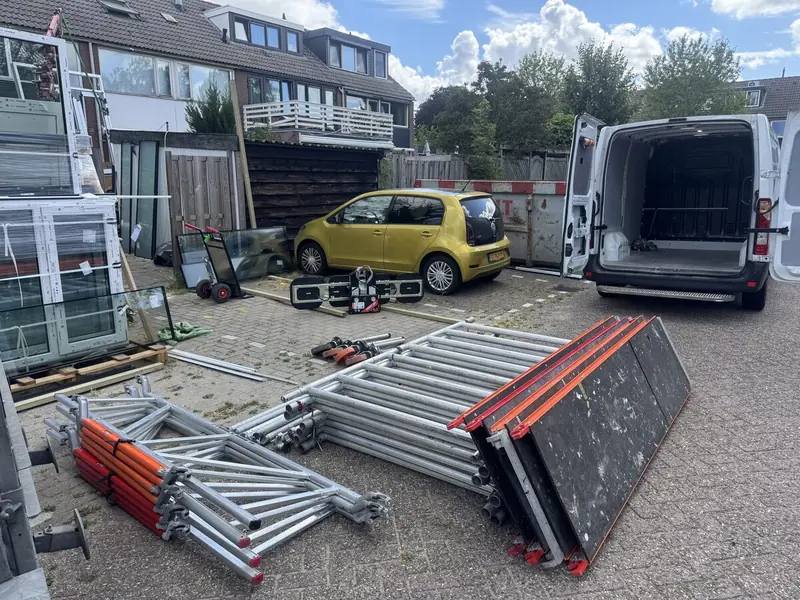
You get the mobile scaffold delivered as a complete, counted set of loose parts. Work out beforehand where that pile may end up, because on facade maintenance the strip along the house is precisely the bit that has to stay free. A corner of the path or a spot under the carport is handier than the lawn you want to splay the stabiliser legs on later. Get your booking in before 15:00 on a normal working day and the parts are with you the working day after.

You enter the arrival day and the going-away day yourself, and on this work you let that choice run with the forecast. A dry start is worth more than an early start, certainly in autumn. Building is on your list and not on ours. A printed manual travels with the parts and an instruction film shows the order of work, so reckon on half a day with two people before you get anywhere near the brickwork.

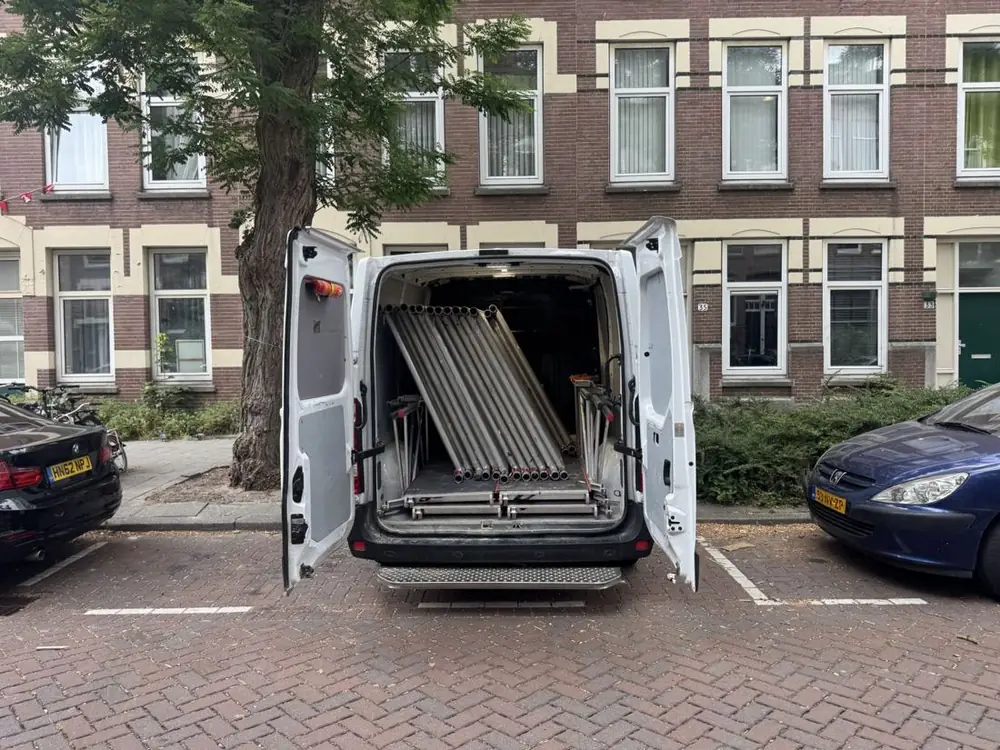
Delivery van with scaffold parts outside a house, the way the set arrives on the day before your first working day

At the end you take the build apart again and lay every part out complete; loading up and driving off we take over after that. Count as you dismantle and you know for certain no coupler is left behind in the border or behind the shed and that the set goes back whole. What we charge in your region for bringing and fetching you see at the rates per province, so you can allow for that figure in your budget.

Safe facade maintenance from a hired mobile scaffold

Two hundred kilos may stand on every square metre of floor, the third load class within EN 1004. On facade maintenance you reach that sooner than on a job that is pinned down, because you take all sorts up with you precisely because you do not yet know what you will need: a bucket of water, a toolbox, a couple of battens and someone to look with you. Put what you are not using at that moment down below rather than up by your feet.

Beyond that the ordinary agreements apply, and they are not complicated. Lock the castors before anyone steps on, never roll the build a metre with a person or material still aboard, and get down the moment the wind starts pushing at the guardrail. After every move, check again that all four stabiliser legs sit well, even when you have shifted only half a stand. What else comes with working at height is set out in this explanation of working safely.

Built-up mobile scaffold with double guardrail and an internal climb, the way up on every round along the facade

Two risks stand out on this work. The first is the clutter on the floor: on maintenance there are loose screws, bits of raked-out joint and a wet cloth about, and you step on them at just the wrong moment. The second is everything that can go down, because under a wall there are children, neighbours and the delivery driver you never hear coming. Fence off the zone below and do not work directly over a garden path or a door that opens.

In 5 steps

How hiring a mobile scaffold works

1
Choose working height

Pick the height that suits your job.

2
Book online

Sorted in 60 seconds, price shown instantly.

3
We deliver

At the agreed spot the next working day.

4
Assemble safely

Assembled by you, with a manual.

5
We collect

One call and we collect the scaffold.

Good to know

Practical tips for facade maintenance

1

Walk a lap of the house with your phone in your hand before you reserve anything and photograph every side. On those pictures you later see which opening is narrowest and which width you must hire.

2

Take a tape measure and a screwdriver up with you on your first day. What you find in the way of loose sealant and soft patches decides whether the mobile scaffold has to be hired for longer than you thought.

3

Start your round on the side where the sun comes early and the wall dries first. That way you lose no half morning on your first hire day waiting for the brickwork to be dry enough to judge.

4

Number the bays in chalk on the paving once you have looked at each one. Next time round you know straight away where the tower stood and how many stands the whole lap took you.

5

Ask the neighbours for permission before you put the scaffold against the boundary. Half an hour of talking beforehand is pleasanter than a conversation about a stabiliser leg in their border on the first working day.

6

Write down what you found and what you left. At the next round of facade maintenance you can then hire a model and a working height on purpose instead of going up to look all over again.

Frequently asked questions

Frequently asked questions about facade maintenance

Which mobile scaffold should I hire if I do not yet know what the facade needs?+

Take the wide RS52 of 135 centimetres in that case. You go up to look, and the moment you come across something you want to tackle it there and then rather than climb down for tools. That deep floor gives you somewhere to leave material and room for two of you side by side. If it will not get you round to the back of the house, you are better off hiring the narrow scaffold of 75 centimetres and accepting that you go down the ladder more often.

How does hiring a mobile scaffold for facade maintenance work from start to finish?+

You book online on model and working height at a fixed price including VAT, and you pin your own date for the tower to arrive and the date it may go again. We drive the parts to your address, you build up, do your round along the wall and take it apart afterwards. After that we bring the whole set back to the depot. Nothing more than that has to be arranged on your side.

For facade maintenance on a whole house, how many hire days should I allow?+

On a terraced house with only a front and a back elevation you usually manage in two to three hire days; on a detached house with four sides you are sooner at four or five. Bear in mind that you only know what else is coming once the first assessment is behind you. Book the tower generously for that reason, certainly if you intend to carry on the moment you find something worth doing.

What is the rental price for this, and what do the later hire days cost?+

That depends on the model and on the build you pick out; bringing and fetching we reckon per province, everything including VAT. The amounts sit together on the page with our rates. For facade maintenance the scale is the interesting part: day one weighs heavily and every following day barely counts. Anyone who does not yet know how much work there is does better to hire generously once than briefly twice.

Which working height should I hire for facade maintenance and how do I check it?+

Assume a range between 5.2 and 10.2 metres and choose within that on your own elevation. Measure from the ground your castors will end up standing on to the highest point you want to inspect, usually the roof edge or the top of a gable. Do not add your own height, because that reach is already worked into the figure you hire a scaffold on. The build at ten metres is on the page about that working height.

Do I have to collect the scaffold or can I hire it with delivery?+

Both are possible and the choice is yours. Go for delivery and the tower comes on the day you picked, and we fetch everything afterwards, at a fixed rate per province. Would you rather collect the set, it waits by arrangement and at no cost at our yard on Zeeburgerpad in Amsterdam, provided the whole load fits in your van. On a lap round the house most people go for delivery anyway, since at these heights it is quite a stack of tubes and platforms.

Is putting the tower up included when I hire it, or is that mine to do?+

Building stays your work. We hire out the tower, bring it as a counted set and take it away again afterwards, but assembly, shifting it on around the elevation and pulling it apart are down to you. Paper instructions and a film of the build order travel with the parts, so two people manage it in half a day. Count that half day into your planning, because on the day you build you rarely get to the facade as well.

What happens if the facade maintenance overruns and I want to hire for longer?+

Ring or email as soon as you notice more days are needed; we move the collection date then, unless the set is already promised to another customer. On this job in particular it regularly overruns, because up top you find more than was visible from below. If you expect that, book the tower a little longer straight away; handing it back early is always fine. That way you never stop halfway across a bay because the van is on its way.

How much clear space has to be around a hired scaffold along the wall?+

Reckon on a level strip that is wider all round than the build itself, because the four stabiliser legs point outwards at an angle. Along a house that is often just what is missing, thanks to a water butt, a border or a bike rack. Clear that spot before you have the tower delivered, not on the morning you want to start. If it stands on soft garden soil, lay sturdy boards under the castors so nothing sinks away.

What do I do if the weather turns against me while I have the scaffold on hire?+

A soaked wall cannot be assessed and in a strong wind you are not going up anyway, so that day shifts along. Because every following hire day costs only a fraction of the first, a spare day is the cheapest insurance you can take. If the bad spell lasts longer, say so and the collection day moves further out. The tower may stay standing as long as you leave it stable and braked.

What happens to the deposit after the hire has finished?+

You put down a sum when you book, and we release that deposit as soon as the complete set is back with us, which in practice means one working day after the parts have been checked in at our yard. Count the pieces as you dismantle the tower and no argument arises about a clamp still lying somewhere in the garden. The explanation of that sum describes the settlement step by step.

I walk the same fixed maintenance round along the wall every year, is this page meant for me?+

Then you are just beside it here. This explanation helps you choose while it is unclear what is wrong with the facade and you are therefore picking a scaffold on the wall itself. If you work to a fixed route past numbered bays and already know per bay what you are going to do, look instead at the recurring service on a facade. That sets out what such a lap costs in hire days.

Hire a mobile scaffold for facade maintenance today?

Calculate your rental price now or ask for free advice.

Rolsteiger van SteigerTaxi geleverd op locatie
Book it online

Your scaffold sorted in 2 minutes.

Choose your scaffold and working height, see the price instantly and book online.