
See your price
Application

Dormer window? Choose the right scaffold.

Work on a dormer comes under one heading, but it runs from painting and checking the zinc to replacing a side panel. What all those jobs share is the place: the dormer sits back on the sloping roof, so you have to go not only up but also out across a stretch of roof. That is why you look at two measurements when you hire, and not at one. On an ordinary house it comes down to a wide mobile scaffold reaching 6.2 to 9.2 metres, plus several positions along the cheeks.

  • Order before 3 pm, delivered tomorrow
  • Professional Altrex scaffolds
  • Up to 14.2 metres working height
  • Easy to assemble yourself
4,2 tot 14,2 mWorking heights available
12Provinces served
7Days a week
200 kg/m²Load class 3
In short
  • For dormer window we recommend the Wide mobile scaffold.
  • For a dormer you hire the RS52, because a wide deck lets you reach out across the sloping roof more calmly.
  • Two measurements decide your choice: the height of the dormer and the distance from the eaves to its front.
  • Allow three to four hire days, since the front and each of the two cheeks want a position of their own.
  • First 24 hours from €175 incl. VAT and delivery; every day after that 95% off.
Key facts for this job
FeatureValue
Recommended scaffoldWide mobile scaffold (Altrex RS TOWER 52)
Working height for this job6.2 to 9.2 metres
Available working heights4.2 to 14.2 metres
StandardEN 1004, load class 3 (200 kg per m²)
DeliveryOrdered before 3 pm, delivered next working day
Each extra day95% off, from €8.75 a day
Why a mobile scaffold for dormer window?

Safe, stable and professional work at height

A dormer is harder to get at than a wall, because it does not sit in line with the brickwork but a good way back on the roof. The mobile scaffold stands below against the elevation and you have to look and reach over that roof. The further back the dormer sits, the higher you have to stand to get at it, and that is precisely where people misjudge it. Hiring a scaffold for work on a dormer therefore asks for two measurements beforehand: the height up to the point you need to reach, and the horizontal distance across the sloping roof. Only after that do you pick a build.

  • Measure the height to the dormer before hiring
  • Count in the horizontal distance across the roof
  • Working height 6.2 to 9.2 metres for dormers
  • Separate positions for the front and the cheeks
Read more about working safely →

Which mobile scaffold to hire for work on a dormer

The wide Altrex RS52, 135 cm between the uprights, is the model you want at a dormer. You rarely work straight ahead of you here: you lean out over the guard rail towards a point that lies a good way off, and then a wide deck under your feet is literally the difference between comfortable and standing on your toes. Which other sizes are in the range you compare on the page for mobile scaffolds to hire.

Dormer work also means carrying things up. A panel or a length of fascia timber, a sealant gun, sanding kit, paint or zinc tools, and usually a second person to pass things across. On a deck of 245 by 135 cm those items lie beside each other rather than on top of each other, which saves searching at the moment you are holding a panel in place with one hand. The second person then still has somewhere to stand without stepping over your tools.
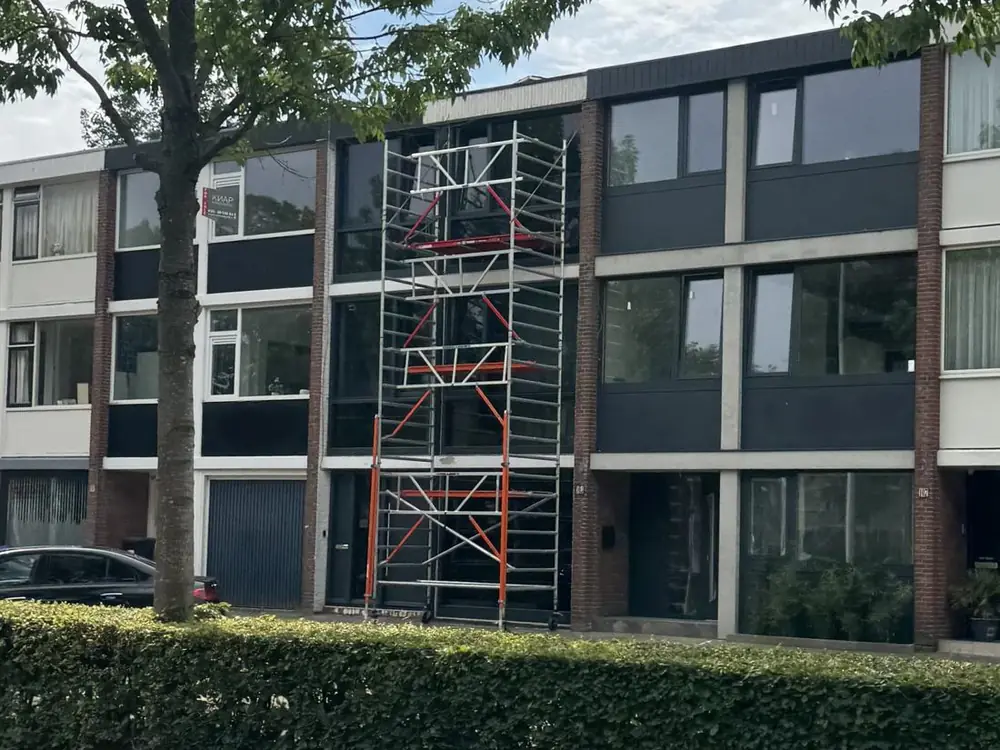
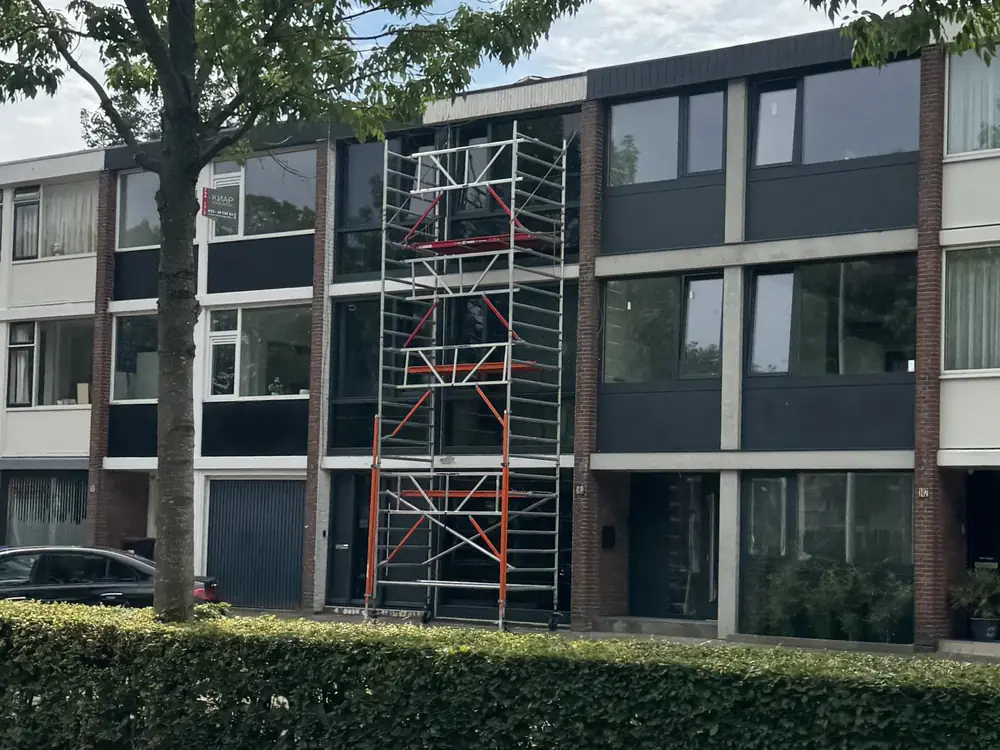
Wide mobile scaffold built up along a front elevation past the roof edge, the position that puts a dormer in reach

The narrow RS51 comes into play if the dormer sits above a narrow alley or an extension where 135 cm simply will not pass. You give up working room then, so measure that passage first. A room scaffold or a MiTower is out here: they reach four and 6.2 metres respectively, which is too low as soon as the dormer sits on a second floor. In this comparison for dormers the options stand side by side.
Working height and distance: two measurements when you hire

The first measurement is the ordinary one: how high does the point sit that you need to reach. Measure from the ground the castors will rest on up to the top of the dormer, so to its little roof and not to the bottom sill. On a house of two storeys you usually land between 6.2 and 9.2 metres of working height. The deck then hangs between 4.2 and 7.2 metres, because a good two metres of your own reach comes on top of the platform height.

The second measurement is the one most people forget. A dormer does not begin at the gutter but a metre or a metre and a half higher up the sloping roof, and you cover that distance horizontally as well. Stand level with the front of the dormer and there is still a stretch of roof between you and your work. So measure how far back the front sits from the eaves and count that in when you choose your level.

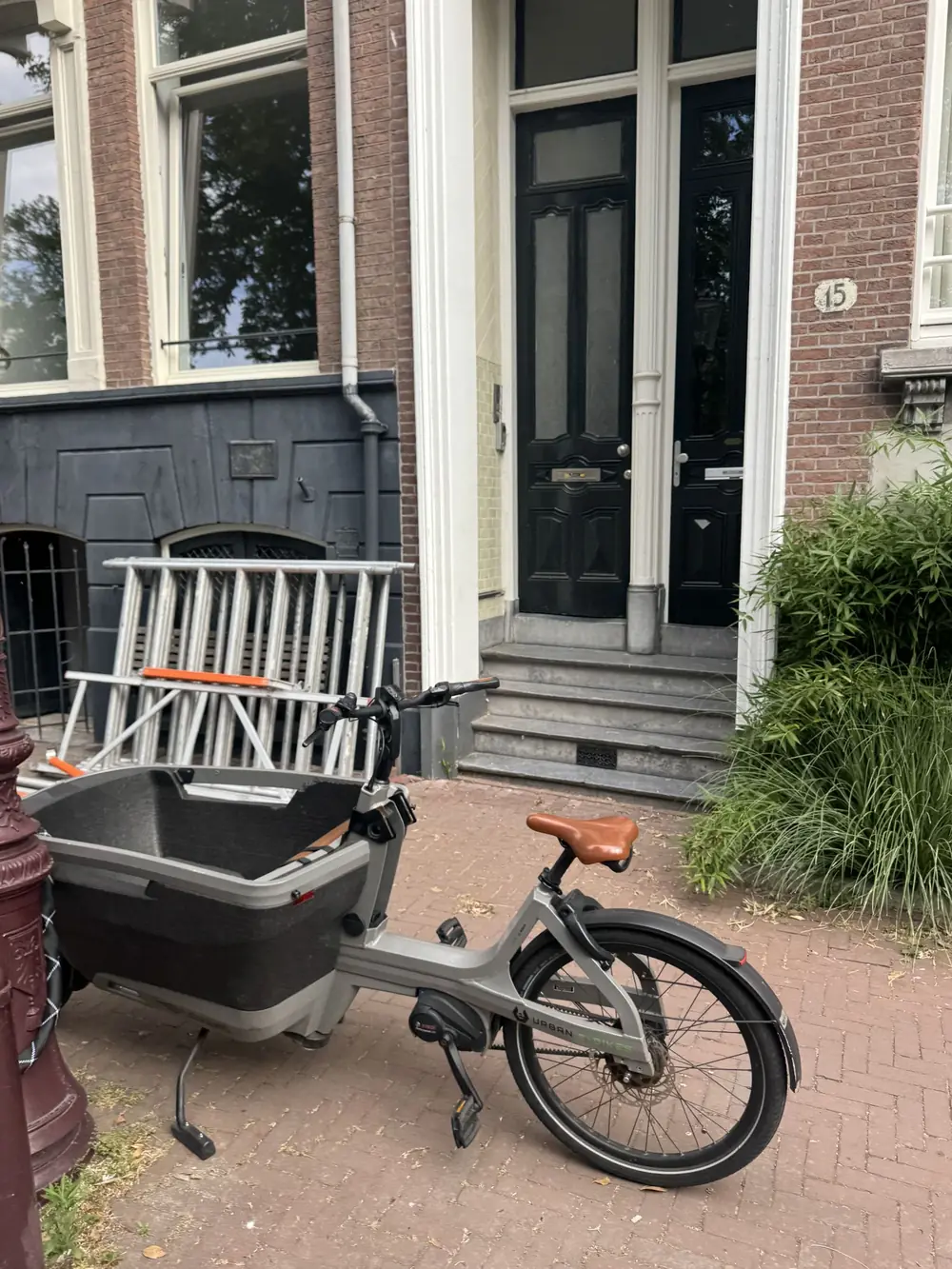
Guard rail frames leaning by a front door with number 15, the hire set as it arrives before you build

In practice that means you nearly always pick a level higher than the height alone would suggest. From a deck that comes out a little above the dormer you look and reach across to it at an angle instead of pressing against it. What that means for a dormer on the second floor is set out on the page about work on the second living floor. Choose too tight and you stand too far off and never make the top edge.

Where the hired mobile scaffold stands for a rear dormer

The standing position follows from where the dormer sits, and that is as often at the back as at the front. At the rear you are dealing with a garden, a terrace, a shed hard against the boundary and a fence that narrows the delivery route. Walk that route first with the parts in mind: will the longest components pass through the gate, or do they have to go over the fence. At the street side the carrying is easier, but you have parking and the pavement to deal with.

Under the build you want flat, firm ground. Terrace slabs on sand sink under an extended stabiliser, and a border turns to mud after a shower. Put down spreader plates or thick boards under the feet if you have to. Bear in mind too that a dormer usually needs two or three places along the same elevation, so that flat strip has to run on. For soft or falling ground the approach is in this guidance on the ground.

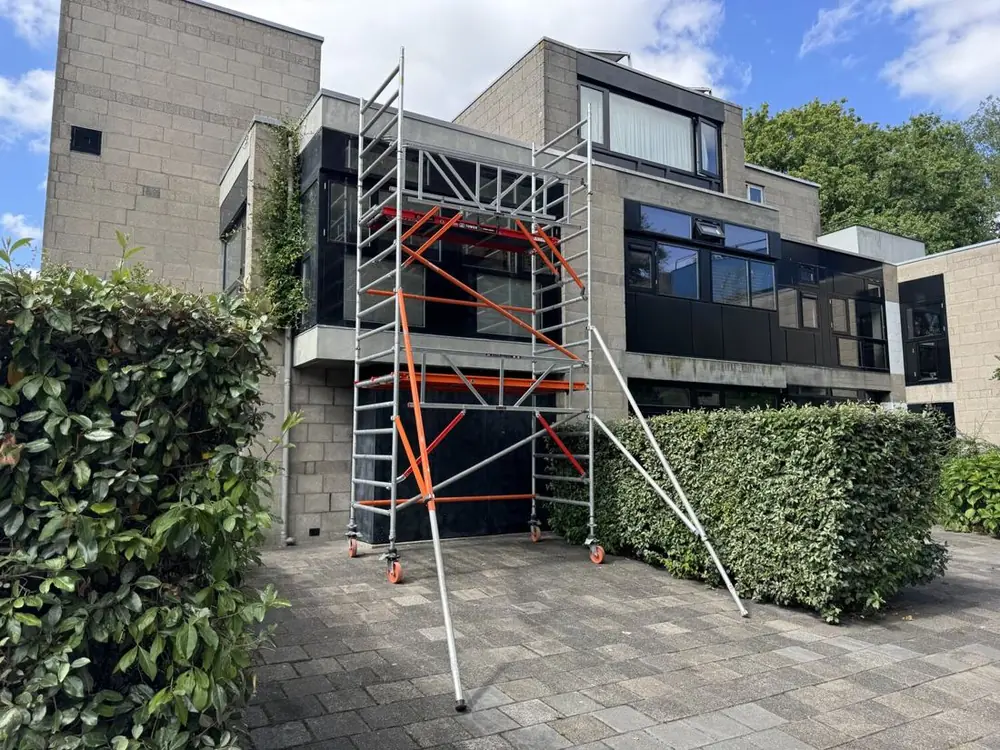
Stabilisers extended at the base of a mobile scaffold, the firm footing dormer work needs in several places

When you set out, look at exactly where the dormer comes out above. You do not want the build straight under its middle but slightly off centre, so that you can take the front and one of the sides without moving straight away. A downpipe, an extension or a low outbuilding sometimes forces you a metre to one side, and then the point you reach across the roof from shifts as well. Walk it through with a broom in your hand and you see at once how far you will get.

Dormer work: how many days to hire the mobile scaffold

All sorts of things fall under dormer work, which makes the number of hire days mainly a question of how many part jobs you stack up. Just checking the front over and touching it up is a day. Add the sanding, the zinc at the junction or a rotten section in a cheek, and you are soon at three or four days. Count in as well that every part job means moving from front to cheek, and that costs half an hour each time.

Waiting time comes with the territory and you cannot make it up. Sealant and paint have to cure before the next coat goes on, and on a dormer in full sun that happens faster than on a north wall. Rain stops the work, because you cannot reach the top edge across a wet sloping roof. So book your period with the slowest step as your starting point rather than the quickest, certainly if you are starting in autumn.

Erected mobile scaffold with decks and rails at a house, as it stays by the dormer for several hire days

Margin like that costs little when you hire. The first twenty four hours is charged at the whole rate; from day two a 95 per cent discount applies, which leaves a twentieth per day. A day of waiting for dry weather therefore hardly counts. Booking a second hire period, by contrast, costs you a whole build and an extra journey. So reckon a day too many rather than too few. What others allow on jobs like these is in this overview of hire days.

Which mobile scaffold suits dormer window?

Kamersteiger RS44
  • Working height up to 4 metres
  • Compact and narrow
  • Great for indoor and small jobs
View and calculate →
Smalle rolsteiger RS51
  • Working height up to 14.2 metres
  • Narrow (75 cm)
  • Ideal for narrow passages
View and calculate →
Most chosen
Brede rolsteiger RS52
  • Working height up to 14.2 metres
  • Wide platform (135 cm)
  • Extra stability and workspace
View and calculate →
1-persoons steiger MiTower
  • Working height up to 6.2 metres
  • Very compact
  • Quick and easy to assemble
View and calculate →

Working along the dormer cheeks from a platform of 245 cm

An average dormer is two to three metres wide, so a deck of 245 cm has the front covered in one position. The cheeks are another story. They stand at right angles to your platform, and to get at them properly you move the build a good way to one side and work in towards the flank at an angle. So do not count on a single position but on two to three places around the same dormer.

You move with an empty deck. Take the material off, release the brake, roll a few metres along and set the stabilisers out again before anything goes back up. That looks laborious for three metres sideways, but with a sloping roof above your head you particularly do not want to push a half loaded deck. On a terraced house with the dormer at the back this is usually the only moving of the whole job.

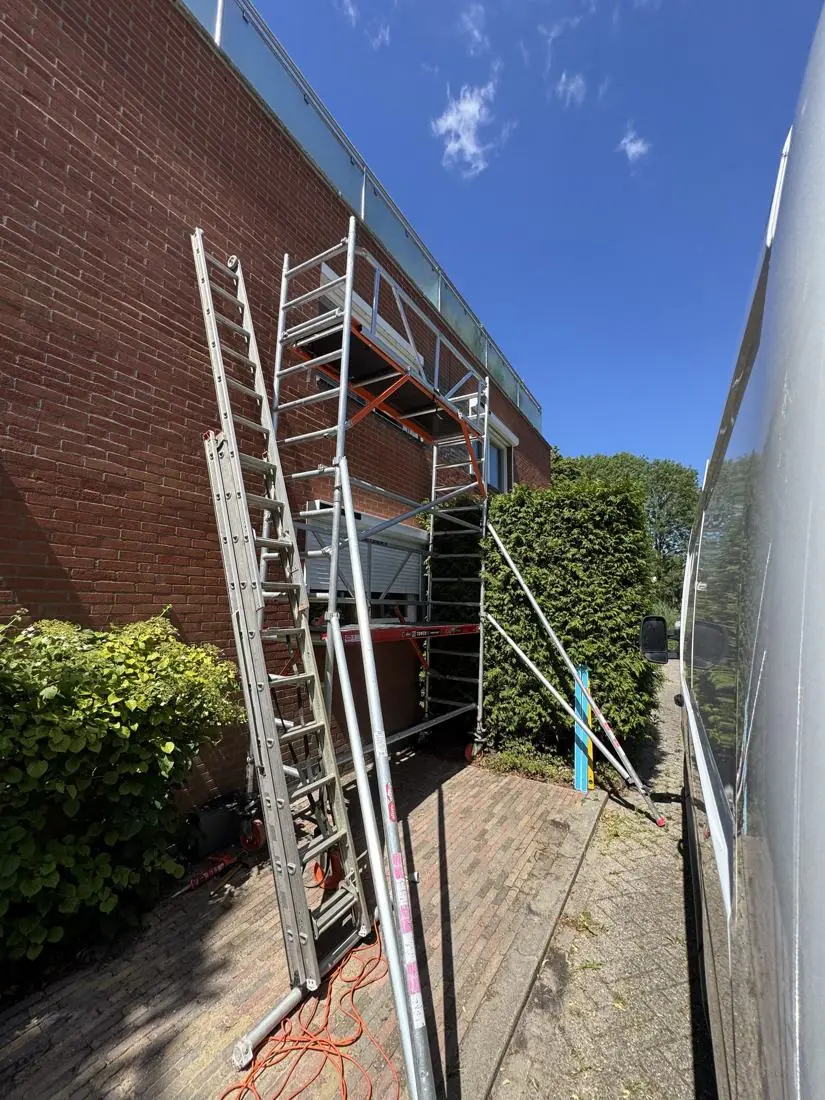
Mobile scaffold set up along a side elevation, the place you move it to in order to reach a dormer cheek

What people misjudge is the top edge of the little roof. From a level measured out on the front you just fail to make the roof trim, and then you are working with outstretched arms exactly where you need force. So take that top edge into account as soon as you take your measurements, even if you are not going to touch it. If it is purely about the roof of the dormer, you hire a level higher still.

Hiring a mobile scaffold with delivery for a dormer job

The set reaches your door as loose parts, counted and complete, and building it is your own job, with the supplied manual and an instruction video beside you. For a build of this height two people set aside half a day. If the dormer is on the rear roof, agree where the van may unload and how you get the parts round the back, because carrying through a narrow gate is invariably the first thing to disappoint on jobs like these.

The arrival date and the departure date are both yours to name. Get an order in before 15:00 on any working day and the parts can be standing with you by the next working day. On dormer work, let the delivery preferably coincide with the start of a dry run of days, so that you build straight away and can start the next morning. What the journey to your province costs is set out clearly under the charges for dropping off and collecting.

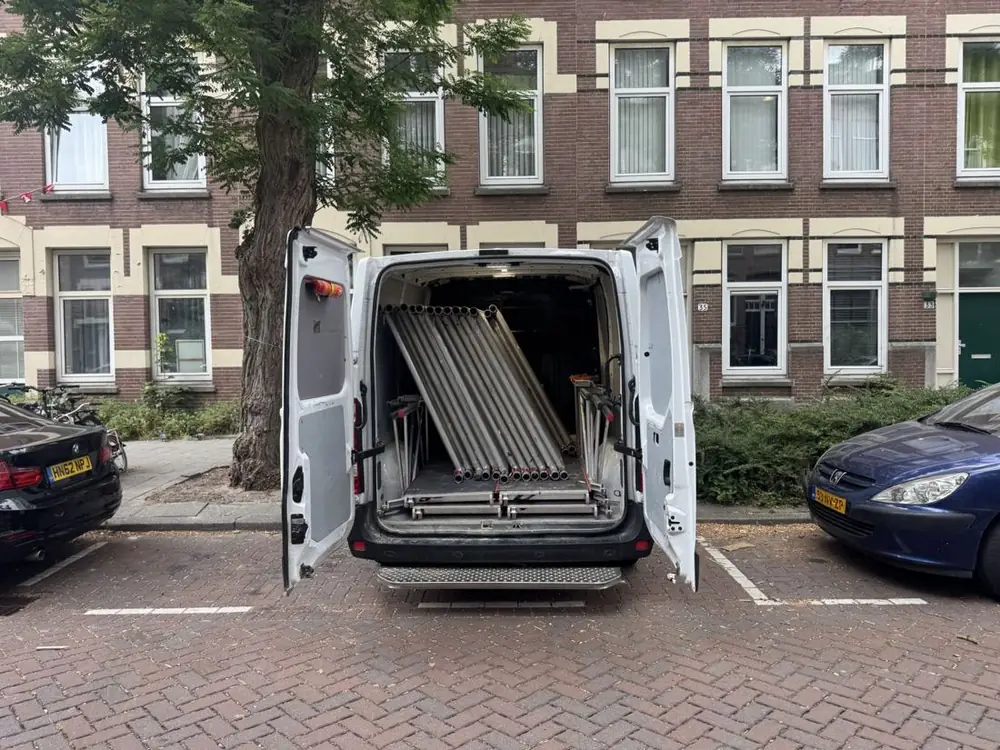
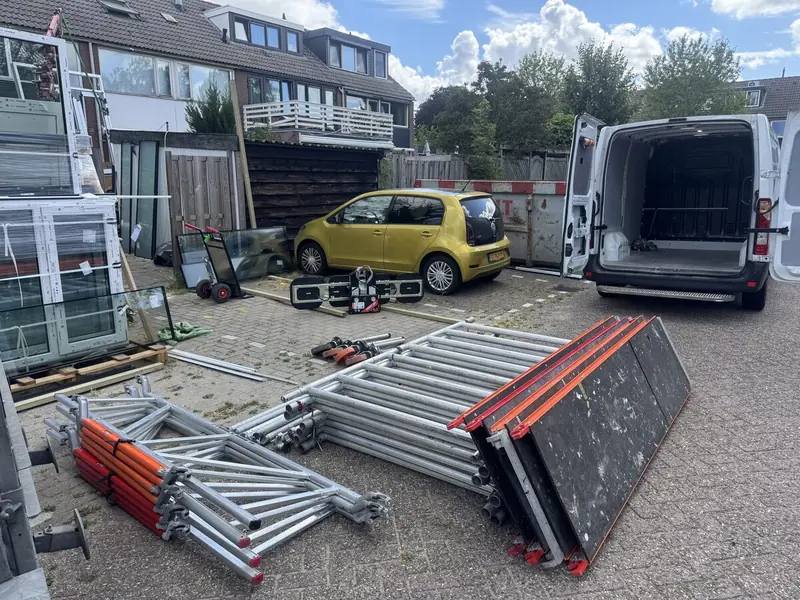
Delivery van unloading scaffold parts outside a house, the moment the set of components for a dormer job turns up

After your last day we come and collect the set. You make sure everything is dismantled and complete at the spot you gave us. Take it down while it is light and while you are still sharp: the parts of the top layer are better passed down with attention than at the end of a long day. So do not put the stack at the bottom of the garden where the van has no chance of reaching it.

Working safely on a dormer from the mobile scaffold

The build follows the EN 1004 standard in load class 3, which puts the limit at 200 kg for a square metre of decking. On dormer work, with two of you up there plus panels, tools and a bucket, you get closer to that than you think, so spread the weight and leave spare material below. Put the castors on the brake before you step up, never wheel it with anyone or anything still aboard, and stop once the wind starts pulling at the decks.

The risk that heads the list here is reaching. Because the dormer lies further off than a wall does, it tempts you into hanging far over the guard rail or putting a foot on the top rail. Do not do it: move the build one more time instead. Nor should you step onto the sloping roof to finish a last patch, because tiles are slippery and they break, and there is nothing up there to hold on to.

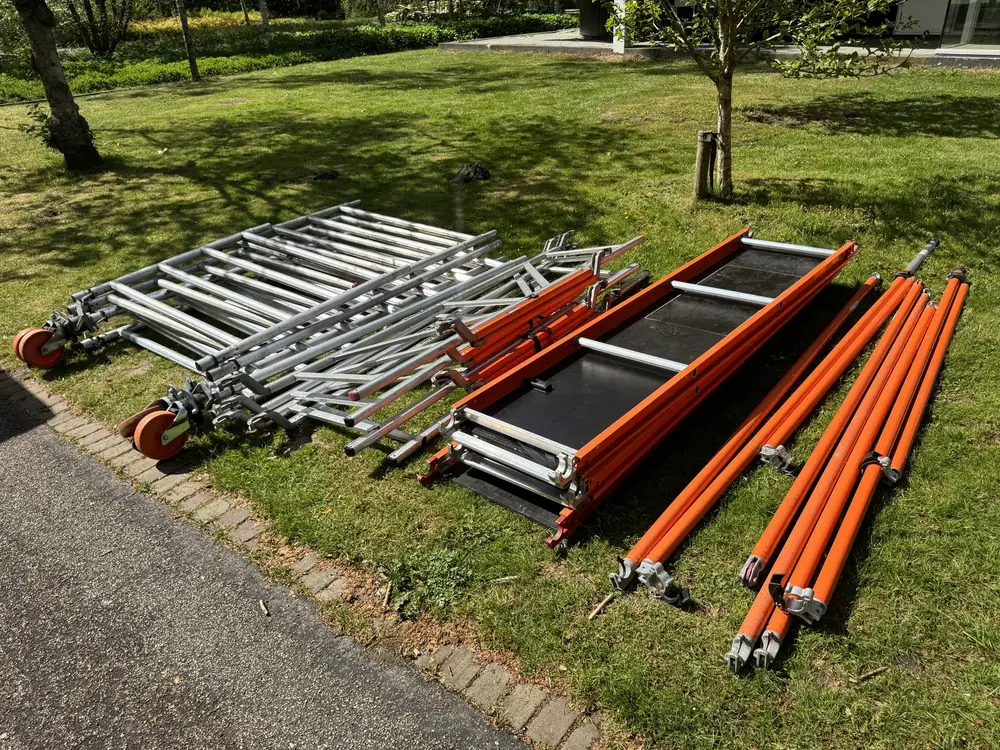
Scaffold parts lying on the grass beside a house, exactly the soft ground you watch out for on dormer work

Keep the space under the build clear as well. At a dormer you often work above a terrace or a garden path where children and pets simply walk past, and anything that slips out of your hands lands exactly there. Do not work with tools lying loose along the edge, fence the zone off with what you have and say indoors that nobody should walk underneath. The further rules are with the guidelines for working at height.

In 5 steps

How hiring a mobile scaffold works

1
Choose working height

Pick the height that suits your job.

2
Book online

Sorted in 60 seconds, price shown instantly.

3
We deliver

At the agreed spot the next working day.

4
Assemble safely

Assembled by you, with a manual.

5
We collect

One call and we collect the scaffold.

Good to know

Practical tips for dormer window

1

Measure the distance from the eaves to the front of the dormer with a long batten from the ground. That measurement sets your level just as much as the height does, and it is almost always forgotten.

2

Photograph the dormer from a distance before you hire and zoom in on the junctions. You can already see where the zinc or the timber wants attention and whether one position will do or two.

3

Start with the cheek furthest from the delivery route. You carry material the longest distance the first time and then work steadily back towards the place where your things are lying.

4

Do not set your build exactly in front of the middle of the dormer but slightly off centre. You then take the front and one side from the same position and have to move once less.

5

Take a short batten up with you to check the top edge of the little roof for fall. While the mobile scaffold is standing you can still adjust something; after that it is a new hire period.

6

Lay an old blanket over the guard rail on the side facing the dormer. Panels and trim then rest against it without damage, and it saves scratches on freshly painted timber.

Frequently asked questions

Frequently asked questions about dormer window

Which mobile scaffold should you hire for work on a dormer?+

In most cases you hire the wide RS52. At a dormer you work forwards at an angle across a stretch of roof, and then a generous deck is pleasanter and safer than a narrow one. More material can go up with you too, which helps because a dormer often gets several part jobs at once. Only if the way through to the back garden will not take 135 cm do you hire the narrow tower and accept the loss of working room.

How does a dormer hire run, from booking through to collection?+

You measure the height and the distance to the dormer first, then choose a model and a reach online and add your delivery and collection dates. The amount is fixed in advance, VAT included. We bring the parts, you build the tower, work the front and the cheeks and take it apart at the end. After that we collect the set. When planning, allow half a day for the build and a couple of hours for dismantling.

How many hire days does a dormer take if you hire a mobile scaffold?+

For one part job you manage in a day or two, but as soon as you tackle the front, the zinc and both cheeks you are at three to four hire days. That is not down to the work itself but to the number of scaffold positions: every move costs time, and between two coats of paint or sealant there is drying time. Book tightly and you spend the last day looking at a half finished cheek while the van pulls up.

What does hiring cost, and how does the second day count?+

The rental price of the tower depends on model and reach, with a fixed journey charge for your province on top. All rates are shown with VAT included at the prices per build. More important for your planning is that the opening day weighs heaviest and each day after it adds only a fraction. At a dormer, where the work often goes in phases, that suits you: you hire the whole run of working days in one go.

What working height do people usually hire for a dormer?+

For a dormer on an ordinary mid terrace most people hire a reach between 6.2 and 9.2 metres. You measure to the top of the little roof and not to the sill, and you count in the distance across the sloping roof, because that effectively pushes you a level higher. If the dormer sits on a taller roof or far back, you end up higher. The page on nine metres shows the matching build.

Can the scaffold be delivered right into the back garden?+

The driver unloads the set at a reachable spot by your house, usually at the street or on the driveway. Carrying it round the back is yours to do, and with a dormer on the rear roof that is worth thinking about beforehand. Measure the gate and check whether the longest parts will pass. When you hire you give a delivery date of your own choosing, so allow half a day if the carry is a long one.

Does someone come to erect the build, or is that part of hiring?+

No, that stays your task. You get a complete set with a manual, and the accompanying video shows the order step by step. Two people are up at this level within half a day, provided you work calmly from the inside. We deliver and collect, and no more than that. A scaffold erected by us or a cherry picker is not in the hire range, so allow for the build and the dismantling in your planning.

What if the dormer work overruns and I want to hire longer?+

Tell us in good time and the collection date moves back, provided the set is not already promised to the customer after you. At dormers the overrun usually comes from something appearing under the zinc or behind a cheek that you could not see from the ground. That is why it is wise to take a day of slack when you hire. Finish sooner than expected and the set may leave earlier too.

How much clear room does hiring a scaffold for a dormer take?+

More than the build itself occupies, since the stabilisers splay outwards on every side and at a dormer you also shift a few metres along the elevation. So you need a level strip that runs on, plus a corner where the parts may lie for as long as you hire the tower. Move garden furniture, planters and the wheelie bin before the delivery arrives, since shifting something mid job easily costs you an hour.

Can you work on a dormer if it rains during your hire period?+

The build can stay standing, but the work cannot always go on. Paint and sealant want a dry surface, and the sloping roof you reach across turns treacherous. Use a day like that for sanding, for masking or for laying out material, and pick the outside work up again the next morning. Because you decide yourself when the set is collected, a delay costs you at worst one extra day of hire on your booking.

And the deposit, how does that work when hiring for dormer work?+

You pay a deposit when you hire and get it back within one working day after the set has been collected and counted. On dormer work two things can hold that up: a part left lying in the garden, and paint or sealant dried onto the deck boards. So lay a sheet down where you are painting and walk the garden before you dismantle. This explanation of the deposit covers the rest.

Can I reach a dormer that sits far back with a mobile scaffold?+

Usually yes, provided you hire high enough. The further back the dormer stands on the roof plane, the more height you need to come at it diagonally, so that horizontal distance translates directly into extra metres of build. If it sits so far back that you cannot see over it even from a high level, working from the roof itself is the only route left. Measure that distance with a long batten before you reserve a tower, and add a level if the answer surprises you.

Hire a mobile scaffold for dormer window today?

Calculate your rental price now or ask for free advice.

Rolsteiger van SteigerTaxi geleverd op locatie
Book it online

Your scaffold sorted in 2 minutes.

Choose your scaffold and working height, see the price instantly and book online.