
Knowledge base · reading time 12 min
Which scaffold for a dormer window?
A dormer sits just too high for a ladder and just too low to call in a machine. That is exactly where a mobile scaffold belongs: a fixed platform at dormer level, with room for your tools and enough width to work on the frame, the cheeks and the little roof. Below you go step by step through the height, the model, the set-up position and the assembly.
- Which scaffold do you need for a dormer? Work out the working height, choose RS51 or RS52, judge the set-up spot and work safely by a sloping roof.
- In practice you usually end up at 6 to 9 metres working height.
- You can, but it works badly and it is unsafe.
- With the narrow RS51 at 75 cm wide it usually will.
Where a dormer usually sits
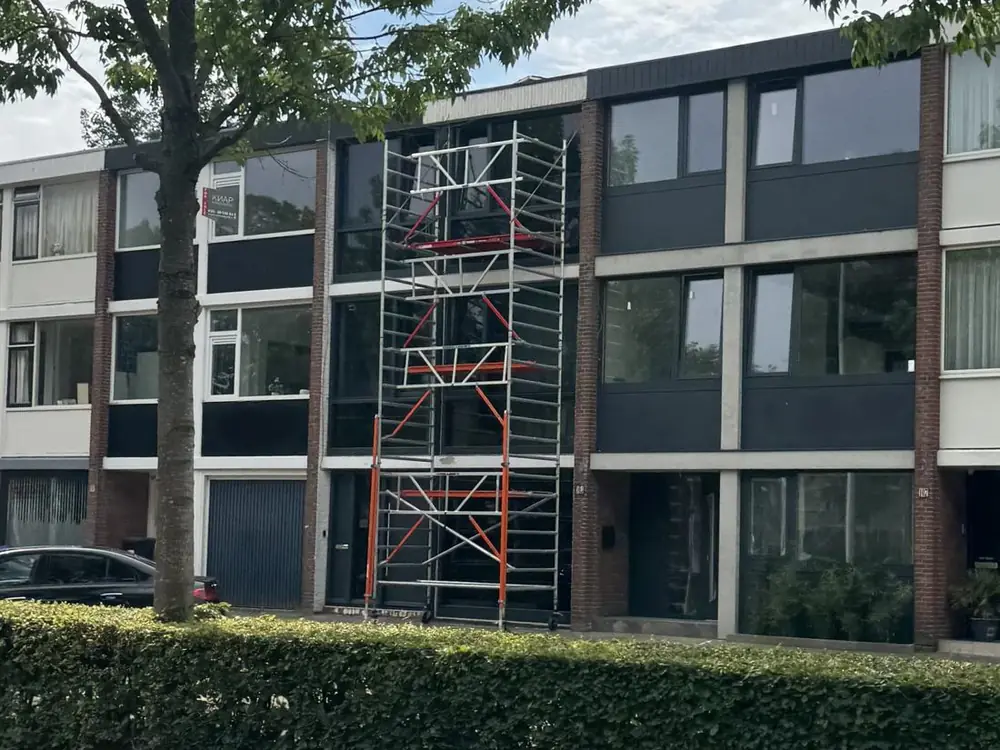
A dormer projects from the sloping roof and therefore starts above the gutter or the eaves. On an ordinary family home that quickly puts you at 6 to 9 metres working height, depending on whether the dormer is on the first floor or the second floor. In a house with a tall storey height or an added top floor it sits higher again.
What matters is that you measure not to the bottom of the frame but to the highest point you still need to reach. On a dormer that is almost always the top of the little roof or the fascia, because that is where the lead, the zinc capping or the board you want to paint or replace sits. Measure to the bottom and you end up standing too low and stretching.
If you are between two sizes, take the taller one. A platform half a metre too high works fine, because you can always stand slightly lower or work from a lower deck level. A platform that is too low tempts you into stretching and standing on the guardrail, which is precisely what the scaffold was meant to prevent in the first place.
Key facts
| Feature | Value |
|---|---|
| Core answer | Calculate the working height to the dormer: platform height + 2 metres |
| Working height | Platform height + 2 metres |
| Available working heights | 4.2 to 14.2 metres |
| Platform width | 75 cm (RS51) or 135 cm (RS52) |
| Delivery | Ordered before 3 pm, delivered next working day |
From roof edge to platform height
The rule is simple: working height is platform height plus 2 metres. Those 2 metres are the reach of an adult working upwards from the deck. So if you want to get to 8 metres, you are looking for a platform height of around 6 metres. The working height page shows which build belongs to each size, and how high a mobile scaffold may go walks through the limits once more.
Measure with a tape from ground level at the exact spot where the scaffold will stand, not from a terrace or a raised area further along the wall. A sloping garden easily costs you half a metre. If the scaffold stands on a sunken path or on a raised patio, that difference counts straight into the height you need to order.
If your tape does not reach far enough, count the storeys instead and add the roof pitch by eye. Then go to the matching page, for instance 8 metres working height, and check whether that build fits your spot in terms of width and ground conditions. A photo taken from the set-up position tells us more than a description, so send one if you are unsure.
RS51 or RS52 for dormer work
For a dormer you are effectively choosing between two mobile scaffolds. The RS51 is the narrow version at 75 cm wide and the RS52 the wide one at 135 cm. Both have a deck length of 245 cm, so lengthwise either of them covers the full width of an average dormer without you having to move the scaffold along or dismantle it halfway.
Choose the RS51 when the route to the set-up spot is tight: a side passage to the back garden, a gate, a strip between two sheds. It also fits into a small yard or onto a narrow pavement more easily. The deck is narrower, so you have less room to set tools beside you and working with two people gets noticeably cramped.
The RS52 is the more comfortable workplace if you can fit it in. At 135 cm wide you can put a paint box, a circular saw and a stack of fascia boards next to you and still pass each other. For fitting or replacing a dormer, where two people hand material up, that is the difference between working comfortably and shuffling things around all day.
| Model | Size | Deck or reach | On a dormer |
|---|---|---|---|
| RS51 | 75 cm wide | deck length 245 cm | narrow side passages and tight set-up spots |
| RS52 | 135 cm wide | deck length 245 cm | generous work surface for two people and material |
| RS44 room scaffold | fits through an internal door from around 70 cm | for indoor work | finishing the inside of the dormer |
| MiTower | one person scaffold | up to 6 metres working height | low dormer on an extension or garage |
Judging the set-up spot before you order
Walk outside and stand where the scaffold will go. Look at the ground first: it has to be level and able to carry the load. Paving, block paving and a well compacted garden path are fine. Loose sand, fresh soil and a border edge are not, and there you put base plates under the castors to spread the weight. A sloping surface is levelled out with the spindles.
Then look at what is in the way. A shed, a water butt, a low branch or a carport determine whether you can stand the scaffold against the wall. With a dormer at the rear, the route to the back is often the bottleneck: does the longest tube fit through the gate, and can you still turn with the assembled base?
Finally, measure the distance to the wall. You want to stand as close to the house as possible so you never have to lean out and the guardrail stays in front of you. An overhanging roof edge, a gutter or a window sill sometimes forces you back a little. That is not a problem as long as you adjust the build height accordingly instead of reaching from the deck.
- Level, load bearing ground where the castors will stand
- Clear access to the set-up spot, including for the longest parts
- Room all around for the stabilisers that splay outwards
- No low cables, branches or canopies above the build
- A clear view of where the gutter, roof edge or overhang projects
- Enough free space to lay the parts down during assembly
Working alongside a sloping roof and an overhang
At a dormer, the roof slopes towards you. That means the gutter or the eaves sit between you and the work. So do not push the scaffold tight against the wall, but set it at the distance where you can reach the dormer cheek with a straight arm without leaning over the guardrail. There is more on that situation in a mobile scaffold at a sloping roof.
If the roof edge projects a long way, it can be smarter to set the deck slightly lower and work upwards from underneath. That keeps the guardrail at chest height while you still reach the fascia. What you never do is put a plank or a crate on the deck to gain height. That puts you above your guardrail and removes the fall protection entirely.
Do not step from the deck onto the roof to reach the ridge or the chimney either. Roof surfaces are slippery, certainly with moss, dew or frost, and getting back onto the scaffold is harder than getting off it. If you genuinely need to be on the roof, that is a different job requiring different provisions than a mobile scaffold, and one to plan in advance.
Stabilisers and ties at greater heights
The higher you build, the more the stabilisers matter. They splay outwards and widen the base of the scaffold so the structure cannot tip. They belong firmly on the ground rather than hanging in the air. On a sloping garden you adjust each stabiliser separately until all of them make contact. The details are set out in stabilising and tying in.
For a dormer on the second floor, tying the scaffold to the wall is often sensible, certainly if it stays up for several days. A scaffold that stands outside all week will catch wind at some point. When strong wind is forecast, either leave it tied in or take it down a few frames, and clear loose items off the deck first.
Our scaffolds are made by Altrex and built to EN 1004 in load class 3. That works out at 200 kg per square metre of deck, ample for two people with tools and a stock of material. Do spread that weight along the length of the deck, and put heavy stacks of fascia boards or panels against the wall side rather than loose at the edge.
Painting, fitting or replacing: what changes
Painting a dormer takes time rather than material. Sanding, filling, priming and two topcoats means several days in the same spot with drying time in between, and sometimes a lost day to rain. A narrow RS51 is usually enough, and because every following hire day costs only 5 percent, those extra days stay cheap. Plan the extra days in from the start rather than extending halfway.
When fitting a dormer or replacing the cheeks, material has to come up with you: panels, fascia boards, insulation, lead and sometimes a complete frame. Then the wide RS52 with its roomier deck is the better choice, not least because you usually work with two people who need to pass each other on the deck without shifting everything first. Expect a good deal more climbing up and down with material on that kind of job.
If you only work on the inside of the dormer, on the panelling or the plaster for instance, you do not need to go outside at all. That is what the RS44 room scaffold is for: it fits through a standard internal door from around 70 cm, so you wheel it from room to room without dismantling. See also the general page on dormer work.
Assembling it yourself: sequence and pitfalls
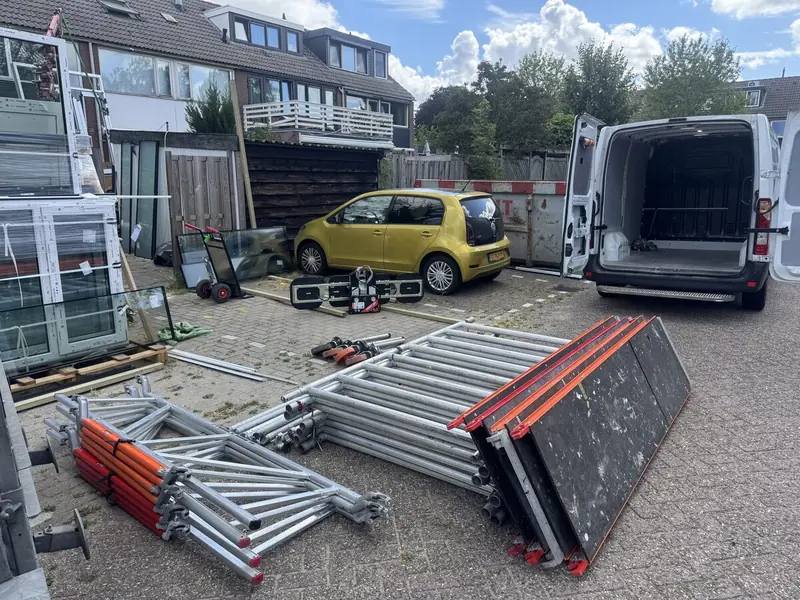
We do not assemble the scaffold and we do not deliver it ready built. You build it yourself, using the manual and the instruction video supplied on delivery. That sounds more daunting than it is: the parts fit together in one way only and the sequence is fixed. Allow a comfortable hour for a low build and more as you go higher.
The biggest pitfalls sit at the start. A base that is not level takes its revenge higher up with a scaffold that runs out of true and decks that will not seat properly. Castors that are not all braked let the whole thing drift while you are building. And diagonal braces skipped because it already feels solid are precisely the parts that keep the structure square.
Build it with two people if you can: one handing up the parts and one fitting at the top. That saves time and, above all, saves climbing up and down with loose components. The full assembly step plan runs through the stages in the right order. Before you start working, check once more that every guardrail, toe board and hatch is in place.
How many days to hire it for
Dormer work almost always takes longer than expected, especially painting with drying times and weather that turns against you. With us the first hire day is charged at the full rate and every following day costs 5 percent of that day rate. A week is therefore barely more expensive than three days, and you never have to rush or work through the rain.
Count the assembly and dismantling days as well. The day the scaffold arrives is rarely a full working day, because you have to unload and build first. On the last day part of your time goes into taking it down and stacking the parts for the driver. Have it delivered late on a Friday and collected late on a Monday and you have the whole weekend to work steadily.
What it costs for your height and model is calculated in the configurator, where you enter the model, the working height and the number of days. The structure of the rate is explained on the cost of hiring a mobile scaffold, and the comparison between loose days and a full week is in hiring per day or per week. Enter the delivery day and the collection day as well, so you see the full picture for your job.
Delivery, collecting it yourself and the deposit
Order before 15:00 and we deliver the next working day, anywhere in the Netherlands. Delivery and collection together sit in one fixed amount per province, regardless of how many days the scaffold stays on site. That amount is shown on the delivery costs page. Make sure somebody is home and that there is a dry, clear spot to put the parts down.
If you would rather drive yourself, collection is free of charge by appointment at Zeeburgerpad 89 in Amsterdam. Bear in mind that the frames and decks are long, so an ordinary car is usually too small and you will want help loading. For most dormer jobs delivery is simply the more practical route, certainly on the taller builds. Ask for the parts list before you arrange a van, so you know what you are loading.
Deposits are fixed amounts. On delivery that is 500 euro for the RS51, the RS52 and the MiTower and 150 euro for the room scaffold. If you collect yourself it is 1000 euro for the RS51 and RS52, 750 euro for the MiTower and 150 euro for the room scaffold. After return the deposit is back within 1 working day, as explained at deposit for scaffold hire.
Still unsure about the size, let us look with you
Most mistakes are not about the model but about the height and the set-up position. A photo of the facade with the dormer in it, taken from the spot where the scaffold will stand, tells us more than a long description. Send one via WhatsApp and we will look at which size and which model belong with your situation. A second photo of the route to the back is just as useful.
If the job covers more than the dormer alone, the gutter, the fascia boards or paintwork along the whole facade for example, mention that too. Then we can check whether one build covers both jobs or whether you are better off one size taller and moving the scaffold once. For the gutter specifically, the explanation is in which scaffold for the gutter.
- The height of the top of the dormer, measured from the set-up spot
- The width of the narrowest point on the route to the back
- The type of ground the scaffold will stand on
- Whether you work alone or with a second person
- How many days you expect to need, drying times included
Frequently asked questions
What working height do I need for a dormer?
In practice you usually end up at 6 to 9 metres working height. Measure from the ground to the top of the dormer and subtract 2 metres to find the platform height. If you fall between two sizes, take the taller one. Standing too low leads to stretching, which is exactly what you want to avoid.
Can I paint a dormer from a ladder?
You can, but it works badly and it is unsafe. On a ladder you have one hand free, nowhere to put tools and you keep repositioning. A mobile scaffold gives you a 245 cm deck where material can sit and where you can stay for hours. For paintwork in several coats that easily saves half a day.
Will a mobile scaffold fit through my side passage?
With the narrow RS51 at 75 cm wide it usually will. Measure the narrowest point of the route, including a gate or a projecting meter cupboard. Remember that the loose parts are carried through and only assembled at the back. If you are unsure, send a photo of the passage.
Do I need stabilisers for dormer work?
Yes, the heights involved in dormer work call for a scaffold with stabilisers. They widen the base and keep the structure stable. Set them so that every one genuinely contacts the ground and adjust them on sloping surfaces. Allow some extra space all around the scaffold.
How much weight may stand on the deck?
Our Altrex scaffolds are built in load class 3 to EN 1004, meaning 200 kg per square metre. That is enough for two people with tools and material. Spread the weight across the deck rather than putting everything in one place. Never rest anything on the guardrail.
Do you assemble the scaffold at my address?
No, assembly is done by you. We deliver the complete package and supply a manual and an instruction video so you can follow the sequence. With two people it goes noticeably faster. It also means you decide when the scaffold stands and how high you build it.
How quickly can the scaffold be delivered?
Order before 15:00 and we deliver the next working day, anywhere in the Netherlands. Delivery and collection sit in one fixed amount per province. Collecting it yourself is free of charge by appointment in Amsterdam. Ideally plan the delivery day one day before you actually want to start.