
Knowledge base · reading time 11 min
Which scaffold for installing solar panels?
Laying solar panels means hours spent at the roof edge, with panels, rails and tools that all have to go up. A mobile scaffold gives you a stable floor for that, with guardrails and room to set things down. The only question is which height and which width you need, and that starts with a measurement from the ground.
- Which scaffold for solar panels? Work out the height to the roof edge, choose between RS51 and RS52 and see what matters when setting up and moving.
- Enough to reach the bottom row of panels at hip height.
- Only if the scaffold stands stable and level with the castors locked.
- For a single installer with limited material, yes.
Measure from the ground to the roof edge
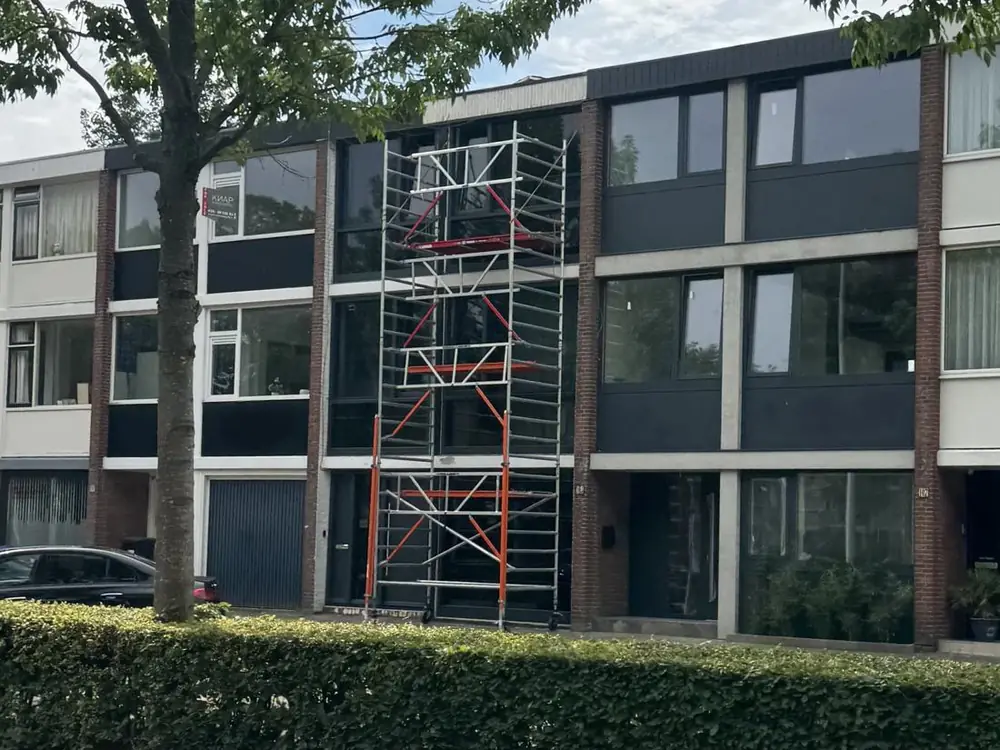
Start with the one measurement that truly matters: the distance from the ground to the roof edge along which the panels will run. Measure from the spot where the scaffold will actually stand, so not from the patio if the scaffold ends up in the border. A thirty centimetre difference in ground level carries straight through into the height you end up needing.
Measure at the point where you have to reach highest, too. On a pitched roof you often lay the bottom row of panels from the scaffold and climb onto the roof for the rest, while on a flat roof you want your hips above the roof edge. That easily accounts for half a metre in the size you choose. Write down both measurements, so you can see straight away which one governs.
Note what sits in the way along the route as well: an extension, a conservatory, a roof overhang or a satellite dish. Those do not set the height, but they decide whether the scaffold fits where you want it. On the working height page you then pick the size that matches your measurement. Sketch those obstacles onto a quick drawing of the facade, and you know in advance where the scaffold goes.
Key facts
| Feature | Value |
|---|---|
| Core answer | Safe access to the roof edge: pick a working height just above the gutter |
| Working height | Platform height + 2 metres |
| Available working heights | 4.2 to 14.2 metres |
| Load class | Class 3: 200 kg per m² |
| Delivery | Ordered before 3 pm, delivered next working day |
Working height is platform height plus two metres
Working height and platform height get mixed up constantly, and on roof work that is a costly confusion. Working height is platform height plus two metres, the reach of an adult. Stand on a platform at four metres and the working height is six. Order on working height when you meant platform height and you end up standing two metres too low.
For solar panels, incidentally, that two metres of reach is less useful than on paintwork. You do not want to hold a panel above your head, you want to slide it over the roof edge at hip height. So take the size at which the platform lands just below the roof edge, rather than the one where you can theoretically reach.
The range covers working heights from 4.2 to 14.2 metres, so almost any house can be served. For a terraced house or a flat on a higher storey, work back per floor in how high a scaffold for which floor or via the first floor page. A garage or an extension with a lower roof is covered the same way, without having to improvise a different arrangement.
Narrow RS51 or wide RS52 along the facade
The RS51 is 75 centimetres wide, the RS52 is 135 centimetres wide, and both have platforms of 245 centimetres. For a solar job that width is decisive, because panels, rails, clamps and tools all end up on the platform for a while. On the RS52 there is room for that without stepping over your own gear. Platform length is the same on both, so you gain width only, not another metre along the facade.
You choose the RS51 when the route to the back garden is narrow, a gate or a side path between two houses for instance. You give up working room, but you get the scaffold to the right spot. What fits on each platform is set out in mobile scaffold dimensions and sizes. An RS51 standing in the right place always beats an RS52 stuck in the gate, however roomy the latter is.
Working with two people, which is nearly always sensible with panels, the RS52 wins again. Two people side by side on 75 centimetres is uncomfortable once a panel is lying between you. What both models involve is set out at mobile scaffold hire. Agree in advance who stands where, because on a narrow platform two people get in each other's way all day if you do not.
Getting panels and material up safely
Panels are not extremely heavy, but they are awkwardly large and catch the wind. From a ladder that is not workable: you have no hand free and no way to correct a panel that starts to sail. From a platform with guardrails you stand stable, grip with both hands and have someone beside you steering the other end. A second person on the platform is no luxury on panel work.
Work in fixed rounds: take all the rails and clamps up first and lay them on the platform, then the panels one by one. That way you avoid climbing down halfway for a forgotten part and the platform stays readable. Do not lean anything against a guardrail where it can slide past. Keep the route to the ladder or the hatch clear at all times, even when one more rail looks like it will fit.
What such a day looks like otherwise, and what else deserves attention, is set out on the application pages installing solar panels and mounting solar panels. Those pages also cover the preparation each job needs and which work you can take on in the same hire period, such as the cabling to the inverter or checking the tiles around the mounting hooks.
What may stand on the platform
The equipment is Altrex and complies with EN 1004 in load class 3, which comes down to 200 kilos per square metre. That is enough for two people with panels and tools, but it is not a licence to bring the whole pallet up. Spread the weight across the platform instead of stacking everything in one corner. Two people with tools is the normal occupancy.
In practice that means bringing up what you will lay in the next half hour. A platform full of material is not only heavier, it also shrinks your walking room, and that room is exactly what you need to move safely along the roof edge. That counts double on a pitched roof, where you often work with your back to the guardrail and have no time to step over a stack of rails.
What the load class covers and how to apply it on site is explained in mobile scaffold load and weight. The background to the standard itself is in EN 1004 explained. Use those two pages as well to judge in advance whether material goes up in batches or in one big load, because that decides how often you walk up and down.
The models side by side for this job
The table shows where each model earns its place on a solar job. In practice the choice is nearly always between the RS51 and the RS52, but the other two come in handy for the work that goes with it. So look not only at the width but also at the route to the spot where the scaffold will stand, since those two together decide what realistically remains.
If the inverter sits in the loft or in the meter cupboard, a room scaffold is handier for that part than a mobile scaffold that will not fit through the door. For a shed roof or a garage a MiTower is often enough. If you are working indoors and outdoors, hire the two in the same period so you only plan one delivery day.
| Model | Dimensions | Where it fits a solar job |
|---|---|---|
| RS51 mobile scaffold | 75 cm wide, platform 245 cm | Side paths, gates and narrow gardens |
| RS52 mobile scaffold | 135 cm wide, platform 245 cm | Panels and tools on the platform |
| RS44 room scaffold | Fits an interior door from about 70 cm | Inverter and cabling indoors |
| MiTower | One person, up to 6 metres working height | Shed roof, garage or outbuilding |
Setting up on grass, gravel and paving
Solar panels rarely sit above a neat patio. More often you are standing in a border, on gravel, or on slabs pushed up by tree roots. The scaffold has to stand level and every castor has to carry, otherwise you are building a leaning structure at a height where you will spend hours. Look at what lies under the scaffold, too: a drain, an inspection hatch or a freshly laid slab is not a load-bearing base for a castor.
On soft ground use base pads to stop a castor sinking in during the day. On a slope you adjust with the spindles. Never roll on with a scaffold that visibly drops on one side. Do not stow the spindles away afterwards, because you need them again at every new position. If a castor does sink in, take the scaffold down below that level rather than propping it up with a piece of board.
Every awkward-ground situation is gathered in a mobile scaffold on uneven ground, including what to do with a sunken path or a sloping drive. Read that through before you roll for the first time, because ground that was dry on the first morning can behave very differently after a night of rain. That saves trouble halfway through the day.
Moving along the roof edge during installation
A row of panels is rarely laid from one fixed position. You shift along the facade bit by bit, and that is exactly the moment things go wrong if you get sloppy. Clear the platform before you move, let nobody stand on the scaffold while it rolls, and lock the castors again afterwards. Move it with two people where you can, one pushing and one checking that nothing is left behind or snagging.
At each new position, check that the stabilisers are set correctly and that you are still level. On a garden path with a slight fall that changes every metre. It costs a minute or two each time, a fraction of what clearing up a toppled scaffold would cost you. Do that check out loud, then nobody skips it by accident.
How to handle stabilisers and anchoring on taller set-ups is covered in stabilising and anchoring a mobile scaffold. With a roof edge that overhangs a long way, plan your positions in advance so you are not constantly correcting. Walk the facade beforehand and work out how many metres apart your positions need to be, so you know exactly how often you will move and can lay the panels out in the right order.
- Take tools, rails and panels off the platform
- Let nobody stand on the scaffold while it rolls
- Push low on the frame, never high on the guardrail
- Lock the castors again straight afterwards
- Reset the stabilisers for the new position
- Check with a level that the scaffold still stands square
What to have ready on installation day
Assembly goes faster when the ground is ready before the scaffold arrives. You build the scaffold yourself, using the supplied manual and an instruction video, so you do not want to be dragging garden furniture around halfway through. Allow half an hour for clearing the strip along the facade, and rather longer if a fence or a hedge is in the way.
Run through the points below the day before. A full preparation for the hire itself is in the mobile scaffold hire checklist, and what you need in terms of protection at height is covered in fall protection on a mobile scaffold. Between them those two pages cover both the hire and the work at height, so you do not discover midway through the day that something is missing.
- Clear the strip along the facade of plants, furniture and bikes
- Have base pads ready for grass, gravel or loose slabs
- Arrange a flat spot to store the panels at ground level
- Agree who lifts and who stays up on the platform
- Check the forecast for wind, because panels catch a lot of it
- Set out power and an extension lead at the point where you will work
Ordering, delivery and returning the set
Order before 15:00 and the scaffold is ready the next working day, anywhere in the Netherlands. Delivery and collection together sit in a fixed amount per province, listed on the delivery cost page. Collecting it yourself is free by appointment at Zeeburgerpad 89 in Amsterdam. Make sure someone is present during the agreed window, otherwise the job slips a day after all.
The first hire day carries the full rate and every following day costs five percent of that, so a job that runs into the weekend need not be a problem. The deposit is 500 euro on delivery for an RS51, RS52 or MiTower and 150 euro for the room scaffold; collect yourself and it is 1000 euro for the RS51 and RS52 and 750 euro for the MiTower. Details are on the deposit page.
If the size has you doubting, send a photo of the facade with your measurement via WhatsApp. With the distance to the roof edge and the number of panels, a suitable model is usually named within a few messages. Mention what the scaffold will stand on as well, because that decides whether you need base pads. A short description of the job usually settles it.
If you come back later for maintenance, you use the same size. For cleaning solar panels, maintaining solar panels and fitting optimisers you stand in exactly the same place, only without lifting panels. So note which model and which height you choose now, and next time you order in two minutes. Keep that note with the installation paperwork so you can find it again.
Frequently asked questions
How much working height do I need for panels on a pitched roof?
Enough to reach the bottom row of panels at hip height. Measure from where the scaffold will stand to the roof edge and add what you need to work comfortably. If in doubt, take the next size up.
May I step onto the roof from the mobile scaffold?
Only if the scaffold stands stable and level with the castors locked. Stepping across is where most accidents happen, so never do it with a panel in your hands. Have someone watching as you transfer.
Is an RS51 wide enough for panel mounting?
For a single installer with limited material, yes. Working with two people or setting panels down temporarily, the 135 centimetres of the RS52 is considerably more comfortable. Choose the RS51 when the passage into the garden is the limiting factor.
Can I store the panels on the platform during the job?
Briefly and spread out, yes; permanently, no. The load class of 200 kilos per square metre covers people and material together, and a full platform shrinks your walking room. Bring up what you will lay in the next half hour.
What do I do if the wind picks up during installation?
Stop lifting and lay loose panels flat or take them down. A panel catches a lot of wind and pulls you off balance before you notice. Check the stabilisers again before carrying on.
Do you assemble the scaffold in my garden?
No, you assemble it yourself. The set comes with a manual and an instruction video so you can follow the sequence step by step. Steigertaxi never delivers assembled.
How many days do people usually hire for a solar job?
That depends on the number of panels and the number of installers. Allow for assembly and dismantling time in your planning. If it overruns, every day after the first costs only five percent of the day rate.