
Knowledge base · reading time 12 min
Mobile scaffold: load and weight
Two questions come up most often when weight is the subject. How much may go on the deck, and how heavy is the scaffold itself once you have to carry and assemble it? The first is about safety while you work, the second about the practical side of lifting, transporting and moving. Both sides are worked out below, with the load class of our equipment and how you apply it on an actual job.
- How much weight can a mobile scaffold take and what does it weigh itself? Load class 3, spreading weight, ground conditions and lifting during assembly.
- Load class 3 to EN 1004 stands for 200 kg per square metre of deck.
- Yes, as long as you stay within the permitted load and spread the weight.
- On the lower builds you can, because the parts are aluminium and each one is manageable.
What load class 3 means in practice
Our equipment is made by Altrex and built to EN 1004 in load class 3. That class stands for 200 kg per square metre of deck. So it is not a single total for the whole scaffold, but a load per unit of area. The larger the deck, the more total weight it may carry. What else that standard covers is explained in EN 1004 explained.
Those 200 kg per square metre stay abstract until you fill them in. Two adults standing side by side take up a good part of the deck between them, and whatever they carry counts as well. Tools, a bucket of paint, a box of screws and a stack of material come on top of that. The manual states what is permitted per deck, and that is the figure that governs.
Where people go wrong is assuming that a scaffold which feels solid is therefore unlimited in strength. Aluminium is stiff and flexes very little, so you will not feel an overload coming the way you would on a timber board. Go by the load class and by the distribution instead of by feel. More on the upper limit is in how high a mobile scaffold may go.
Key facts
| Feature | Value |
|---|---|
| Core answer | Class 3 means 200 kg per m² of platform, people and material combined |
| Load class | Class 3: 200 kg per m² |
| Standard | EN 1004 |
| Platform width | 75 cm (RS51) or 135 cm (RS52) |
| Platform length | 245 cm |
Estimating your own load before you climb
Before you start, it helps to count out loud what is going up with you. Not with scales, but with common sense: people, tools, material and waste. On paintwork that stays modest, on facade repairs or window replacement it adds up quickly. Certainly once you also stack old sections on the deck halfway through the day to bring down later.
Think about the things you do not register as weight. A bucket of water, a box of tiles, a bag of mortar and a cordless drill with two batteries all count. On indoor work a stool or a small sawing table sometimes joins them. That is fine, as long as it stays within the permitted load and does not sit in the way of the hatch.
What you mostly want to avoid is material sitting on the deck that you will not use that day. It takes up walking room, adds to the load, and it is exactly what slides over the edge when you squeeze past it. Take up only what you need that day and leave the rest on the ground. At the end of the day take down whatever you will not need tomorrow, so you start clean.
- The people standing on the deck at the same time
- Tools, batteries and a tool chest
- Paint, sealant, mortar, water and other wet materials
- Building material such as panels, fascia boards, insulation or lead
- Waste and old sections still waiting to go down
- Loose extras such as a stool, a small sawing table or a tray of tools
Spreading weight instead of stacking it
The main rule is not how much, but where. A load spread neatly along the length of the deck behaves very differently from the same kilos in one spot. Our deck is 245 cm long, so there is room enough to set things apart. Put heavy stacks against the wall side, where you do not walk, and keep the route across the deck clear.
Rest nothing on the guardrail and hang no buckets from the rail tube. The guardrail is there to stop you, not to carry a load. The same goes for the toe boards: they stop tools rolling over the edge, but they are not a shelf. Balance things on them and sooner or later something drops. Balance things on them and sooner or later something drops, with damage or worse below.
If you handle heavy or long sections, fascia boards or a window frame for instance, lay them flat in the middle of the deck rather than upright against the guardrail. Upright sections catch wind and topple. There is more on that in mobile scaffold dimensions and sizes, which sets out the deck space you have to work with. Never leave them loose across the hatch either, because then you cannot get past on the way down.
How many people can be on the deck at once
On the wide RS52 at 135 cm, two people work comfortably side by side with material next to them. On the narrow RS51 at 75 cm it is possible too, but you end up standing one behind the other and you have to agree who stands where. In both cases, the people plus their gear together must stay within the permitted load.
The MiTower is explicitly a one person scaffold. It is meant for work up to 6 metres working height that you do alone, fitting a light, painting a ceiling or mounting a smoke alarm. Two people on a MiTower is not the idea, however tempting it is when somebody needs to hand something up. Look at the MiTower if you mostly work solo.
In practice it often works better to have two people with one staying on the ground. That person hands things up, keeps an overview and keeps the area clear. It saves load on the deck and, above all, it saves climbing up and down. Working from a mobile scaffold is far calmer with a second pair of hands below. It is also easier when long sections have to be passed up and when waste has to come down.
What a mobile scaffold weighs itself
The weight of the scaffold itself depends on the model and on the height you build it to. A build to 4 metres working height consists of far fewer parts than a build to 12 metres, and you feel that difference in every frame you pick up. On the working height page you can see what the build looks like per size.
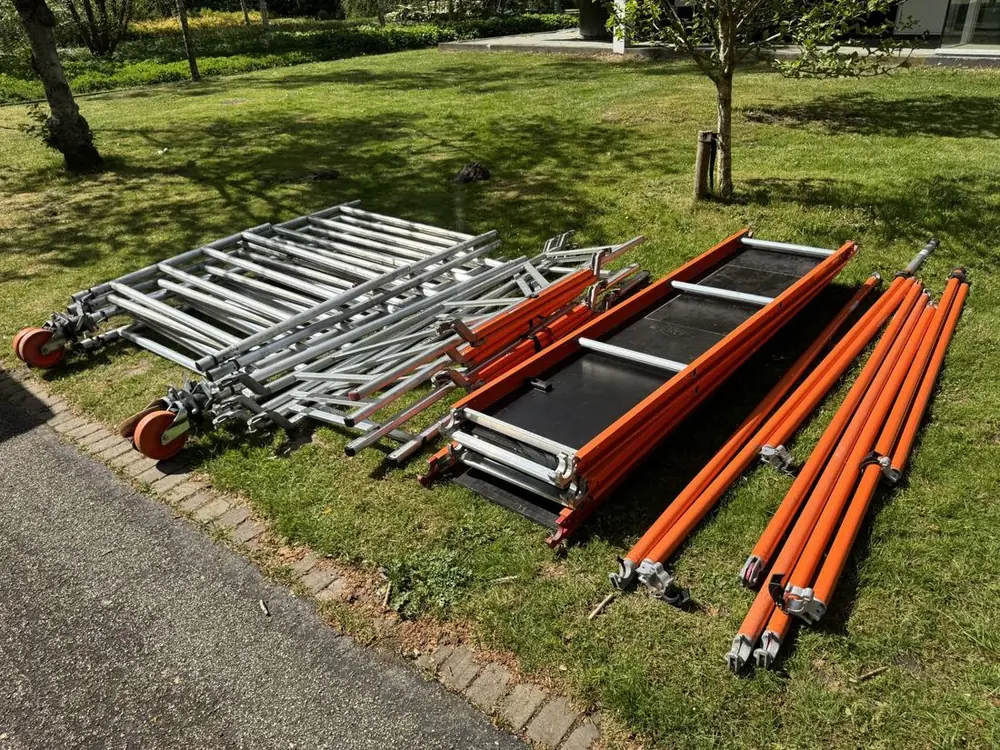
More important than the total weight is that you never lift the whole scaffold at once. You work with separate parts: frames, diagonal braces, decks, guardrails, toe boards and stabilisers. Every part is made so that one adult can pick it up and hand it on. That is precisely why these scaffolds are aluminium rather than steel. So do not go looking for a total weight, look at the number of parts you have to carry.
If you want to know why that material choice matters so much for carrying and transporting, read aluminium or steel scaffold. In short: aluminium is light enough to carry on your own and strong enough for the load class the equipment is built to. In practice that means two people can have a complete build standing in a morning, without a crane or a hoist, and can take it down and stack it again just as easily after the job.
Lifting and carrying during assembly
We do not assemble the scaffold for you and we do not deliver it ready built. You receive the complete package, with a manual and an instruction video, and build it yourself. That means every part passes through your hands once: from the pavement or the trailer to the set-up spot, and then upwards to where it belongs. Plan that carrying time into your day rather than treating it as a five minute job.
Do that with two people if you can. One below handing up and one above fitting is the quickest and the calmest way to work. On your own it is possible too, but you climb up and down far more often and you lift parts above your head. On the taller builds that is the reason to ask somebody along.
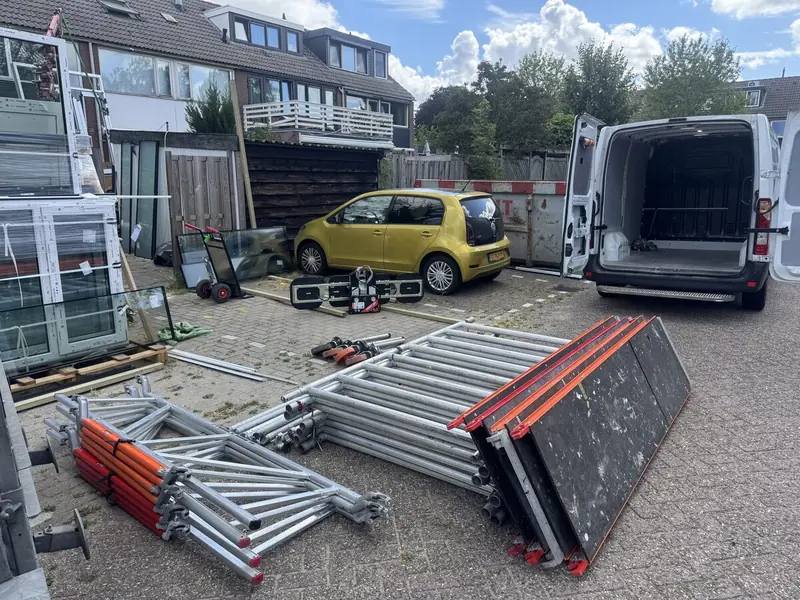
Lay the parts out sorted on a dry, level spot beside the set-up position when they arrive. Frames together, braces together, decks flat. That saves searching during assembly and stops you stepping between things with an armful of tubes. The full assembly step plan takes you through the order. Keep the route from the stack to the scaffold clear of tools and packaging as well.
The ground carries everything together
The weight of the scaffold, the people and the material all ends up on four castors. That is a small area, so the pressure per castor is high. On paving, block paving and concrete that is no problem. On grass, sand, fresh soil or a newly laid garden path it is, because a castor sinks in as soon as load comes onto it.
In those cases you place base plates under the castors. They spread the pressure over a larger area so the scaffold stays where you put it. How to go about that is covered in a mobile scaffold on uneven ground, along with what to do when the surface slopes away from the building. Lay them flat and fully under the castor so the wheel does not overhang an edge and sink anyway. Check them again halfway through the day, because a base plate slowly presses itself into soft ground.
Also consider what sits beneath the surface. A basement roof, a garage floor, a roof terrace or a timber floor indoors each have a load capacity you cannot see. If in doubt, position the scaffold above a load bearing wall or a beam rather than in the middle of a span, and otherwise ask whoever knows the building. That check costs five minutes and prevents damage you cannot undo afterwards.
- Paving, block paving and concrete: base plates usually not needed
- Grass, sand and loose soil: always use base plates
- Sloping ground: level it out with the spindles
- Indoor floors: check the floor can take the point load of the castors
- Roof terrace or basement roof: find out first what the structure carries
The models and their dimensions side by side
The table below sets the models next to each other on the points that concern load and size. The dimensions are those of our own equipment, so what you actually receive on delivery. For the full set of dimensions per model you can read on in mobile scaffold dimensions and sizes. That way you know the model in advance instead of on delivery day.
When you choose, look not only at the deck width but also at the route to the spot. A wide deck you cannot get into the back garden helps nobody. And a narrow deck that has to carry two people plus a stack of material fills up faster than you expect. So look at the narrowest point on the route first, and only then at comfort on the deck.
| Model | Defining dimension | Load class | What you use it for |
|---|---|---|---|
| RS51 | 75 cm wide, deck length 245 cm | class 3 to EN 1004 | narrow passages and tight set-up spots |
| RS52 | 135 cm wide, deck length 245 cm | class 3 to EN 1004 | generous work surface for two people with material |
| RS44 room scaffold | fits through an internal door from around 70 cm | class 3 to EN 1004 | indoor work in homes and stairwells |
| MiTower | one person scaffold up to 6 metres working height | class 3 to EN 1004 | one person with light tools |
What goes wrong with too much or badly placed weight
Overloading rarely ends in a dramatic collapse of the deck. What you see in practice is different: a scaffold that goes out of plumb because the weight sits on one side, a deck that no longer seats properly in its rebates, or a hatch that jams. Those are the signals to take seriously. As soon as you see any of them, take weight off the deck before you carry on working.
The second risk is tipping. A mobile scaffold stays upright because the base is wide enough and the stabilisers widen that base further. Put all the weight on one side and you shift the centre of gravity that way. Combined with wind or with somebody leaning over the guardrail, that becomes noticeable. See also stabilising and tying in. So distribute the weight deliberately along the deck.
The third risk is the simplest: things falling. A bucket standing on the edge, a drill on the toe board, a board leaning against the guardrail. Keep the ground below clear and never work underneath somebody who is busy above. Fall protection on a mobile scaffold explains what guardrails and toe boards are actually for. Put tools you are not using into a tray rather than leaving them loose on the deck.
Getting material up and down
Climbing with a full bucket in one hand is the most common way to make something go wrong. You climb up on the inside through the hatch, and that works best with two free hands. So have material handed up or hoist it rather than carrying it up with you. Never climb up the outside to get there faster either, because there is no guardrail on that side.
For small items a bucket on a rope works fine. For long sections such as fascia boards or panels it is easier to pass them up between two people from a lower deck level. Take your time over it and make sure the person above is standing firmly before anything is handed over. Agree who lets go and who holds on, so two people are never doing different things at once.
Waste goes down the same way, not over the edge. Old sections, packaging and pieces of masonry get lowered or handed down. That saves damage to the garden and it keeps the zone around the scaffold safe for anybody walking past. Bear in mind too that sharp sections can damage a bucket or a sheet on the way down, so wrap them first.
Transport, delivery and the deposit
Because the parts come separately, you can in principle transport a scaffold yourself. The frames and decks are long though, so an ordinary car is usually too small. What that involves in practice is set out in hiring a mobile scaffold without a trailer. Collecting it yourself is free of charge by appointment at Zeeburgerpad 89 in Amsterdam. If you collect yourself, count on help with loading and on space to unload again at home.
The simplest route is delivery. Order before 15:00 and we deliver the next working day, anywhere in the Netherlands. Delivery and collection together sit in one fixed amount per province, which you will find on the delivery costs page. You then load nothing yourself and the parts arrive complete. Do make sure somebody is present and that there is a clear spot to put the parts down.
Deposits are fixed amounts. On delivery that is 500 euro for the RS51, the RS52 and the MiTower and 150 euro for the room scaffold. If you collect yourself it is 1000 euro for the RS51 and RS52, 750 euro for the MiTower and 150 euro for the room scaffold. After return the deposit is back within 1 working day, as described at deposit for scaffold hire.
Frequently asked questions
What exactly does load class 3 mean?
Load class 3 to EN 1004 stands for 200 kg per square metre of deck. So it is a load per unit of area, not one total figure for the scaffold. The larger the deck, the more it may carry in total. The manual for the model states what is permitted per deck.
May I leave tools and material on the deck?
Yes, as long as you stay within the permitted load and spread the weight. Put heavy items against the wall side and keep the walking route clear. Leave nothing resting on the guardrail or on the toe board. At the end of the day, take down whatever you will not need tomorrow.
Can I assemble a mobile scaffold on my own?
On the lower builds you can, because the parts are aluminium and each one is manageable. With two people it goes considerably faster and saves a lot of climbing. For the taller builds we always advise working in pairs. The manual and the instruction video take you through the sequence.
Will a mobile scaffold sink into a lawn?
Without base plates it will. The weight ends up on four castors, so the pressure per castor is high. On grass, sand or loose soil you put base plates under the castors to spread that pressure. Check again during the job that everything has stayed level.
Is aluminium strong enough for professional work?
Yes. Our equipment is made by Altrex and built to EN 1004 in load class 3. Aluminium was chosen because it is light enough to carry and move yourself while handling the load of that class. That combines working at height with the ability to assemble everything on your own.
How much does a complete scaffold package weigh?
That depends on the model and the build height, because a taller build consists of more parts. You never lift the scaffold as a whole: you always work with separate frames, decks and braces. Ask us what a specific build contains if you plan to collect it yourself.
Can material stay on the deck while I move the scaffold?
No. Moving is always done with an empty deck and nobody on board. Take tools and material off, release the brakes, roll the scaffold along a level route and set the brakes again afterwards. Then check once more that the scaffold is standing level.