
See your price
Application

Repairing pointing? Choose the right scaffold.

Repairing pointing rarely starts at the grinder. It starts with the question of where the water is actually getting in, because a damp patch on an inside wall almost never sits directly behind the joint that failed. You trace the source first, then rake back to sound mortar, draw the grit out and fill the run again. That is slow work carried out close against the brick. On a two storey house it means hiring the narrow 75 cm RS51, built to give 6 to 8 metres of working height.

  • Order before 3 pm, delivered tomorrow
  • Professional Altrex scaffolds
  • Up to 14.2 metres working height
  • Easy to assemble yourself
4,2 tot 14,2 mWorking heights available
12Provinces served
7Days a week
200 kg/m²Load class 3
In short
  • For repairing pointing we recommend the Narrow mobile scaffold.
  • Repairing pointing on two storeys calls for the RS51 you book online, narrow enough to clear a gate and pass a bay window.
  • The grinder, the suction nozzle and a small tub of mortar go up with you, while the vacuum cleaner itself stays beside the foot.
  • Two to four hire days is the usual span, because tracing, raking out, filling and drying a test patch never fit inside one.
  • First 24 hours from €150 incl. VAT and delivery; every day after that 95% off.
Key facts for this job
FeatureValue
Recommended scaffoldNarrow mobile scaffold (Altrex RS TOWER 51)
Working height for this job6 to 8 metres
Available working heights4.2 to 14.2 metres
StandardEN 1004, load class 3 (200 kg per m²)
DeliveryOrdered before 3 pm, delivered next working day
Each extra day95% off, from €7.50 a day
Why a mobile scaffold for repairing pointing?

Safe, stable and professional work at height

A pointing repair lands on exactly the few square metres where things have gone wrong, and those are hardly ever at eye level. You need both hands up there: the grinder in one, the suction nozzle in the other, and a moment later the iron that presses the fresh mortar home. On a ladder that is simply not possible, because no hand is left to steady yourself with and you cannot edge sideways along the course you have just opened. Hiring a scaffold for repairing pointing buys you a firm deck with all of that kit lying beside your boots. How many positions you need follows from the count of damaged patches, never from the length of the elevation.

  • Grinder and suction nozzle held at the same moment
  • A steady deck right beside the leaking patch
  • Repairing pointing starts by locating the leak
  • Space for grit, a mortar tub and a bucket
Read more about working safely →

Which mobile scaffold to hire for repairing pointing on a house

For local repair work on the joints of a two storey house the model to hire is the Altrex RS51, the version that measures only 75 cm across the base. A generous deck is not the point here. What you want is a frame you can park on one precise spot, and that spot turns out more often than people expect to be the corner behind the shed, the strip between two dwellings or the passage running past the garage. The range of mobile scaffolds kept for hire lists what is in stock.

Everything that travels up with you sits happily on a slim platform: a grinder wearing a thin raking disc, the suction nozzle and its hose, a small tub of made up mortar and the iron you finish with. The vacuum cleaner itself stays down at the foot, because a machine that size is not something you carry up a ladder. Platform length of 245 cm counts for more here, since it settles how many courses of joints you can open, clean out and close again inside one day.
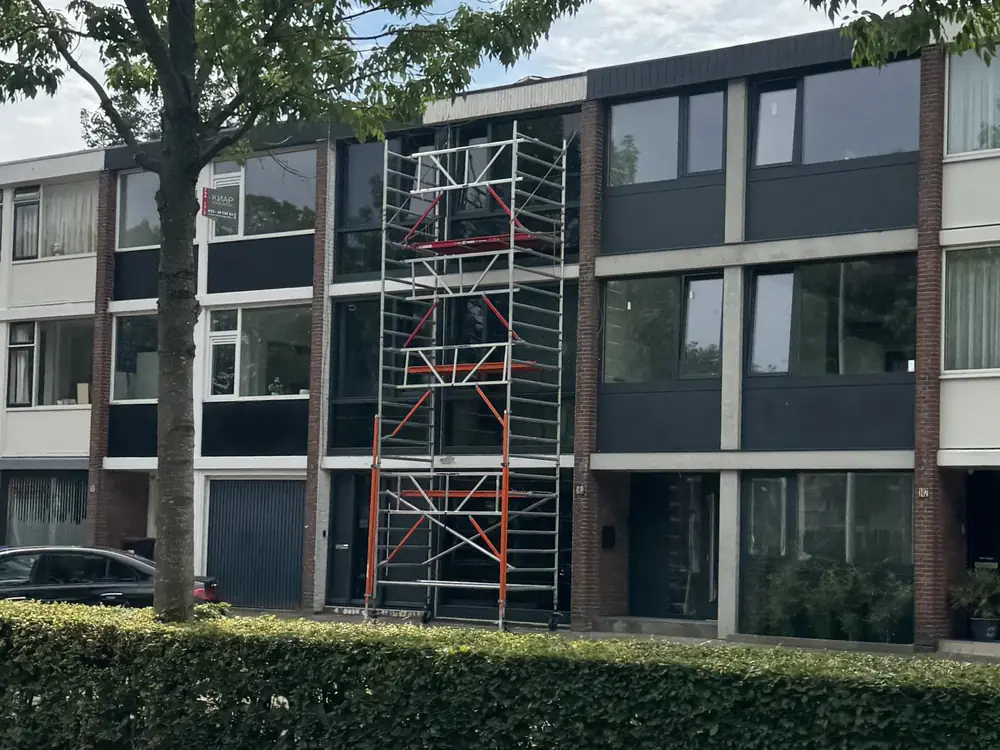
Slim mobile scaffold standing tight against a three storey building, the sort of narrow build a joint repair asks for

The wide RS52 makes sense only where two people work the same run together, one raking out while a second comes behind with the mortar, or where a full bucket of mix plus a heap of tools has to travel up. On repairing pointing across a few square metres that extra width mainly costs you time carrying parts through the garden. Weigh that against how often you would actually be working in pairs. Both widths sit side by side in the table of mobile scaffold dimensions.
Hiring the working height above the suspect joints

Your top limit here is set not by the damp patch but by the highest joint under suspicion. Water that tracks through an open joint runs down behind the brick and shows up half a metre lower, sometimes a whole storey further down. So keep looking above the stain, right up to the junction with the window head or the soldier course sitting over it, and take your reach from there. Across two storeys that quickly brings you out at 6 to 8 metres.

You then translate that figure into the build you reserve. It puts your platform somewhere around four to six metres, since on top of the deck you count roughly another 2 metres of arm reach before your hands run out. Measure up from the ground the castors will end up standing on, not from the threshold of your back door. A sunken terrace or a garden falling away from the house can easily swallow half a metre of build, and on the topmost course of joints you feel that straight away.

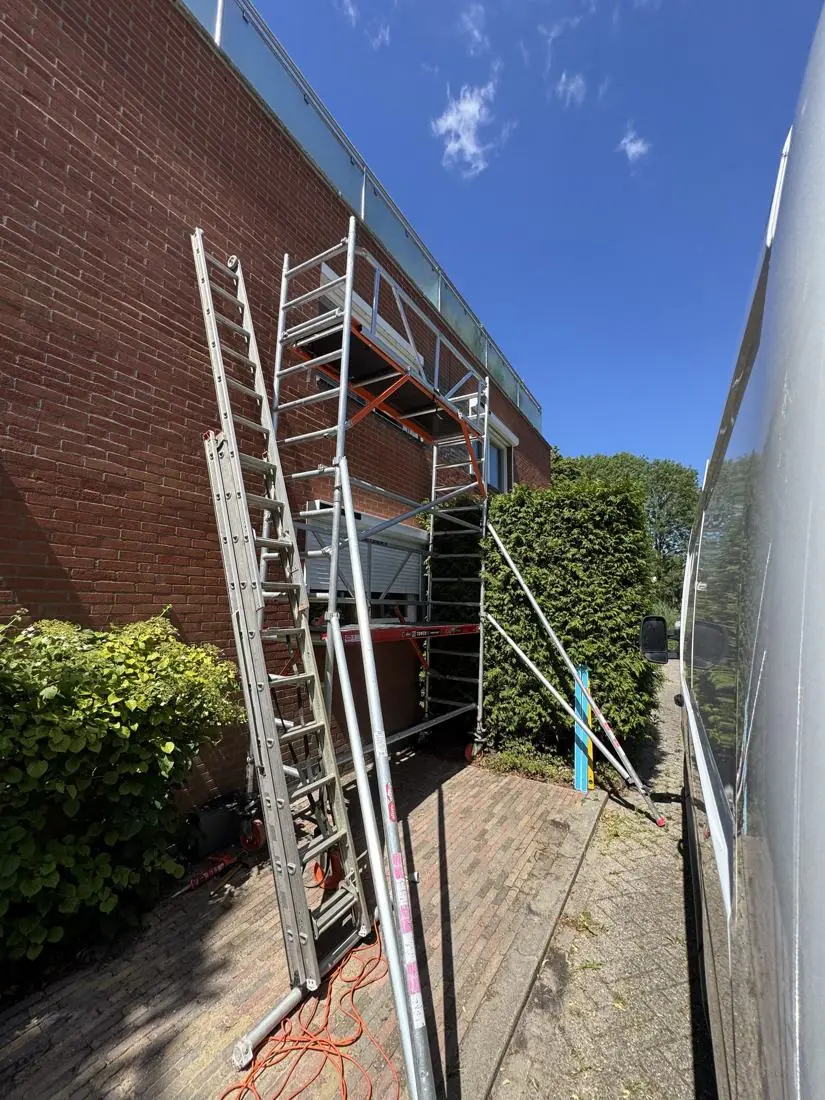
Mobile scaffold raised in a narrow passage beside a brick flank wall, with a ladder leaning against the same wall

Pick a build that is too short and you repair the wrong stretch. You rake out what you can get at, fill it neatly, and leave the joint the water genuinely runs through standing wide open, so the stain indoors returns quietly after the first autumn downpour. Taking a little extra height when you hire a mobile scaffold costs very little, while starting over costs a full week. The page on a seven metre working height shows what such a build involves.

Hiring a tower and siting it where the water gets in

Here the damage sets the standing position. If the leak sits above the utility room, behind the bay window or hard beside the dormer, that is where the build has to go, and a beautifully flat driveway ten metres away is worth nothing to you. Look first at where the patch actually is, and only then at what lies underneath it: a border of wet soil, a terrace of loose slabs, an inspection chamber or the sloping strip beside the extension where the ground runs off towards the boundary.

Count on power and on somewhere to park the vacuum. The extension lead runs from the meter cupboard or the shed to the foot of the tower, the machine stands beside the build and the hose travels up with you. That strip has to stay clear, and so does the ground where the stabilisers splay outwards. Run the cable along the wall rather than straight across the path, so that nobody catches a foot in it at the moment you are working the grinder overhead.

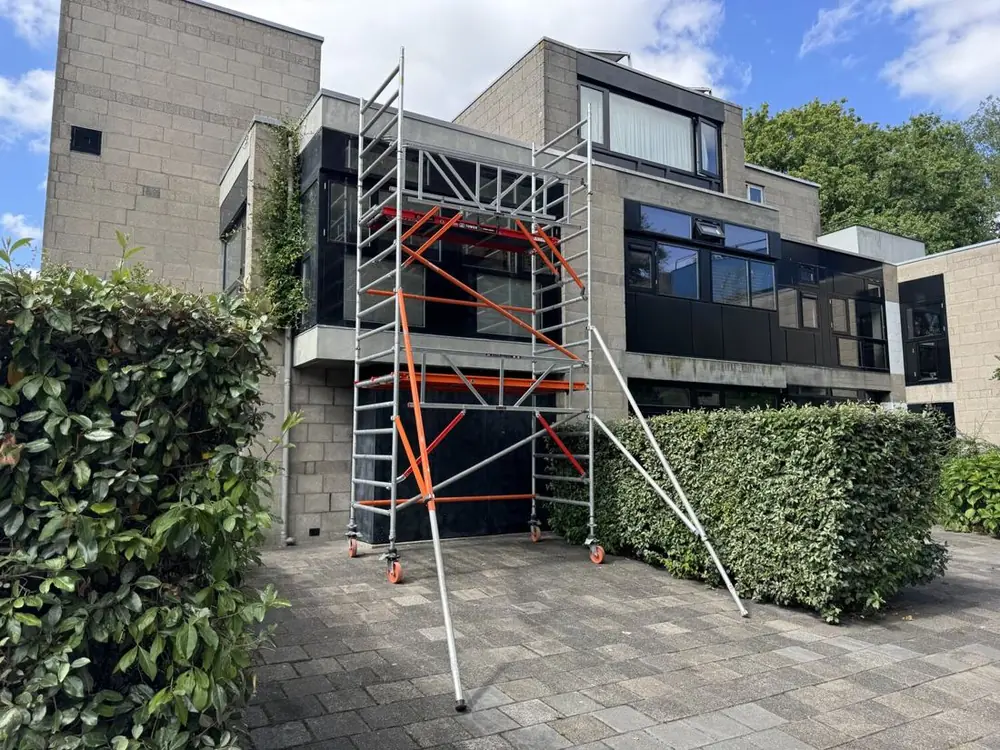
Four stabiliser legs angled down to the paving under a built tower, marking how much clear ground the foot claims

Then think about everything parked or hanging below the patch. Raking out throws a fine, stubborn cloud of dust that settles on a car, a shed door and a set of garden furniture alike, so sheet those things over or move them a few metres clear. Shut the windows on that side of the house and give the neighbours notice if you are working tight against the boundary. Fixing the build down is covered in the guidance on stabilising a mobile scaffold.

How many hire days does repairing pointing take

Allow two to four hire days for a repair covering a few square metres. Much of the first day tends to go on tracing: you play a garden hose over one strip of wall at a time from the bottom up while somebody indoors watches for the moment the stain darkens. That search costs half a day and saves you a repair in the wrong place, which is to say it saves you a second booking. Only once you know which joints let water through do you pick up the grinder.

After that come the waits you cannot hurry along. Fresh pointing mortar wants leaving alone rather than being reworked the same afternoon, and your test patch has to dry right through before its colour tells you anything true. If there is frost overnight or full sun on the wall, the filling shifts to a kinder part of the day. Moments like that never appear in your programme, yet they fall squarely inside your hire period, so give them a place there in advance.

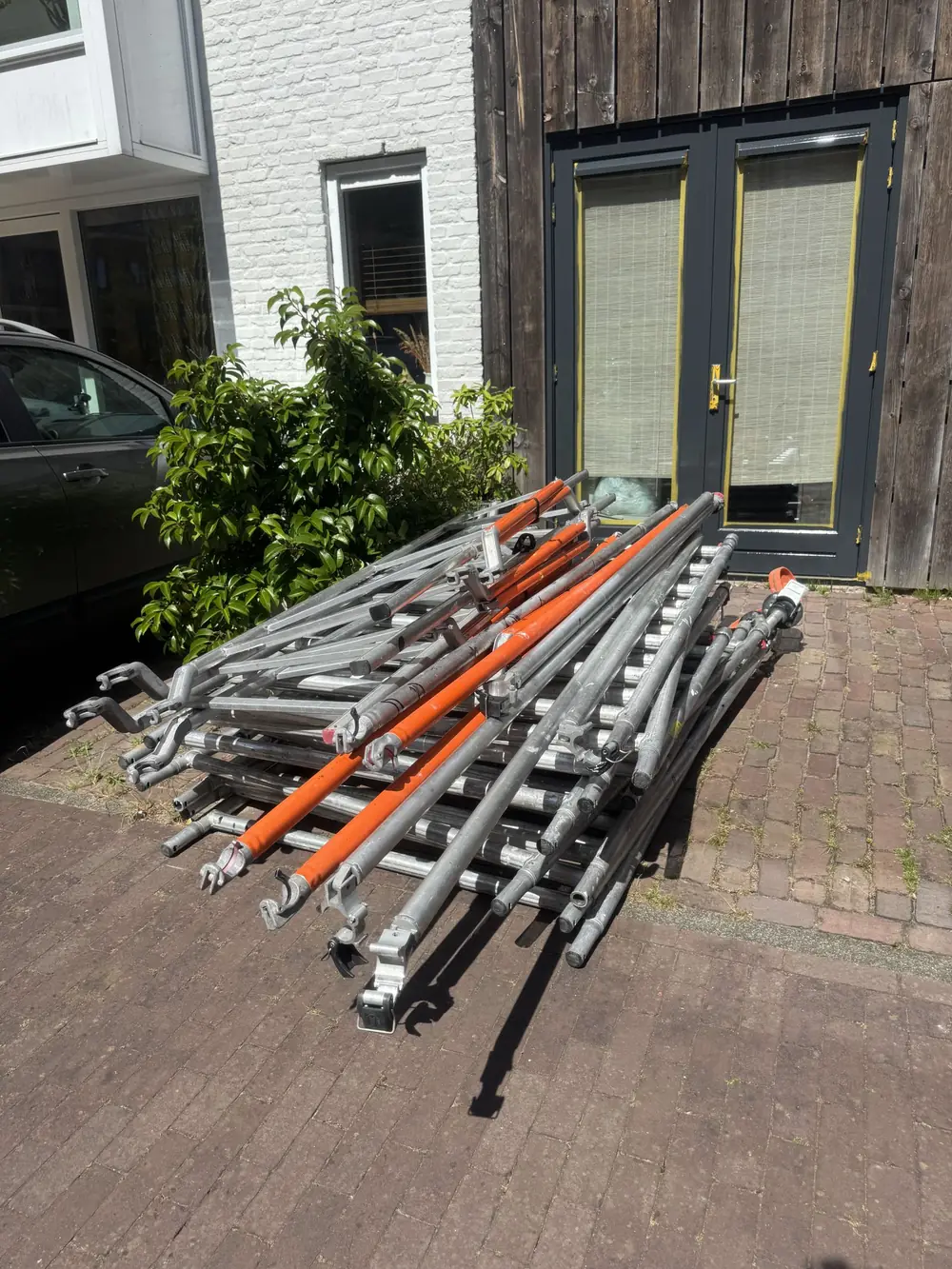
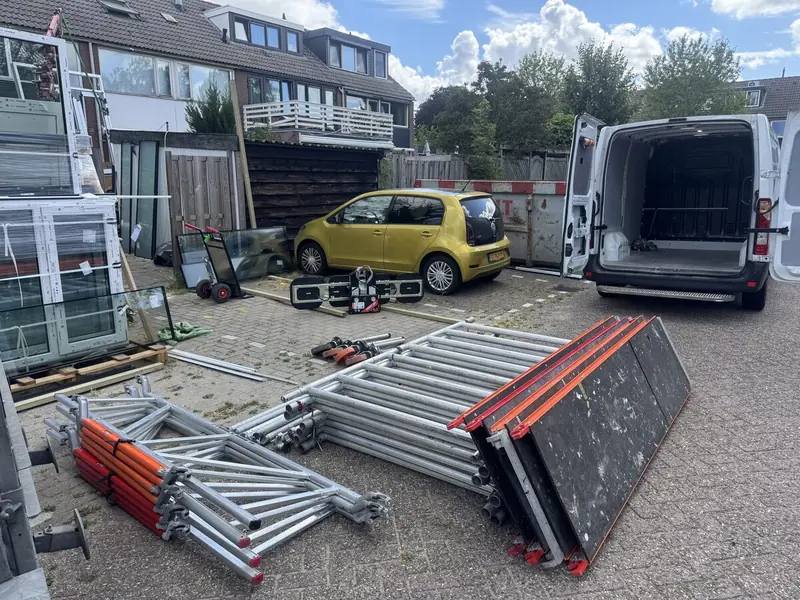
Loose scaffold frames and orange braces stacked on a brick driveway beside a house wall, ready to be built up

Happily the later days are cheap. The full amount is settled over the opening 24 hours, and every day beyond that comes with 95 per cent knocked off, which makes an extra day of breathing space cost you almost nothing. Booking tight does cost something: a half opened wall waiting while the collection van pulls up outside. Reckon a day long rather than a day short. What a period runs to is set out on the page of hire rates.

Which mobile scaffold suits repairing pointing?

Kamersteiger RS44
  • Working height up to 4 metres
  • Compact and narrow
  • Great for indoor and small jobs
View and calculate →
Most chosen
Smalle rolsteiger RS51
  • Working height up to 14.2 metres
  • Narrow (75 cm)
  • Ideal for narrow passages
View and calculate →
Brede rolsteiger RS52
  • Working height up to 14.2 metres
  • Wide platform (135 cm)
  • Extra stability and workspace
View and calculate →
1-persoons steiger MiTower
  • Working height up to 6.2 metres
  • Very compact
  • Quick and easy to assemble
View and calculate →

Raking out and refilling pointing from a 245 cm platform

A deck of 245 cm lets you work off a strip a good two metres wide, and on this job that is usually exactly enough. Rake the joint back until you meet mortar that is still holding fast; as a rule of thumb take roughly twice the joint width as your depth. Do not go deeper than you need to and keep the disc away from the brick, because a nick in the face never comes out again and that nick will draw damp in all over again later.

Vacuum the grit away afterwards, right into the corners of the opened joint. Leave dust behind and your fresh mortar beds down on a layer of powder, then lets go again within a couple of winters, precisely the way the old joint did. Damp the brick lightly next and use a mix no harder than the masonry itself: with soft old brick you want a lime rich blend, or the new joint will break the arrises off the face of the brick.

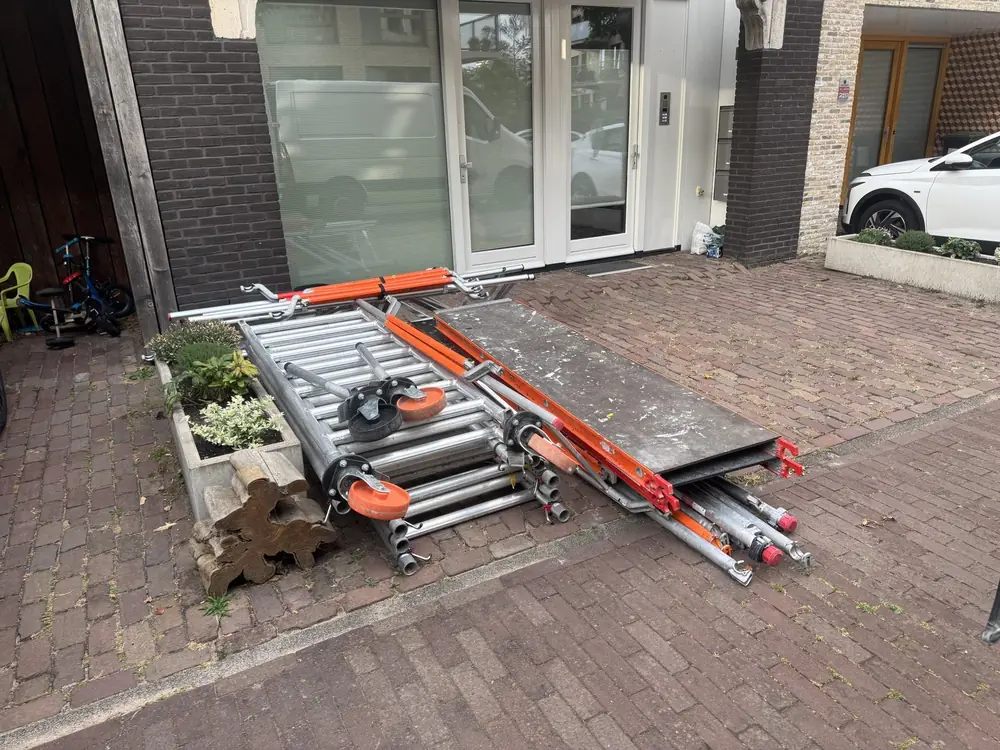
A deck board, stacked frames and red clamped stabiliser legs waiting on brick paving outside a house entrance

Always put a test patch somewhere out of the direct line of sight, and judge it only once it has dried right through. Wet mortar sits several shades darker than the same mortar a week on, so anyone who judges colour on the day gets it wrong as a matter of course. If the tone and the hardness both look right, fill the rest of that panel from the same position and only then move the build along.

Mobile scaffold hire with delivery for a pointing repair

The delivery day and the collection day are both yours to name when you book. Get an order in ahead of 15:00 on a weekday and the components are on their way for the following working day. On a pointing repair that suits people well, because most only want to fix a date once they have seen indoors how far the stain is spreading. Rain in the days beforehand is no disaster either, since a thoroughly soaked wall actually helps you find where the leak begins.

What turns up is a full set of loose components, counted through and checked, which you raise into a scaffold yourself. A manual sits with the bundles and there is a film showing which part goes on next, so nobody needs experience beforehand, and at this height two people have it standing quickly. Agree beforehand where the bundles may go: on a repair that is best close to the damaged patch, so you are not walking tube and deck boards across the whole garden.

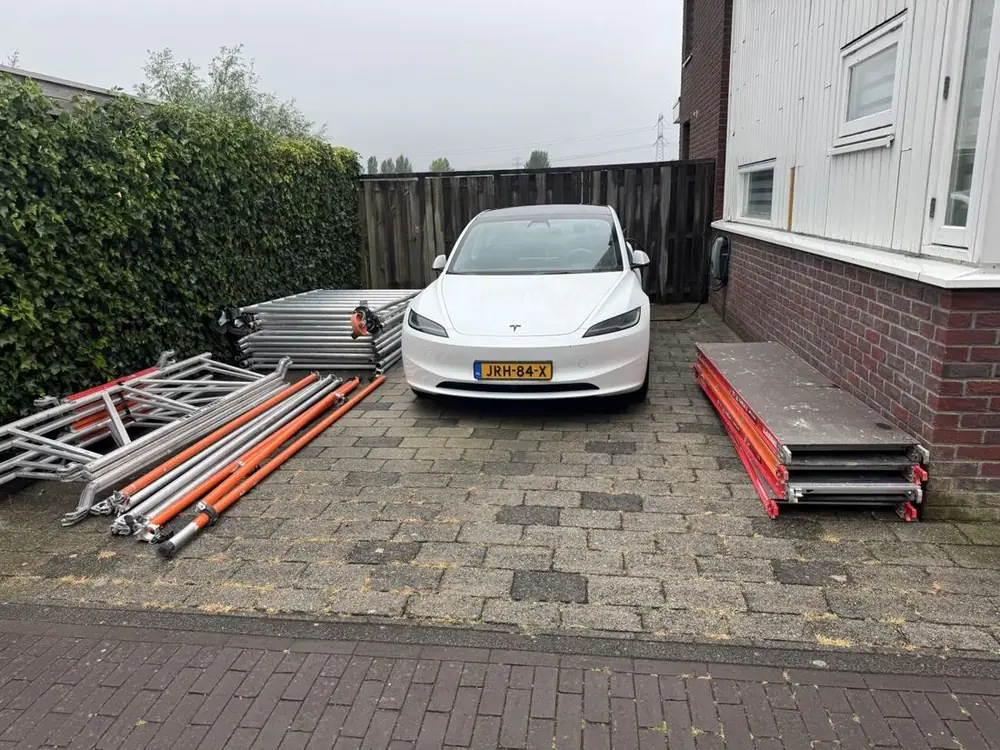
Scaffold frames, braces and decks set down on a paved drive either side of a parked car beside a house

Once the filling is done you take the build apart and stack the components back on that same spot. On the date you picked we come and take them away again, and nothing further is asked of you. Anyone close by with a van of their own may pick the parts up at no charge, by arrangement, at Zeeburgerpad 89, 1019 AD Amsterdam, though over a job of several days that is rarely the calmest way to organise things.

Grinding dust, grit and safety on the hired scaffold

EN 1004 puts builds of this kind in load class 3, and that class stands for 200 kg on every square metre of deck. Repairing pointing rarely comes near that figure, since you work with small tools and small quantities of mortar at a time. Do keep an eye on it if a bag of sand, a bucket of water and a second person all go up together, because those three add up faster than you expect, so spread them out instead of stacking them in one corner.

Put the castors on the brake the moment the build is standing and leave them braked until everybody is back on the ground. Moving the tower along with tools or a person aboard is not on, even for the single metre to the next course of joints. In a stiff wind you stop grinding, because the dust then blows straight back at you and nobody has proper control of the disc. Wear eye protection, ear defenders and a mask rated for fine dust.

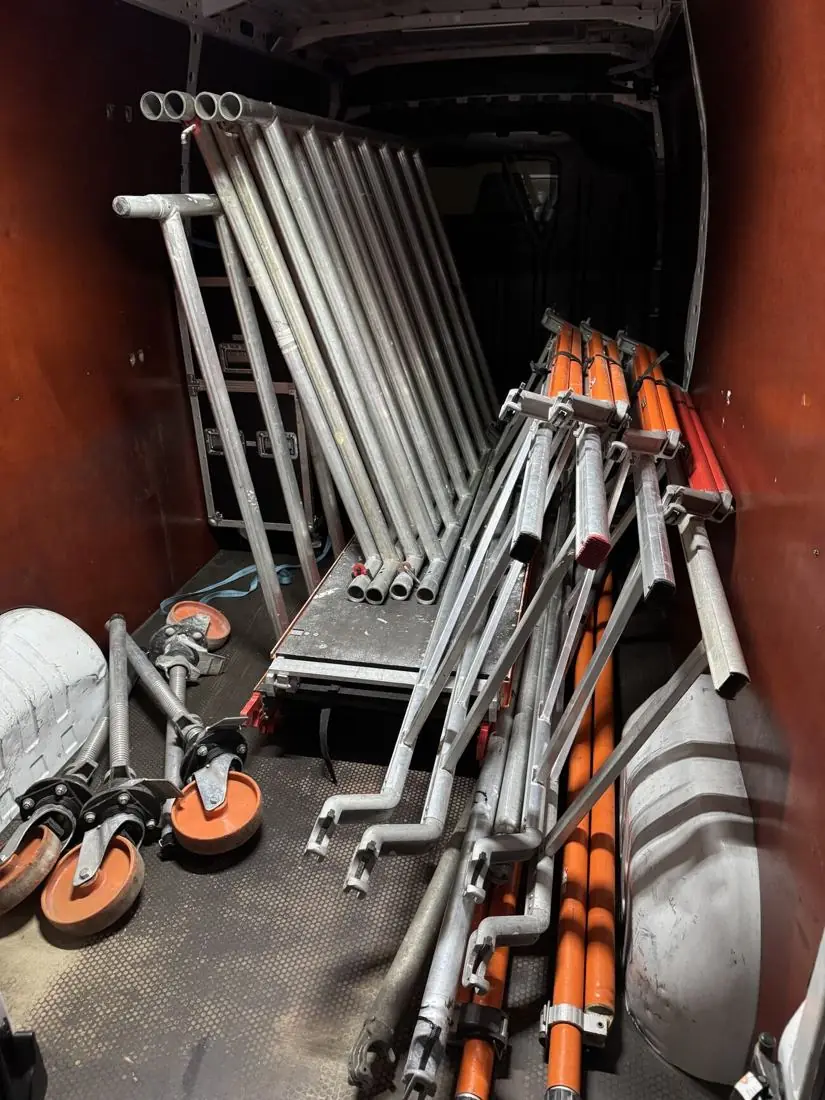
Scaffold frames, orange braces and castor wheels stacked inside the load space of a van ready for transport

The real risk on this job points downwards. Raked out mortar drops as sharp grit and the grinder hangs on a lead that can chafe over an edge, so lay that lead over the guard rail rather than across the lip of the deck. Cordon off the ground beneath you while the disc is running and let nobody wander underneath for a look. Sweep the dust off at the end of the day, because it makes the boards slippery underfoot.

In 5 steps

How hiring a mobile scaffold works

1
Choose working height

Pick the height that suits your job.

2
Book online

Sorted in 60 seconds, price shown instantly.

3
We deliver

At the agreed spot the next working day.

4
Assemble safely

Assembled by you, with a manual.

5
We collect

One call and we collect the scaffold.

Good to know

Practical tips for repairing pointing

1

When you are tracing the leak, wet the wall from the bottom upwards one strip at a time and work slowly higher. That tells you which course makes the stain react, instead of soaking the whole elevation at once.

2

Rake the joint out with a disc narrower than the joint itself. A broad disc inevitably bites into the arrises of the brick, and once the pointing is back in you see that as a ragged line.

3

Draw the grit away while you are cutting rather than at the end of the run. A packed layer of powder in the joint never comes fully out again and it stays trapped between brick and mortar.

4

Mix a mortar that stays softer than the surrounding brick. A rock hard cement joint looks strong but forces damp and frost pressure into the brick, and then the arrises of your wall crumble away.

5

Put your test patch on an elevation out of the line of sight and give it several dry days standing. Fresh mortar is always darker, so only then do you see the colour you actually end up with.

6

Finish repairing pointing, then keep watching that spot until after the first proper rain with wind behind it. If the wall stays dry you got it right and the next stretch can be tackled with confidence.

Frequently asked questions

Frequently asked questions about repairing pointing

Which mobile scaffold should I hire for repairing pointing on a house?+

In most cases the RS51 at 75 cm wide. A repair covers a limited number of square metres, so what you want is a build that fits a cramped spot rather than a roomy floor. A grinder, a suction nozzle and a small tub of mortar all sit within reach on a slim deck anyway. If two of you work together, one cutting while the other fills, the wide RS52 is more comfortable to hire, though you still have to get it through the garden.

How does hiring a mobile scaffold for local pointing repair work?+

You choose the version and the height online, pick a delivery date and say when everything may be collected again. The components arrive on that day and you raise the scaffold yourself, right at the spot where the water comes in. Then you cut out, vacuum clean and fill, all at your own pace with nobody standing over you. Once the last joint is closed you take it apart and stack the parts ready for the collection day.

How many days should I hire for repairing pointing over a few metres?+

Two to four hire days covers most repairs. Tracing the source takes anything from half a day to a full one, the cutting out and filling then move along briskly, and in between you are waiting on a dry test patch. If more of the pointing turns out to be poor than you thought, those days shift of their own accord. Because you name the collection date yourself, the sensible thing is to build that margin in at the booking stage.

What drives the rental price for a pointing repair, and how does day two count?+

The rental price follows the version of the scaffold and the height you build to; those rates are listed per model online. For planning, the day count matters more. The opening 24 hours are charged in full and every day after that falls under the discount rule, which is why a repair running four days costs far less than four separate days in a row. So hold off dismantling until you are sure you have finished.

What working height do I hire if the leak sits halfway up the wall?+

Measure not to the stain but to the highest joint you suspect, because damp sinks down behind the masonry before it shows on the inside. In practice, on two storeys, that lands you on a build reaching 6 to 8 metres. Choose the meaner option and you will repair neatly below the point where the water genuinely enters, then start the whole thing again a season later, a second hire period included in the bargain.

Can the hired scaffold be delivered on the day the cutting out starts?+

That is possible provided the reservation is settled in time, since the delivery date is yours to choose. Bear in mind that the scaffold still has to be built before you touch the wall, so do not count that first morning as full working time. Plenty of people have the set brought a day early, put it together at a comfortable pace and start on the first course of joints fresh the next morning.

Do I put the scaffold together myself if I hire one for repairing pointing?+

Yes, the building stays with you. We bring the complete set and you stand it up with the instructions to hand. On a repair that actually works in your favour: you place the scaffold exactly where the damage is and rebuild it as soon as you move to the next patch, without waiting on a fitter. Delivery ready assembled is not something we offer, we do not put up facade scaffolds, and we do not supply cherry pickers either.

Can I extend the hire if more bad joints turn up behind the first?+

Yes, and with pointing repairs that comes up regularly. Only once the first joints are open do you see how far the soft mortar runs. A call or an email is enough to move your collection date, and the scaffold then simply stays where it is until the last joint is closed. Given how little the later days weigh, that beats dismantling and booking a fresh period for the same wall a month on.

How much clear ground does the hired tower want at the repair spot?+

Keep more room free around the foot than the tower is wide, because the stabilisers reach out at an angle across the path. On the RS51 that comes to roughly two metres across, plus a separate strip for the vacuum, the bucket of water and the extension lead. If the bad pointing sits in a narrow alley between two houses, measure that gap before you confirm the booking. A tower that will not fit through stands uselessly on the drive all week.

Can I keep the scaffold on hire if frost arrives during the filling?+

Fresh pointing mortar and night frost do not mix, so in a week like that you hold off on the filling itself. Cutting out and vacuuming are perfectly fine on such days, as long as you then cover the opened joints against rain and sleet. The tower may stand as it is provided you leave it alone in strong wind, and moving your collection day is a matter of telling the planners. Frost seldom lasts long enough to ruin a booking.

How is the deposit handled when you hire for repairing pointing?+

The deposit sits separately from the hire sum and comes back to your account within 1 working day of collection. So have the whole scaffold ready at the agreed spot, stabilisers and small fittings included. On this job it pays to rinse your deck boards down as well, because dried mortar spatter is a great deal harder to shift after a week than on the day itself. A bucket of water and a brush will do it.

Must the hired scaffold stay up between the cutting out and the filling?+

Yes. It is exactly why this job gets counted in days and not in hours. You open a panel, vacuum it clean and preferably close it again the same day or the next, because an opened joint catches rain. The scaffold simply stays put for that; you shift it only once a panel is completely finished and you start on the next stretch. It makes the hire period longer than the net working time, and you plan for that.

Hire a mobile scaffold for repairing pointing today?

Calculate your rental price now or ask for free advice.

Rolsteiger van SteigerTaxi geleverd op locatie
Book it online

Your scaffold sorted in 2 minutes.

Choose your scaffold and working height, see the price instantly and book online.