
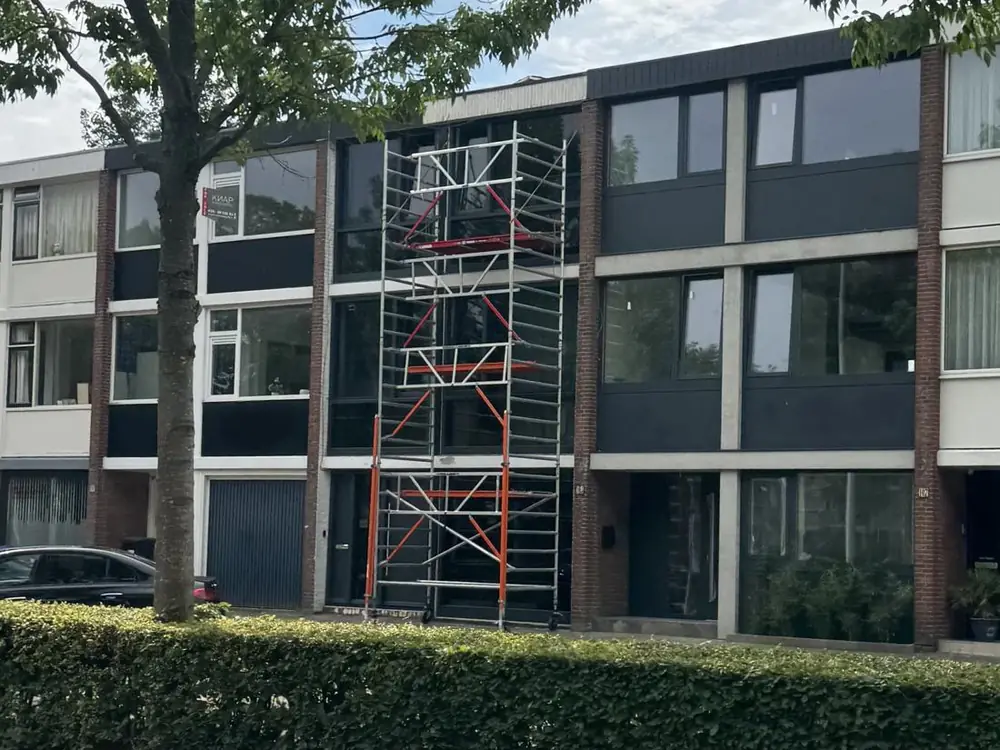
Mobile scaffold for the 3rd floor
Working on the third floor usually means somewhere around ten metres of working height. Think of the top windows of a townhouse, the gutter of a canal house or the roof edge of a large building facing the street. At that height everything depends on the base: firm ground, enough room on the pavement and stabilisers placed exactly as the assembly chart prescribes.
- For the 3rd floor you can count on a working height of approximately 10 metres.
- Hire from €240 per day incl. VAT (Narrow mobile scaffold (RS51)).
- Ordered before 15:00 means delivery the next working day, anywhere in the Netherlands.
- Assemble it yourself without tools, using the manual and video.
Which working height do you need?
For work at third-floor height you usually assume a working height of around 10 metres. At this height wind and the ground surface deserve extra attention: set the stabilisers as the assembly table prescribes, and postpone the work when strong wind is forecast.
Working height is not the same as platform height: the working height is the platform height plus approximately 2 metres reach height of an average adult. If you are between two heights, most customers prefer the taller one, so that you do not have to stretch or stand on your toes while working.
Which scaffold fits the 3rd floor?
| Model | Working height | Platform height | First 24 hours | Each extra day (95% off) | Deposit |
|---|---|---|---|---|---|
| Narrow mobile scaffold (RS51) | 10.2 m | 8.2 m | €240 | €12 | €500 |
| Wide mobile scaffold (RS52) | 10.2 m | 8.2 m | €265 | €13.25 | €500 |
The jobs that come up at ten metres
On the third floor you rarely work on something small. It is the window frames you cannot reach from the ground, rot in the upper sill, paintwork that has been skipped for two rounds, and the gutter that overflows during every downpour. Replacing a rainwater downpipe, checking the lead flashing along the roof edge or fitting bird protection under the tiles also falls exactly into this zone.
These jobs take longer than you expect. Sanding, filling, priming and topcoating spreads over several days, which is why it makes sense to rent the tower for the whole period instead of building it twice. The first 24 hours are charged at the full rate and every following day comes with a 95 percent discount, so a tower that simply stays up mainly saves you time.
The base on the street: ground and room
A canal house or townhouse stands almost directly on the pavement, and that is where the real work starts. Look first at where the castors will stand: sunken bricks, a cellar light, a hatch to the basement or a tree pit are not load bearing ground. Move the whole setup a metre sideways rather than putting a castor on a cover plate that was never made for it.
Also count on more width than the tower itself. The platform is 245 cm long, the RS51 is 75 cm wide and the RS52 is 135 cm, but the stabilisers reach out further on every side. So you need a strip free of bicycles, waste containers and parked cars, with room for pedestrians to pass. Arrange that with your neighbours or the council in advance, not on the morning of the build.
Stabilisers and anchoring according to the assembly chart
From about ten metres upward, stability is no longer a matter of feel. The manual contains an assembly chart showing which stabilisers are needed at which height and how they are placed. Follow that chart literally, even if the tower already feels solid after three levels. Mobile towers comply with EN 1004 and load class 3 is rated for 200 kg per square metre, but only with an assembly as intended.
Do not improvise with your own ballast, loose paving slabs or a strap to the fence. If the chart states that the tower must be anchored or secured, do it in the way and at the points indicated. Put the castors on the brake as soon as the tower is in position, check that everything is level again at every new layer, and have a second person watching from the ground while you build.
Suitable for
- HOA maintenance on apartment blocks
- Facade renovation of taller homes
- Roof work on a four-storey building
Frequently asked questions
How much working height do I need for the roof edge of a canal house?
That differs per building. Storey heights vary widely: an old townhouse often has taller floors than post war housing. Measure from the spot where the base will stand up to the point where you have to work. Working height is the platform height plus about two metres of reach, so around the third floor you usually end up near ten metres.
Can I put the tower on the pavement or in a parking space?
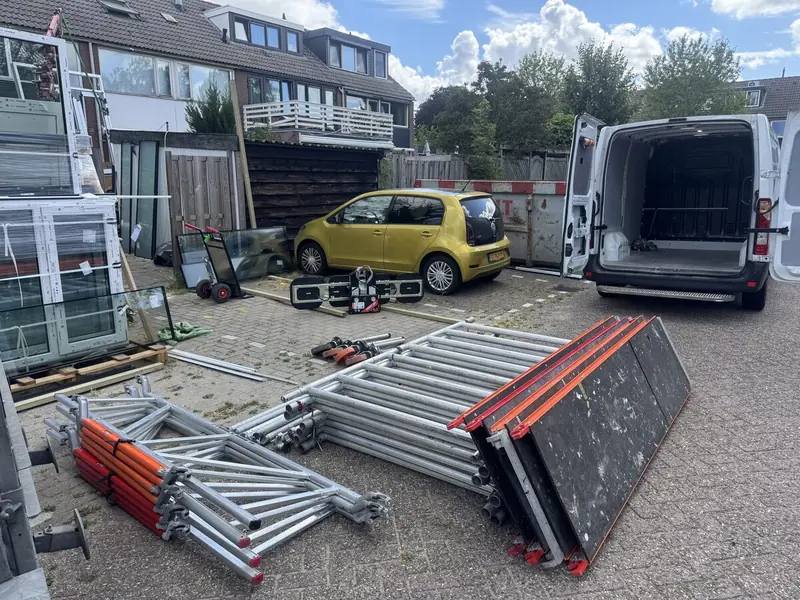
That depends on your municipality and on the situation on site. In any case make sure pedestrians can pass safely, that you do not block anyone in, and that the parking space is cleared beforehand. Arrange this well before the delivery date, because the parts arrive as a complete set and need somewhere to go straight away.
What do I do with a cellar light or hatch under the base?
No tower leg belongs on top of it. Glass, a thin cover plate or an old cellar hatch will not carry the point load of a castor. Shift the setup across to solid bricks or concrete, or work in two positions along the facade. Rolling the tower over such a spot is just as much a risk.
RS51 or RS52 along a narrow facade?
The RS51 is 75 cm wide and fits along a narrow pavement or between the facade and a parked car. The RS52 is 135 cm wide and gives far more working room, which helps with painting when you have trays and tools with you. Both have a platform length of 245 cm and are available up to 14.2 metres working height.
Do you assemble the scaffold, or do I do that myself?
You assemble the scaffold yourself, at this height too. Follow the assembly diagram in the Altrex manual; it states exactly from which height you need stabilisers or anchoring. Unsure about your facade? Send a photo via WhatsApp and we will think along with you.
Can I choose a lower working height for the 3rd floor to save money?
You can, but we advise against cutting it too fine: too little working height means you still have to stretch or stand on your toes, which is less safe. Choose a slightly taller working height rather than one right on the limit.