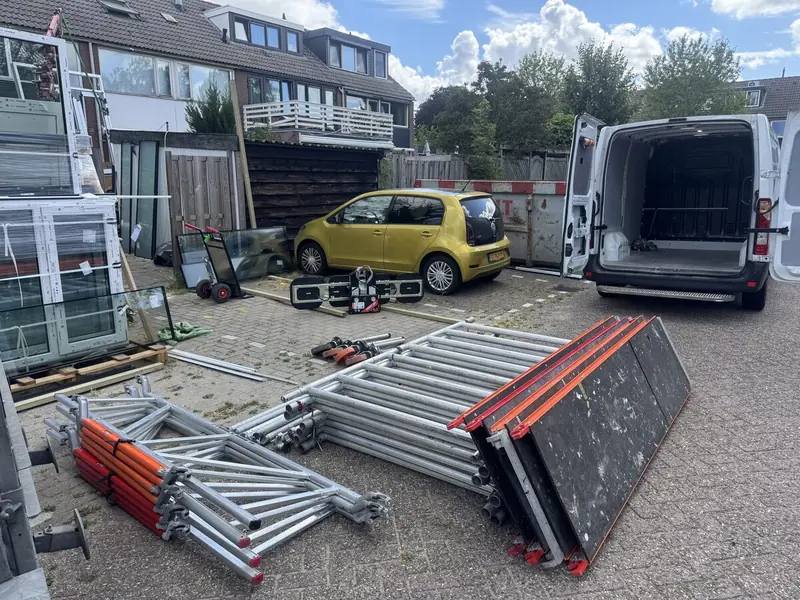

Mobile scaffold hire with 10 metres working height
Ten metres of working height puts the platform at roughly eight metres: the third floor, the top of a tall townhouse facade or the roof edge of a large building. At this height everything revolves around building the tower exactly as the assembly diagram shows, with stabilisers and, where prescribed, anchoring. A flat, load bearing surface is no longer a detail but the foundation of the whole scaffold.
- Working height 10 metres = platform height approximately 8 metres.
- Hire from €240 per day incl. VAT (Narrow mobile scaffold (RS51)).
- 2 models fit this height; compare them in the table below.
- Ordered before 15:00 means delivery the next working day, anywhere in the Netherlands.
Platform height versus working height
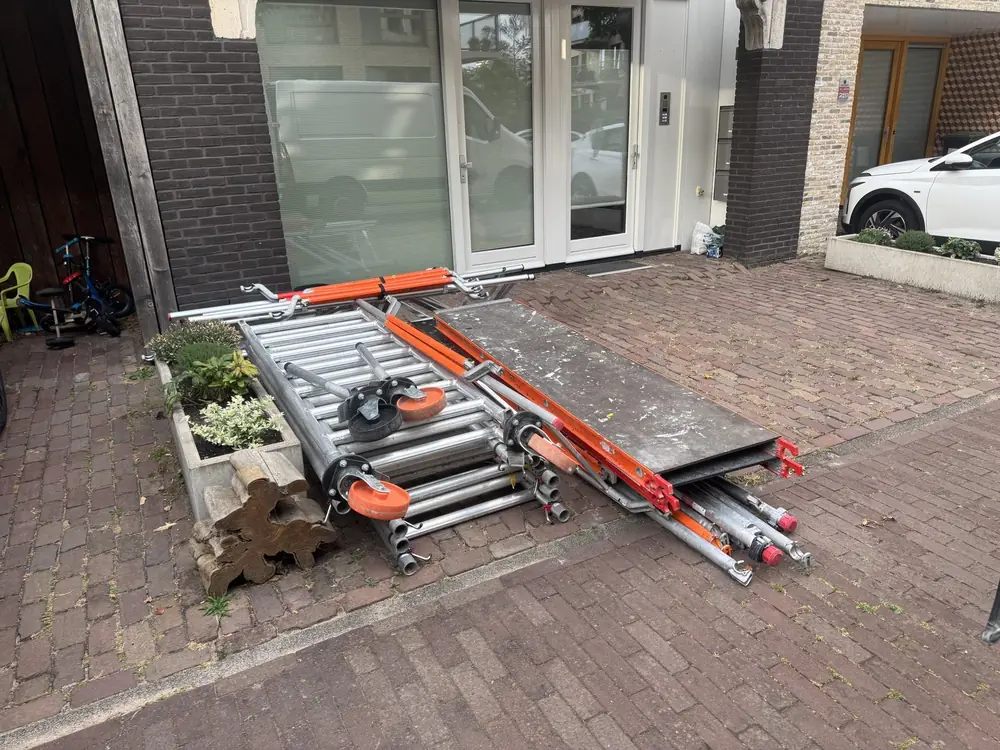
The platform height is the height of the work platform itself, measured from the ground. The working height is the platform height plus approximately 2 metres reach height of an average adult standing on the platform. A working height of 10 metres therefore corresponds to a platform height of approximately 8 metres.
Which scaffold fits 10 metres working height?
| Model | Working height | Platform height | First 24 hours | Each extra day (95% off) | Deposit |
|---|---|---|---|---|---|
| Narrow mobile scaffold (RS51) | 10.2 m | 8.2 m | €240 | €12 | €500 |
| Wide mobile scaffold (RS52) | 10.2 m | 8.2 m | €265 | €13.25 | €500 |
What you can reach at ten metres working height
With the platform at about eight metres you are at eye level with the third floor. Think of painting the upper window frames of a townhouse, replacing a section of downpipe, inspecting the roof edge of a large building or repointing brickwork just below the gutter. From the platform you still reach around two metres higher, so the gutter itself is within comfortable reach without stretching or leaning on the guard rail.
That is exactly where things go wrong. Many people pick a height by feel and only discover at the gutter that they are standing slightly too low, or that they are working with the rail against their stomach. Measure the distance from the street to the highest point you need to reach, then subtract the two metres of reach height. What remains is the platform height you need, and with it the number of levels you have to build.
Anchoring and extra stabilisation according to the assembly diagram
At ten metres a mobile scaffold is no longer a loose tower you simply stand up. The assembly diagram supplied with the set states, for each configuration, which stabilisers you fit and where anchoring to the facade is required. Work through that diagram step by step and never skip a level, even when the base already feels solid. Mobile scaffolds comply with EN 1004, but that standard assumes the tower is built the way it is meant to be.
Width matters here. The RS51 is 75 centimetres wide and therefore narrow in relation to its height, while the RS52 is 135 centimetres wide and stands on a broader base. Each one has its own diagram at this height. If you choose the narrow version because the pavement is tight, bear in mind that the demands on stabilisation and anchoring grow heavier as the tower becomes narrower and taller.
A flat surface that carries the load
Everything you do at the top ends up on four wheels at the bottom. At ten metres working height a flat, load bearing surface is therefore essential. Paving, concrete and asphalt are fine, while loose sand, fresh garden soil, a wooden deck or a cellar hatch are not. Check the street for camber as well, and for manhole covers or service trenches that end up just under one wheel. If a spot feels doubtful, move the scaffold a few metres.
Level the tower with the wheel spindles and check that again after every level, not only when you reach the top. A few centimetres out of true at the base becomes a serious lean at eight metres platform height. Then lock the wheel brakes and walk around the base to see whether all four wheels really carry weight. A wheel hanging just free of the ground means the load is running through three points.
Safety at 10 metres
Our mobile scaffolds meet the European standard EN 1004. Always lock the castors as soon as you stand on the platform, use the guardrails, and never move the scaffold while someone is on it. Do not work in wind force 6 or higher, certainly not at greater working heights such as 10 metres.
Frequently asked questions
How high do I actually get with ten metres working height?
Working height is the platform height plus roughly two metres of reach. At ten metres working height you stand on a platform of about eight metres and work comfortably up to around ten. In practice that is the third floor, the top of a tall facade or the roof edge of a large building.
Do I have to anchor the scaffold to the facade at this height?
That depends on the configuration you choose. The assembly diagram supplied with the scaffold shows which stabilisers are needed and whether anchoring to the facade belongs to that setup. Follow the diagram to the letter and never build higher than the level the stabilisation covers. If something is unclear on site, call before you build on.
Can the scaffold stand on a garden path or a grass verge?
Only if the surface is flat and can carry the weight. Grass, sand and fresh soil give way under the wheels, and you usually notice that once the tower is already high. Choose paving or concrete instead, or create a stable and level base under all four support points before you start building.
What if the job takes longer than one day?
The first 24 hours are charged at the full rate, and every following day comes with a 95 percent discount. So you do not have to gamble on a tight schedule or dismantle the tower in a hurry because the weather turns. Order before 15:00 and the complete set is delivered on the next working day.