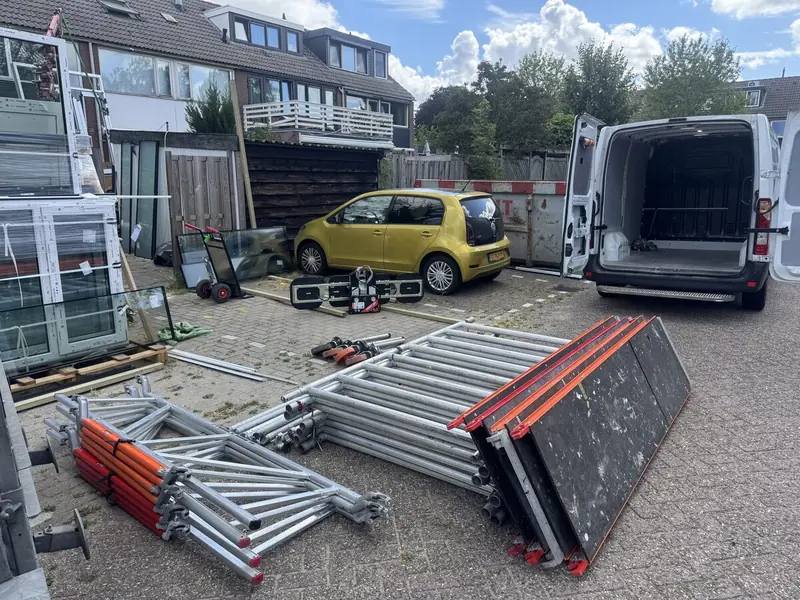

Which working height do you need?
Our mobile scaffolds are available from 4.2 to 14.2 metres working height, in steps of 1 metre. Choose the desired height below for an explanation, prices and the matching model.
The tiles on this page run from 4 to 14 metres of working height. Working height is not the same as the height of the platform you stand on, and that difference decides which tower fits your job. Below you will find how to convert the height of your facade, what changes in each height group, and why width and model matter just as much.
Working height is not platform height
Working height is the height at which your hands can actually reach the work, and it follows one fixed formula: platform height plus roughly 2 metres of reach. Stand on a platform at 5 metres and you get to about 7 metres with your arms stretched out. Every tower on this page is listed by its working height, because that is the number you need when you are standing in front of a wall wondering whether you will reach the top of it.
This is where people slip up. Someone measures the gutter at 8 metres, then looks for a tower with a platform at 8 metres, and ends up two steps too high. The opposite happens too: you pick a low tower by eye and only notice halfway through the build that the last metre stays out of reach. So measure the point where you have to work and compare it straight to the working height on the tile, never to the platform height.
How to work out your own height
Start at the highest point you genuinely need to reach. For painting that is usually the top of the window frame, for gutter or roof edge work it is the edge itself, and for roof jobs it is the last point you still want to touch with your hands. Measure from the spot where the tower will actually stand up to that point, so not from the front door and not from street level if you are working in the back garden.
Then look at the ground under the castors. A raised terrace makes your job shorter, while a sloping garden or a sunken light well next to the wall makes it taller, and that difference is easily half a metre or more. Heights run in steps of roughly 1 metre, from 4.2 up to 14.2 metres of working height. If you land between two steps, or you are not certain about your measurement, take the next step up.
What changes at each height group
Up to about 6 metres things stay simple. You usually build a single section above the base, and plenty of people manage that on their own, certainly on a shed, a garage or a low wall. This group also includes the MiTower, a one person tower reaching 6 metres of working height. Between 7 and 10 metres the picture changes: the stabilisers take up real space around the base, and you want two people for the build because every part has to go up.
From 11 metres you are stacking many sections on top of each other, and the ground and the free space around you become the deciding factors. The surface under the castors has to be level and firm across the whole area the tower and its stabilisers cover, and above you the space has to be clear of branches, canopies and cables. The maximum working height is 14.2 metres; if you need more than that, a mobile tower is no longer the right tool.
Width and model matter as well
Next to the height you choose a width. The RS51 is 75 cm wide, so it fits through tight passages, along a side path, between a hedge and a wall, or through a gate. The RS52 is 135 cm wide and gives you working room on the platform, for tools, a bucket of render or a second person. The platform length is 245 cm on both, so each set up covers the same stretch of wall.
For indoor work there is the RS44 room tower. It passes through an internal door from roughly 70 cm wide, so you can move it from room to room without stripping it down completely. All towers are built to load class 3 under EN 1004, which comes down to 200 kg per square metre of platform. That covers two people with tools and material, as long as you spread the weight instead of stacking everything in one corner.
More frequently asked questions
Why is the working height 4.2 or 14.2 metres instead of a round number?
Those figures come out of the build itself. Platform heights run in fixed steps of roughly 1 metre, and about 2 metres of reach is added on top. What you are left with is the height you can genuinely work at, and it happens to end in a decimal. Rounding down would cost you height you really do have, and rounding up would promise height that is not there.
Can I build a taller tower to a lower height?
Yes, you do not have to build a set to its maximum height. You follow the manual for the configuration you need and leave the top section off. It does not work the other way round: you cannot get above the height of the set you reserved, because the parts for that are simply not in it. So when you are torn between two heights, the taller one is the safer choice.
How do I measure for a dormer window?
Measure up to the highest point of the dormer your hands still have to reach, for example the top of the frame or the edge just above it, and not up to the ridge of the roof. Take the measurement from the spot in the garden or on the street where the tower will stand. Compare the number you end up with to the working height on the tile and round upwards.
How much room do the stabilisers take up?
The stabilisers angle outwards and stick out past the base of the tower on every side. The higher you build, the further out they end up standing. Keep that space around the base clear and check in advance whether a garden wall, a parked car, a shed or a flower bed is in the way. The stabilisers are part of the build, so they are never left off.
What if I picked a height that turns out to be too low?
Do not improvise with a step stool, a ladder or a crate on the platform. You cannot extend a set yourself either, because it arrives as a complete, counted set of parts and is collected the same way. You will need a different set instead; order before 15:00 on a working day and it is with you the next working day. Better to measure twice before you reserve.