
See your price
Application

Installing solar panels? Choose the right scaffold.

Installing solar panels does not start on the roof but on the ground: the panels arrive on a pallet and each one has to travel upwards. The handover happens over the roof edge at gutter level, and there you want a wide floor beneath you. So the hire is an RS52, 135 cm across the deck, built no further than a metre above your gutter: higher is pointless, because you hand over and never climb onto the tiles. Below you can read how many hire days that takes and how to order the rows.

  • Order before 3 pm, delivered tomorrow
  • Professional Altrex scaffolds
  • Up to 14.2 metres working height
  • Easy to assemble yourself
4,2 tot 14,2 mWorking heights available
12Provinces served
7Days a week
200 kg/m²Load class 3
In short
  • For installing solar panels we recommend the Wide mobile scaffold.
  • For installing solar panels an RS52 on its 135 cm deck is the model, built to 6.2 or 9.2 metres.
  • The platform is your transfer point: every panel lands there and then goes over the roof edge to the fitter.
  • Work from the bottom row upwards, so that the hired tower only has to travel along the elevation once.
  • First 24 hours from €175 incl. VAT and delivery; every day after that 95% off.
Key facts for this job
FeatureValue
Recommended scaffoldWide mobile scaffold (Altrex RS TOWER 52)
Working height for this job6.2 to 9.2 metres
Available working heights4.2 to 14.2 metres
StandardEN 1004, load class 3 (200 kg per m²)
DeliveryOrdered before 3 pm, delivered next working day
Each extra day95% off, from €8.75 a day
Why a mobile scaffold for installing solar panels?

Safe, stable and professional work at height

Installing solar panels is above all a matter of lifting at the right height. A panel of a good metre and a half passes over easily as long as you can slide it horizontally across the roof edge; lift it above your head and something gives, either your back or the glass. That is why you pick a build where the deck comes out just under the gutter and no higher. On that deck you also need room for a panel to rest and for the person taking it. Hiring a mobile scaffold for this job is therefore about width, about the right height and about how many days the supply run lasts.

  • Panels handed over the roof edge at gutter level
  • Wide deck as the transfer point per panel
  • Build of 6.2 to 9.2 metres, no higher
  • Bottom row first, then the rows above it
Read more about working safely →

Which tower to hire for installing solar panels

A standard panel measures roughly 175 by 115 centimetres and weighs around twenty kilos. That thing has to be able to rest somewhere before it disappears over the roof edge, and for that you hire the Altrex RS52 with its deck width of 135 cm. On that size a panel stands at an angle while somebody is still standing next to it. On a narrower floor you have to take the panel from below to the tiles in one movement, and that seldom happens without knocking something.

The narrow RS51 of 75 cm and the one person MiTower drop out here, not because they come up short in height but because there is no space for a second pair of hands. When installing solar panels you are nearly always on the tower with two people: one taking the panel from below and one pushing it on. That only works if you can pass each other. Among the mobile scaffolds we hire out the wide version is the standard answer for this work.
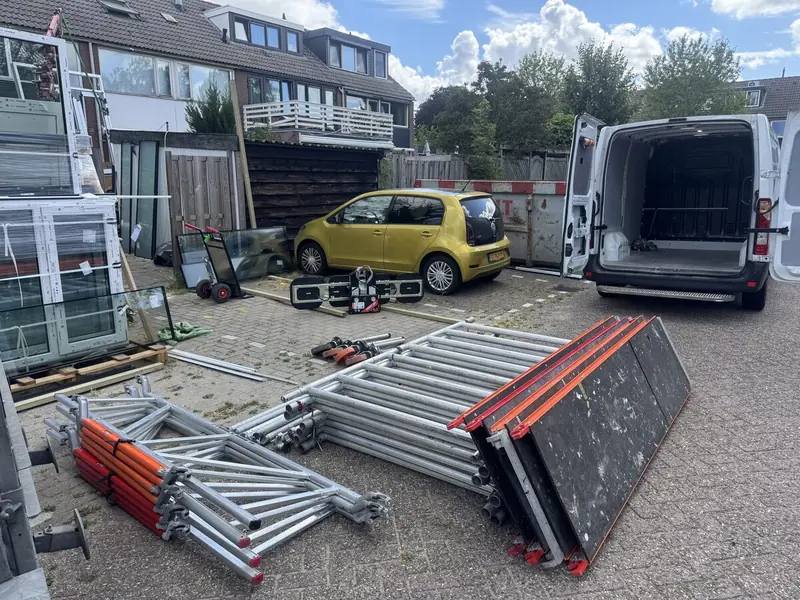
Scaffold frames, red edged platform decks and guardrail tubes spread over brick paving in front of a house

Do measure the route to the spot where the tower will stand. A wide 135 cm scaffold does not fit through every gate, and on this job you want it in the garden where the pallet of panels sits as well. If it will not pass, you give up working room and hire the narrow version instead, which means handing panels up one by one on their edge. Allow more time per row then, as set out in the notes on doorways and tower widths.
The hired scaffold working height that stops below the gutter

For installing solar panels you choose your height differently from other roof work. You do not have to reach the ridge, because the fitter on the roof takes the panel over as soon as it crosses the gutter. Reckon the working height as your deck height with a further 2 metres of reach, and here you hardly use that reach at all. What counts is that the deck itself comes out just below the roof edge, and not a lift above it.

So you measure from the point under the castors to the underside of the gutter. If your garden lies lower than the pavement in front, that difference simply belongs in the sum. If an extension or a conservatory is in the way, the tower has to clear it and you measure where it really stands. For a two storey house that lands you on a build somewhere between 6.2 and 9.2 metres, and an eight metre build sits in the middle of that range.

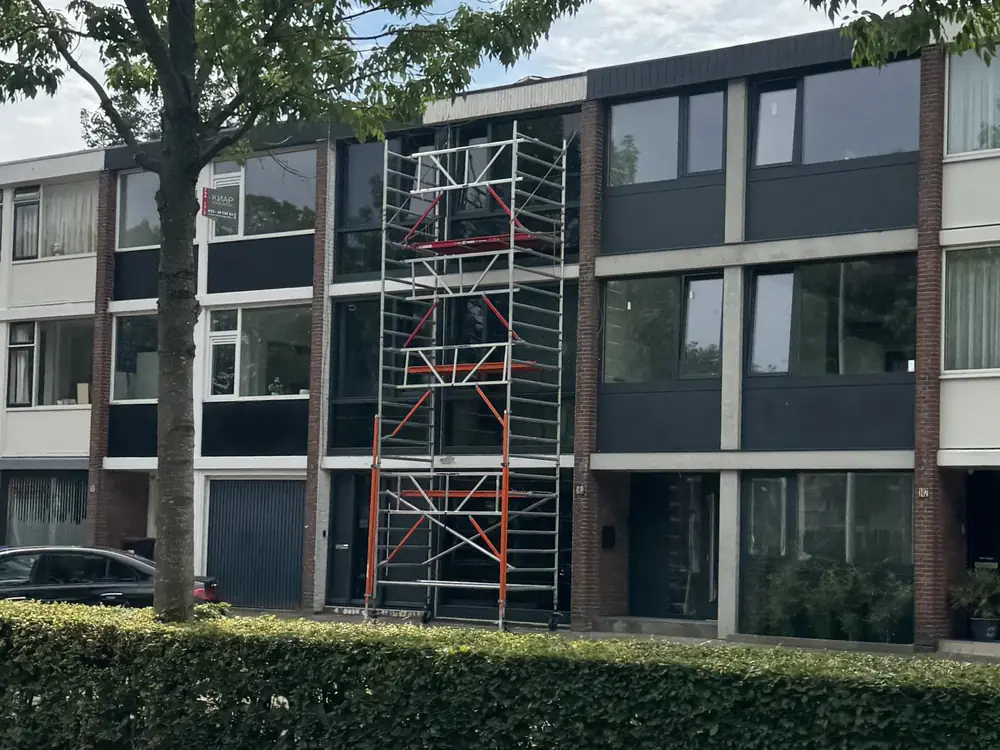
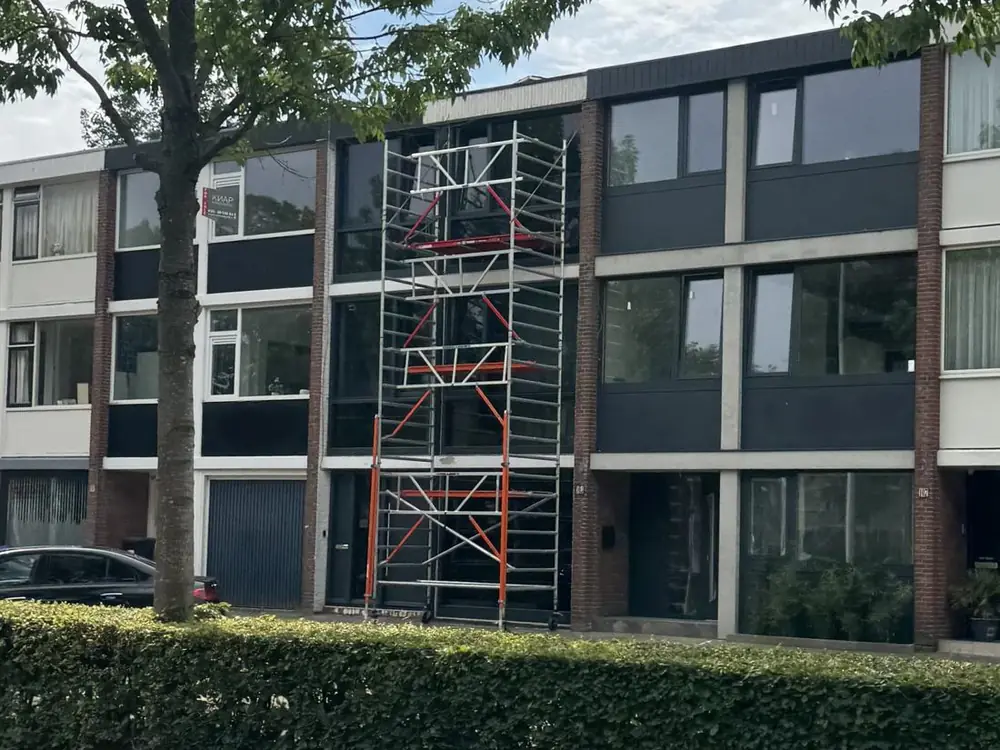
Tower built up several lifts in front of a three storey elevation, its top deck level with the roof line

Hiring too low is worse here than hiring too high. If the deck stops half a metre under the gutter you push every panel up at an angle instead of sliding it through level, and you feel that in your shoulders by panel five. Come out too high and you reach down over the roof edge, which works just as badly and treats your back no better. If you fall between two builds, check your gutter height for a first floor roof and choose around it.

Hiring a tower beside the pallet of solar panels

On this job the standing place follows from the pallet and not from the roof slope. Wherever the panels are dropped, usually on the drive or along the street, you have to be able to carry them across with two people without steps or tight corners. So put the tower as close to that stack as you can, on flat ground that carries the castors. Block paving, concrete and firm gravel are good; a newly laid lawn sinks as soon as you walk it a few times.

Around the foot the four stabilisers have to come out, and on top of that you want a clear walking strip along which the pair of you carry the panels. That is more space than people estimate beforehand. So move the garden furniture, the barbecue, the planters and the bikes off the whole route, not just next to the tower. Trip with a panel in your hands and glass breaks. For a sloping patio the guidance on stabilising and anchoring takes you further.

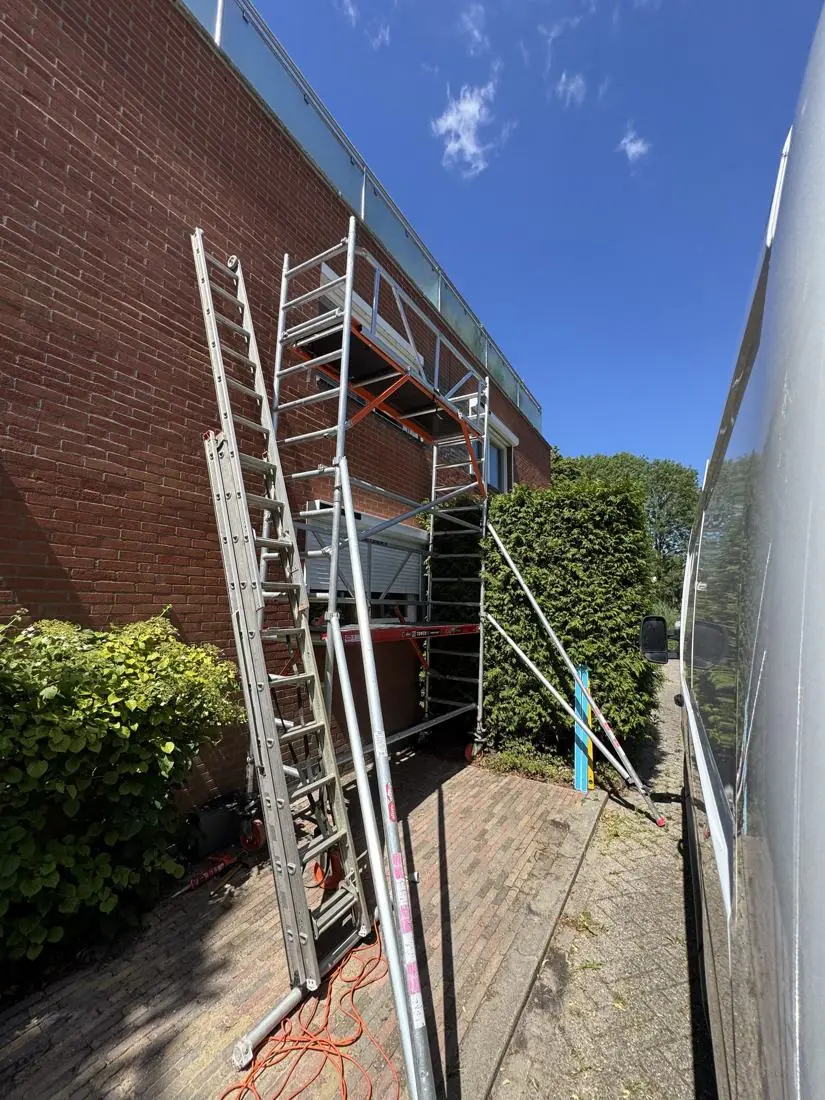
Mobile scaffold standing in a side passage between a brick wall and a parked van, with a ladder alongside

Choose the first position at the end where your row begins, so usually in a corner of the roof slope. From there you shift in the same direction each time, so that the supply line from the pallet grows steadily shorter or steadily longer and never zigzags across the garden. Leave a little play between the guardrail and the gutter, or the top tube scrapes the gutter brackets when you move. And look where the downpipe sits, because no stabiliser fits around it.

Hire days for getting the panels up onto the roof

The lifting itself goes faster than people expect: with two on the tower and one on the roof a panel is in place within a few minutes. Twelve to eighteen panels come to half a day of work. What fills the days is everything around it: the build, unpacking and checking the panels, dragging the pallet about and clearing up the polystyrene that blows everywhere if you do not bag it at once. Nobody counts that clearing up until it is happening.

So reckon on the tower standing for two to three days. The waiting is in there too: the installer who connects the cabling and the inverter works to his own diary, and in rain you do not open a pallet of panels. Each move along the elevation eats a quarter of an hour, stabilisers out and in included. On a slope that gets covered across its full width you end up at three or four positions, and a spare day is then no luxury.

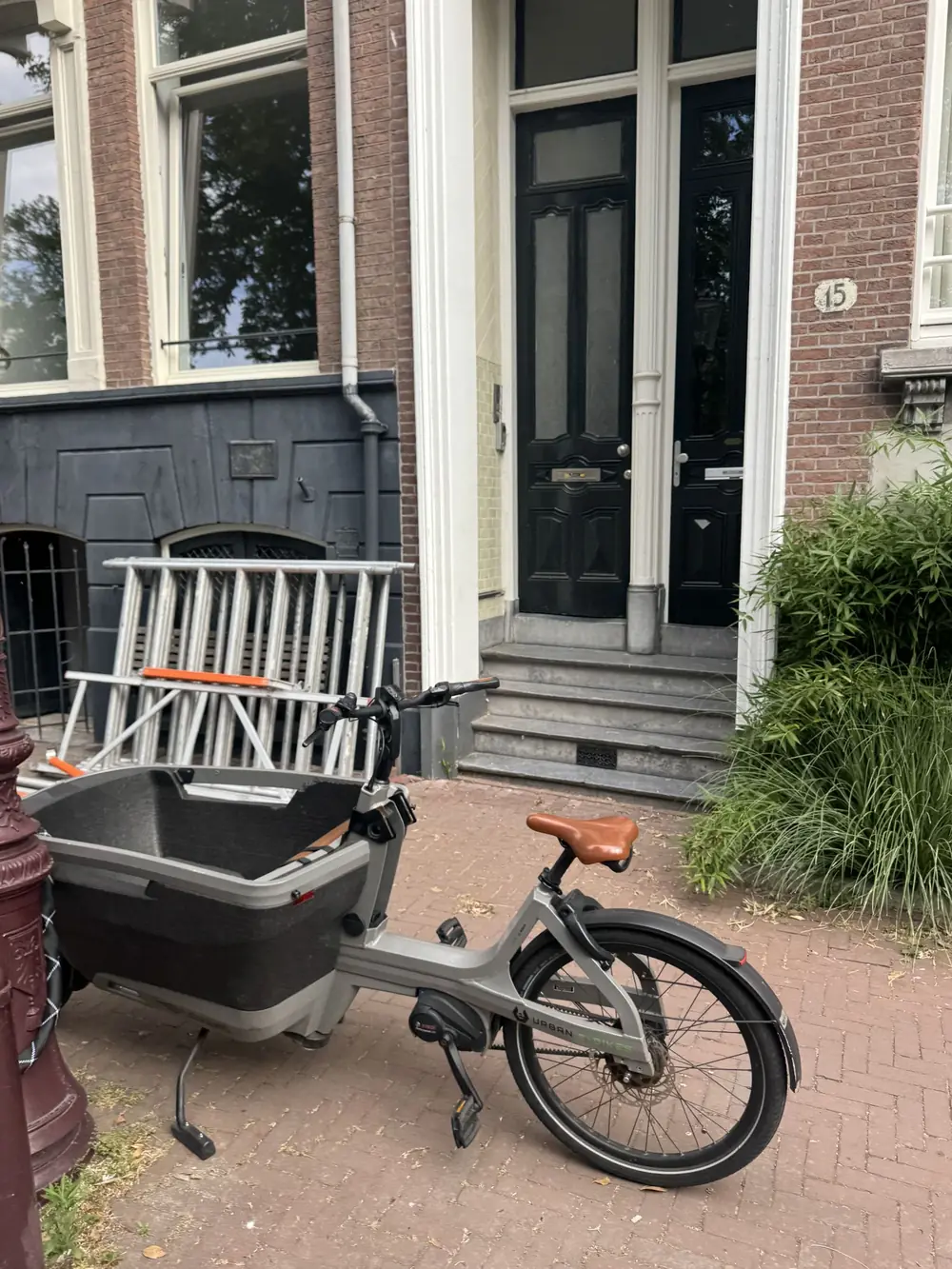
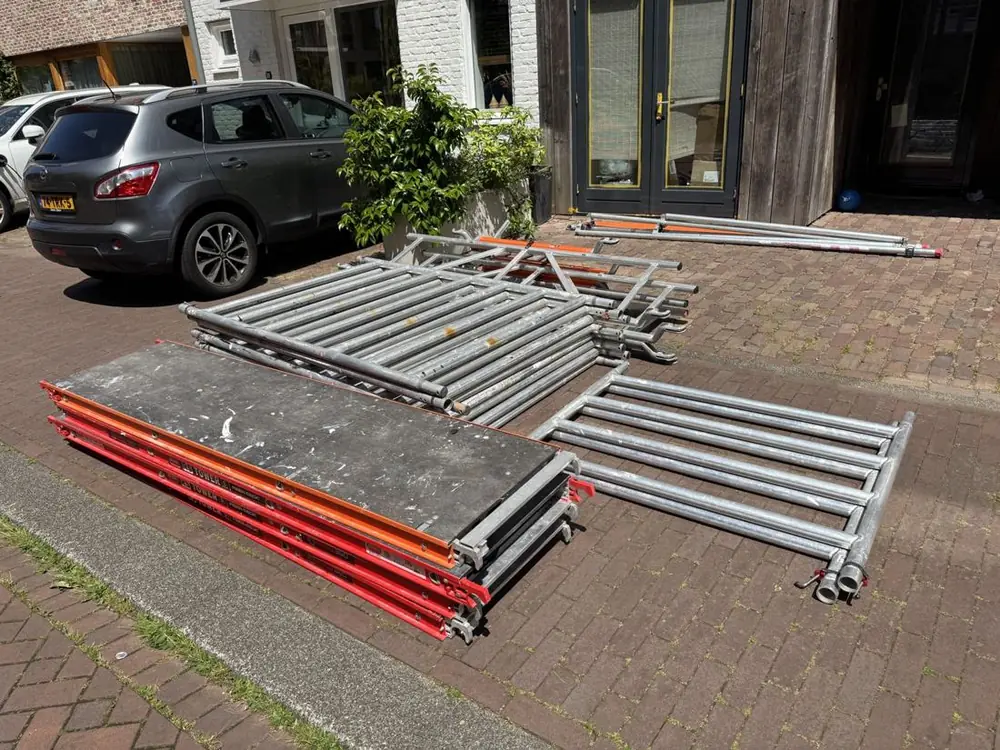
Scaffold frames and guardrails stacked beside the front steps of a brick house, a cargo bike parked in front

Plan your hire period around the delivery date of the panels and not around your own days off. If the load comes a day late, the tower stands built and waiting for work. The other way round is no better: panels lying on the drive for days are not insured against everything. Because you name the arrival day and the pick-up day yourself, you can put the tower exactly around that shipment. More on period length sits in the comparison of daily and weekly hire.

Which mobile scaffold suits installing solar panels?

Kamersteiger RS44
  • Working height up to 4 metres
  • Compact and narrow
  • Great for indoor and small jobs
View and calculate →
Smalle rolsteiger RS51
  • Working height up to 14.2 metres
  • Narrow (75 cm)
  • Ideal for narrow passages
View and calculate →
Most chosen
Brede rolsteiger RS52
  • Working height up to 14.2 metres
  • Wide platform (135 cm)
  • Extra stability and workspace
View and calculate →
1-persoons steiger MiTower
  • Working height up to 6.2 metres
  • Very compact
  • Quick and easy to assemble
View and calculate →

Installing solar panels from a 245 cm platform

With 245 cm of platform length you stand in front of roughly two panel widths of elevation per position. That is just enough to work a whole column from top to bottom without moving. Lay the panel flat on the deck first with the long edge towards the wall, then take it with two people by the short edges and slide it over the roof edge. The fitter on the roof pulls the last stretch. Nobody has to hold the weight above their head.

The order of the rows decides how often you move. Start with the bottom row across the full width and work upwards, because a panel that is already lying there cannot be passed. Anyone who decides halfway through that the top row should be different carries panels back down again. Agree with the fitter before you start which row fills first and which way you are going, and hold to that until the slope is closed. One agreed direction beats two good intentions.

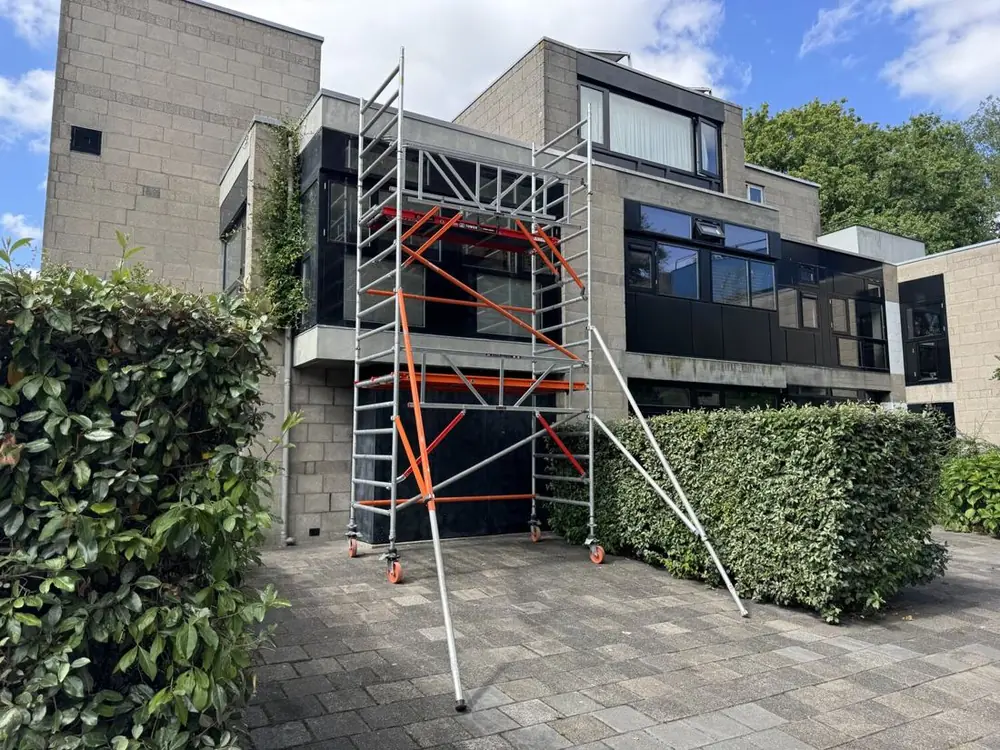
Narrow mobile scaffold assembled in front of a modern block, its top deck reaching the second floor windows

What else goes up with you is limited: gloves with grip, a pair of suction cups if you have them and a rope to secure a panel. All the fixing tools are already up there, because the rails and clamps of the mounting system belong to a different stage from the supply run. What people misjudge most is how often they climb the ladder; with eighteen panels that is easily thirty times, and your legs keep the score. Wear boots you can climb in all day.

Hiring the tower with delivery and collection included

The scaffold arrives in parts that you stack yourself: uprights, platforms, guardrails, braces and a set of braked castors, counted down to the last bolt. Place the order on a weekday and keep it under 15:00; the van comes the next working day. Pick a spot for that stack which does not coincide with the place the pallet of panels will land; those two fight over the same square metres on a drive. A strip along the fence usually works best.

The build is on your account, with the manual and the instruction video taking you through it step by step. At this height two people are busy for something under three hours, so have the delivery arrive the day before you start. You set the arrival date and the departure date when you reserve, which is handy here because the panels and the installer each have their own date and rarely land together. The order of parts sits in the step by step assembly guide.

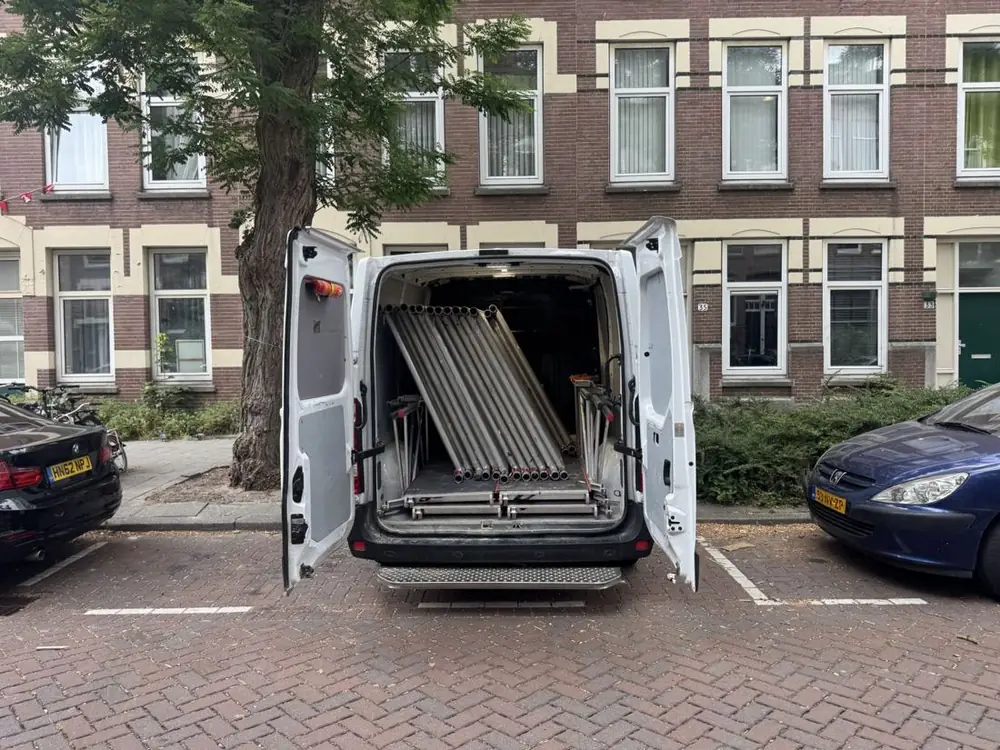
White van at the kerb with its rear doors open and scaffold tubes loaded inside, brick terraces behind

At the end you take the tower down yourself and lay all the parts in one tidy stack; we come and take them off your hands on the day agreed. Do not dismantle until the last panel is fixed, because a half covered roof often asks for one more position. What bringing and fetching cost together depends on your province, and you will find it at the charges per province. We do not drive to the Wadden Islands or across the border, so bear that in mind for a holiday home.

Safety on the tower while installing solar panels

Two people and a panel on one platform is no problem: the deck will hold 200 kg on every square metre, which in the terms of EN 1004 is class 3. Even so it is wise not to have more than one panel up there at a time. Not for the weight, but because with two panels side by side there is nowhere left to put your feet. So bring them up one at a time and leave the rest below on the pallet where they came from.

Before anybody sets foot on the ladder all the castors are braked, and nobody stands on the tower while it moves. That last point matters especially during the handover, because the temptation to shuffle half a metre along with a panel in your hands is strong. If it blows harder than a stiff breeze, the handover stops: a panel works like a sail the moment you hold it upright. Fold the stabilisers out again after every move. A braked castor is not the same as a stabilised base.

Four angled stabilisers reaching from a built tower onto the paving, hedge and house wall behind them

Two things go wrong most often while installing solar panels. The first is glass: a panel that taps a guardrail does not always break at once, but it picks up hairline cracks that only show months later in the output. The second is the zone under the tower, where nobody belongs while anything is crossing the roof edge. Stand a barrow across it as a marker. The basic rules are on the page about working at height. Tell whoever is in the garden where that zone runs.

In 5 steps

How hiring a mobile scaffold works

1
Choose working height

Pick the height that suits your job.

2
Book online

Sorted in 60 seconds, price shown instantly.

3
We deliver

At the agreed spot the next working day.

4
Assemble safely

Assembled by you, with a manual.

5
We collect

One call and we collect the scaffold.

Good to know

Practical tips for installing solar panels

1

Unpack the pallet where it stands and set the panels upright against a wall on a sheet of cardboard. That way you pick them up one at a time without lifting a whole stack each time.

2

Agree a fixed hand signal with the person on the roof before the first panel goes up. Shouting works badly in wind when the two of you have your hands full of glass anyway.

3

Lay an old blanket or a piece of carpet on the platform of the hired tower. A panel you rest there then does not scratch across the aluminium deck and is far less likely to slide.

4

Count the panels through before you start and set the damaged ones aside. Discover a broken corner only when you are up top and you have carried it over the roof edge for nothing.

5

Keep the polystyrene and the film from the packaging together in one large sack. Loose material blows into the neighbours' garden and costs you more time at the end of the day than you would like.

6

Only reserve your hire period once the confirmed delivery date for the panels is in. A tower standing three days too early costs you hire days while nothing at all goes up onto the roof.

Frequently asked questions

Frequently asked questions about installing solar panels

Which mobile scaffold do you hire for installing solar panels on a pitched roof?+

The RS52 with its 135 cm floor. On this job the platform is your transfer point: the panel rests there for a moment before it goes over the gutter, and two people stand there side by side. At 75 cm that no longer works without shuffling past each other on the tower. If you do hire the narrow version because the gap is so tight, allow more time per row and an extra pair of hands on the ground. Measure the gate before you settle on a model.

What do you arrange when you hire a mobile scaffold for this?+

Everything runs through the website. You look for the build that matches your gutter height, fill in the delivery day and the collection day and pay a fixed amount straight away, VAT included. On the delivery day the parts lie ready, you put the tower up and after the last panel you take it down. We then take the parts away. There is no paperwork in advance and nobody has to call round beforehand to measure anything up. The set is counted onto the van and counted off it again.

How long a hire period does installing solar panels usually need?+

An average roof slope is covered by two or three hire days. Handing the panels up takes half a day, but the build, the unpacking and the wait for the installer come on top of it. If there is a slope full of panels at the back as well, you move the whole tower and lose a day. In that case book generously from the start, since a longer period barely adds to the total. A slope with dormers between the rows adds positions as well.

What does hiring a tower cost and how does the day discount fall?+

The amount has two parts: the model with its build height, and a fixed price for bringing and fetching. The rental price of that first full day weighs heaviest, because from the second day onwards 95 per cent comes off the daily amount. Per model and per build you find the figure, VAT and all, among the rates per tower. For this job that means a day over beats a day short. Two short bookings with a gap between them always cost more.

Which working height should you hire to install solar panels?+

Measure to the underside of the gutter, because that is where the handover happens. For a two storey house you end up at a build of 6.2 to 9.2 metres. Do not automatically take the highest position a model can manage; higher than the gutter works against you when you are passing panels. The builds are listed one by one on the working heights of our towers. If in doubt, measure again with a long tape from the garden.

Can I have the hired scaffold delivered, or do I collect it?+

Delivery happens on any working day you choose, for a set amount with VAT already included, and afterwards we drive the same route back for the parts. Collecting is possible too: you make an appointment and take the set away from Zeeburgerpad 89 in Amsterdam for nothing. Bear in mind that you also have panels to move that day, which is why most people have the tower brought the day before. Most people would rather spend that morning on the roof than on the road.

Does the tower come assembled or do I build it during the hire?+

We deliver loose parts; putting them together is down to you. That build time comes off your fixing time, so plan it for the day before the panels arrive. No cherry picker sits in our range, and no facade or system scaffolding either, so a tower you assemble yourself is the usual solution for this work. Count the build day inside your hire period rather than treating it as a free extra. Read the manual through once before the first upright goes in.

If the panel delivery shifts, can the tower stay on hire for longer?+

Usually that works. As long as the set does not have to stand at somebody else's address straight afterwards, we move your collection day. When you are installing solar panels this is a familiar scene, because the load does not always come on the day the supplier first named. Ring too early rather than too late; a further day of hire is arranged in five minutes. Move the delivery day as well and your period stays unbroken. Keep the two dates in one continuous block if you can.

How much room do I need between the pallet and the hired tower?+

Enough for two people to carry a panel horizontally without squeezing past anything, so allow a clear run at least a metre wide. At the tower itself the stabilisers reach out further still on every side. If the pallet lies more than ten metres away, consider moving the panels closer first. Every metre you walk with glass in your hands counts double on a day with twenty of them. Sweep that run clear before the first panel leaves the pallet at all.

What do I do if it rains on the day the panels must go up?+

You need not dismantle the tower, but the handover is postponed. Wet glass slips out of your gloves and a pitched roof turns treacherous, so you do not take that risk. Use a day like that to finish the build, unpack the pallet and mark out the rows. Because your hire period runs on and each further day costs little, postponing is cheaper than a broken panel. Clear the loose items off the deck before you go in. Rain also puts a stop to opening the packaging.

How quickly is the deposit paid back once the hire has ended?+

As soon as the parts are back and the count is right we return the deposit; the amount is on your account within 1 working day. On this job check that no packaging film or polystyrene has stayed between the platforms and that nothing is missing. A brace still lying under the pallet holds the whole thing up needlessly, and you are the one waiting. Handing the tower back tidily is literally worth money. Count the parts as you stack them, not afterwards.

Can I use the same hired tower for the rear roof slope as well?+

Yes, but count on a move. A tower does not drive round the house if there is a fence or a change in level between front and back; you take it partly apart and build it up again on the other side. That costs half a day. With panels on both slopes, plan that move as a hire day of its own rather than as something you slot in. Set the collection date a day later. Two moves on one roof is one move too many.

Hire a mobile scaffold for installing solar panels today?

Calculate your rental price now or ask for free advice.

Rolsteiger van SteigerTaxi geleverd op locatie
Book it online

Your scaffold sorted in 2 minutes.

Choose your scaffold and working height, see the price instantly and book online.