
Knowledge base · reading time 11 min
Hiring a mobile scaffold per day or per week: choosing your period
Choosing between a day and a week is mainly a planning question. The first hire day costs the full rate and every following day 5 percent of it, so a longer period hardly adds up. What does count is how often you start a period: every new booking brings a full first day, delivery cost and a deposit with it again. Below is how to choose a period that matches your job, your weather and your model.
- Hire a mobile scaffold per day or per week? How the 5 percent per extra day works and how to pick the hire period that fits your job.
- Yes, extending is the cheapest way to overrun, because every extra day costs 5 percent of the day rate.
- Yes, the day the scaffold is delivered belongs to your hire period.
- One continuous period of three days, because you then pay one full first day and two additions of 5 percent, plus one round of delivery and collection.
How the daily hire rate is built up
The structure is simple: the first hire day costs the full day rate, every following day costs 5 percent of that day rate. As a result your total rises far more gently than you would expect when you need a full week. Delivery and collection sit separately, in a fixed amount per province, so that amount does not change when your period gets longer. Current rates are listed on the prices page.
That structure turns the day-or-week question into a planning question rather than a pricing one. You are not choosing between two rates, you are choosing how many days to allow yourself. Planning tightly rarely saves money, because the days you cut are precisely the cheapest days in your period. The most expensive day is always the first, and you pay it again with every new booking.
Compare a short and a longer period side by side on price per day and on price per week. There you see per model what your period costs, including the amount for delivery and collection. Always work through both together, because comparing day rates alone gives a distorted picture of what you actually transfer. Put the deposit alongside it as well, because that amount has to be available in your account.
Key facts
| Feature | Value |
|---|---|
| Core answer | A week costs far less than seven separate days: day 1 full, then 5% |
| Each extra day | 95% off: €2.50 to €16.25 a day |
| Delivery | Ordered before 3 pm, delivered next working day |
| Deposit | Refunded within 1 working day of return |
| Collection | Free by appointment, Zeeburgerpad 89 Amsterdam |
What actually counts as a hire day
A hire period is not the same as the number of days you spend at the facade. The day the scaffold is delivered counts, so does the day it is collected, and so do all the days in between spent waiting for dry weather or a cured coat of paint. Anyone who counts only working days books one or two days short as a matter of routine.
The overview below lists the days that appear in almost every hire period. Walk through them before you fill in your dates, because most periods that turn out too tight are missing the same two days: the assembly day and the day the work had to dry. Order before 15:00 and the scaffold is delivered the next working day, anywhere in the Netherlands.
| Day in your period | What happens that day | What to watch |
|---|---|---|
| Delivery day | The scaffold arrives at the address, or you collect it | Order before 15:00 for delivery the next working day |
| Assembly day | You put the scaffold up using the manual and instruction video | On a tall set-up two people finish faster |
| Working days | The work on the facade progresses | Every reposition along the facade takes extra time |
| Waiting days | Paint, sealant or coating cures, or it rains | These days count towards your hire period as normal |
| Dismantling day | You take the scaffold down and sort the components | Count the components against the assembly list |
| Return day | The driver collects, or you bring it back yourself | Have everything complete and accessible |
When hiring per day is the logical choice
Hiring per day suits work that finishes before dark and does not depend on the weather. Replacing an outside light, fitting a smoke alarm on a high ceiling, checking a roof window or sanding a single frame: these are jobs you can reasonably expect to complete within a day. For that kind of work a short period is entirely sufficient.
Interior work often falls into the same category. With a room scaffold you are standing within a quarter of an hour and rain or wind are irrelevant, so your planning is predictable. The MiTower is likewise a model people often take for a single day, because you assemble and reposition it alone and it reaches up to 6 metres working height.
Do watch the ratio between assembly time and working time. On a low set-up you lose little to it, but on a scaffold of ten metres assembly and dismantling together take a serious part of your day. A single day is then tight, even when the work itself lasts two hours. In that case an extra day is the better call.
When booking a full week is wiser
As soon as weather or drying times enter the job, a week is the calmer choice. Painting a facade, repairing a gutter or cleaning and treating fascia boards are all jobs where you need to be able to write off a day without your planning collapsing. Because every extra day costs only 5 percent of the day rate, that slack is relatively cheap.
A week also makes sense when you work evenings or weekends. You may only have three or four genuine working slots, but they are spread across seven days. Seven consecutive days cost you one full first day and six small additions, whereas two separate periods cost two full first days and two rounds of delivery. The slack in a week costs far less than the second booking you would otherwise need.
- You work outdoors and the forecast is unsettled for the whole week.
- Your job contains drying times, for paint, sealant, coating or impregnating agent.
- You have several jobs on the same facade lined up one after another.
- You work evenings or weekends only, so your working slots are spread out.
- You are unsure about the volume of work, for instance with wood rot that may run deeper.
- You have to reposition the scaffold several times along a wide or tall facade.
Delivery, working days and the weekend in your planning
Order before 15:00 and the scaffold is delivered the next working day, wherever in the Netherlands you live. That means a job starting on Saturday has to be ordered by Thursday afternoon at the latest, because Friday is the last working day before it. Anyone deciding on Friday afternoon to spend the weekend working is usually too late. An order placed on Friday therefore means delivery on Monday, not on Saturday.
Think about the return side of your period as well. If you finish on Sunday evening, the scaffold sits dismantled in the garden until Monday. So book your period up to and including the day the equipment actually leaves, not the day you put down your brush. That avoids discussion afterwards and it adds very little to your total. Booking to the actual return date also keeps the collection round predictable.
If you are in a hurry, see what is still possible in hiring a scaffold urgently. At short notice, self-collection is often the fastest route, because you do not depend on the delivery round. The frequently asked questions explain further how delivery days and working days relate. At short notice, plan the pick-up at a time when you can genuinely load and unload.
Extending is cheaper than booking a second period
The most expensive way to finish a job is to start a second hire period. You then pay a full first day again, delivery and collection again, and you tie up the deposit again. Extending an existing period, by contrast, costs 5 percent of the day rate per day. The difference between tight and generous booking is therefore smaller than the cost of a miscalculation.
That argues for choosing the longer period whenever you are in doubt. Not because you will use every day, but because a setback otherwise turns into an expensive correction immediately. Rain on the day the primer had to go on, or a gutter bracket that turns out to be rusted solid, costs you a day you never allowed for. A day of slack is cheaper than the correction you would otherwise have to make.
Work out what your period costs in advance on the mobile scaffold cost page, and see how the components relate in what hiring a mobile scaffold costs. That shows at a glance how small the gap is between four and seven days, and how large the gap is between one and two hire periods. Take that comparison with you before you fix your dates in the order.
Delivery and collection are charged once per period
Delivery and collection sit in a fixed amount per province. That amount is not tied to your hire duration, which makes it one of the few items you can genuinely halve through better planning. Two separate hire periods in the same month mean paying it twice; one continuous period means paying it once. For most jobs that is the largest saving on the table.
To see exactly what applies to your address, check delivery cost or the page on the cost of having a scaffold delivered. Because the rate is fixed per province, it makes no difference whether you live in a village at the edge or in the middle of a city. You know the amount before you order. Include the amount in your overall budget rather than at the checkout stage.
There is a second reason to keep the number of deliveries low: every delivery needs someone on site and a place where the equipment can stand. In a narrow street or a city centre that is often the trickiest part of the day. A period you run through in one go saves you that logistics twice over. A second delivery also means keeping another half day free to receive the equipment.
The deposit is tied up again for every hire period
The deposit is not part of the hire amount, but it does determine how much money is temporarily tied up. On delivery the deposit is 500 euro for the RS51, the RS52 and the MiTower, and 150 euro for the room scaffold. If you collect the equipment yourself the deposit is higher: 1000 euro for the RS51 and RS52, 750 euro for the MiTower and 150 euro for the room scaffold.
This matters for the choice between a short and a long period: every new booking ties up that deposit again. Two separate periods therefore mean two amounts that have to be available in your account. After return the deposit comes back within 1 working day, so it is never long, but across three periods in a month it does add up.
All amounts are listed together on the scaffold hire deposit page. To see where the handling actually stalls in practice, read getting your deposit back. In almost every case it comes down to missing components, and those turn up simply by counting while you dismantle. Lay the components out sorted, then a single glance shows you what is missing.
Self-collection and what it does to your period
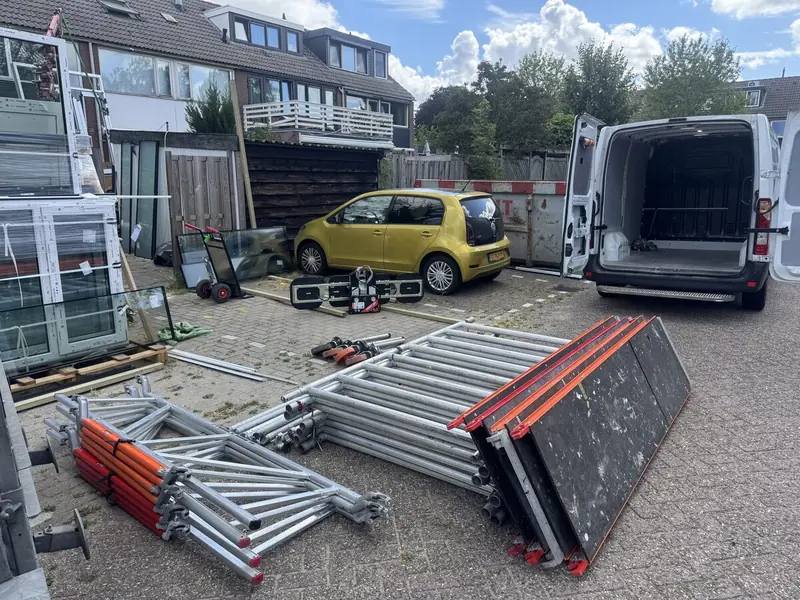
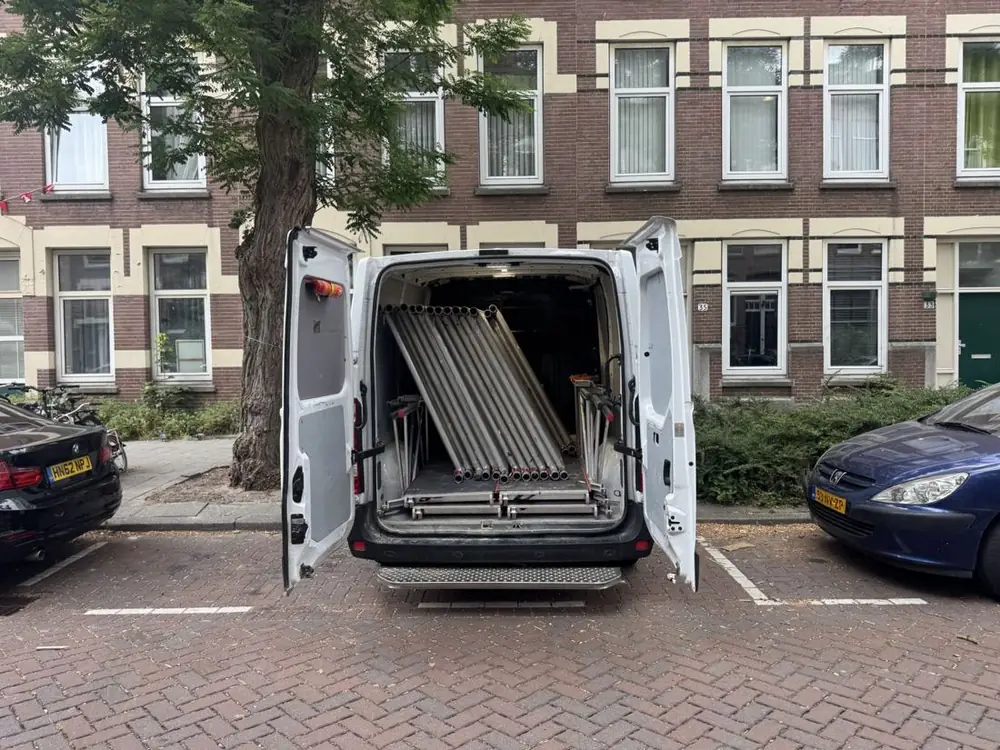
Self-collection is free by appointment at Zeeburgerpad 89 in Amsterdam. That removes the amount for delivery and collection and gives you more grip on the start and end of your period, because you decide when to drive. The condition is that your transport can handle the longest components; the scaffold travels dismantled. Measure the loading length of your van or trailer before you make a collection appointment.
For short periods, collecting usually works best. You pick up on the morning you start and bring the equipment back as soon as you finish, without waiting for a delivery round. For long periods it matters less, because you already have time to spare. Read hiring a mobile scaffold without a trailer if you are unsure about transport. Allow time for loading and unloading as well, which is more work than it looks.
Do bear in mind that you drive twice and that the deposit is higher on collection. If you live near Amsterdam that is a minor effort. If you live in Limburg or Groningen, the journey soon weighs heavier than the amount you save, particularly when you still have to load materials as well. Weigh the travel time up carefully when your period covers only one or two days.
Which model suits which period
The model determines how much time you spend assembling and repositioning, and therefore indirectly your hire period. The RS51 is the narrow mobile scaffold at 75 cm wide, the RS52 the wide one at 135 cm. Both have a platform length of 245 cm and are made by Altrex, complying with EN 1004 in load class 3, so 200 kg per square metre of platform.
On the wide version you take more material up with you, which means fewer trips down. On a job of several days that shows clearly in your pace. You choose the narrow version when the space along the facade forces it, for instance beside a path or in an alley. Compare both on mobile scaffold hire. Look at the space beside the facade too, because that often settles the question already.
Working heights run from 4.2 to 14.2 metres, and working height is always platform height plus 2 metres. So settle your height first via working height and choose your period afterwards, because a taller set-up costs more assembly time and more often a second person. That is exactly the sort of time that eats hire days. On a taller set-up, book a day more rather than a day less.
Estimating the length of your job realistically
Start with the number of set-up positions. Count how often you have to move the scaffold along the facade to reach everything, and allow time per move for retracting and re-extending the stabilisers. On a terraced house with a wide facade that is soon two or three moves, and it is more work than most people allow for in advance.
Add the fixed items to that: assembly, dismantling and sorting the components for return. Then include the drying times printed on your paint or sealant, and add a margin for the weather. What you end up with is your real period, and it is nearly always longer than your first estimate. Write the total down before you open the order form, so your dates match your estimate.
The guide on how many days to hire a scaffold gives guidance per type of job. Also run through the hire checklist, so you do not discover halfway that an extension lead, a ladder section or a tin of primer is missing. If the duration is unclear, ask for advice over WhatsApp before you order. Only fix your dates once that estimate is made, and your period will be right first time.
Mistakes that make a hire period cost more than it should
Most miscalculations come from counting working days instead of hire days. Delivery, assembly, waiting time and return then fall outside the count, while all of them fall inside the period. The second common mistake is splitting jobs that could have been done in one go, which means paying everything fixed a second time. You then pay everything that does not move with the duration twice, for the same amount of work.
A third source is the order of the work. Anyone working from the bottom up often has to return to a spot they had already finished, because something ran or blew down from above. Work from the roof edge towards the frames instead, and finish each position before you roll on. See also the application page on painting a facade.
- Counting only working days and forgetting the delivery, assembly and return days.
- Leaving the drying times of paint, sealant or coating out of the planning.
- Splitting two jobs on the same facade across two separate periods.
- Ordering after three on Thursday afternoon for a job that starts on Saturday.
- Buying materials only once the scaffold is up, which costs a full day.
- Not allowing time for repositioning along a wide facade.
Frequently asked questions
Can I extend my hire period if the job overruns?
Yes, extending is the cheapest way to overrun, because every extra day costs 5 percent of the day rate. Let us know as soon as you know you need more time, so the return date in your order is correct. Starting a second hire period is more expensive, because you then pay a full first day and delivery again.
Does the delivery day count as a hire day?
Yes, the day the scaffold is delivered belongs to your hire period. Plan delivery for the morning you actually start assembling. The same applies to the day the equipment is collected again.
What is cheaper for a three day job?
One continuous period of three days, because you then pay one full first day and two additions of 5 percent, plus one round of delivery and collection. Three separate days spread across a month cost three full first days and three deliveries. The gap is considerable while your working time is identical.
Can I hire over a weekend?
Yes, but account for delivery on working days: order before 15:00 and the scaffold arrives the next working day. For a job starting on Saturday you therefore order by Thursday afternoon. Collecting the equipment yourself on Friday is an alternative if you are later than that.
Do I pay the deposit twice if I hire twice?
Yes, the deposit is tied up again for each hire period. On delivery that is 500 euro for the RS51, RS52 and MiTower and 150 euro for the room scaffold. You get the amount back within 1 working day after each return, but in the meantime the money is committed.
How many days do people usually hire for facade maintenance?
That depends on the facade, but with drying times involved, count on several days rather than a single one. Add up the number of set-up positions, the assembly and dismantling time and the drying times. The guide on the number of hire days gives guidance per type of job.
Can the room scaffold be hired by the week as well?
Yes, every model follows the same structure with a full first day and 5 percent per following day. For interior work people often choose a short period, because the weather is irrelevant. For large interior jobs such as a stairwell, a week is more comfortable.