
Knowledge base · reading time 13 min
What does hiring a mobile scaffold cost?
Hiring a mobile scaffold involves more than a day rate, and at the same time it costs less than most people expect once a job runs on. You pay for the hire itself, a fixed amount for delivery and collection, and a deposit that comes straight back to you. How those three parts relate to each other decides whether you hire smartly or expensively. Below you can see which choices genuinely move the price, from model and working height to the number of days and the way the scaffold reaches your site.
- What does hiring a mobile scaffold cost? How the price works: hire days, fixed regional delivery, deposit per model and free collection in Amsterdam.
- Yes, all amounts include VAT.
- You extend the hire period and pay 5 percent of the day rate for each extra day.
- No, delivery and collection sit together in one fixed amount per province.
The three parts that make up the hire price
An invoice has three separate parts. The first is the hire itself, which depends on the model and the working height you choose. The second is transport: delivery and collection together sit in one fixed amount per province, which you pay once. The third is the deposit, which is not a cost at all but an amount you advance and get back once the scaffold returns complete. Keep those three apart and any quotation immediately becomes easier to read.
What the price does not do is move with the season or with how busy the diary is. Rates are fixed and include VAT, so private customers see exactly what they will settle and meet no surcharge afterwards. The price page lists the amounts per model side by side, and the configurator lets you enter model, working height and dates to see your own total straight away. Comparing two sizes or two periods costs a few clicks.
The deposit deserves separate attention, because the amount differs per model and per delivery method. It sits apart from the hire sum and appears as its own line on your confirmation, so you can see at a glance which share of the total is temporary. The page on the scaffold hire deposit shows which amount applies in each case. Leave that line out when you put two quotations side by side.
Key facts
| Feature | Value |
|---|---|
| Price structure | One fixed day price incl. VAT, delivery and collection |
| Each extra day | 95% off: €2.50 to €16.25 a day |
| Delivery | Ordered before 3 pm, delivered next working day |
| Deposit | Refunded within 1 working day of return |
| Collection | Free by appointment, Zeeburgerpad 89 Amsterdam |
Full rate on day one, 5 percent on every following day
The structure of the hire rate is deliberately simple. On the first hire day you pay the full day rate. Every following day costs only 5 percent of that day rate. That means days two, three and four together still stay comfortably below a second full day, and the gap between a long and a short hire is smaller than with most other equipment. The big step in the price sits at the start, not in the length of your period.
That tiering has a practical consequence for the way you plan. Anyone worried that a job might overrun does not need to book a tight period and extend later. You include the days you realistically need from the outset, because the extra days barely register in the total and you avoid the hassle of extending. The page on the price per day shows how that sum works out per model and per working height.
Count the delivery day and the collection day in your planning as well. The scaffold is yours from the moment it is dropped off until the moment we take it away again, and that whole period counts as hire. Take delivery late on Friday and collection on Monday and you hire across the weekend at the low follow-on rate. That is often cheaper than trying to squeeze everything into a single Saturday.
Why a week costs barely more than a weekend
Because of the tiering, the price of a longer period rises very gently. A week is not seven times the day rate and a month is not thirty times the day rate. On a facade job you tackle in stages, that means you can simply leave the scaffold standing between two working days rather than having it delivered twice. Two transports do cost two transport fees, and that weighs far heavier than a handful of extra hire days.
This makes the choice between short and long hire different from most other equipment. The question is not so much how many days you actually stand on the scaffold, but how many days it has to remain on your site. Paint that has to dry, a rain shower that costs a day, a supplier running late with window frames: they are all reasons why a generous period works out cheaper than planning tightly and extending anyway.
The page on the price per week shows the weekly amounts per model, and the guide on how many days to hire a scaffold goes deeper into estimating the length of your job. A useful rule of thumb: estimate the days you think you need and add at least one spare day for outdoor work. It costs little and saves you a second trip.
- Count the assembly day and the dismantling day as full hire days
- Plan a spare day for rain or strong wind on outdoor work
- Leave the scaffold standing between two working sessions instead of returning it
- Include drying time between coats on painting work
- Book a day too many rather than paying for a second transport
Delivery and collection sit in one fixed regional amount
Transport is not charged per kilometre or per trip, but as a fixed amount per province that covers delivery and collection together. That amount does not change if you hire for longer, because it covers two trips and not the time between them. For anyone hiring a week or more, transport therefore becomes a steadily smaller share of the total. On a one-day job it is instead a relatively heavy part of the bill.
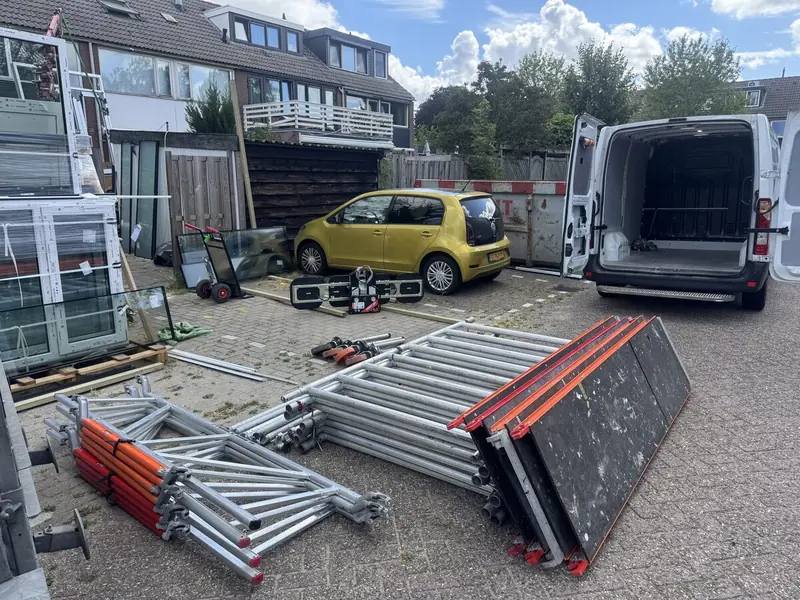
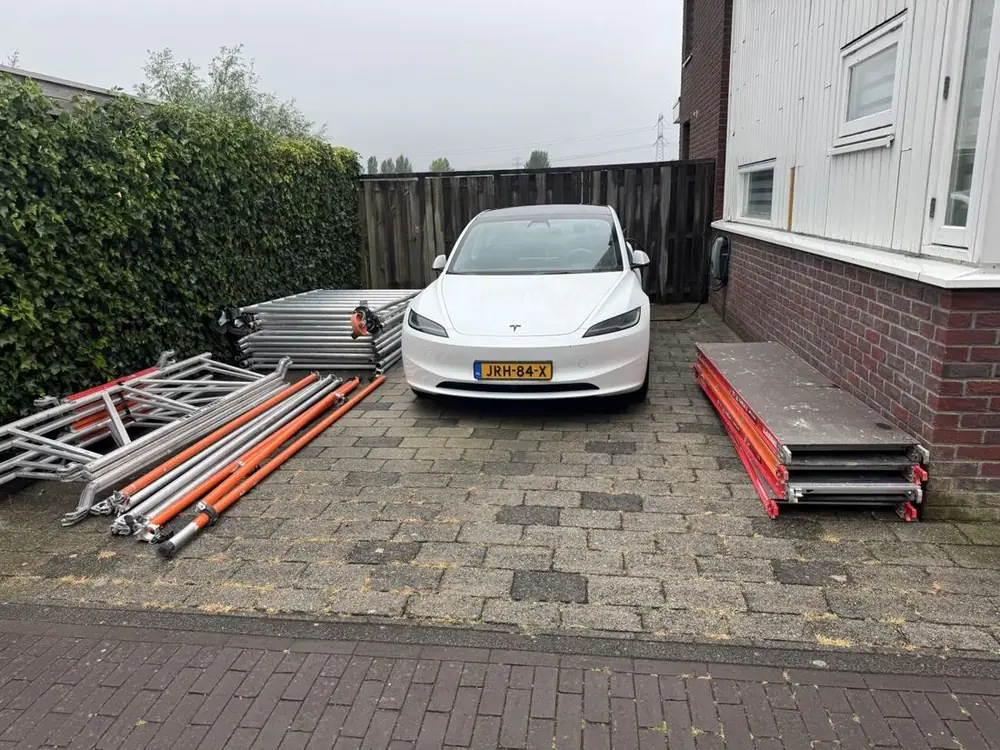
Order before 15:00 and the scaffold is delivered the next working day, anywhere in the Netherlands. That makes it possible to plan a job without ordering days ahead, for instance when the weather suddenly turns in your favour. What you do need is a spot where the driver can leave the parts: a drive, a pavement or a garden path that can be reached. Keep that spot clear, because the set arrives in parts and takes up room.
The exact amounts per region are on the delivery costs page, and the background on how transport is calculated is set out under the cost of having a scaffold delivered. In the configurator the amount for your province is added to your total automatically, so you need not look anything up. Where we deliver is listed on our page of service locations.
Collecting the scaffold yourself in Amsterdam
If you are in or near Amsterdam, you can collect the scaffold yourself free of charge by appointment at Zeeburgerpad 89. The transport amount then disappears entirely, which on a short job removes a sizeable share of the total. You book the slot in advance so the set is ready and you are not standing around while parts are gathered. Arrive with a van or a trailer and you are usually away again within a quarter of an hour.
Collecting does require the right vehicle or trailer. The parts of a mobile scaffold are light individually, but they are long, and a platform of 245 centimetres does not fit in every load space. Measure your loading length beforehand and check with us if you are unsure, because a second trip quickly wipes out the saving. The guide on hiring a mobile scaffold without a trailer sets out your options if you cannot transport anything yourself.
Note that collection carries a higher deposit than delivery, because the equipment then travels outside our own transport. For the narrow and wide mobile scaffolds that difference is largest, while for the room scaffold nothing changes. If you want to know which route suits your situation better, we are glad to think along through contact or on WhatsApp about driving yourself versus having it delivered.
The deposit per model and when it returns
The deposit is a security amount rather than a cost. You advance it when booking and receive it back in full within one working day after return, provided the scaffold comes back complete and undamaged. The amount differs per model and depends on whether we deliver or you collect. The table below shows exactly what applies in each situation, so you know which share of your payment is temporary.
Returning everything is by far the most important condition. One toe board or a loose brace left behind in the garden holds up the whole settlement and costs you days. When dismantling, run through the parts list once more, stack everything in one place and count the platforms and guardrails separately. How that check works in practice is covered in the guide on getting your scaffold deposit back.
| Model | Deposit on delivery | Deposit on collection | Returned after hire |
|---|---|---|---|
| RS51 narrow mobile scaffold | 500 euro | 1000 euro | Within 1 working day |
| RS52 wide mobile scaffold | 500 euro | 1000 euro | Within 1 working day |
| MiTower | 500 euro | 750 euro | Within 1 working day |
| RS44 room scaffold | 150 euro | 150 euro | Within 1 working day |
Model and working height decide the rate you pay
Across the range, working heights run from 4.2 to 14.2 metres, and the rate follows that scale. A taller scaffold simply consists of more frames, more braces and more platforms, and those extra parts are in the price. So the question is not which scaffold reaches highest, but which working height your job genuinely needs. Choosing one size too tall costs money and carrying work, because you build up parts you then never use.
Working height equals platform height plus two metres, because an adult reaches roughly two metres above the platform. Anyone working up to a gutter at seven metres therefore needs a platform at five metres rather than seven. That two-metre difference quickly saves a couple of frames and with them a step in the rate. The working height page gives an overview per size of what you can actually reach.
The model then sets the width and with it the price bracket. The mobile scaffold in its narrow RS51 form is 75 centimetres wide, the wide RS52 measures 135 centimetres, and both carry a platform 245 centimetres long. For straightforward work up to six metres working height the MiTower is a compact single-user option, and for indoor work the room scaffold is the cheapest model.
What the hire includes and what you arrange yourself
The hire gives you a complete Altrex set to EN 1004, with all the frames, braces, platforms, guardrails, toe boards and stabilisers that belong to that build. Load class 3 means the platform takes 200 kilos per square metre, so tools, paint and material can come up with you. You therefore never have to hire anything extra to work safely and completely, and no separate line items for parts appear on the bill.
What is not included is assembly. Steigertaxi does not deliver the scaffold assembled and does not build it for you: you put it together yourself using the supplied manual and the instruction video. That keeps the price down considerably and takes little time on most sizes, certainly with two people. The guide on hiring a scaffold including assembly explains which options do exist if you would rather outsource that.
- A complete Altrex set to EN 1004, in load class 3
- Guardrails, toe boards and stabilisers belong to the set
- Manual and instruction video for assembling it yourself
- Delivery and collection at a fixed amount per province
- A deposit returned within one working day after the hire
- Advice up front through WhatsApp on model and height
Working out your own job in the configurator
The quickest way to know what your situation costs is the configurator on the homepage. You pick the model, the working height and the start and end dates, and the total appears including transport and deposit. In a few clicks you can compare whether an extra day or a different model works out better. If your planning shifts, you move the dates and see at once what that does to the amount.
Start with the height, not with the model. Measure from the ground to the point where you have to work and subtract two metres to find the platform height. On the gutter of an average terraced house you often land on eight metres working height. For work at a window on the second floor, that page shows which sizes fit, including what you just about reach and what you do not.
Then choose the width. Narrow works well on a tight pavement, a garden path or between two houses, while wide gives more base area and more room to set material down beside you. If you hesitate, the answer usually lies in the ground surface and the access route rather than in the job itself. So measure that narrowest passage before ordering, because that is where the choice is really made.
Costs you avoid by measuring up in advance
The most expensive mistake is a scaffold that does not suit the situation. A set that is too low means overreaching anyway or having a second size delivered, with transport charged again. A set too wide for the access route stands idle for half a day while you work out a solution or carry it around the house after all. Both problems cost more than the ten minutes of measuring you could have done first.
So measure three things before ordering: the height up to your work point, the width of the narrowest passage to the spot where the scaffold must stand, and how level the ground is. Loose paving, a sloping drive or soft garden soil call for base plates and for extra care while levelling. A projecting roof edge or a conservatory below your work point also decides which model you need.
The mobile scaffold hire checklist walks through those points step by step, from measurements to storage on site. If you are still unsure, send a photo of the situation on WhatsApp and we will look at which size and model fit. That costs nothing and prevents exactly the second trip that throws your budget out, and it usually takes a single message rather than a phone call.
When hiring stays cheaper than buying
For anyone working at height a few times a year, hiring is almost always the cheaper route. You pay only for the days you use it, you do not have to free up storage space, and you do not have to check or replace equipment yourself when a part gives out. The trailer needed to move a scaffold you own also drops out of the sum, and for private customers that is often the hidden cost.
The tipping point lies in frequency rather than in the number of days per job. Anyone needing a scaffold monthly or more often, and who already has the storage standing empty, ends up somewhere different over time than someone painting the facade once a year. That trade-off is worked out in full in the guide on hiring or buying a scaffold, including the points that are easy to forget.
For companies there is the added point that hired equipment always arrives in its current specification and that no capital sits tied up in kit standing idle between two projects. The guide on hiring or buying for companies covers planning, running several projects at once and the difference between fixed and variable costs. If you run several crews, hiring also means taking exactly as many sets as that week demands.
Frequently asked questions
Do the prices include VAT?
Yes, all amounts include VAT. What you see in the configurator is what you settle. Alongside the hire and the transport, the deposit appears as its own line, and that comes back once the scaffold is returned.
What happens if my job overruns?
You extend the hire period and pay 5 percent of the day rate for each extra day. Let us know so the collection trip can be moved. Because follow-on days are so low, overrunning is rarely a problem for your budget.
Do I pay separately for collection?
No, delivery and collection sit together in one fixed amount per province. You pay it once, however many days the scaffold stands with you. Only when you collect it yourself by appointment does it disappear entirely.
How quickly can the scaffold be there?
Order before 15:00 and we deliver the next working day, anywhere in the Netherlands. Make sure there is a reachable spot to leave the parts. If you are in Amsterdam, you can also collect the same set by appointment.
Why is the deposit higher when I collect?
Because the equipment then travels outside our own transport. For the RS51 and RS52 collection means 1000 euro against 500 euro on delivery. On the room scaffold the deposit is 150 euro either way.
Does a taller scaffold cost more?
Yes, because a taller build consists of more frames, braces and platforms. So choose the working height that matches your work point rather than the tallest size available. The range runs from 4.2 to 14.2 metres working height.
Is assembly included in the price?
No, you assemble the scaffold yourself with the supplied manual and the instruction video. We do not deliver it assembled and do not build it for you. That keeps the hire price low and takes little time on most sizes.