
Knowledge base · reading time 10 min
Deposit when hiring a scaffold: how it works
The deposit is the amount held temporarily when you hire a scaffold. It is not rent and not insurance, but security you get back in full as soon as the equipment is returned complete and undamaged. Below you will find what you pay per model, why the amount differs between delivery and collection, and exactly what to do to get the money back without fuss.
- How much deposit do you pay for a scaffold, why is it higher on collection and when do you get it back? All deposit amounts per model.
- Yes, as long as the scaffold is returned complete and undamaged you get the whole amount back.
- Within one working day of the return.
- No, the deposit is an amount per scaffold, not per day.
What the deposit is and why it is asked for
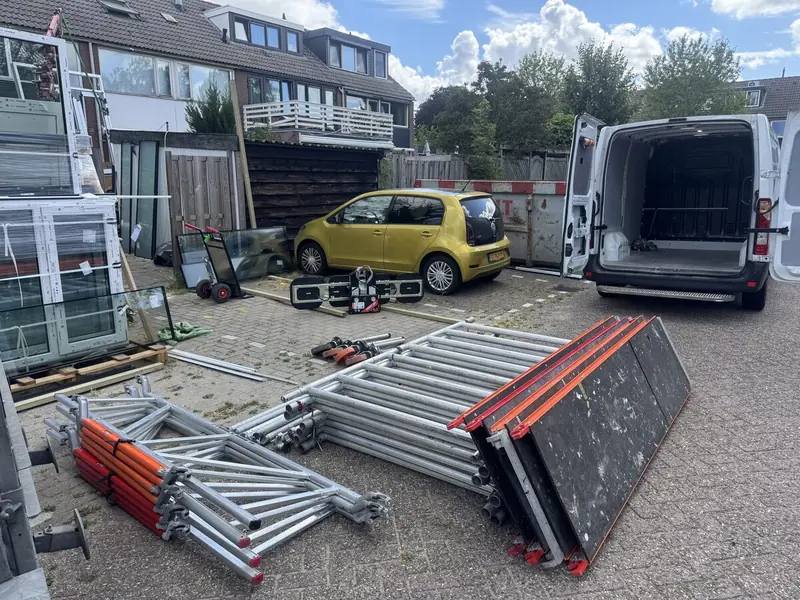
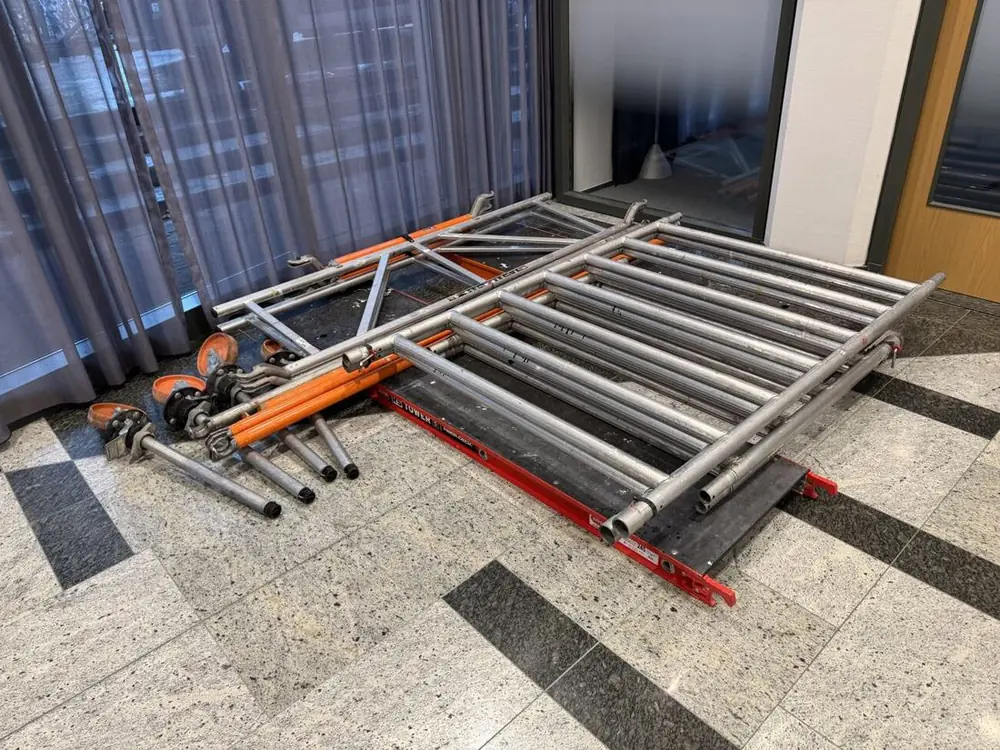
A mobile scaffold is not a single item you carry off in a case. You hire dozens of separate components: frames, platforms, braces, guardrails, toe boards, castors and stabilisers. They spend a week crossing your garden, sitting beside the wall and ending up on a pile. The deposit covers the risk of parts going missing or coming back damaged, and that risk belongs to loose equipment rather than to any particular customer.
The amount is entirely separate from what you pay to hire. It buys nothing and it is not an advance on the hire price, it is a hold you get back. The deposit page lists the amount per model, and on your booking confirmation it appears as its own line alongside the hire and the delivery charge. That keeps it visible which part of the total will find its way back to you.
In practice almost everyone gets the full amount back. Components rarely go missing outright, but they do go astray for people who scatter the equipment across three corners of a garden and then forget two toe boards. Most of the trouble is avoided simply by keeping track of what you put where from day one. One fixed corner of the garden for the equipment works better than spreading it along the whole facade.
Key facts
| Feature | Value |
|---|---|
| Core answer | Set returned complete and undamaged = deposit back within 1 working day |
| Deposit | Refunded within 1 working day of return |
| Delivery | Ordered before 3 pm, delivered next working day |
| Each extra day | 95% off: €2.50 to €16.25 a day |
| Collection | Free by appointment, Zeeburgerpad 89 Amsterdam |
How much deposit you pay per model
If you have the scaffold delivered, the deposit is 500 euro for the RS51 and the RS52 and also for the MiTower. For the RS44 room scaffold the deposit is 150 euro. The difference reflects the size of the sets: a room scaffold is a compact unit for indoor work, whereas an RS52 at full height consists of a considerable number of frames and braces. The deposit therefore follows the size of the set rather than the height you hire.
If you collect the scaffold yourself, the amounts are higher. For the RS51 and the RS52 the deposit is then 1000 euro, for the MiTower 750 euro and for the room scaffold again 150 euro. So it is not a percentage of the hire price or of the height, but a fixed amount per model and per method of transport. You know the figure before you have picked a date or a working height.
It is worth setting that amount aside before you book, particularly if you are working with a business account or a card with a limit. The table below sets the four models side by side, with the deposit on delivery and the deposit on collection. On a credit card the amount sits against your available limit until the refund arrives, which can pinch if you also need to buy materials that week.
| Model | What it is | Deposit on delivery | Deposit on collection |
|---|---|---|---|
| RS51 | Narrow mobile scaffold, 75 cm wide | 500 euro | 1000 euro |
| RS52 | Wide mobile scaffold, 135 cm wide | 500 euro | 1000 euro |
| MiTower | One-person scaffold, up to 6 metres working height | 500 euro | 750 euro |
| RS44 | Room scaffold, fits through an internal door | 150 euro | 150 euro |
Why the deposit is higher when you collect
With delivery the transport stays in our hands. Our driver drops the equipment off, collects it again and counts it back in. The set does not travel on an unfamiliar trailer and it returns along a fixed route. When you collect, that entire journey is yours, from loading at Zeeburgerpad to bringing everything back, and that is what the higher deposit reflects.
Collection is free, by appointment, at Zeeburgerpad 89 in Amsterdam. It saves you the cost of delivery and collection, which is a fixed amount per province. What that fixed amount is for your address is set out on the delivery costs page. The trade-off is straightforward: lower costs with a higher deposit, or higher costs with a lower deposit. If you live a long way from Amsterdam, collecting rarely works out well once you count the driving time both ways.
For the room scaffold it makes no difference at all, since it stays at 150 euro either way. For the RS51 and the RS52 the difference is an extra 500 euro held temporarily. You are not losing that money, but it does sit somewhere other than your account for the length of the hire. For the MiTower the gap is smaller, 250 euro between delivery and collection, because it is a more compact set.
When you pay the deposit and when you see it again
You pay the deposit when you book, together with the hire and any delivery charge. It appears on your confirmation as its own line, so you can see later exactly which part of the total comes back and which part does not. That helps your own bookkeeping and it also helps when you pass the job on to a client. Keep that confirmation until the deposit is back, so you have the right figure to hand if a question comes up.
The refund is quick: once the scaffold is back complete and undamaged, the deposit is returned to your account within one working day. Returned means the moment our driver takes the equipment away, or the moment you hand it in yourself. There is no inspection report to wait for and no need to chase it up. If you see nothing after two working days, a short message is enough to have it looked at.
Just watch the word working. If the scaffold is collected on a Friday afternoon, the refund lands on Monday rather than over the weekend, and the same applies around public holidays. It is not a delay, only a question of which days count. The same principle applies at the start of the hire: order before 15:00 and the scaffold arrives the next working day, and there too the weekend does not count.
What complete and undamaged means in practice
Complete means every component you received goes back, including the small items that are easy to leave behind. A set is not complete without its toe boards, and a frame without its diagonal braces is unusable for the next customer. Undamaged means components may show normal signs of use, but should not come back bent, cracked or filled with dried material. A scratch or a scuff from ordinary use is part of the deal and costs you nothing.
Paint and cement are the classic cases. A spot of paint on a frame is nothing unusual, but a platform with half a tin of wall paint cured onto it is a problem for whoever works on it next. Cover the platform when you work with liquids and you save yourself a conversation at the end. What a full set contains is set out in the hire checklist.
- All frames, platforms, braces, guardrails and toe boards are back
- The castors are still fitted or lying loose with the stack
- The stabilisers are complete, including their clamps
- There is no cured paint, glue or cement on the platforms
- Nothing is bent from a fall or from being overloaded
- The components are sorted rather than scattered across the site
The components that most often get left behind
Nobody forgets a frame. What does get left are the small, flat components you set aside halfway through the job: a toe board behind the shed, a clamp in the hedge, a castor you took off to lever the scaffold into position. Those items only come to mind once the lorry has already gone. Those same small parts are also the hardest ones for the next customer to do without.
The simplest remedy is discipline at the start. When you unpack, sort everything by type in one fixed spot and return anything you detach straight to that spot. At the end, walk the stack with the list from the mobile scaffold hire checklist and tick off what you can see. Do that in daylight rather than in the half dark of the last working day.
- Toe boards, which often end up leaning against a wall or fence
- Stabiliser clamps, small and easy to overlook
- A loose castor taken off to move the scaffold
- A diagonal brace removed from an intermediate level
- The manual, which tends to stay indoors or in the van
Preventing damage during the job
Most damage happens on the ground rather than on the platform. Components dropped down from height instead of handed down arrive bent. A frame thrown flat onto paving picks up a dent in the tube and then fits its spigots less easily. Handing parts down takes a few seconds longer and prevents exactly this kind of damage. Put a couple of planks or an old blanket down where the components will land if the surface is hard.
Watch the loading as well. The platforms are built to EN 1004 in load class 3, which is 200 kg per square metre. That is ample for two people with tools, but a stack of tiles or roof tiles on half a square metre is a very different point load. Spread heavy materials along the length of the platform instead. Put a bucket of mortar or a stack of tiles over a frame rather than in the middle of a span.
If the scaffold stands outside between working days, leave it empty with the brakes on. Loose material on the platform can blow off and damage both the scaffold and its surroundings on the way down. The guidance on tying down and stabilising is in stabilising and anchoring a mobile scaffold. Do not just lock the castors either, but turn them inwards as well, so a gust cannot walk the scaffold in any one direction.
Getting the scaffold ready for collection day
Dismantle in reverse order: toe boards and guardrails first, then the platforms, then the braces and the frames. Work from the top down and throw nothing off the side. Sort the components by type as you go and you avoid a sorting job at the end, while immediately seeing whether anything is missing. Dismantling is usually quicker than assembly for that reason, provided you do not start stacking in the wrong place halfway through.
Put the stack somewhere the driver can actually reach. Behind a locked gate, in a back garden with no through access or behind a parked car all cause delays. A reachable stack by the drive or at the kerbside saves everyone time. The full method is in dismantling and returning a mobile scaffold. If the stack ends up on the pavement, keep the footpath clear and do not lean anything against a lamp post or a cycle rack.
If you are not at home on collection day, agree where the equipment will be waiting and make sure it is accessible. As long as everything is there and complete, the deposit refund runs its normal course. Do not leave components in the shed or the garage in that case, because the driver only takes what is standing there. Anything left behind counts as missing at the count.
Bringing the scaffold back to Amsterdam yourself
If you collected the scaffold, you also return it yourself to Zeeburgerpad 89 in Amsterdam, by appointment. Allow a little time: the equipment is counted back in, and once that is done the refund starts. On collection terms that means 1000 euro for an RS51 or RS52, 750 euro for a MiTower or 150 euro for a room scaffold being released.
Load the components sorted and strap them down. Frames that slide against each other during the drive arrive damaged. A blanket and a couple of ratchet straps solve it. That is not only in our interest: damage that happens during your own transport falls inside the period the deposit covers. Measure your trailer beforehand as well, because the platforms of the RS51 and the RS52 are 245 cm long.
Keeping deposit, hire price and delivery costs apart
Three kinds of amount appear on your confirmation and all three behave differently. The hire is payment for use: the first hire day is the full rate and every following day costs a further five percent of that daily rate. A longer period therefore becomes cheaper per day quite quickly. What that means for your job you can work out via the prices page. Over a week-long job the gap with a single day is therefore smaller than most people expect.
Delivery and collection together form a fixed amount per province. It is not a per-kilometre charge and it does not change with the length of the hire, so it weighs more heavily on a short hire than on a long one. How that is built up is explained on the cost of having a scaffold delivered. If you live close to Amsterdam you can avoid that amount altogether by driving over yourself, in exchange for the higher deposit that comes with it.
The deposit is the only one of the three that comes back. Anyone costing out a job therefore leaves it out of the total. How long to hire for, and why one extra day rarely matters much, is covered in how many days to hire a scaffold. When you budget a job, count the hire plus the delivery charge and leave the deposit out of it entirely.
What to do if something has gone wrong
If something went wrong along the way, report it yourself before the driver arrives. A broken toe board or a component that genuinely cannot be found does not resolve itself by being buried at the bottom of the stack. Reporting it means you know where you stand in advance, rather than hearing about it after the count. Reporting a damaged component is not a penalty either, it is simply information.
If you are not sure whether something counts as damage, send a photo. On WhatsApp you usually get an answer within a few minutes, and otherwise you can reach us through the contact page. If your question is not covered here, the frequently asked questions may help. A photo of the component and of where it sat is usually enough to judge what is needed and whether it affects your deposit.
Frequently asked questions
Do I always get the deposit back in full?
Yes, as long as the scaffold is returned complete and undamaged you get the whole amount back. Nothing is withheld for signs of use, cleaning or hire days. Only missing or damaged components are a reason to deduct anything.
How quickly is the deposit back in my account?
Within one working day of the return. The clock starts the moment the driver takes the equipment away or you hand it in yourself. If that falls on a Friday, you will see the amount on Monday.
Do I pay a deposit per hire day?
No, the deposit is an amount per scaffold, not per day. Whether you hire for two days or two weeks, the deposit stays the same. Only the hire runs on, with every day after the first costing five percent of the daily rate.
Can the deposit be offset against the hire price?
No, the two are separate and are handled separately. The hire is payment for use and does not come back; the deposit is a temporary hold and does. That is why they appear on separate lines on your confirmation.
What happens if a component is missing?
Report it before the equipment is collected and you will know where you stand straight away. A missing part often turns up behind a shed or in the van after all. If it really is gone, it is settled against the deposit and you get the remainder back.
How much deposit do I pay for a room scaffold?
For the RS44 room scaffold the deposit is 150 euro, and that is the same whether you have it delivered or collect it yourself. The set is compact and consists of considerably fewer components than an RS51 or RS52 at height.
What if I want to keep the scaffold longer?
That is possible, just let us know. The deposit does not change, because it is tied to the model rather than to the duration. Only the hire runs on, and each extra day costs five percent of the daily rate, so extending is rarely expensive.