
Knowledge base · reading time 11 min
Stabilising and anchoring a mobile scaffold
Things rarely go wrong on the platform of a mobile scaffold. They go wrong at the bottom: a stabiliser that was never tightened, a castor sinking into a flower bed, or a scaffold left standing over the weekend while the wind picked up. Stabilising and anchoring are not loose extra steps at the end, they belong to the build itself and they have a fixed order.
- Fitting stabilisers, checking the ground, choosing anchor points and working in wind. Practical guidance on setting up a mobile scaffold securely.
- They are required at greater heights, and the manual for your configuration states from which build they apply.
- Often yes, by tying around a load bearing element rather than drilling.
- The equipment is built to load class 3 under EN 1004, which is 200 kg per square metre.
What makes a mobile scaffold tip
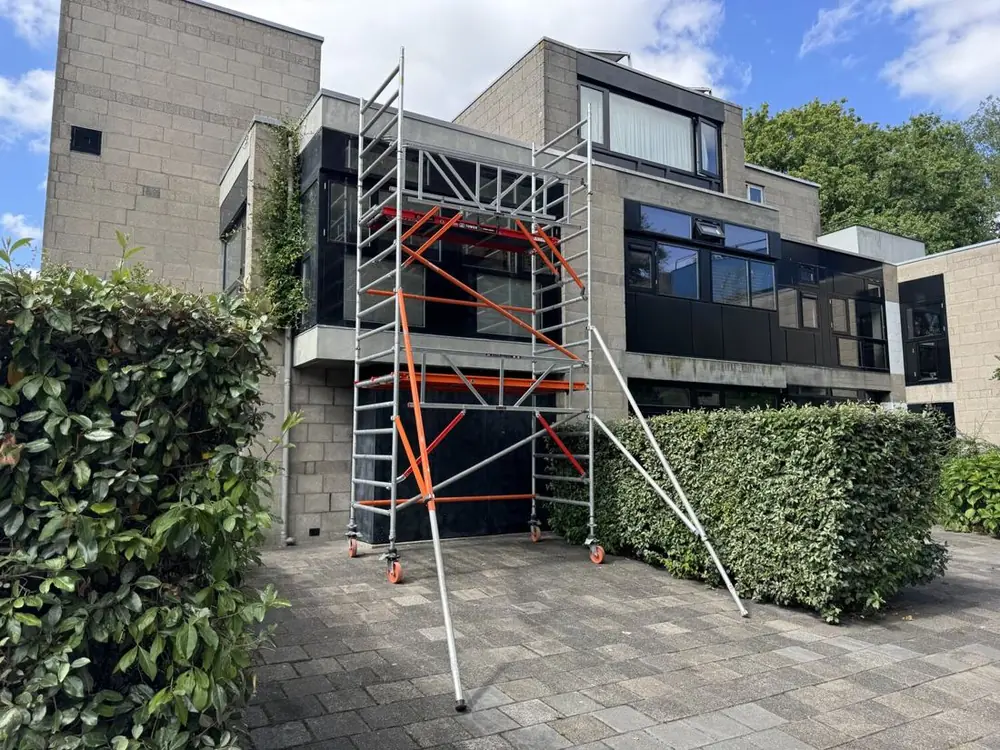
A mobile scaffold is a narrow, tall structure on castors. The higher you build, the smaller the support base becomes relative to the height, and the less sideways force is needed to upset the balance. That force almost never comes from the scaffold itself: it is wind against the facade side, someone reaching too far over the guardrail, or a drill binding in hard masonry.
Tipping always starts around a castor. As soon as the centre of gravity passes outside the imaginary line between two support points, the scaffold rotates about it. Stabilisers and outriggers do exactly one thing: they push that tipping line further out. They carry almost no weight themselves, they enlarge the area within which your centre of gravity may wander. A half extended stabiliser therefore does half a job.
Anchoring tackles the same problem from the other side. An anchor ties the scaffold to the building, so the facade absorbs the sideways force instead of the castors. That is the answer when you cannot fully deploy the stabilisers, for example in a narrow alley or hard against an extension, and when the scaffold stays up for several days. For the upper limits, see how high a mobile scaffold may be.
Key facts
| Feature | Value |
|---|---|
| Core answer | Fit stabilisers according to the assembly scheme in the manual |
| Standard | EN 1004 |
| Load class | Class 3: 200 kg per m² |
| Castors | Swivel castors with brakes, locked while in use |
| Wind | Work up to wind force 6 |
Fitting stabilisers before you build higher
The order matters more than how hard you tighten. Set down the base frame with the castors, lock the brakes, and fit the stabilisers at all four corners before you insert the first build frames. Anyone who builds three metres first and only then decides to add the braces ends up working at the bottom of a structure that can already move, which is the worst possible moment for that job.
A stabiliser runs diagonally outwards and downwards, with the foot flat on the ground. Tighten the clamps on the upright and adjust the foot so that it genuinely bears load: you should not be able to rock it with one finger. Then walk all four corners, because a foot tightened too far lifts one corner and takes weight off a castor.
Every single build height has its own matching stabiliser position. That is set out in the Altrex manual supplied with the scaffold, with a separate drawing for each configuration. Follow it rather than guessing, because the angle and the reach together decide how wide your support base really becomes. The full build sequence is covered in the step-by-step assembly guide.
What the width of your scaffold does for stability
An RS51 is 75 cm wide and an RS52 is 135 cm. Those 60 cm sit precisely in the direction in which a mobile scaffold tips first, namely across the facade. You choose the narrow RS51 because it fits through a gate or along a garden path, not because it works better. Where you have the room, the wider RS52 gives you more margin and more space to put materials down.
The platform length is 245 cm on both, so you cover the same run along the wall. The difference lies in the depth of your working area and in how much support you need at the base. For interior work there is the RS44 room scaffold, which passes through a standard internal door from around 70 cm. The MiTower is a one person scaffold reaching up to 6 metres working height.
| Model | Width | Platform length | Where it fits best |
|---|---|---|---|
| RS51 | 75 cm | 245 cm | Narrow passages, garden paths, tight alleys |
| RS52 | 135 cm | 245 cm | Facade work with materials on the platform |
| RS44 room scaffold | Fits a standard internal door from about 70 cm | Interior work | Ceilings, stairwells, tall walls |
| MiTower | One person scaffold | Up to 6 metres working height | Shorter jobs carried out by one person |
The ground under the castors
Stabilisers achieve nothing if the ground beneath them gives way. A castor on a paving slab that rocks, or a stabiliser foot on grass that sits ten centimetres lower after a night of rain, changes the whole build. So walk the area first, and look not only at where the castors go but also at where the four feet will land.
On soft or loose ground, use sole boards: a solid plank or panel that spreads the load over a larger area. That applies to grass, sand, soil and gravel, and to old paving where the bricks have worked loose. On a sloping pavement, level with the adjustable feet rather than the castors, because a castor loaded at an angle rolls away at the worst moment.
- Grass and soil: always use sole boards, even in dry weather.
- Sand or gravel: compact it and place a panel under each foot.
- Loose bricks: relay them flat or lay a plank across.
- Sloping pavement: level with the adjustable feet, never with wooden blocks.
- Manhole covers and gratings: not a bearing surface, so avoid them.
Levelling up and locking the castors
Levelling happens at the base frame, not halfway up. Put a spirit level in two directions on the lowest rung and adjust with the feet until both directions read true. A few millimetres out of level at the bottom becomes a visible lean at eight metres, and you only notice it once you are up there and the guardrail is not where your eye expects it.
Lock the brakes as soon as the scaffold is in position, and check them again before you climb. All castors braked, not two. A single free castor lets the scaffold slowly rotate while you work, which you only feel once you lean your weight to one side. Check at the same time that every castor is secured with its locking pin, because one sometimes slides up during loading. See also mobile scaffold on uneven ground.
When anchoring to the facade becomes necessary
Anchoring comes into play as soon as you cannot create the wide support base that your build height calls for. That happens more often than expected: a stabiliser meeting a fence, a corner landing above the neighbour's lower roof, or an alley with no room on either side. In each of those cases the facade takes over the work the stabiliser cannot do.
The second reason is time. A scaffold left up between two working days also stands there at night and at weekends, with nobody watching the wind. Anchoring does not mean you can leave the stabilisers off, by the way: the stabilisers keep the base wide, the anchor holds the top against the facade. How many anchor points you need is set out in the manual for your configuration. See also the rules for working at height.
Choosing anchor points on the facade
An anchor is only as strong as what you fix it to. Choose load bearing masonry, a concrete edge or a solid frame that is properly built in. What you do not use: the downpipe, the gutter, a gutter bracket, an awning or a timber fascia board. Those parts are built to carry their own weight, not a scaffold in the wind.
Place anchors symmetrically, left and right at the same height, and fix them so the scaffold can move neither towards the facade nor away from it. A tie that only takes tension still lets the scaffold knock against the wall with every gust. At the same time keep the gap between facade and guardrail small enough that nobody can step through it.
If you are working on a dormer or under a projecting roof edge, the position of your anchors is often the trickiest part of the whole build. Decide it before you start building, and not once you are already up there with a drill in your hand. For that kind of job the approach is described in putting up a scaffold for a dormer.
Wind, sheeting and banners
Wind is the force most often underestimated, because it feels different at ground level than at eight metres. Do not work on a mobile scaffold in wind force 6 or higher. If the wind builds during your job, stop, clear the platform and come down. An anchored scaffold may stay up; if it is standing free, take it down or reduce it to a lower configuration.
Scaffold sheeting, a tarpaulin or an advertising banner turns your scaffold into a sail. The area the wind can catch multiplies at a stroke, while the support base at the bottom stays exactly the same. So hang nothing on it that can catch wind, unless the configuration allows for it in the manual and the anchoring has been adjusted accordingly.
Loose items are the third wind factor. A bucket, an offcut of sheet material or an empty paint roller blowing off at eight metres is more dangerous to the people below than the scaffold itself. Clear the platform whenever you stop working, including at lunch. In winter, ice and frost are added to that; see hiring a scaffold in winter.
Spreading the load on the platform
The equipment is Altrex, built to EN 1004 in load class 3, which comes down to 200 kg per square metre. That is ample for normal facade work, but it is a distributed load and not a stacking area. Do not put heavy bags or bricks in one corner: that shifts the centre of gravity to an edge while the total weight stays within limits.
Pulling and pushing forces count just as much as weight. Jet washing a facade, prying loose a stuck window frame or a hose pulled taut all give the scaffold a sideways shove the stabilisers must absorb. So arrange your work to push downwards or towards the facade, never over the guardrail. More figures are given under loading and weight on a mobile scaffold.
Moving the scaffold without losing stability
Moving is the moment when everything you built stops working for a while. Nobody stays on the scaffold, full stop. First take tools, paint and materials off the platform, because they slide or fall as soon as the scaffold rolls over a threshold. Then wind the stabiliser feet just clear of the ground so they cannot snag, but leave the stabilisers themselves fitted.
Roll the scaffold lengthways and push low down rather than halfway up, because pushing at eye level produces exactly the tipping movement you want to avoid. In the new position the build check starts again: level up, adjust the feet, brakes on, stabilisers bearing load once more. An anchored scaffold is fully released first and anchored again afterwards. Never shuffle it half a metre with the anchors still attached.
The check before you climb
Walk the same round of the scaffold every working day before you climb it for the first time. It takes a minute or two and catches precisely the things that change overnight: a foot that has sunk after rain, a brake somebody released to get past, a guardrail knocked loose while materials were being unloaded. Do the round even when you are sure nobody has been near it.
If several people are working on the same job, agree who does the round and at what moment. For a scaffold standing on the street, also check that nothing has been hung on it and that no bicycle is leaning against a stabiliser. If you do find something, sort it out first, before the first person climbs rather than afterwards.
- Are all four stabilisers tight and are the feet bearing load?
- Are all castors braked and the locking pins in place?
- Is the scaffold level in both directions?
- Are the guardrails, toe boards and hatch in place?
- Are the anchor points still tight and undamaged?
- Is the platform clear and not slippery?
- What is the wind forecast for this afternoon?
What comes with the hire
At Steigertaxi you hire Altrex equipment built to EN 1004 in load class 3, covering working heights from 4.2 to 14.2 metres. The stabilisers that belong to your build height are included as standard, along with the manual and an instruction video showing the assembly step by step. You build the scaffold yourself, so keep that manual to hand and follow the sequence it sets out.
Order before 15:00 and delivery follows the next working day, anywhere in the Netherlands. Delivery and collection are covered by a fixed amount per province, shown on the delivery costs page. Collecting the scaffold yourself is free by appointment at Zeeburgerpad 89 in Amsterdam. What your job costs in total is worked out in the configurator on the pricing page.
The deposit on delivery is 500 euro for the RS51, the RS52 and the MiTower, and 150 euro for the room scaffold. If you collect yourself, the deposit is 1000 euro for the RS51 and RS52, 750 euro for the MiTower and 150 euro for the room scaffold. After return it is refunded within one working day. If you are unsure about the build or the anchoring, you can message us for advice.
Frequently asked questions
Are stabilisers required at every height?
They are required at greater heights, and the manual for your configuration states from which build they apply. They come as standard, so in practice you always fit them. Even on a low build, the scaffold still has to stand level with the castors braked.
Can I anchor a mobile scaffold without drilling into the facade?
Often yes, by tying around a load bearing element rather than drilling. Think of a solid window frame or a concrete edge that can take the force. What you never use are downpipes, gutter brackets, awnings and fascia boards. Ask us if you are unsure which solution suits your facade.
How much weight may the platform carry?
The equipment is built to load class 3 under EN 1004, which is 200 kg per square metre. That is a distributed load, so spread heavy materials instead of stacking them in one corner. Count your own weight and tools in the total.
What do I do if the pavement in front of the house slopes?
Level the scaffold with the adjustable feet, not with blocks of wood or stacked slabs. Lay a solid panel under the feet on the low side so the load is spread. Then check with a spirit level in both directions before building higher.
Does Steigertaxi assemble the scaffold for me?
No, you build the scaffold yourself. You receive the manual and an instruction video, and the scaffold arrives with the parts that belong to your build height. If you get stuck, we will think along with you over WhatsApp.
May the scaffold stay up overnight?
It may, provided it is anchored or properly stabilised, the castors are braked and the platform is clear. Check the forecast before you head home, because a free standing scaffold in rising wind is a risk. If a storm is expected, take it down or reduce it to a lower build.
Do I lose my deposit if a brace comes back damaged?
The deposit exists so the equipment comes back complete and undamaged, so report damage or a missing part to us straight away. On a normal, complete return the amount is back in your account within one working day. The deposit page explains this.