
See your price
Application

Painting work? Choose the right scaffold.

Painting work on most houses is not one job but a list: the frames facing the street, the front door, the timber under the roof edge and perhaps a rendered panel round the back. For a list like that you do not pick something different per item; you pick one build that reaches everywhere. That almost always turns out to be the narrow 75 cm tower, put up to somewhere between 4.2 and 8.2 metres. This page covers how you make that choice and how many hire days such a project asks for.

  • Order before 3 pm, delivered tomorrow
  • Professional Altrex scaffolds
  • Up to 14.2 metres working height
  • Easy to assemble yourself
4,2 tot 14,2 mWorking heights available
12Provinces served
7Days a week
200 kg/m²Load class 3
In short
  • For painting work we recommend the Narrow mobile scaffold.
  • For a whole painting project you hire one narrow tower that reaches everywhere, instead of finding something different for each separate item.
  • The highest point on your whole list decides the build you hire, which on ordinary houses lands between 4.2 and 8.2 metres.
  • Hire in one unbroken period, because the second day onward is cheap and a second delivery run is certainly not.
  • First 24 hours from €150 incl. VAT and delivery; every day after that 95% off.
Key facts for this job
FeatureValue
Recommended scaffoldNarrow mobile scaffold (Altrex RS TOWER 51)
Working height for this job4.2 to 8.2 metres
Available working heights4.2 to 14.2 metres
StandardEN 1004, load class 3 (200 kg per m²)
DeliveryOrdered before 3 pm, delivered next working day
Each extra day95% off, from €7.50 a day
Why a mobile scaffold for painting work?

Safe, stable and professional work at height

Painting work on a house rarely stays inside one plane. You start on the frames at the front, notice the board beneath them is also due, and weeks later you are standing at the back door. Anyone who arranges something separate per item spends half the season dragging ladders about. It plays out differently when you hire a mobile scaffold: you look for a build narrow enough for the path beside the house, tall enough for the highest timber and light enough to move on your own. From then on your attention goes to the paint and not to the question of how to reach it. So a painting project begins with a decision about hire, before you open a single tin.

  • Several elements inside one large painting project
  • Narrow enough for the path beside the house
  • Highest timber between 4.2 and 8.2 metres
  • Paint days that depend on the weather
Read more about working safely →

Which mobile scaffold to hire for painting work on a house

The narrow Altrex RS TOWER 51 is the version asked for most often when painting work is the reason. At 75 cm across it passes a garden gate, the alley between two houses and the gap between a hedge and the brickwork, which on a project with ten standing positions saves you carrying every single time. Just as important, you move it single handed, and that happens several times a day here. The complete line up sits under the different mobile scaffold builds on offer.

If two of you are painting, or the job is mostly large surfaces rolled on, the wider RS52 at 135 cm is the better buy. Two people pass each other on that deck and your paint kettle is not in the way. Either version gives you a platform 245 cm long, and that length settles how much wall or how many frames you finish per position before you climb down again. On loose frames you end up somewhere else each time regardless.
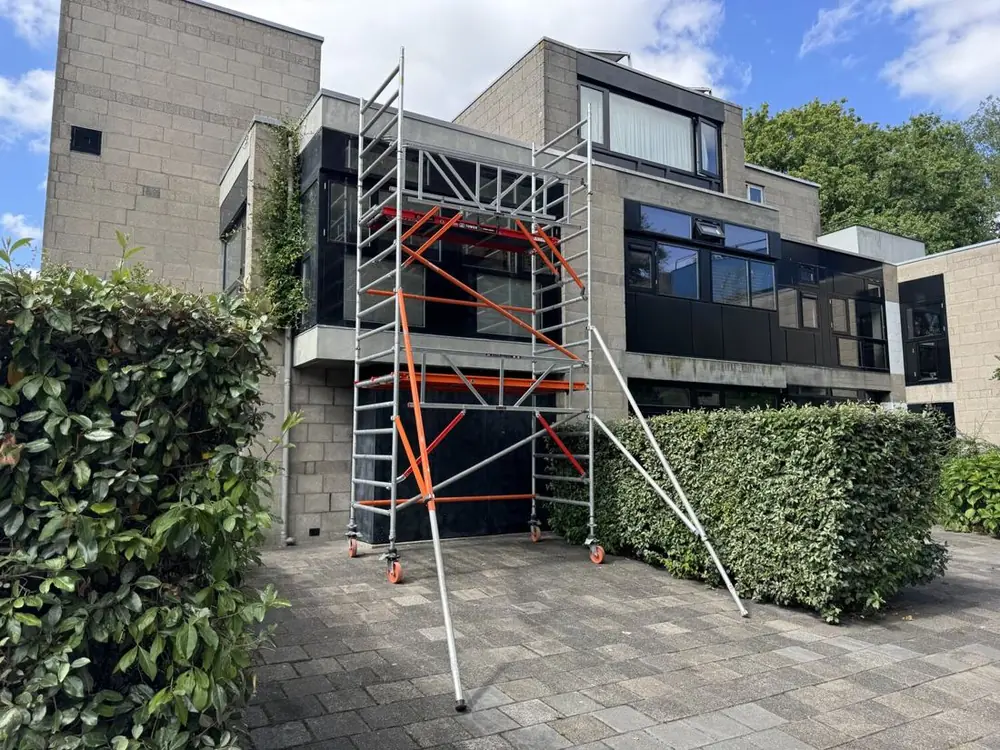
Assembled mobile scaffold with guardrails next to a dwelling, the single hire build that serves a whole project

If your painting work carries on indoors, that needs something separate. An RS44 room scaffold covers 3 to 4 metres and goes through an internal doorway from roughly 70 cm, which makes it usable over a stairwell, under a ceiling or along a tall wall. Working outside alone on something that stays under 6.2 metres, the one person MiTower with the same 75 cm width is enough. Which of the two suits your interior is shown at the room scaffold you can hire for indoor work.
Hiring the working height your highest element demands

Walk the whole list before you commit and write the height beside each item. It is not the average that counts but the highest point: if the frames sit on the first floor and the board below them runs on to the gutter, that board decides what you hire. On an ordinary terraced house the list ends somewhere between 4.2 and 8.2 metres of reach, and seldom above that. Note per item whether it faces front or back, because that sets your route later on.

Turning reach into a build is small arithmetic. Working height means the height of the platform with roughly two metres of reach added, so at 8.2 metres you are standing around six and can put a brush on the gutter with a straight arm. Take the tape from the paving on which the wheels will end up, and remember that the back of a house often sits lower or higher than the pavement at the front. Which build goes with that is on the page about eight metres of reach.

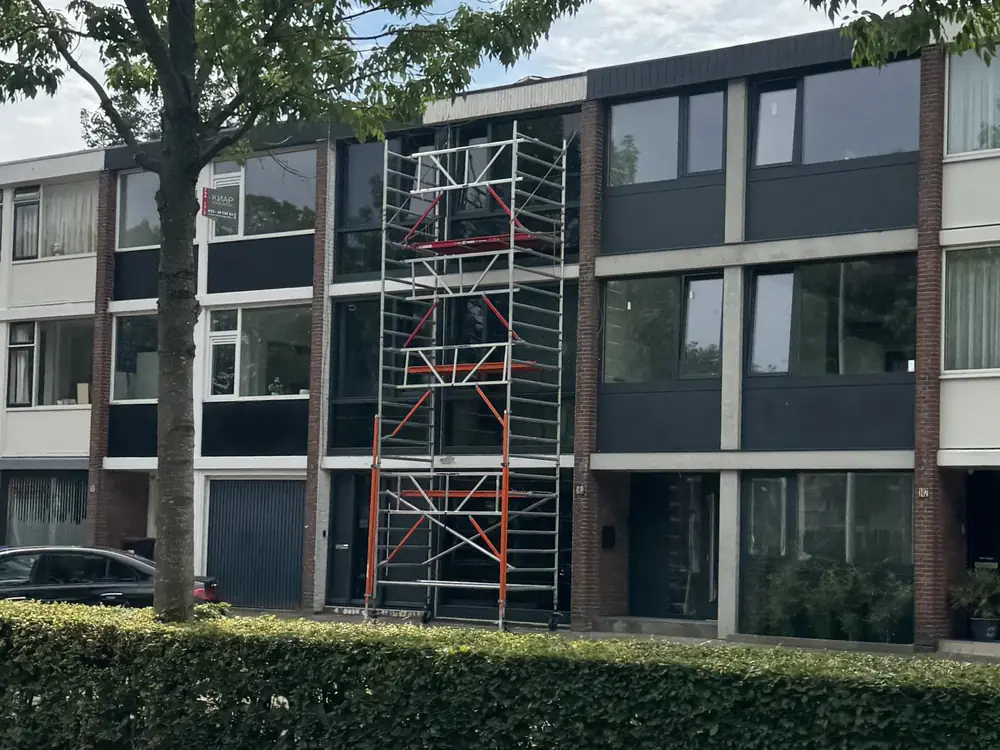
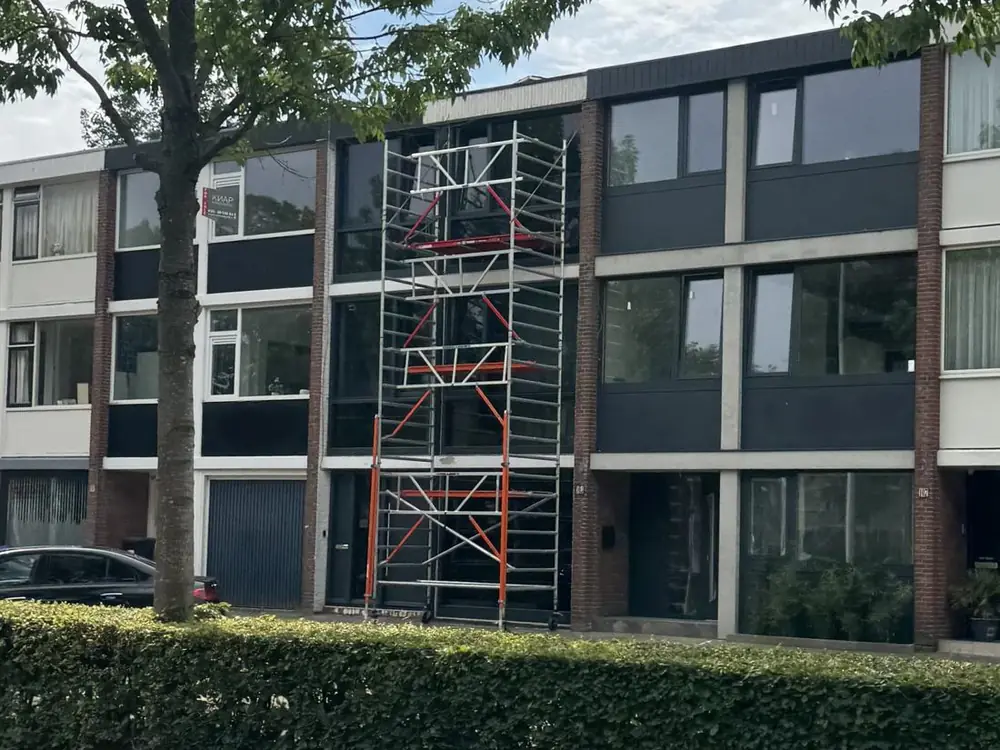
Mobile scaffold standing against a front elevation up to gutter level, the reach a highest element sets

Choosing tight only shows up at the last item on your project. Standing with your brush just under the top edge of a board, you stretch, lose the stroke and see it later in the gloss. On top of that you pay for a second delivery to cover that final half metre. For a list that runs up to the second floor of the house take the build above. At hire that is a few frames extra and nothing more.

Standing positions and the route your hired tower takes

A painting project has no single standing position but a route. You do the front from the pavement, shuffle past the bay to the side, go through the gate to the back and finish at the shed. Walk that route once with a tape in hand, because the narrowest gap on it decides the width you can hire and the softest ground decides where you will want base plates. If 75 cm already jams at the gate, your whole plan changes.

The surface under the wheels changes with every side of the house: block paving at the front, a drive at the side, terrace slabs and grass at the back. Allow for the four stabilisers that swing outwards and clear accordingly. The obstacles on painting work are predictable: a low hedge under the sill, an outside tap, a wheelie bin, and the buckets and tins you have just set down yourself. Move those along to the next position too. For a plot that slopes there is the guide to bracing and anchoring a tower.

Extended stabiliser legs bracing a mobile scaffold at street level, the ground each hire position must offer

Think about the days you are not painting as well. Between two coats the tower simply stands there, and you do not want it in front of the neighbours' door or in the middle of a footpath. Pick a spot where it can stay for a few days without being in anybody's way, and ask the council what applies if part of it lands on the pavement. That is better sorted out before you start than on your first painting day.

How many hire days a full painting project needs

Painting work is not counted in hours but in passes. First sanding and dusting off, then filling where needed, priming, and after that an undercoat and a top coat. Each pass runs along the same standing positions, and between two passes the paint has to be hard enough to go over. For the outside of an ordinary house that quickly comes to a week and a half on hire, while only a few of those days have a brush in them. Frames facing north dry more slowly than timber on the sunny side.

The weather takes a few more days out. Below about ten degrees most exterior paint dries slowly, in rain you do not start, and on a wall in full sun your coat closes too fast. Evenings count as well: dew settling on a fresh coat leaves it dull. So reckon in hire days rather than painting days, and leave air at the end of your period for the day that goes wrong. Look for a stretch where two dry days sit together, because each coat wants a day of its own.

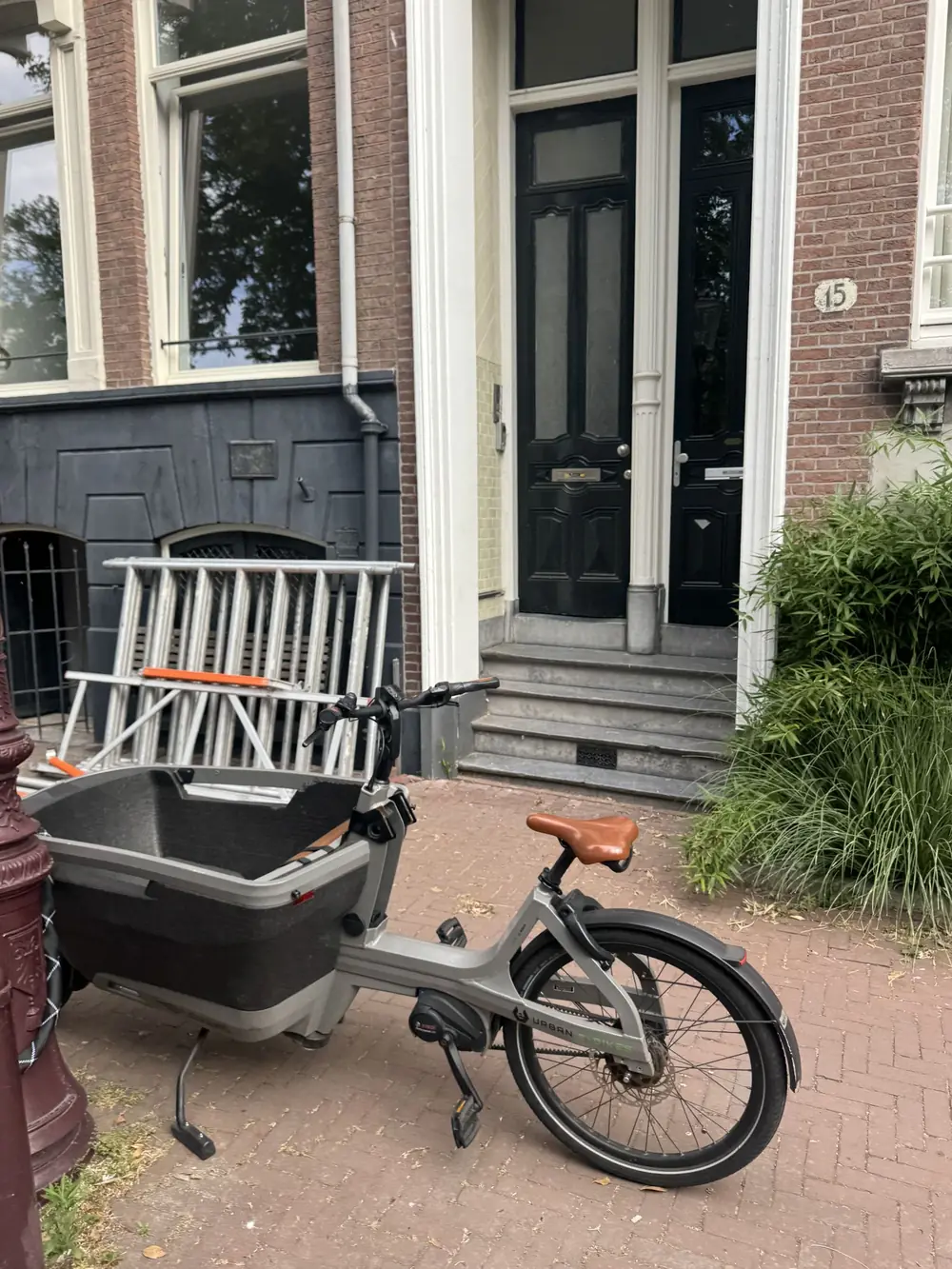
Guardrail frames and an orange brace propped by a front door, the hire set that waits out a painting week.

A long period is luckily not expensive here. The full rate applies to the first day and night alone; ninety five per cent then comes off every following day, so standing between two coats costs almost nothing. Striking the tower and having it come back later works out badly, because you then pay transport twice and build twice. What short and long booking really differ by is set out in the comparison of daily and weekly hire.

Which mobile scaffold suits painting work?

Kamersteiger RS44
  • Working height up to 4 metres
  • Compact and narrow
  • Great for indoor and small jobs
View and calculate →
Most chosen
Smalle rolsteiger RS51
  • Working height up to 14.2 metres
  • Narrow (75 cm)
  • Ideal for narrow passages
View and calculate →
Brede rolsteiger RS52
  • Working height up to 14.2 metres
  • Wide platform (135 cm)
  • Extra stability and workspace
View and calculate →
1-persoons steiger MiTower
  • Working height up to 6.2 metres
  • Very compact
  • Quick and easy to assemble
View and calculate →

Painting work per position: what one platform length covers

With 245 cm of deck you finish roughly two and a half metres of wall per position, or two to three frames above one another. On flat surfaces that goes quickly and you move often; on detail work a single position eats time because you sand, dust, mask and paint each window separately. Know in advance which sort of painting work sits where, because that settles whether a day holds three moves or three long stops.

Take up per position exactly what has to happen there and finish it all before you come down. A tin, a brush, a roll of tape, abrasive paper and a cloth is enough; haul the heavy things up on a line rather than carrying them under your arm. Hang your kettle on a hook at the guardrail instead of standing it on the floor, and then you cannot kick it over the edge either. Anything you carry up loose will end up being carried down again at the end of the day.

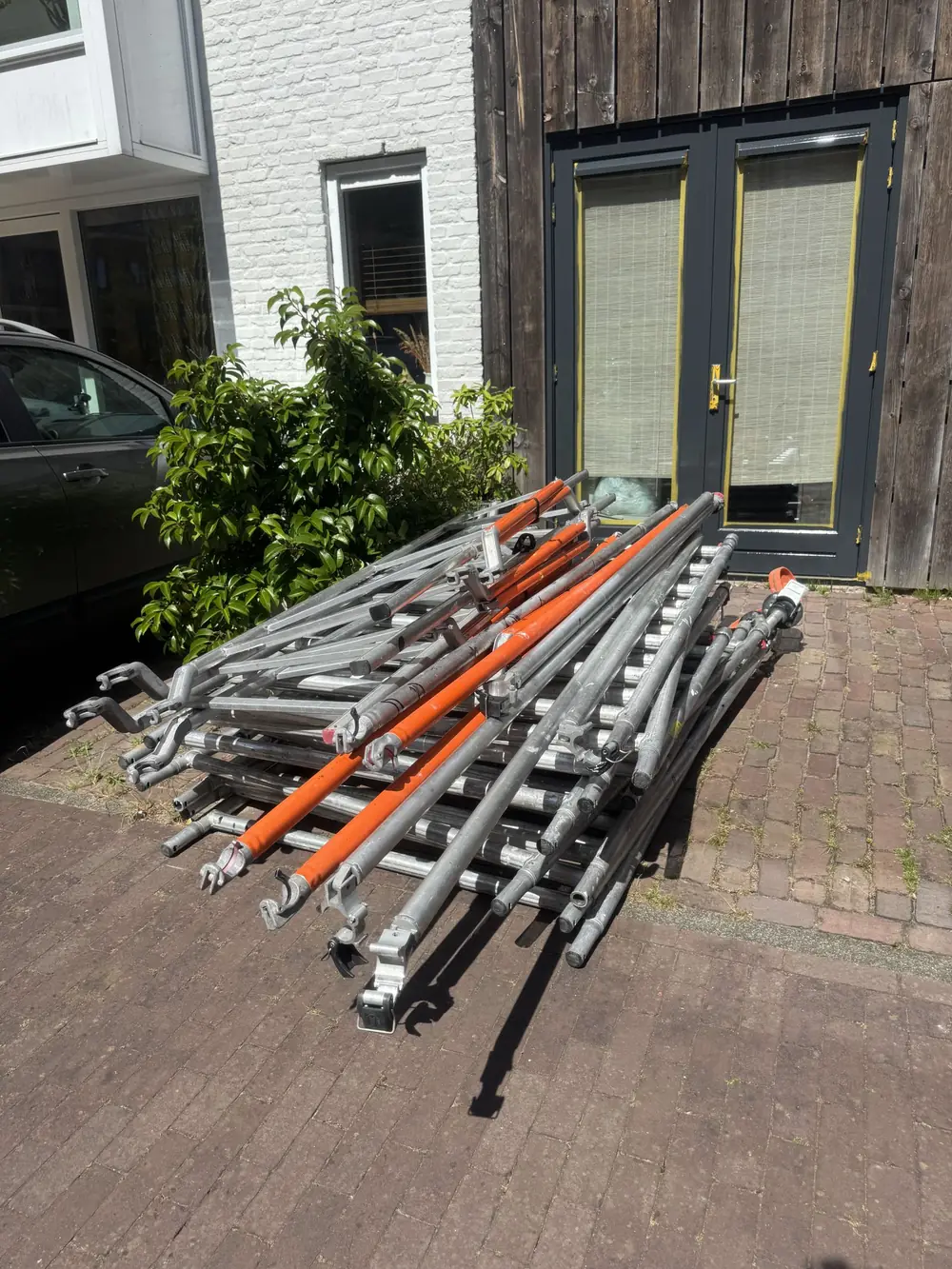
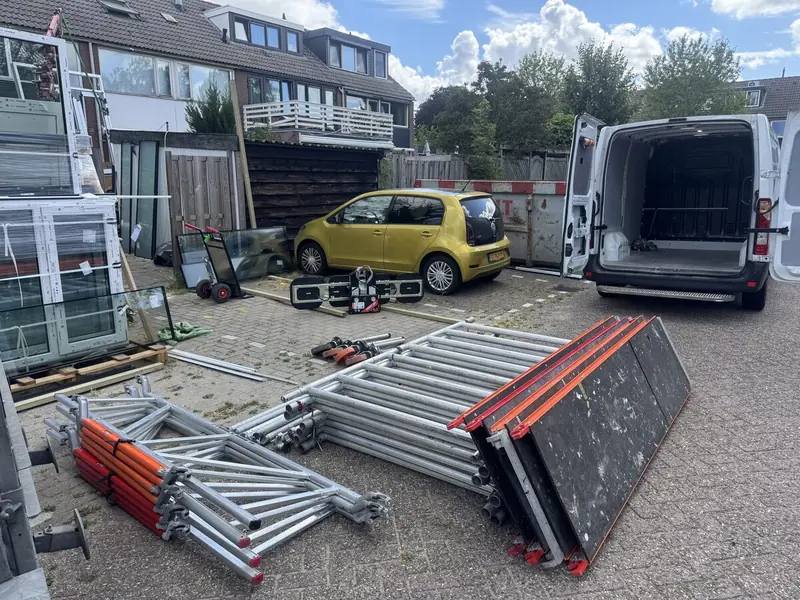
Frames, orange braces and tubes heaped on a brick drive, one hire set covering two and a half metres per position.

If your project consists of only one kind of painting work, different rules of thumb apply to the number of positions and the length of your hire. For that, go to the page on painting a facade from a hired tower or the one on timber painting at height, where each situation is worked out. On a mixed list you keep to the narrow version, simply because it reaches everywhere the timber is. Both pages assume you keep the same hired build for the whole run, moved rather than swapped.

Delivery and build day when hiring for painting work

A stack of loose parts is delivered to you, counted and complete, and during the rest of your project that stack does not go away. So choose a corner where it hinders nobody and where you can keep it dry. Keep it off a lawn if you can, because frames left on wet grass go back muddy. Finish the booking on a working day while it is still before three, and the parts arrive the working day after. That way you start building on a day the weather is with you.

The day it arrives and the day it leaves you fill in yourself at booking. For painting work put the arrival a day before your first sanding day, because building takes half a day and you want to do something after that. Building is your work: two people, layer by layer, with the manual and the video supplied alongside the set. Moving it and taking it down belong to that as well, which on a project with ten positions is worth knowing beforehand.

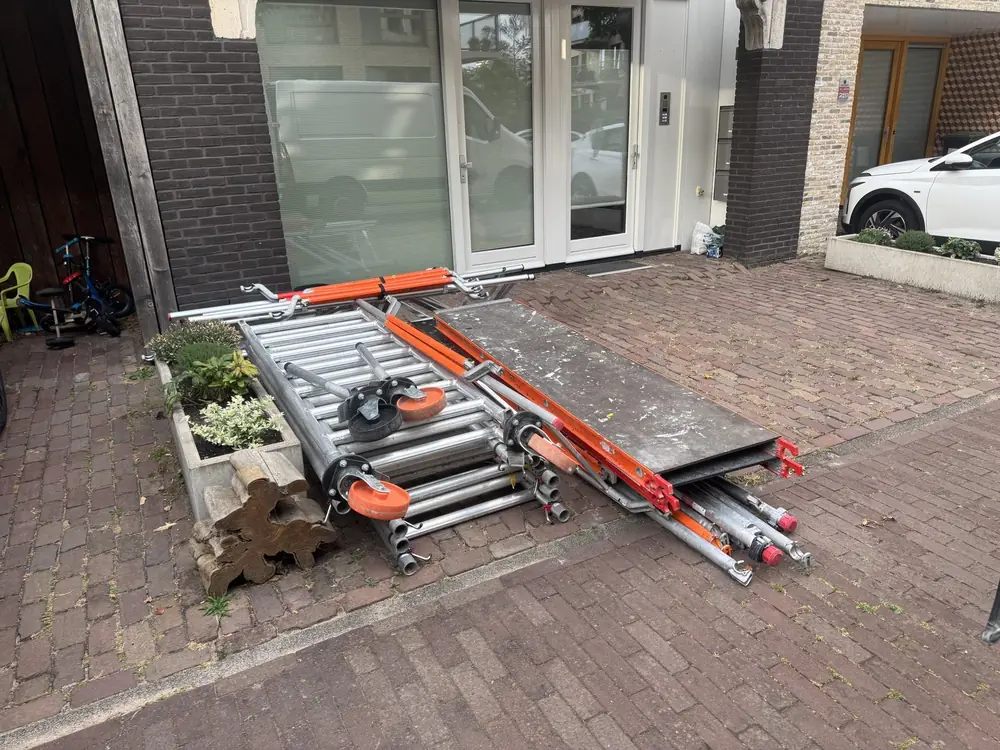
Scaffold components stacked on a kerbside pavement beside a dwelling, the counted set that opens your hire

When the last coat has dried you take it apart and we put everything back on the van. Do wait until the paint is genuinely hard, because a scaffold tube tapping a fresh door frame costs you more time than an extra day on hire ever would. Count the parts as you stack them and nothing ends up among the things in your shed. That count is also what your deposit hangs on. The amount per province for bringing and fetching is on the page about delivery and collection charges.

Safe painting work at height: what you settle when hiring

Everything on hire is built to EN 1004, and the platform is rated for 200 kg on each square metre under load class 3. On painting work you rarely come near it, until the moment two people are up there with a full kettle, a spare tin, filling gear and a sander. Keep the heavy things together in the middle of the floor and not at the edge. What the class actually means is unpacked in the piece explaining this scaffold standard.

The biggest risks on this job are in the paint itself. A spilt coat on the deck turns slippery the moment it rains, so wipe it off at once or lay card over it. Lock the wheels before you climb, and never roll the build with tins, kettles or a second person aboard, however small the shift looks. If it blows hard you stop: spray mist and loose cloths go everywhere, and a tin that topples runs across next door's paving.

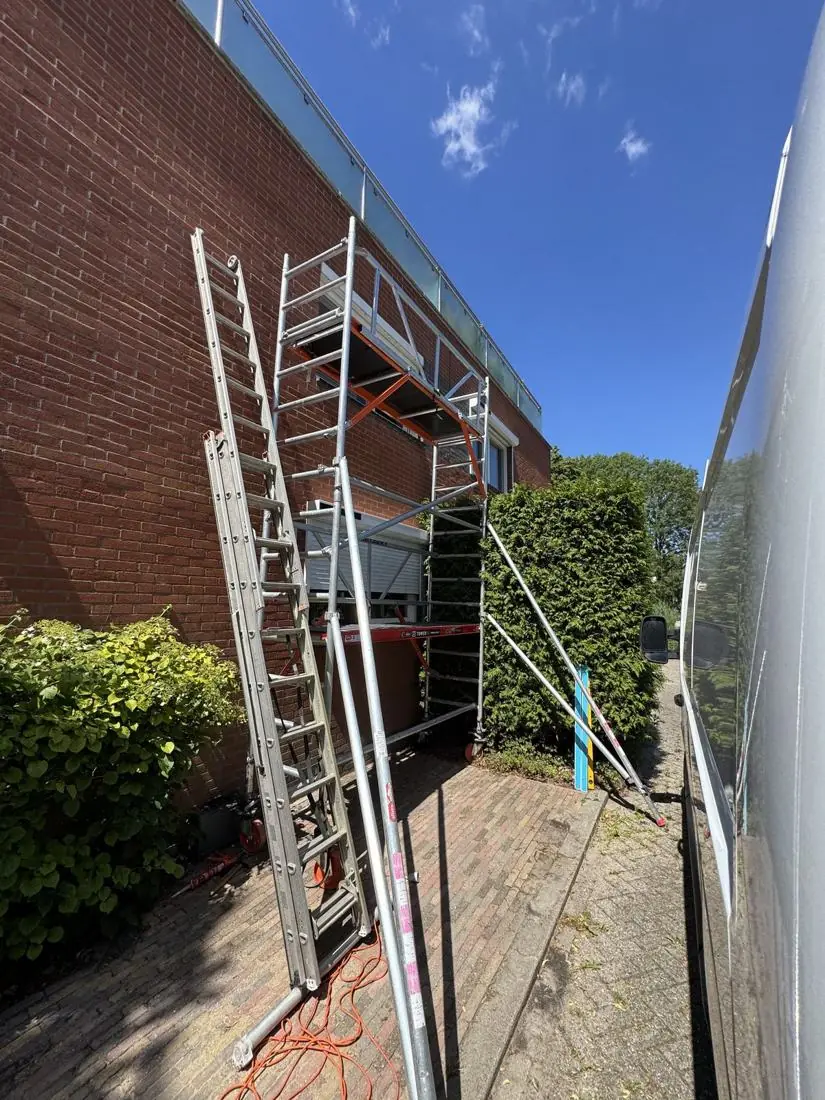
Tower built up in a narrow passage with stabilisers out, a separate extension ladder leaning on the brick wall beside it.

Finally, look at what happens below you. A brush falls off a guardrail easily and a tin set too near the edge goes the same way. Keep the strip under the build clear, certainly on the street side where people walk past. Climb up on the inside and never up the outside of the frames, not even quickly with a tin in your hand. The remaining agreements are gathered at the rules for working safely at height.

In 5 steps

How hiring a mobile scaffold works

1
Choose working height

Pick the height that suits your job.

2
Book online

Sorted in 60 seconds, price shown instantly.

3
We deliver

At the agreed spot the next working day.

4
Assemble safely

Assembled by you, with a manual.

5
We collect

One call and we collect the scaffold.

Good to know

Practical tips for painting work

1

Before you hire anything, make a list of everything that needs painting with the height written beside each item. The top line decides your build; the rest decides how many standing positions you need.

2

Lay your hire period over a week of dry weather rather than over your days off. Paint that will not cure costs you more time than the day you meant to take.

3

Hang the kettle at eye level on the guardrail instead of standing it on the floor. You then do not stoop at every refill, and you cannot knock it off the platform either.

4

Do everything that belongs to a position while you are there: sand, dust, mask and only then paint. Moving costs ten minutes each time, and on a big project you count that three times a day.

5

Work from top to bottom per elevation. Sanding dust and paint drips fall downward, and on this job you see later exactly what landed on a frame you had already finished.

6

Book one extra day after your final top coat. You can then take paint spatters off the tubes calmly and dismantle without a door or a frame anywhere still being tacky.

Frequently asked questions

Frequently asked questions about painting work

Which mobile scaffold should you hire for painting work on your house?+

For a mixed project the narrow 75 cm version is the handiest choice. It gets past gates and paths where a wide one sticks, and you move it alone. Painting with two of you, or mostly large surfaces with a roller, makes 135 cm pleasanter to work on. If the painting work stays indoors you hire a room scaffold that fits through an internal door. Measure your narrowest gap before you settle on a model, because that is where the choice most often founders.

How does hiring work when painting work stretches over weeks?+

You reserve a model online with the working height you need, and pick the start date and the end date yourself. On a long running project you set those far apart: your tower stays put for all those weeks and you move it from position to position. On the last day you dismantle and we take the parts back. Nothing about a hire changes because the job list is long. There is no need to top up in between as long as your period is booked generously enough.

How many hire days does painting work on a terraced house take?+

For the complete exterior a week and a half is realistic. There are sanding and filling days, a priming day, an undercoat and a top coat, with drying time between each of them. Doing only the frames at the front brings you down to four or five days on hire. Checking over the timber under the roof edge as well adds at least two more. Book generously rather than tight, because half a day short means a final coat missed.

What does hiring a tower for a longer painting period cost?+

Your rental price is what the model with the chosen build costs, plus a transport amount fixed per province. Those figures appear with VAT on the page with our hire rates. What matters on painting work is that your opening day weighs heavily and the days after it lightly, so two weeks on hire costs nowhere near two weeks at full rate. A second run of the van is almost always dearer than simply keeping the tower standing.

Which working height should you hire for the highest timber?+

Look at where your top item sits: usually the fascia board or the frame on the upper floor. On an ordinary house that lands you at 4.2 to 8.2 metres. Measure from the ground under your wheels to the top edge of that item and choose the build above if you are unsure; hiring too high costs a few frames, hiring too low costs a day. Which reach belongs to which build is in the working height overview per model.

Is the hired tower delivered, or would you rather collect it yourself?+

You may pick whichever suits. With delivery a set amount per province applies and we put the parts down on your start date, collecting them after your last paint day. Prefer to drive yourself, make an appointment and take the parts without extra charge from Zeeburgerpad 89 in Amsterdam, if the frames fit your trailer. On a painting project of weeks most people have the scaffold brought, if only to keep their car free of frames. Either choice leaves the rest of the hire the same.

Do you build it, or is that part of hiring a scaffold yourself?+

Building is yours, and so is moving it and taking it down at the end. We bring the hired parts and fetch them again. With two people you are busy half a day, manual and instruction video to hand. On painting work that counts in your plan, because build day usually gets you no further than sanding and masking. You will not find system scaffolds, facade scaffolds or cherry pickers with us; at these heights a mobile tower remains the obvious choice.

Can you hire on if painting work overruns because of rain?+

Yes. Tell us and your collection day moves, unless that set is already booked out to somebody else. On this job that happens often, because a wet week shifts your whole schedule and a coat that is not dry cannot be painted over. Since every extra day counts lightly, book a little wider when in doubt. Returning earlier is fine too. Your hired tower does not have to go on the day it happens to rain.

How much clear space does each standing position need on hire?+

Start from the width of the model and add whatever the stabilisers reach out to left and right. Flat ground matters more than tidy ground, so check the fall across each spot before your hire starts. In practice you want a flat patch of roughly two by two metres per position, plus a way through to roll the build to the next spot. Clear hedges, planters and your own painting gear before the tower arrives, because tidying up between coats costs you time and breaks the rhythm you had going.

May you keep the hire running when it turns too cold to gloss?+

That is exactly what a generous period is for. The build stays where it is and you wait for a day warm and dry enough; only the painting work shifts. Use days like that for sanding, filling or masking, which carry on fine at lower temperatures. It is worth keeping your materials indoors rather than leaving them standing on the tower overnight in the damp. Ask us to shift the collection day if the cold sits in longer than the forecast promised, and the hire simply runs on.

Do you get the deposit back if there are paint spatters on the hired parts?+

Fresh spatters wipe straight off, dried ones do not. So cover the deck and the top guardrail when you work with a roller or a spray gun, and go over the tubes with a cloth at the end of the day. Once the hired set is checked back in complete and clean, the deposit lands on your account inside a single working day. There is more in the note on deposits and returned parts.

Can you paint indoors from a hired outdoor tower, or hire separately?+

An outdoor build will not usually pass the front door and certainly not an internal one, so for the inside you hire a separate room scaffold. That is narrow enough for a doorway from about 70 cm and reaches 3 to 4 metres, ample for a ceiling or a stairwell. Plan the interior painting work in a different season from the outside work, then you only have one thing standing in the house at a time.

Hire a mobile scaffold for painting work today?

Calculate your rental price now or ask for free advice.

Rolsteiger van SteigerTaxi geleverd op locatie
Book it online

Your scaffold sorted in 2 minutes.

Choose your scaffold and working height, see the price instantly and book online.