
See your price
Application

Painting woodwork? Choose the right scaffold.

Painting woodwork in opaque paint is not one round but three. First sanding and priming, then an undercoat and finally the finishing coat, and each time at the same frame from the same places. That makes your stand position weigh more than when you are only touching up: you come back to it twice. For frames, doors, shutters and fascia boards on two storeys the choice is an RS51, 75 cm narrow, in a build arriving at 6 or 8 metres of working height. Here is how those rounds turn into hire days.

  • Order before 3 pm, delivered tomorrow
  • Professional Altrex scaffolds
  • Up to 14.2 metres working height
  • Easy to assemble yourself
4,2 tot 14,2 mWorking heights available
12Provinces served
7Days a week
200 kg/m²Load class 3
In short
  • For painting woodwork we recommend the Narrow mobile scaffold.
  • Opaque paintwork on exterior timber over two floors runs off an RS51 of 75 cm wide, with a reach of 6 or 8 metres.
  • Each coat takes you along the same route past the same stand positions, so the number of coats sets the hire days you book.
  • Mark where the wheels stood, because on the second and the third coat you want to come back to that very spot.
  • First 24 hours from €150 incl. VAT and delivery; every day after that 95% off.
Key facts for this job
FeatureValue
Recommended scaffoldNarrow mobile scaffold (Altrex RS TOWER 51)
Working height for this job6 to 8 metres
Available working heights4.2 to 14.2 metres
StandardEN 1004, load class 3 (200 kg per m²)
DeliveryOrdered before 3 pm, delivered next working day
Each extra day95% off, from €7.50 a day
Why a mobile scaffold for painting woodwork?

Safe, stable and professional work at height

Opaque paintwork on exterior timber is work in layers, and that changes the sum when you hire. You do not pass your frames once but three times, and between those rounds the paint stands drying while you can do nothing. The tower stays where it stood in the meantime, because measuring and building again at every coat costs you more than an extra day of hire. On top of that an opaque coat is unforgiving: a strip you rushed at arm's length shows up in low sunlight. Hiring a scaffold for painting woodwork is therefore about coats, about drying time and about stand positions you can return to easily.

  • Three rounds past the same frames and doors
  • Drying time between coats costs you hire days
  • Back to the identical stand position for each coat
  • A narrow tower for frames and tight side paths
Read more about working safely →

Which mobile scaffold to hire for painting all your woodwork

With opaque paintwork you stand still a long time at one element and hardly move sideways. Deck width therefore buys you little, and the RS51 with its 75 cm is more than enough. What matters more is that the size gets everywhere: along the path to the back door, through a gate to the garden side and between a hedge and the wall, because your exterior timber sits on all four sides of the house. The other models and their dimensions are on the page about mobile scaffold hire by type.

What goes up with you differs per round, and that is exactly why it has to stay orderly. For the first coat abrasive paper, a filling knife, a cloth and primer travel up. For the finishing coat you take clean brushes, a paint kettle and tape, and you leave the sanding gear below. Stand those things in a fixed place at the end of the deck, so on the second and third round you reach blind for what you need and knock nothing over.
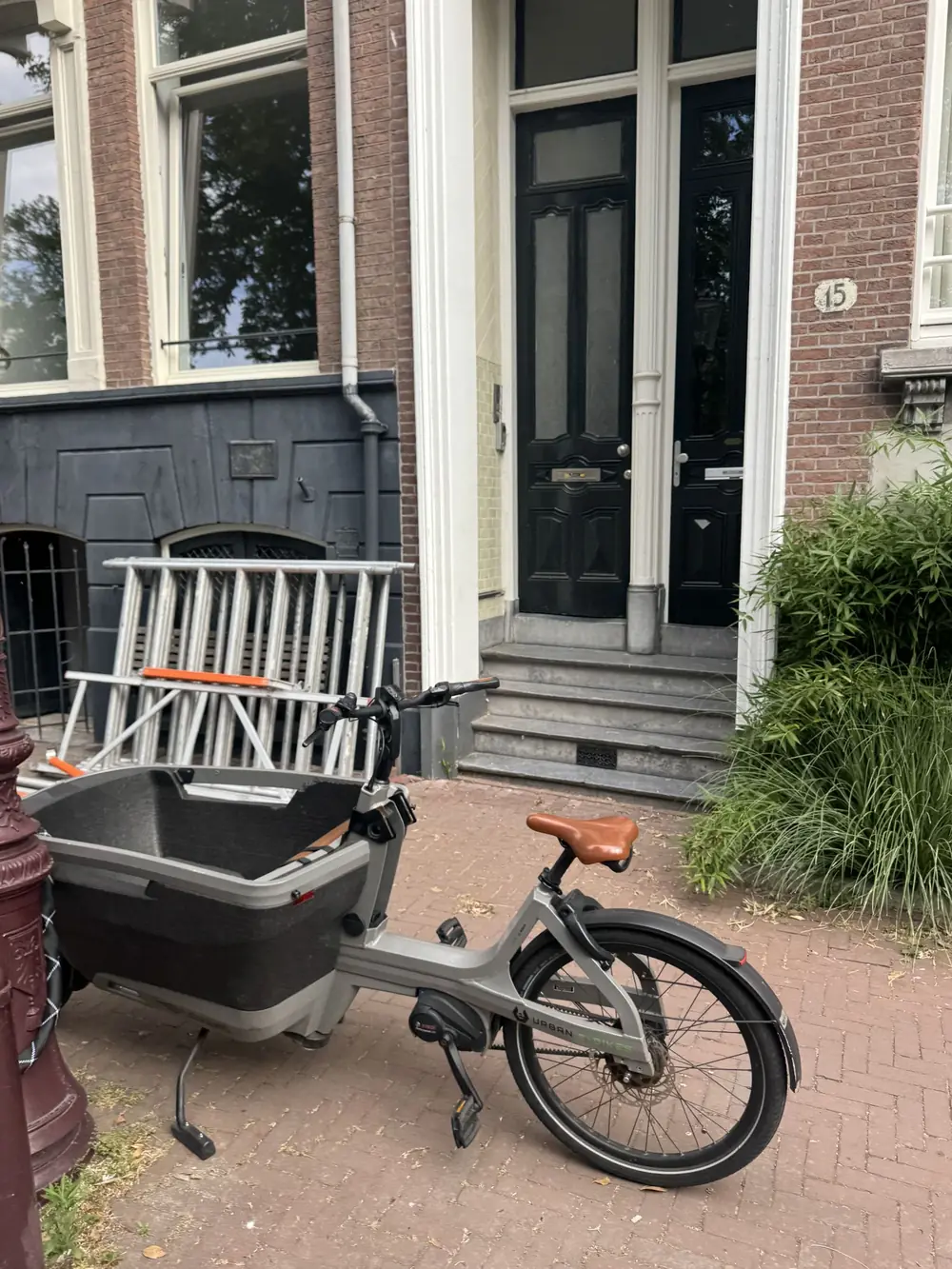
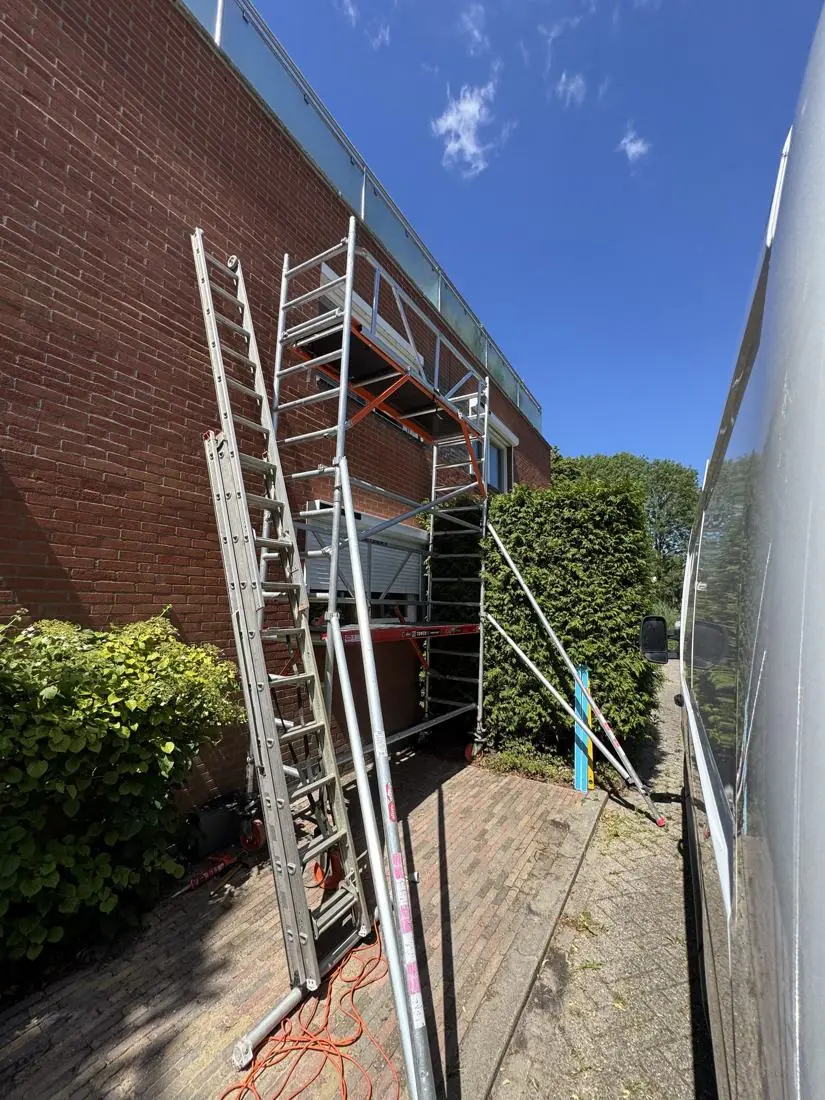
Narrow mobile scaffold along a dwelling, the set-up from which frames and fascia boards get their successive coats

Where two of you work at the same element, or you take on a large boarded area at once, the RS52 with its 135 cm gives noticeably more room to move. If the inside of those same frames also needs doing, a room scaffold is the answer: it passes a doorway from roughly 70 cm and makes three to four metres. That is a separate reservation, though one you can plan in the same week. The difference between outdoor and indoor work is described in the explanation about indoor use.
Which working height to hire for your highest woodwork

Look first at which timber part sits highest before you settle on a build. At most houses that means the boarding along the roof edge or a bargeboard, sometimes the head of a dormer. That point fixes your order, even though you begin at ground level. Two storeys puts you in the band of 6 to 8 metres. Working height you arrive at by putting some two metres of arm reach on top of your platform height.

With painting something counts here that matters less on other jobs: you want to stand just below your working face and look at it in raking light. Hang your platform too high and you look down on a sill and miss the underside of the profile. Stand too low and you paint with a raised arm, which leaves the coat uneven. So choose your build such that you can hang the platform at a comfortable level for each round, and measure from the ground the wheels rest on.

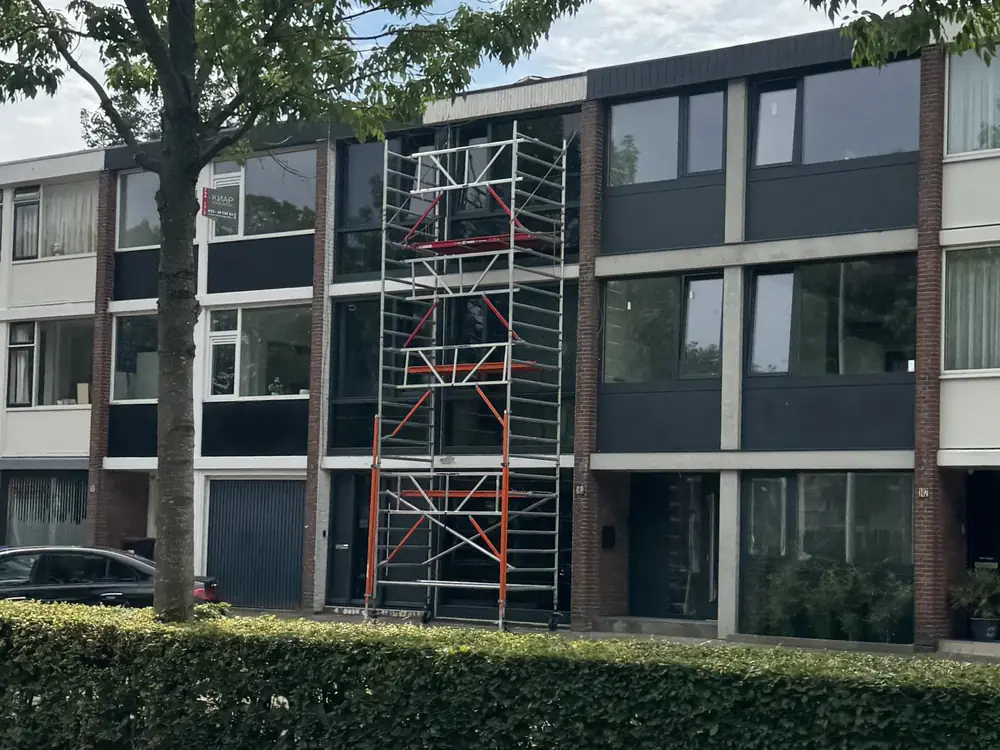
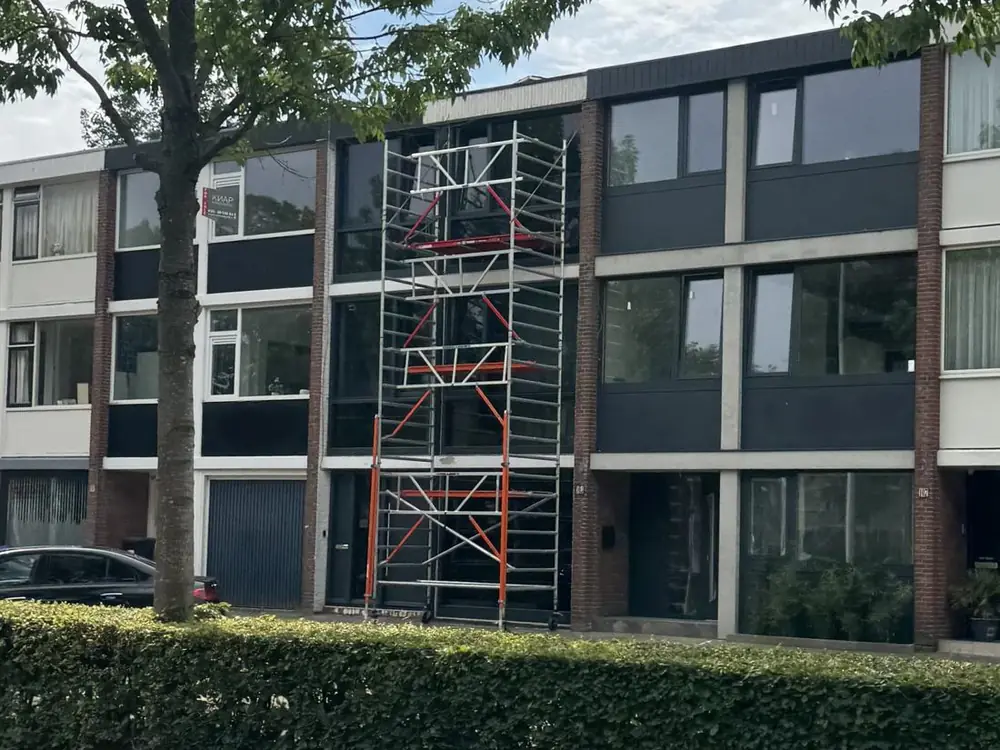
Tower reaching the eaves of a front elevation, the build you want when fascia boards and upper frames need coats

Picking too tight bites you three times here instead of once. Every strip you cannot reach comfortably gets painted at arm's length again on every coat, and in opaque paint that stays visible as a band of a different thickness. Hiring one section more is still cheaper than half finishing the top metre three times and looking at it afterwards with real regret. Which reach asks for which build is set out at a build to 8 metres of reach.

Hiring a mobile scaffold and painting from each stand position

Set your stand positions out before the delivery arrives, because you use them not once but at every coat. Mark in chalk or on a slab where the four wheels stood, and on rounds two and three you roll back to that exact position in a minute. That saves time, and it keeps your set-offs on the same vertical line, so a join in the finishing coat disappears neatly behind a corner profile or a downpipe.

The ground has to stay usable for that whole period, and with paintwork that is a week or more. On slabs and a drive that happens by itself; on grass rather less, since after two wet days the wheels sink and your tower stands out of true just as you want to start the finishing coat. So put plates or paving slabs under the feet from the outset and set the stabilisers carefully. How to tackle a sloping surface is covered at stabilising and tying in your tower.

Stabilisers beneath an erected mobile scaffold, the stand position you return to again at every coat of paint

Think about the place below as well. On this job something is always standing on the ground: a paint tin, a tray of brushes, a jerrycan, a sheeted length of terrace. Set aside a corner for that outside the running line of the tower. Bear in mind, finally, that the scaffold stands at the boundary for a week or more. A short word with the neighbours prevents awkwardness when you are still glossing above their fence on day five.

How many hire days do three coats of paint need

With three coats over all your exterior timber, allow a stretch of five to eight hire days, depending on how many elements the house has. The sanding and priming of the first round is the most work; the undercoat and the finishing coat go faster after that, because you know your stand positions and the preparation is behind you. What stretches the planning is not the hours with the brush but the days in between, and those you cannot make up by working harder.

Paint has to harden through before another coat may go over it, and outdoors that hangs closely on temperature and humidity. In spring you can usually lay a coat every other day; in autumn a full day of waiting is normal. Add to that the wait each morning until the dew is off the timber, and the stop in the afternoon before it turns damp again. Your workable window is a good deal shorter than the daylight you get.

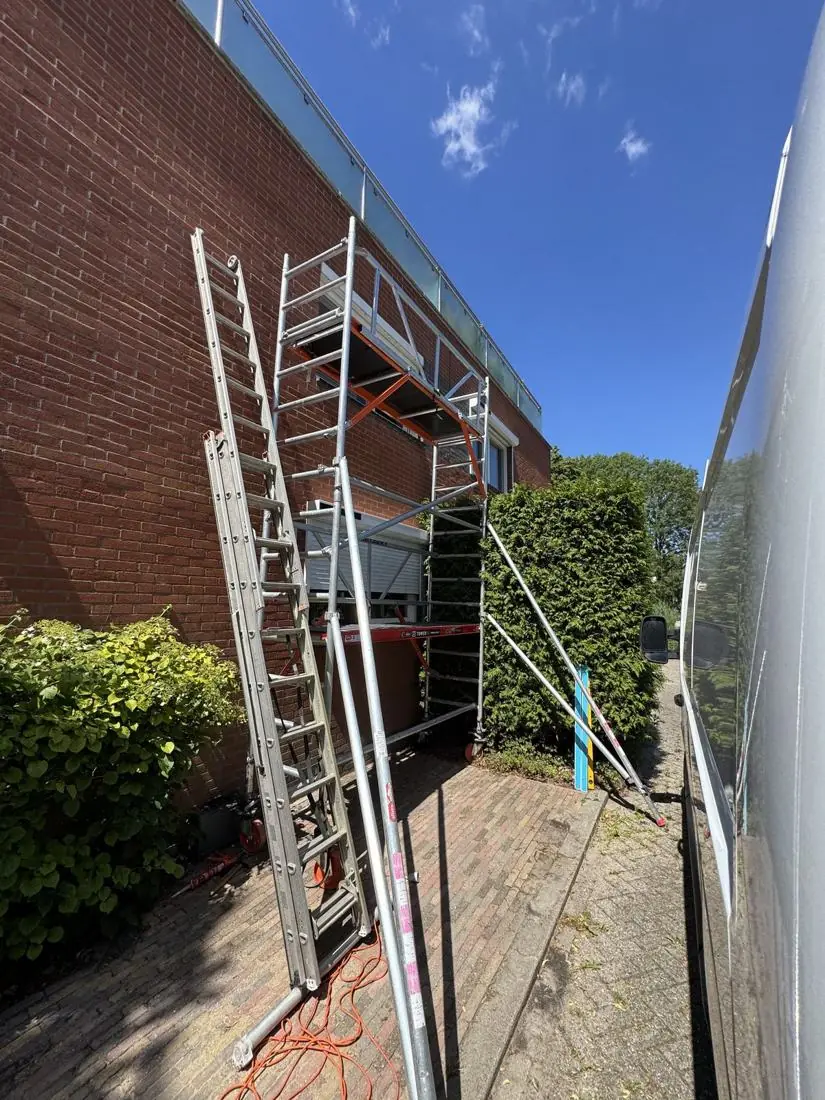
Tower still in position beside a side elevation, exactly as it waits between one coat of paint and the next

Just because of that it pays to leave the tower simply standing between the coats. Only the first twenty four hours are reckoned at the whole tariff, and from there on each day has 95 per cent removed, so the waiting days add almost nothing to your rental price. Booking two short periods with an assembly and a transport in between costs you far more. How to judge such a run of days is explained in the overview of hire days per job.

Which mobile scaffold suits painting woodwork?

Kamersteiger RS44
  • Working height up to 4 metres
  • Compact and narrow
  • Great for indoor and small jobs
View and calculate →
Most chosen
Smalle rolsteiger RS51
  • Working height up to 14.2 metres
  • Narrow (75 cm)
  • Ideal for narrow passages
View and calculate →
Brede rolsteiger RS52
  • Working height up to 14.2 metres
  • Wide platform (135 cm)
  • Extra stability and workspace
View and calculate →
1-persoons steiger MiTower
  • Working height up to 6.2 metres
  • Very compact
  • Quick and easy to assemble
View and calculate →

Painting woodwork from a platform of 245 cm

With 245 cm of platform length you stand at most houses in front of a whole frame including the junctions around it. Always finish the entire element from one stand position before you roll on, even if that means pushing through for a while. A frame whose half was laid an hour before the rest shows a faint transition once dry, and in opaque paint that never goes away. That argument weighs heavier here than the pace at which you work along the wall.

Take up only what belongs to that coat and keep your brushes separate from one another. Use primer and finishing paint through each other and you will see it later in the sheen. Hook your paint kettle onto the rail instead of standing it beside your feet; knocking off a brush tips a kettle sooner than you think. What falls, moreover, usually lands on the element you had just finished, and then you start that piece again.

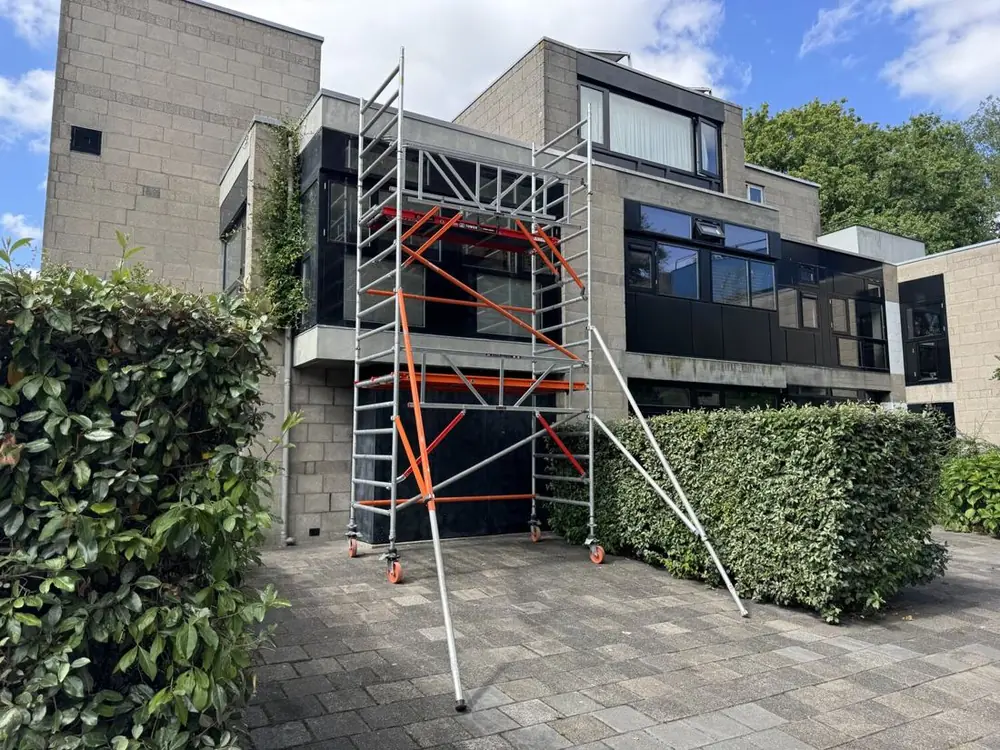
Erected mobile scaffold at a modern house, the 245 cm deck on which a whole frame is finished in one go

What almost everyone underestimates is the number of times you pass the same place. Count your stand positions and multiply that figure by three: only then do you have the real number of set-ups, and with it a fairer picture of your hire period. The edges cost the most time as well: the underside of a sill, the rebate round the glass and the corner where a fascia board meets a bargeboard. Together those are worth more hours than all the flat timber.

Scaffold hire with delivery for a run of painting days

You receive the mobile scaffold in the form of a complete set of loose, counted parts. Find a corner for them where the stack can lie undisturbed for days, because you assemble once and only roll after that. Do not lay them on the terrace you want to sheet, nor directly under the stand position where you start on day one. Round the reservation off on a working day, keeping under the 15:00 mark, and we load everything the next working day.

The delivery date and the collection date are both your choice, and for paintwork you make it with a settled spell in view. Have the parts turn up a day before your first sanding session; then you stand it up in peace and start the next morning on dry timber. That saves you a lost first working day. Erecting it belongs to your share: with the manual and the film alongside, an RS51 to eight metres stands in about two hours with two people.

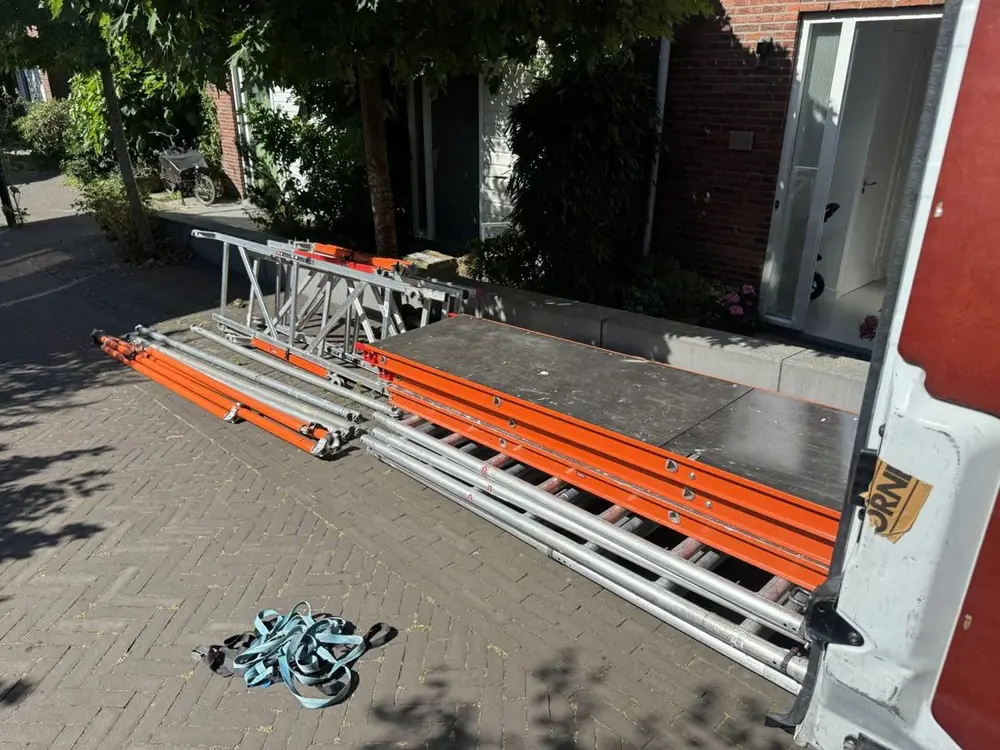
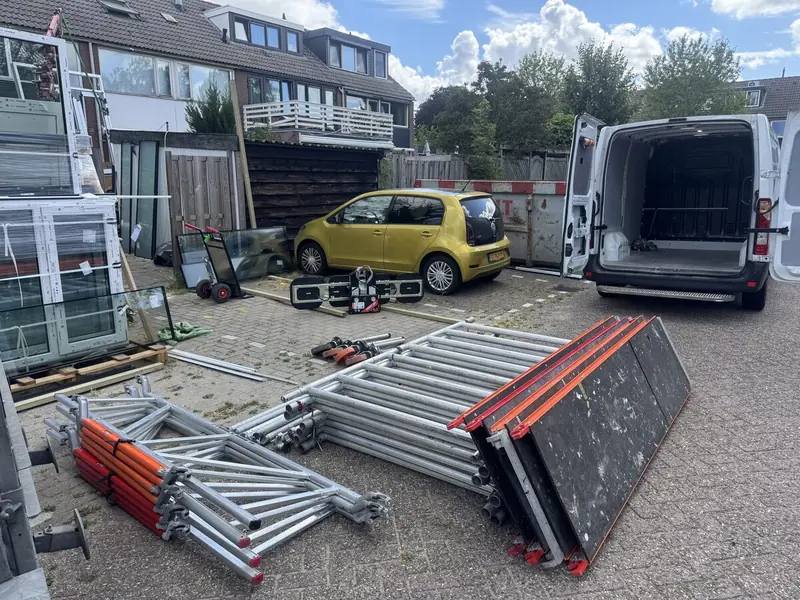
Loose scaffold components set down on the road by a dwelling, the opening of a hire period full of painting days

Once the finishing coat is dry we come back for the components. Do not break the tower down until you are sure the paint is hard, because a tube leaning against a freshly glossed frame leaves a print you can only get out by sanding. Lay the parts ready afterwards and count them one by one, then nothing is missing at loading. The rate for transport hangs on the province you live in and is listed with VAT at the delivery charges per region.

Painting safely on a hired tower along frames and fascia boards

The platform deck carries two hundred kilos on each square metre. That is load class 3, the banding the EN 1004 standard gives this type of tower. Painting woodwork you seldom reach it, but stand up there with two of you and add a few tins and a bucket of water and it climbs faster than expected. So spread that weight along the length of the deck and keep the hatch clear of tins, buckets and paint rollers you have just put down.

The basic rules do not change, not even on your third round when everything is becoming routine. Brake all the wheels as soon as anyone goes up, never move the tower while paint or people are on it, and fold the four stabilisers right out after every move. If it blows hard, stop. On this job you have a second reason for that: wind drives dust and sand into your wet finishing coat, and then you are sanding that strip again tomorrow.

Mobile scaffold with guard rail and inner ladder, the way up you use with a brush and paint kettle in hand

The risk that comes with paint is a slippery deck. A few spots of primer and a little water make aluminium treacherous, and you notice only when you step sideways. Lay down something you can easily replace and wipe spilt paint away before it sets. Keep the zone under you clear of people as well, certainly when you are working above a front door, a garden path or a terrace. The further agreements are at the requirements for working at height.

In 5 steps

How hiring a mobile scaffold works

1
Choose working height

Pick the height that suits your job.

2
Book online

Sorted in 60 seconds, price shown instantly.

3
We deliver

At the agreed spot the next working day.

4
Assemble safely

Assembled by you, with a manual.

5
We collect

One call and we collect the scaffold.

Good to know

Practical tips for painting woodwork

1

Write down per stand position which elements you did there and in which coat. On round three you will otherwise not be sure whether that one shutter on the side has had its undercoat.

2

Lay the first coat on the shaded side of the house and work with the sun. Paint that skins too quickly in full sun leaves brush marks you cannot take out again in the finishing coat.

3

Buy your finishing paint in one go for the whole house and keep it to a single batch. Two tins from different batches give neighbouring frames a colour difference you only see once everything is dry.

4

Mask the glass on the assembly day and not between two coats. Tape that has sat in the sun for a week leaves glue behind and tears exactly along the fresh line of paint.

5

Keep a clean cloth and a little white spirit at every stand position. A drop on a window or a slab comes off wet in ten seconds and only after a quarter of an hour of scraping once dry.

6

Plan the collection day at least a full day after your last finishing coat. You then have room to check everything, touch in and take the tower down dry and complete without haste.

Frequently asked questions

Frequently asked questions about painting woodwork

Which mobile scaffold should I hire for opaque paintwork on my woodwork?+

For frames, doors, shutters and fascia boards on two storeys, hire a mobile scaffold in the RS51 version, with a width of 75 cm. You stand still a long while at an element on this job, so there is no need to hire much deck width; the tower does have to pass everywhere, including a narrow path round the back. Working with two of you at the same spot, the RS52 of 135 cm gives more room. Both stand ready in the same build heights.

How does hiring work when the woodwork gets three coats of paint?+

You book online a tower with the build that suits your highest timber element, choose the day we deliver and the day we collect, and pay a fixed amount including VAT. The scaffold stays standing for the whole period, so you assemble once and roll it along your stand positions per coat. Only after the finishing coat do you break it down and put the complete set out for the collection run.

How many days do I rent for primer, undercoat and finishing coat?+

Five to eight days is realistic for an average house. The first round of sanding and priming costs the most; after that it goes quicker. The gain is not in your pace but in the drying time: in cooler weather you wait a whole day per coat. So book against your calendar rather than your working hours, and keep a day in reserve when you hire for the shower that lands on your finishing day.

What is the rental price for a tower over several coats of paint?+

That follows from three things: the model chosen, the height of your build and the run to your province and back. All amounts can be seen with VAT included at the tariffs for our mobile scaffolds, so you have a complete picture beforehand. For work in coats the make up of the rental price falls out well: the first day is by far the dearest and the days you spend only waiting on drying cost a fraction. Hiring on is therefore nearly always better value than handing back in between.

What working height to hire for frames and fascia boards upstairs?+

Measure to the highest timber part you are going to paint, usually a fascia board or a bargeboard, and not to the frame you want to tackle first. On two storeys you come out between 6 and 8 metres, with your deck at four to six. Remember that with paint you want to stand just under your working face, so pick your build accordingly. Per reach you can see which tower belongs to it on the page about working height.

Is the set delivered, or had I better come and collect it?+

That is yours to decide at the reservation. With delivery the complete set stands ready on the day you choose and we drive back after your last coat to take everything away, at a rate that is fixed per province. If you have a suitable van or trailer, you may pick the parts up at no cost by appointment at Zeeburgerpad in Amsterdam. With a narrow tower up to eight metres that is perfectly manageable.

Is assembly included when you hire, or does that land on me?+

Assembling, rolling and dismantling you do yourself; we look after the bringing and the taking away again. For a build to eight metres two people together need an hour or two, with the film to help them. Put that block on the day before your first coat has to go on, or your whole schedule shifts. Our hire consists solely of mobile towers, so anyone after fixed facade scaffolding, system scaffolding or a cherry picker has to knock elsewhere.

What if the last coat fails and I want to hire for longer?+

That happens regularly with exterior painting, because you do not lay a finishing coat in the rain. Tell us you are carrying on and the collection day moves, as long as the mobile scaffold is not booked straight afterwards for someone else. Smarter, of course, is to hold a generous margin at the booking and simply sign off early if the last coat goes on smartly. The closing days hardly count in the final amount for the tower anyway.

How much space has to be free under each stand position?+

Reckon on the footprint of the tower plus the triangle the stabilisers take on all sides, and on top of that a corner for your tins and trays. On a drive or a terrace that works out fine; along a narrow side path it becomes a matter of measuring. Walk your route with a tape and remove planters and bicycles before the delivery takes place, because during three rounds with a mobile scaffold you do not want to manoeuvre round them each time.

Can the hire simply run on when it is too cold or wet to gloss?+

Yes, and that comes up more often than anyone wants. If it stays too cold or too damp for a sound coat, you simply wait a day and the mobile scaffold stands braked at its stand position until things improve. Use such days for sanding, degreasing or masking up where you want to carry on the next morning. Because every following day costs only a small amount, waiting always beats booking a second hire period.

What does paint on the parts mean for my deposit when I hire?+

You pay a deposit beforehand. As soon as the tower has been taken back, counted and looked over, we transfer that amount to you within 1 working day. Fresh spatter wipes straight off, but cured finishing paint on a tube or on the deck is another story. So lay some card down and keep a cloth to hand. What is checked exactly you can read in the piece about the deposit.

Does the tower simply stay in place between two coats of paint?+

Yes, and on this job that is the intention. Because you decide on which day we come to collect, you leave the mobile scaffold standing until your finishing coat is hard. Do put the wheels on the brake and take loose tins and cloths off the deck when you stop. Handing back in between means building again, measuring again and an extra transport, which weighs heavier than a few quiet waiting days. If you are also going to paint the shutters, keep that inside the same period.

Hire a mobile scaffold for painting woodwork today?

Calculate your rental price now or ask for free advice.

Rolsteiger van SteigerTaxi geleverd op locatie
Book it online

Your scaffold sorted in 2 minutes.

Choose your scaffold and working height, see the price instantly and book online.