
See your price
Application

Painting shutters? Choose the right scaffold.

Painting shutters is a job with two possible routes. Either you take the shutters off the wall and set them on trestles at ground level, or you paint them where they hang, beside the window frames. That choice settles not only how you work but also whether you need the tower for half a day or for almost a week. With shutters on the first or second floor you hire, in both cases, a mobile scaffold 75 cm across that reaches six to eight metres of working height.

  • Order before 3 pm, delivered tomorrow
  • Professional Altrex scaffolds
  • Up to 14.2 metres working height
  • Easy to assemble yourself
4,2 tot 14,2 mWorking heights available
12Provinces served
7Days a week
200 kg/m²Load class 3
In short
  • For painting shutters we recommend the Narrow mobile scaffold.
  • For shutters upstairs the RS51 is the right model: 75 cm slim, hired between six and eight metres of working height.
  • Every shutter has four faces plus the narrow edges, and the bottom and back are the first to go at damp.
  • Take the shutters off to paint them below and you need the tower for fewer days than painting in place.
  • First 24 hours from €150 incl. VAT and delivery; every day after that 95% off.
Key facts for this job
FeatureValue
Recommended scaffoldNarrow mobile scaffold (Altrex RS TOWER 51)
Working height for this job6 to 8 metres
Available working heights4.2 to 14.2 metres
StandardEN 1004, load class 3 (200 kg per m²)
DeliveryOrdered before 3 pm, delivered next working day
Each extra day95% off, from €7.50 a day
Why a mobile scaffold for painting shutters?

Safe, stable and professional work at height

The question with shutters is not how you lay paint on but where you do it. Leave them on the wall and a ladder never gets you to the bottom edge, the back and the side against the brickwork, and those are exactly the places where the timber starts to move. Take them down with you and you paint in comfort on trestles, but you have to go up twice: once to unscrew them and once to hang them back. Either way you stand beside the frame and not in front of it, because square in front of a window you reach no side at all. Hiring a tower for shutters gives you that sideways position plus a surface to put things on.

  • Four faces per shutter, plus the narrow edges
  • Bottom edge and back need the most attention
  • Standing beside the window frame, not in front
  • Taking them off or not decides your rental period
Read more about working safely →

Which mobile scaffold to hire for painting shutters

Shutters sit left and right of a window, so your working place is narrow and tall rather than wide. The RS51 with its frame of 75 cm suits that well: you drop it between the hedge and the wall, between two bay windows or onto a slim strip of garden, and it puts you exactly beside the frame. A wide build of 135 cm brings you next to nothing here, since you need no crate of material up there, only paint and hand tools.

The deck measures 245 cm, and on shutters that comes out neatly. A window of roughly a metre twenty with a shutter on each side fits inside that length, so you finish a complete opening without moving. You also have room to lay a shutter flat if you lift it off its pintles for a moment, and to put down your tin, your brushes and a roll of abrasive paper without any of it being in the way as you step sideways.
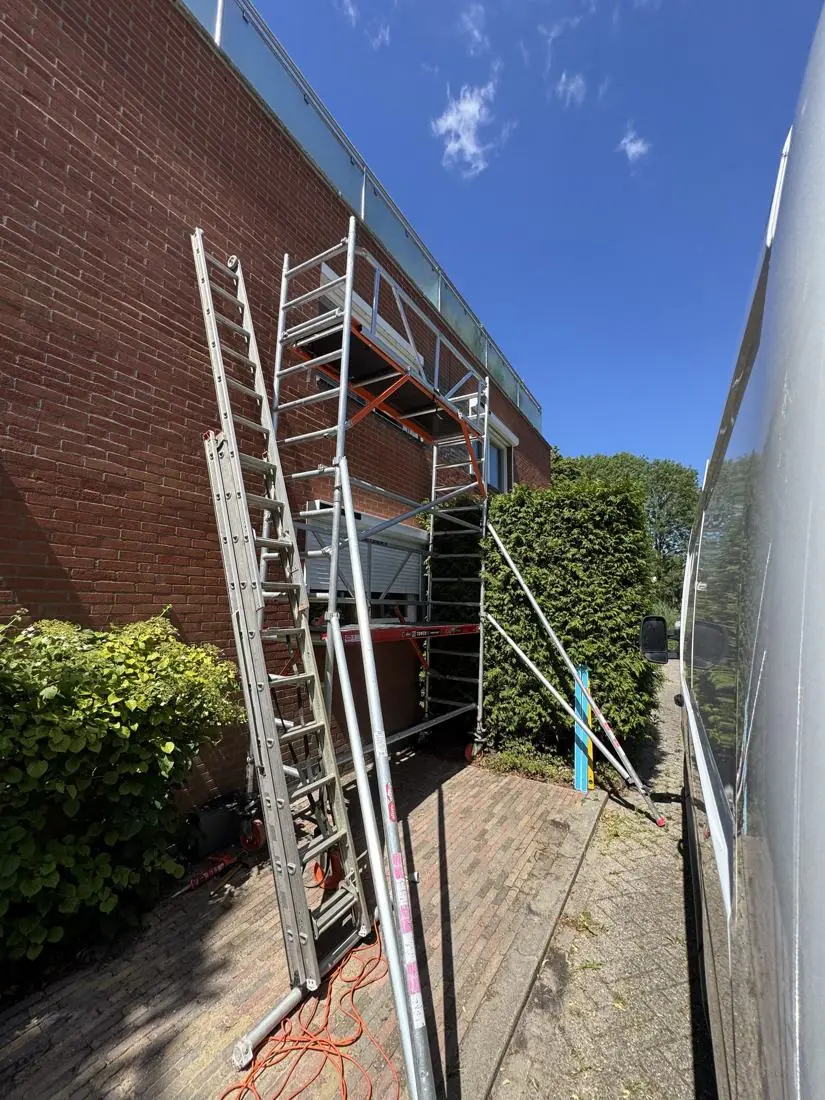
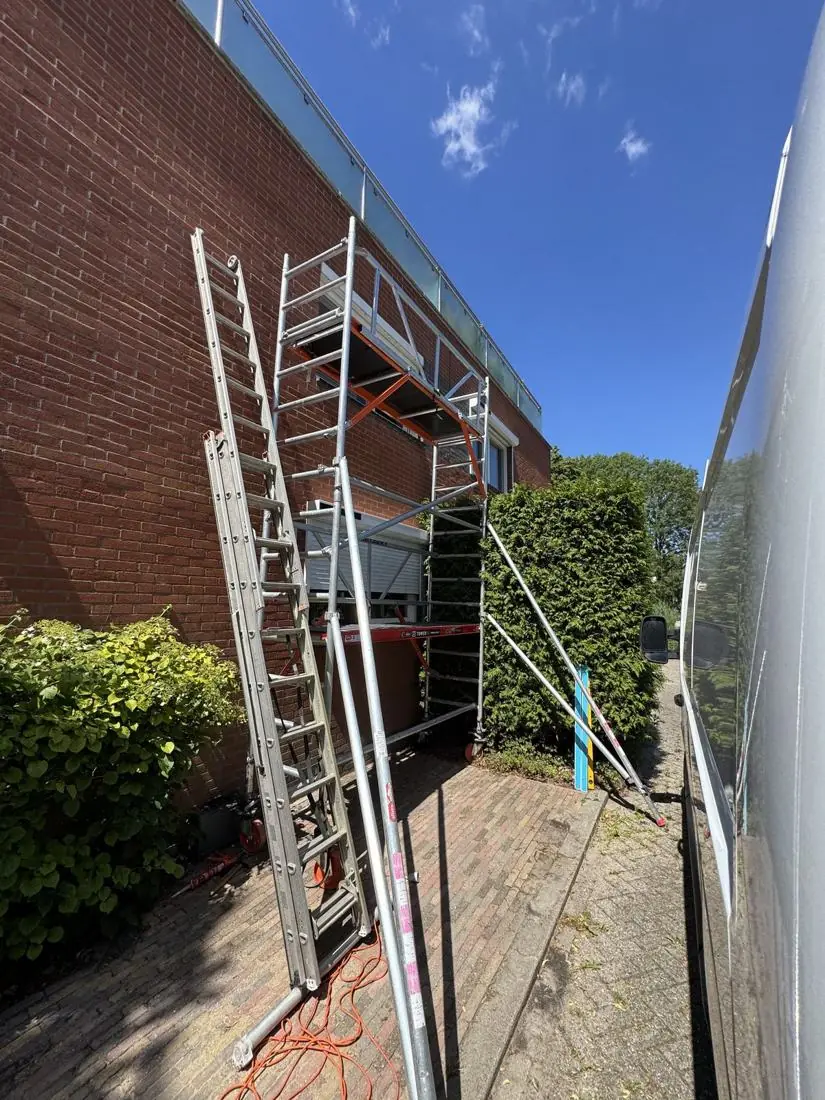
Narrow 75 cm mobile scaffold built along an elevation, the position that puts you beside a window frame with shutters

The model you settle on and the build you order are two different things. As a series the RS51 goes up to 14.2 metres of working height, yet shutters on an upper floor use only part of that reach. So pick the build that matches your own window height; which combinations exist is broken down per height in the range of mobile scaffolds for hire. That way you get precisely the build the top shutters need, without frames you never use.
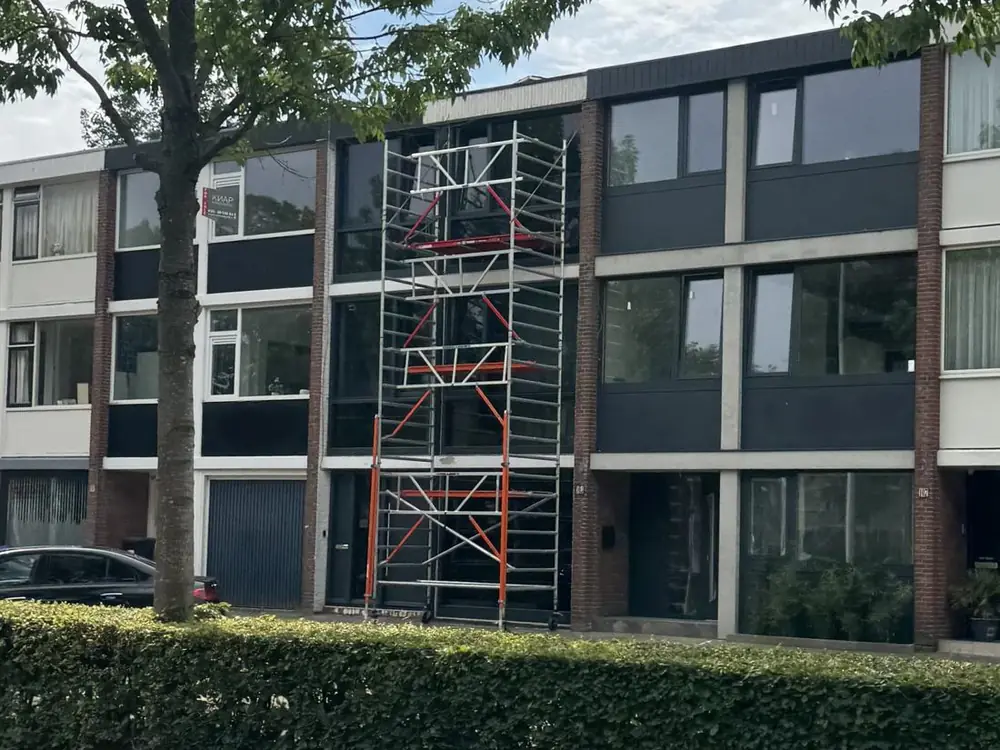
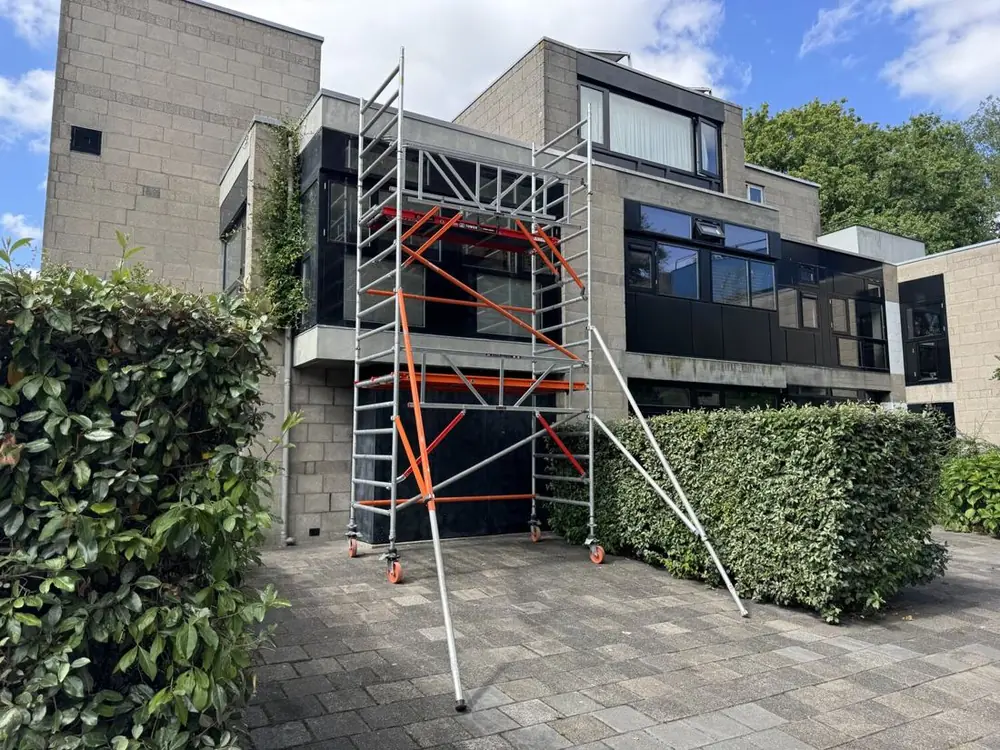
Which working height to hire for shutters on the first floor

Measure to the top of the highest shutter and not to the window sill. On a house from the nineteen thirties the top edge of a first floor shutter soon sits at four to five metres, and if there are shutters under the gutter as well that runs towards six. The highest shutter decides the tower you go and hire; the lower windows you then do with the same material at a lower deck setting, without ordering anything extra or swapping parts.

Working height on this job is your deck height with some 2 metres of reach on top, the distance your arms still bridge. For shutters on an upper floor that puts you in the band of six to eight metres, with the deck hung so that the top edge of the shutter sits at chest height. You would far rather paint slightly downwards, because then you see what you are doing and the gloss does not run back down your brush.

Mobile scaffold built against a front elevation level with the upper windows, the setting that brings shutters to eye height

Choose a build that turns out just too low and you are reaching at every top corner, which shows in the work: streaks, missed edges and a shutter that fails along the top after a single season. What the different heights mean for the number of frames and for stability sits on the page for a working height of eight metres, useful to read before you fix a build and start working the shutters from the top down.

Standing the hired tower under the windows with shutters

Windows with shutters are nearly always in the front elevation, so your build ends up on the street side, in the front garden or on a slim pavement. Look at where the wheels can rest without sinking into a border or blocking a paved path. On a terraced house that often means using a piece of the footway; call on the neighbours in that case, because on this job the tower stays there for several days and nobody enjoys looking at a build that arrived unannounced.

Flat, load bearing ground is what you need, and a front garden rarely offers it unaided. Loose slabs, a gravel strip or a sunken path you take up with firm boards under the wheels and with the adjustable spindles, until the build stands truly upright. Then swing the stabilisers out; they need room on every side, so allow for an area larger than the tower itself appears to ask. Measure that at the narrowest point of your garden before you hire.

Stabilisers of a mobile scaffold folded out beside a house, the extra floor room a build at shutters demands

Look as well at what stands below the spot where you will be laying gloss. Under a window with shutters there is often a water butt, a rack of bikes or a bed of perennials, and you want those covered before the first drip falls. If the build stands partly on the public highway, ask at the council. How to get a tower steady on a sunken garden slab is explained in the article on mobile scaffolds on uneven ground, including what to lay under the wheels.

How many days to hire a tower for painting shutters

Here that choice from the beginning comes back. Take the shutters off and you use the tower only to unscrew them and to hang them back later: two short sessions with several days in between in which you sand, prime and gloss at ground level. Plan it cleverly and you hire the build twice for a day, or simply keep it standing when there are many shutters and the unscrewing alone fills a morning. With six or eight of them that last option usually works out calmest.

Paint them in place and you are tied to the drying times of your gloss. Sanding and dusting off on day one, primer or first coat on day two, gloss on day three: the tower therefore stands for almost a week even though you work only a couple of hours a day. On an elevation full of shutters count on three to five rental days, and on more in autumn when the mornings stay damp. What you are hiring then is mostly waiting time, not working time.

Built mobile scaffold at the front of a house, left standing through the drying times between two coats of gloss

That long hire is less painful than it sounds, because the weight of the cost sits in the first 24 hours and the days after it weigh light. On gloss work that is exactly what you want: you never have to skip a drying day to get the tower off your hands sooner, and you can redo a coat that disappoints. Put your collection date after the day the last coat goes on, so you can still check a shutter before the material leaves.

Which mobile scaffold suits painting shutters?

Kamersteiger RS44
  • Working height up to 4 metres
  • Compact and narrow
  • Great for indoor and small jobs
View and calculate →
Most chosen
Smalle rolsteiger RS51
  • Working height up to 14.2 metres
  • Narrow (75 cm)
  • Ideal for narrow passages
View and calculate →
Brede rolsteiger RS52
  • Working height up to 14.2 metres
  • Wide platform (135 cm)
  • Extra stability and workspace
View and calculate →
1-persoons steiger MiTower
  • Working height up to 6.2 metres
  • Very compact
  • Quick and easy to assemble
View and calculate →

Painting shutters from the deck: four faces on every shutter

A shutter has a front, a back, a top and a bottom, and the narrow edges come on top of that. Hanging on the wall you reach at best two of those faces properly, and the underside is precisely where water stands and where the paint lets go first. If you want to do it thoroughly you lift the shutters off their pintles and paint them all round, lying flat on trestles, where the end grain and the rebate get their share as well.

Decide to leave them hanging and you work window by window from the top down, keeping an eye on the hinge. Hold each shutter with its stay or a clamp, because one that swings away halfway through a stroke leaves an instant streak across the brickwork. From a deck of 245 cm you usually manage a complete window with both shutters, after which you roll the build along and start again at the next opening in the same order.

Mobile scaffold at the side wall of a house with the deck at window level, from where shutters are sanded and glossed

The ironmongery is the part most people look straight past. Hinges, shutter hooks and the pintles in the wall are often thick with old paint and rust, and you would rather sand those clean than lay another coat over them. So take a screwdriver, a wire brush, some abrasive paper and a roll of tape up in one go, and mark which shutter belongs to which window, since they are rarely interchangeable. A shutter that will not go back where it came from can easily cost you an extra rental day.

Hiring with delivery when you take the shutters down

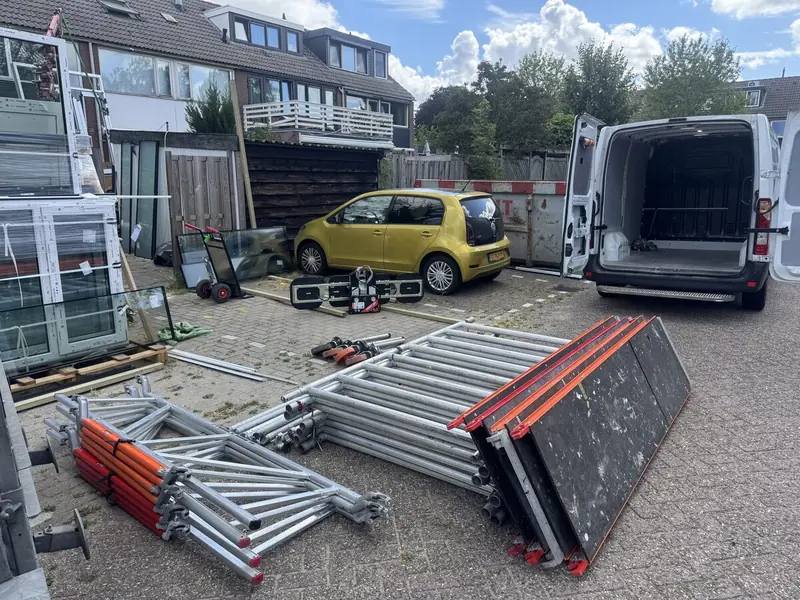
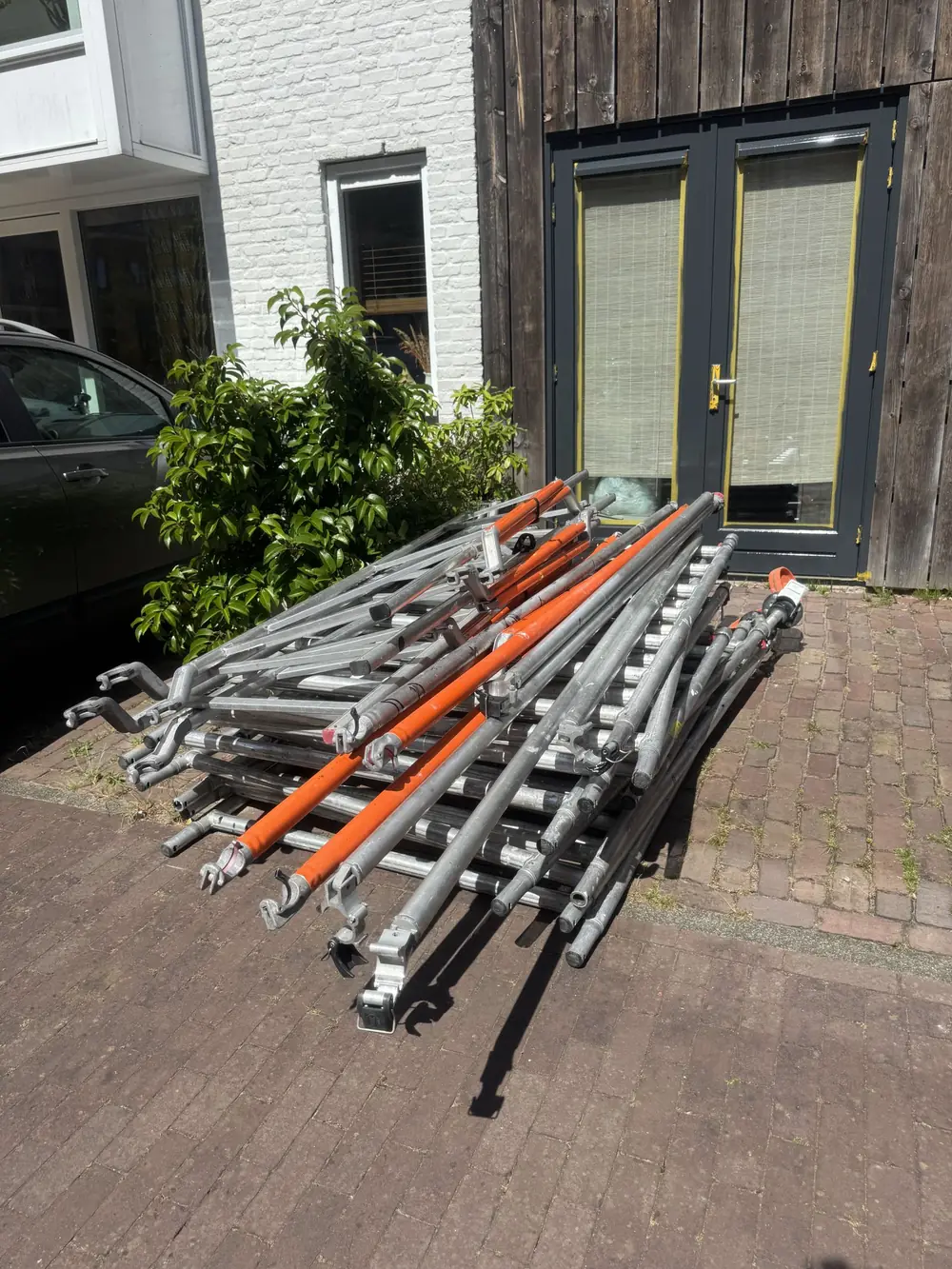
You receive the tower as a set of loose parts, counted right through, and you assemble it yourself. Book on a weekday before 15:00 and the set lies at your door the following working day. Agree where it may be put down: with shutters that is often the front garden or the drive, where the pile does not sit in the way of the place you want the removed shutters on trestles. Stand them on paving and not in wet grass.

You enter both dates yourself at the reservation, the one for bringing the set and the one for taking it away. On paintwork you look at the weather across several days for that, because gloss wants dry and not too cold. Plan the delivery a day ahead of your start, so the build goes up in peace and you are sanding first thing the next morning. If rain holds the work up, the collection day moves back in consultation and the build simply stays in front of your elevation until the last coat is on.

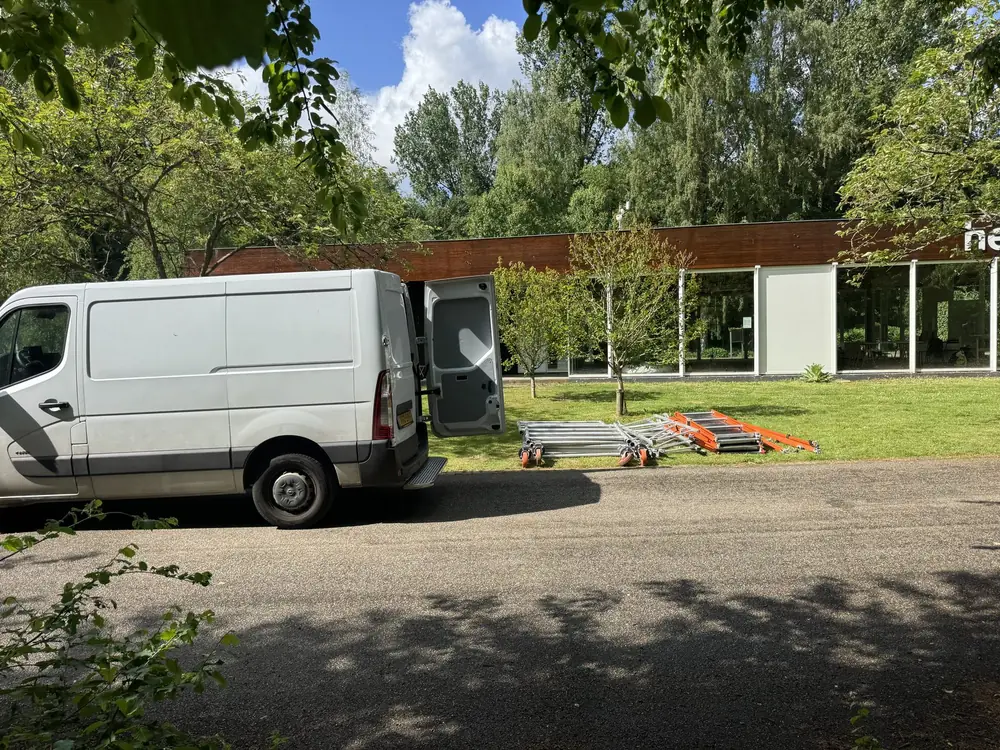
Delivery van with scaffold material at the kerb, the drop off that starts your rental period for the shutter work

Assembly costs you about an hour with two people and rather longer on your own, which is worth knowing before you hire a mobile scaffold for a single day of unscrewing. Once the shutters hang again and the final coat has dried you strike the build and stack the parts in the same place they lay on arrival. We collect them there on the date you gave us, so you concern yourself with finishing the shutters and never with returning anything.

Working safely at height with shutters and wet gloss

Under EN 1004 a deck in load class 3 takes 200 kg for every square metre of floor. Painting shutters comes nowhere near that figure, unless you stack the ones you have removed on the deck instead of carrying them down. So do not do it: timber weighs more than it looks, and a shutter propped against the guard rail starts acting as a sail in the first decent gust. Shutters that come off go straight to the ground.

Wheels braked, stabilisers out, and you move the build only when nothing and nobody is left on it. That last part gets forgotten on paintwork now and then: a tin of gloss or a shutter that was going to come along to the next window. When it blows hard you postpone the glossing, because dust and leaves stick in a wet coat and you lose your grip on a shutter that wants to move with the wind on its hinge.

Mobile scaffold with rails on every side and a ladder within the frame, the way up with paint tins and brushes

Paint makes a deck slippery, certainly once white spirit or a cleaner joins it. Wipe drips up at once and set your tin in a tray or on a hook rather than loose on the floor. On a front elevation somebody walks below you soon enough; close that strip off with tape and remember that a brush or a screwdriver from this height lands hard on the pavement or on a car that happens to be parked there.

In 5 steps

How hiring a mobile scaffold works

1
Choose working height

Pick the height that suits your job.

2
Book online

Sorted in 60 seconds, price shown instantly.

3
We deliver

At the agreed spot the next working day.

4
Assemble safely

Assembled by you, with a manual.

5
We collect

One call and we collect the scaffold.

Good to know

Practical tips for painting shutters

1

Number the shutters and the pintles with a piece of tape before you undo anything. After years they have all settled slightly differently and rarely fit back in a neighbour's place.

2

Take a second set of screws up with you. Old shutter screws often spin in the timber, and then you are standing with a shutter in your hands and nothing to hang it on.

3

Start on the bottom edge of each shutter while you are still sharp. That is the face which catches the water and at the same time the hardest strip to reach from the deck.

4

Lay the shutters below on two trestles with a sheet of plastic underneath if you take them off. You then paint both sides in a day and need the build only for refitting.

5

Finish each window completely before you roll the tower on. Leaving half painted shutters behind because you want the next position set up already costs you an extra round along the whole elevation at the end of the week.

6

Check the pintles in the wall while the shutters are off. A rusted or pulled out pintle you replace in five minutes now, and later only by hiring the tower all over again.

Frequently asked questions

Frequently asked questions about painting shutters

Which mobile scaffold do you hire to paint shutters?+

The narrow version at 75 cm is the logical choice, in a build that reaches six to eight metres. It puts you exactly beside the window frame, even with a hedge or a border in between, and a whole window with a shutter on each side fits on the deck of 245 cm. A wide tower gains you little on this work, because you take only paint and hand tools up and have no sheet material to stack.

How do you go about hiring for an elevation full of shutters?+

On the site you put together your model and your working height, choose two dates and see the fixed amount including VAT straight away. We bring the material as far as your front garden, you raise the tower and start on the shutters, and after the final coat you lay everything stacked and ready. On the agreed collection day we take the material back, even if you only rehung the last shutters that morning.

How many days do you hire if you leave the shutters hanging?+

Count on three to five days in that case, because you depend on drying times between coats. Sanding and degreasing costs half a day, then comes a primer and later the gloss, and in between the timber has to dry. The tower stands in front of the elevation that whole period, including the days you never climb it. Take the shutters off instead and you need the build far more briefly, with the work moving to your trestles below.

What do you pay if the tower stands there for a week?+

The sum follows from the model and from the build you settle on; delivery and collection count as a fixed amount per province, all with VAT included and readable on the rates page. The rental price in full covers the opening 24 hours, and each following day joins it with 95% off. Keeping a build for a week of gloss work therefore costs far less than people expect, and you need not rearrange your planning for a wet day.

Which working height do you hire for shutters under the gutter?+

Measure to the top edge of the highest shutter and pick your build on that. If the upper shutters sit just under the gutter of a two storey house, you usually end up at eight metres of working height. You want to hang the deck so that the top of the shutter is around chest height, since painting downwards simply goes better than working above your head. If in doubt, hire the build one level up and keep that freedom.

Is the set delivered to your door or do you collect it?+

Both are possible with us. Have it delivered and you settle a fixed amount per province in which the later collection is included, with the set ready on the day you picked. Would you rather drive, then after a phone call you are welcome to come by free of charge at Zeeburgerpad 89 in Amsterdam. For a build up to eight metres you do need a van or a trailer to carry all the parts of the tower.

Do you build it yourself when you want to hire a tower for shutters?+

Yes, the assembly comes with it. You get a manual in the set and online a video leads you through the order of assembly; two of you will be at it for roughly an hour. We hire out mobile towers exclusively and therefore deliver nothing assembled, and you will find no cherry pickers or facade scaffolds here. For painting shutters none of that is needed, since this working height reaches every window in the elevation.

What if the gloss work runs late and you want to hire on?+

You arrange that with a message before the collection day arrives. As long as the set is not booked in somewhere else afterwards, we move the date on and you keep the tower until you are finished. With shutters that usually happens through the weather: a day of drizzle means the gloss coat shifts back. Better one extra day of hire than forcing a last coat onto a damp surface you have to tackle again a year later.

How much room do you need in the front garden for this tower?+

An area of roughly two by three metres is enough, with the extended stabilisers counted in. What matters more is having that room at every window with shutters, since you move the build along the elevation a few times. Walk that route beforehand for water butts, garden lights and loose slabs, so you need not clear or dismantle something each time and the tower can roll on in a straight line.

What happens to your rental period if the rain keeps on?+

Your period runs on, but you can stretch it yourself. Because you enter the collection date at the reservation and it can be moved in consultation, you sit a wet week out without losing the build. Glossing a wet shutter is pointless and your deck turns slippery besides. So plan a spare day rather than trying to get a top coat on between two showers with a tower that has to go the next morning.

Do you get the deposit back when the hire has ended?+

You settle the deposit at the reservation, and a working day after the returned set has been counted the money is yours again. On paintwork watch especially for small parts you used to stand something on: a toe board behind the hedge or a clamp in the border shows up in the count. Paint spatter on a frame of the tower is no problem, but missing parts do hold up the settlement of your rental period.

Are you better off taking the shutters down or painting them on the wall?+

Taking them down gives the best result, because you can gloss all four faces and the edges and the shutter cures properly on trestles. You then need the tower only to remove them and to hang them back. Leave them up and you save yourself the screwing, but you stand at height for longer and therefore hire across more days. On badly weathered shutters taking them off is nearly always the better trade, even with the extra climb.

Hire a mobile scaffold for painting shutters today?

Calculate your rental price now or ask for free advice.

Rolsteiger van SteigerTaxi geleverd op locatie
Book it online

Your scaffold sorted in 2 minutes.

Choose your scaffold and working height, see the price instantly and book online.