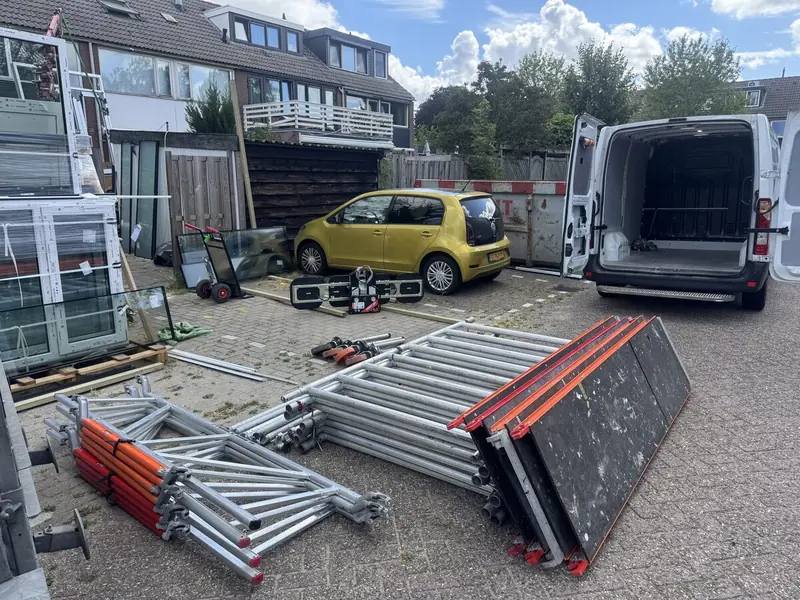

Hire a mobile scaffold in Zeeland
Fixed delivery price of €350 for delivery and collection together, incl. VAT. No hidden costs, regardless of the exact location within Zeeland.
Zeeland consists largely of islands and peninsulas, shaped by the Deltawerken, with Middelburg and Vlissingen as its largest towns.
On the islands and in coastal towns like Middelburg and Vlissingen, we deliver for one fixed price, even when the address is a little further out.
Islands, dykes and water
Zeeland is a series of islands and peninsulas linked by dams and bridges, with broad sea arms between them. The land lies low, dykes are present everywhere in the street scene, and the buildings keep close to the ground. That landscape shapes the building here more than in any other province, right down to the pitch of the roofs and the finish of the walls.
Two things follow from that for work at height. The buildings are seldom very tall, so the reach required usually stays in the lower to middle part of the range. But the conditions you work in are harder than average, because wind and salt are constantly in play rather than an occasional factor. That also explains why the exterior maintenance cycle here is shorter than it is inland.
Villages rebuilt after the flood
Part of the province was rebuilt after the great flood of 1953. Those villages hold whole neighbourhoods from the fifties: plain terraced houses under a simple roof, identical gutter heights, and planned streets with pavements and front gardens. It is housing that has now reached the point where window frames, fascia boards and roof coverings all want attention at once, the materials chosen at the time being sober and functional.
That makes maintenance in these cores predictable and often street-wide. The height stays modest and there is plenty of room to set up, which means the equipment can be positioned without much puzzling. A platform 245 centimetres long is enough on these houses to finish a complete front elevation in two positions. Repositioning, moreover, happens over flat, purpose-laid paving with nothing in the way.
Historic cores behind the dyke
Alongside the reconstruction villages, this province has cores that are far older, with narrow streets, old warehouses and ornamented facades that start right on the building line. Room to set up there is minimal: between carriageway and wall there is barely a pavement to stand on, let alone enough width to extend a scaffold fully. The facades are also taller than in the reconstruction housing further along.
In streets like these only a width of 75 centimetres works in practice, and at the odd address even that is generous. For facade work on these buildings it pays to arrange the delivery for a quiet part of the day and to establish in advance exactly where the equipment can be put down. A short survey beforehand prevents parts being left standing in the street unnecessarily.
Sea clay and dyke ground
The subsoil in this province is marine clay virtually everywhere. It carries a load well in dry spells but turns soft and slick after rain, and that difference is big enough to leave a set-up that stood true in the morning standing out of level by the end of the day. On verges, dyke slopes and semi-paved entrances the effect is strongest. A dry day is therefore a good working day here.
Add to that the fact that a lot of building stands against or on top of a dyke, so the ground level around a property jumps about considerably. The levelling feet then need their full range of adjustment, and plates underneath are a necessity rather than an extra. Rechecking the level after a few hours of work is a habit that repays itself on this ground, certainly if a shower has passed through in the meantime.
Wind and salt as a constant
This province lies open to the sea and there is hardly any natural shelter. Wind is not an occasional problem but a constant you build into the day's planning, and on the islands and along the coast it reaches the facade unbroken. Work on the highest platform positions is better moved to a calm morning than pushed through because it happened to be in the diary.
Salt is the second factor. It attacks paint, metal and pointing on the weather side of a building noticeably faster than inland, which makes the maintenance cycle here shorter than elsewhere. Ironmongery, painted window frames and facade fittings on the southwest side in particular need attention sooner as a matter of course. Skipping a year creates more work than it saves.
Holiday accommodation along the coast
Along the coastal edge of this province there is a great deal of building used for holidays: holiday homes, rental cottages and the service buildings that go with them. That type of building has a maintenance rhythm of its own, because the work has to happen in the quiet months and then in one continuous stretch across several properties at once. Out of season, several buildings on one site are often tackled in a row.
That argues for a longer hire period rather than separate days. Since the first twenty-four hours count in full and every day after that carries a 95 percent discount, hiring continuously through a maintenance round is almost always better value than having the equipment brought and fetched again each time. It also saves transport movements to locations that are poorly accessible out of season.
The run to the southwest
This province sits in the southwestern corner of the country, and the part south of the Westerschelde in particular is a considerable drive from our warehouse in Amsterdam. The delivery date is the same as anywhere else in the country: if the booking is in before three in the afternoon on a working day, the equipment is on site the following day. An address on one of the southern islands is included in that.
Because the islands are reachable from one another by dams and bridges, the whole province falls under one fixed delivery price covering bringing and fetching together. Collecting in person hardly outweighs the journey over this distance, so almost everything here is delivered. The deposit follows within one working day of the return, and for the room scaffold that amount is lower than for the mobile towers.
What comes back most often here
Exterior painting is far and away the leader, with the emphasis on the elevations that take the sea wind and rain head-on. Facade cleaning is recurring too, because salt and damp together leave a stubborn growth that spreads across whole elevations rather than staying in one patch. North-facing walls stay damp longest and are therefore the first to need attention.
Roof edges, fascia boards and gutters need replacing sooner here than inland, and there is plenty of work on window and shutter fittings. On all of it the equipment arrives in parts and is collected again afterwards; putting it up and taking it down is the user's own job, with a manual and an instruction video supplied. In a province where the weather decides when painting is possible, that is precisely the advantage: you can put it up the moment it is dry enough.
All towns in Zeeland
We deliver and collect your mobile scaffold throughout Zeeland, including in:
Frequently asked questions about Zeeland
What does delivery cost in Zeeland?
Delivery and collection together cost €350, regardless of the number of hire days and the exact location within Zeeland.
How quickly do you deliver in Zeeland?
Order before 15:00 on a working day and we deliver the next working day. When booking you choose your preferred delivery and collection date yourself.
Can I also collect it myself instead of having it delivered?
Yes, free of charge by appointment at our warehouse at Zeeburgerpad 89, 1019 AD Amsterdam.
 GoedkoopSteigerHuren.nl
 Bigger job or custom work?
Also façade, system and custom scaffolding, including full assembly
Need a larger or made-to-measure scaffold for a renovation, an HOA or a commercial building? Our partner GoedkoopSteigerHuren.nl arranges it fast, delivered and built up and taken down by professionals.
- Façade & system scaffolding
- Custom sizes for any project
- Professional assembly & dismantling