
See your price
Application

Cleaning a facade? Choose the right scaffold.

Cleaning a facade is wet work in which the product does most of it and you mainly wait. You put a cleaner on, give it the soaking time it asks for and then rinse down gently, without high pressure. All that moisture runs down the wall and lands exactly where the tower stands. A house of two storeys therefore calls for a wide mobile scaffold, built between 5.2 and 9.2 metres. Below you can read which model fits, how many rental days a clean takes and what the ground underfoot endures.

  • Order before 3 pm, delivered tomorrow
  • Professional Altrex scaffolds
  • Up to 14.2 metres working height
  • Easy to assemble yourself
4,2 tot 14,2 mWorking heights available
12Provinces served
7Days a week
200 kg/m²Load class 3
In short
  • For cleaning a facade we recommend the Wide mobile scaffold.
  • For a deep clean over two storeys hire the wide RS52 of 135 cm, built between 5.2 and 9.2 metres.
  • Work without high pressure: it drives water into the joints and pushes back against you and the tower you stand on.
  • Allow waiting time per bay, because the cleaner has to soak before you rinse, and only then does the scaffold move.
  • First 24 hours from €175 incl. VAT and delivery; every day after that 95% off.
Key facts for this job
FeatureValue
Recommended scaffoldWide mobile scaffold (Altrex RS TOWER 52)
Working height for this job5.2 to 9.2 metres
Available working heights4.2 to 14.2 metres
StandardEN 1004, load class 3 (200 kg per m²)
DeliveryOrdered before 3 pm, delivered next working day
Each extra day95% off, from €8.75 a day
Why a mobile scaffold for cleaning a facade?

Safe, stable and professional work at height

When you clean a facade it is the water that sets the pace, not your arms. You put a product on a bay, let it do its work and wash it away again, and all that while you stay in the same spot. Beneath you the rinse water runs down the brickwork, straight towards your wheels and your stabilisers. A ladder is out, because both hands are busy with brush and lance. A routine wash with water and soap is a different thing: there you rinse straight after and wait for nothing. Hire a mobile scaffold for a deep clean and the choice turns on grip, on where the water drains, and on enough rental days per bay.

  • Apply the product, let it soak, then rinse off
  • No high pressure against joints and render
  • Working height of 5.2 to 9.2 metres
  • Saturated ground and a deck that turns slippery
Read more about working safely →

Which mobile scaffold to hire for a facade deep clean

The Altrex RS52 is the wide one in the fleet at 135 cm, and in its heaviest build the model reaches 14.2 metres of working height; for a deep clean over two storeys you pick a build of 5.2 to 9.2 metres out of that range. On wet work you need that width badly. A can of product stands on the deck, a bucket of clean water, a low pressure sprayer and one or two brushes on poles, and you do not want to be shuffling between the lot of them.

There is a second reason. The moment you start rinsing, part of the deck goes wet and slick, and then it helps to keep a dry strip to stand on and to set your things down on. On a deck 245 cm long and 135 cm across that works; on a narrow one everything sits in the same puddle. Working as a pair, with one applying and the other rinsing behind, the wide build is the obvious choice.
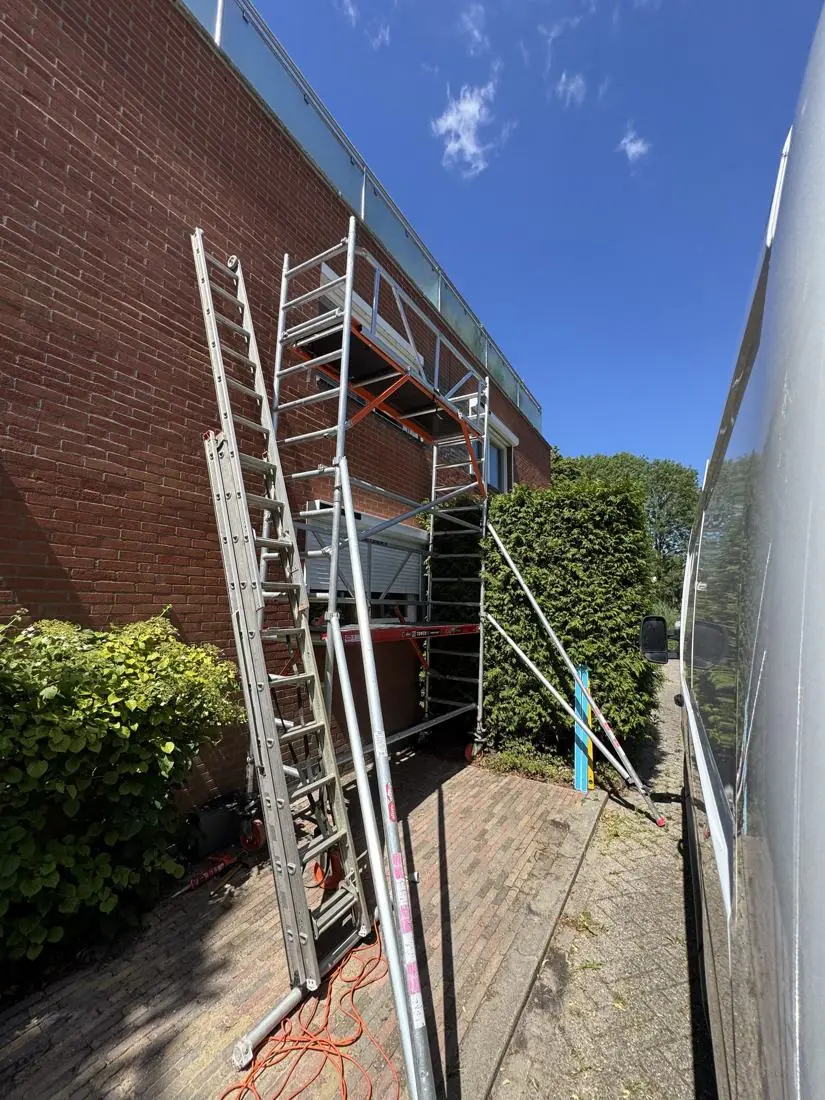
Wide mobile scaffold along a side elevation, the deck that takes your can, bucket and brushes during a clean

The slim RS51 at 75 cm stays usable for the back of a terraced house, where the only way in is a gate or a narrow path. Reckon then on climbing down more often to fetch something, on leaving your can at ground level and on moving more carefully across a wet deck. For a street elevation that is rarely necessary. Both versions are described alongside each other on the mobile scaffolds we hire out.
Which working height to hire for cleaning a two storey facade

A clean rarely stops halfway. Green growth and grime sit precisely under the roof edge, along the gutter and on the north side, so your highest point is nearly always the top of the brickwork. From the deck you stand on, a brush on a pole takes you another two metres or so, and that is the margin you count with. On a wall that finishes at a good seven metres you land on a build of around 9.2 metres.

You start measuring on the paving where the wheels will go, and on this job that is by no means always level with the front door. Cleaning often begins low at the plinth, where most of the growth is, and that plinth sometimes sits half a metre below the terrace. Carry that difference into the figure you book, or you fall short at the top by exactly that half metre. The build to match sits on the page about nine metres of working height.

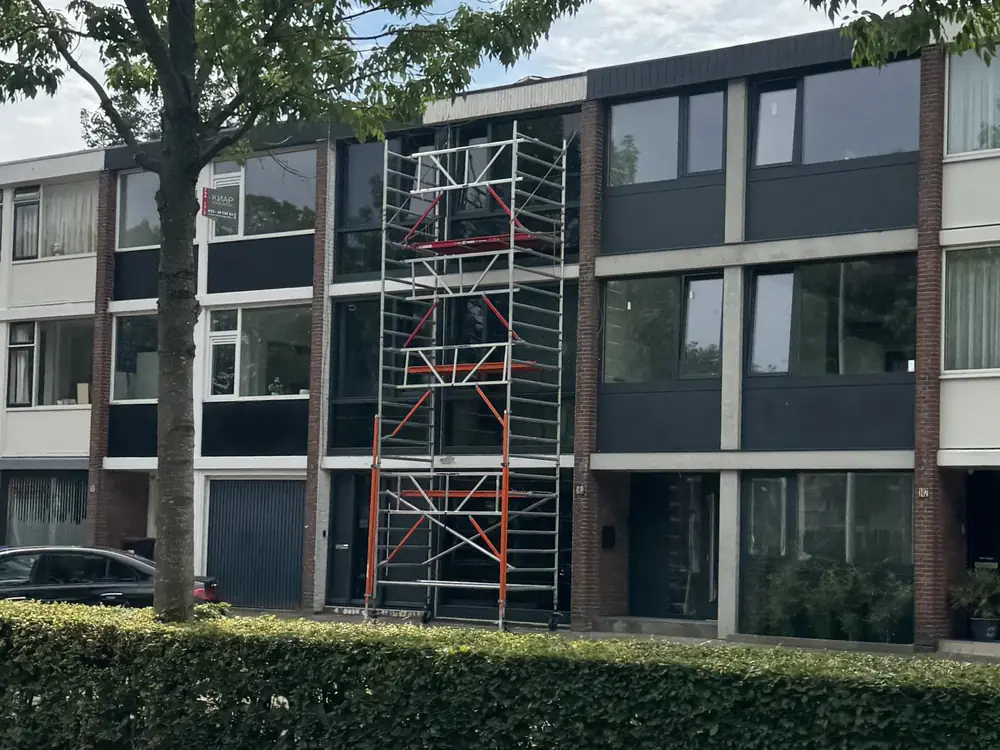
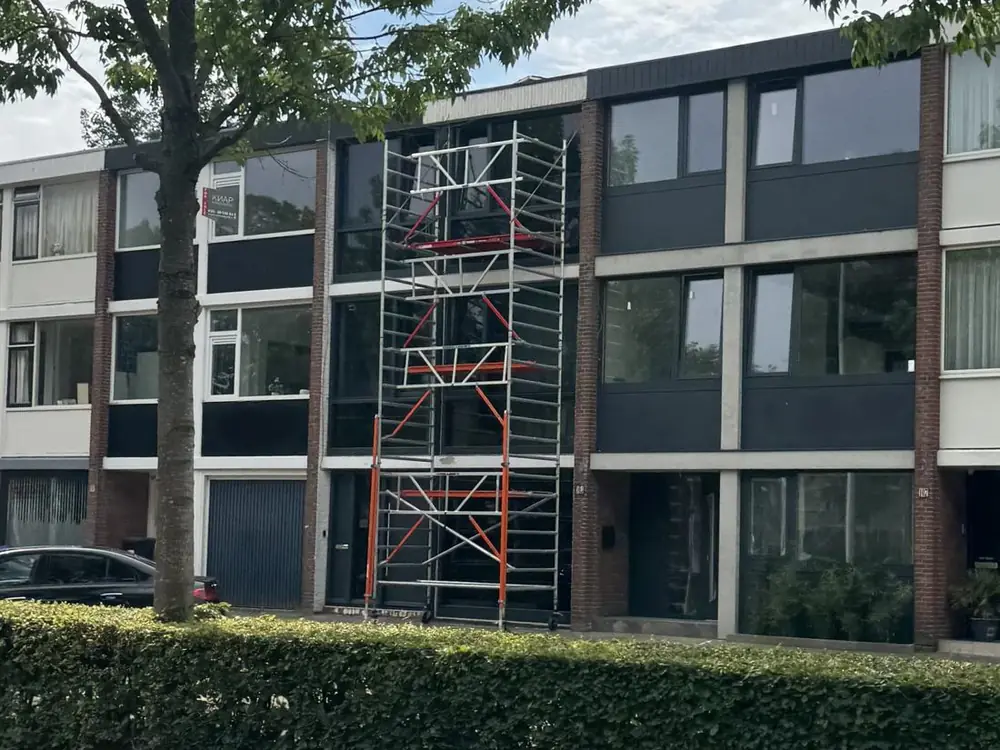
Mobile scaffold built up along a front elevation, at the height you need to take in the top edge

Pick too low and a band is left at the top that leaps out once everything has dried. A cleaned facade with a dirty stripe under the gutter draws more attention than a wall you never touched. Rinse water from that dirty section also runs down over your finished work, so the bottom starts again. In doubt over a facade of two storeys, simply sit one build higher and hire the extra metre with it.

Hiring a scaffold for facade cleaning: the ground under the feet

Everything you put on the wall ends up below in the end. Expect the strip a metre wide along the brickwork to be soaked through by the time you finish, and that is exactly the strip your wheels and your stabilisers are standing in. On blocks or slabs that is no trouble. On a lawn, a border or a path of bark chippings the same strip turns to mud within a day, and then a wheel sinks while you are up top.

Lay road plates, paving slabs or stout boards under every foot before you start, even if the ground looks hard on arrival. Look as well at where the water can go: a gully in the drive, a gravel margin or an outlet in the terrace. One bucket is nothing, but a day of rinsing produces hundreds of litres. If it all runs towards the cellar window or the neighbours' crawl space, move your starting point. Keeping a tower steady on such ground is covered in the explanation about stabilising.

Stabilisers and wheels on the ground beneath a mobile scaffold, the strip that soaks through during a facade clean

Clear the zone under the build out properly as well. Garden furniture, bicycles and pots catch not only water during a facade clean but traces of product too, and planting right against the wall suffers from that. Cover them or move them away, and warn the neighbours if your walls butt up against theirs. That is a matter of thinking a day ahead before the mobile scaffold is delivered, and it saves you an afternoon of cleaning up afterwards.

Rental days needed for a deep clean of one facade

On a deep clean the soaking time sets the pace, not your arms. You put the product on bay by bay, wait out the period the label asks for and rinse afterwards. During that wait you can at most prepare a second bay, but you cannot move, because a half soaked bay is not something you walk away from. On one elevation of two storeys that adds up to two to four rental days, even though the work itself looks like little.

Then comes the drying. Only once the wall is genuinely dry do you see whether the result is even everywhere and whether a bay needs a second treatment. That judgement cannot be made the same afternoon, so keep a day in hand on which you can still touch things up. You also do not want to apply product with rain on the way, because it washes off before it has done anything and that bay starts again.

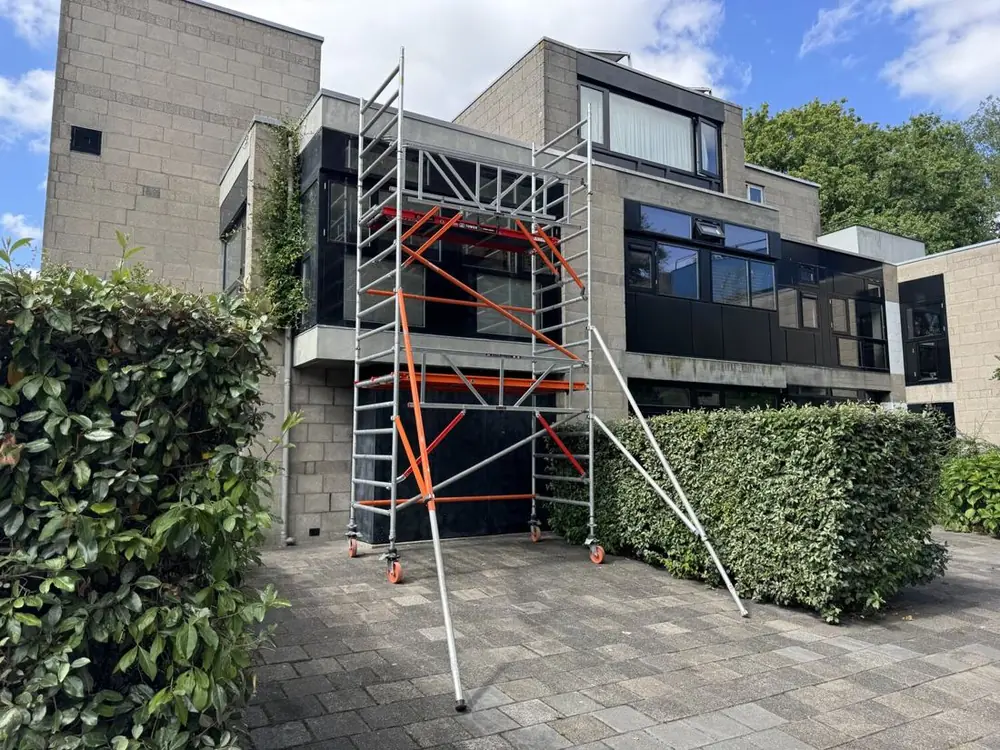
Mobile scaffold positioned beside a house, as it stays put while the cleaner soaks into the wall

The way the tariff is built works in your favour here. You settle the first twenty four hours at the full rate, and every rental day after that has ninety five per cent taken off, so an extra drying day costs you next to nothing. That is precisely the slack a deep clean needs. Book a day too many rather than stand rinsing while the van is already on its way. A realistic estimate comes from the overview of rental days needed.

Which mobile scaffold suits cleaning a facade?

Kamersteiger RS44
  • Working height up to 4 metres
  • Compact and narrow
  • Great for indoor and small jobs
View and calculate →
Smalle rolsteiger RS51
  • Working height up to 14.2 metres
  • Narrow (75 cm)
  • Ideal for narrow passages
View and calculate →
Most chosen
Brede rolsteiger RS52
  • Working height up to 14.2 metres
  • Wide platform (135 cm)
  • Extra stability and workspace
View and calculate →
1-persoons steiger MiTower
  • Working height up to 6.2 metres
  • Very compact
  • Quick and easy to assemble
View and calculate →

Applying the cleaner and rinsing off from the working deck

One set up with a deck of 245 cm covers a bay of wall a good two metres wide, and that bay is your working unit. Put the product on from the bottom upwards, so you avoid dry bands where it runs down over a wet streak. Rinse afterwards the other way round, from the top down, in calm overlapping passes. Only move the build once the bay has been rinsed through and the water has run out of it.

High pressure you leave alone. A hard jet drives water through the joints into the wall, blows soft pointing and render apart and chases dirt rather than dissolving it. On a mobile scaffold something else comes with it: a lance under pressure pushes back hard, and you brace that force against a build standing on wheels. Work therefore at low pressure, with a generous flow of water and a brush for the spots that resist.

Erected mobile scaffold along a building, the set up you leave in place until the bay is rinsed

What people underrate is how often this job sends them down. Refilling a can, fetching a different brush head, shifting the hose: on wet work that happens more than you planned for, and with wet hands on a wet rung you want to limit those climbs. Take everything up in one go per set up and keep a spare bottle ready. If you go on to seal the facade later, you use the same division into bays.

Hiring a mobile scaffold with delivery for wet cleaning work

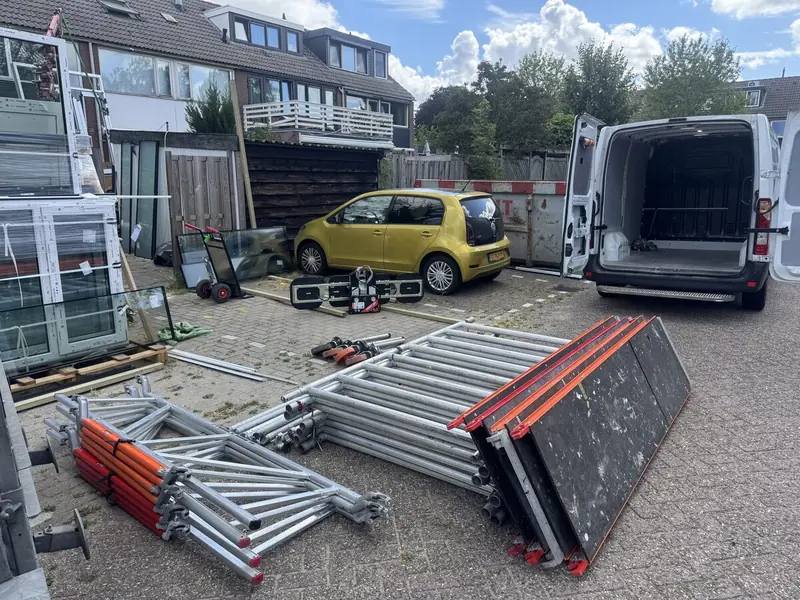
What turns up is a stack of loose parts, counted out and complete. Point out a dry spot for that stack, far enough from the wall that no rinse water will run over it and with room to walk past carrying a full bucket. A drive or a piece of terrace works better than the grass you are going to soak later anyway. Whoever books on a working day and beats the 15:00 mark gets the parts on the next working day.

You fill in the delivery day and the return day yourself, and for cleaning you look at the rainfall forecast to do it. A dry spell of a few days is worth more than an early start date, because rain during the soaking time makes your product useless. Have the set arrive the day before your first cleaning day, so the build already stands before the first bay comes up. Allow half a day for that, and do not start on a wall the morning the van pulls in.

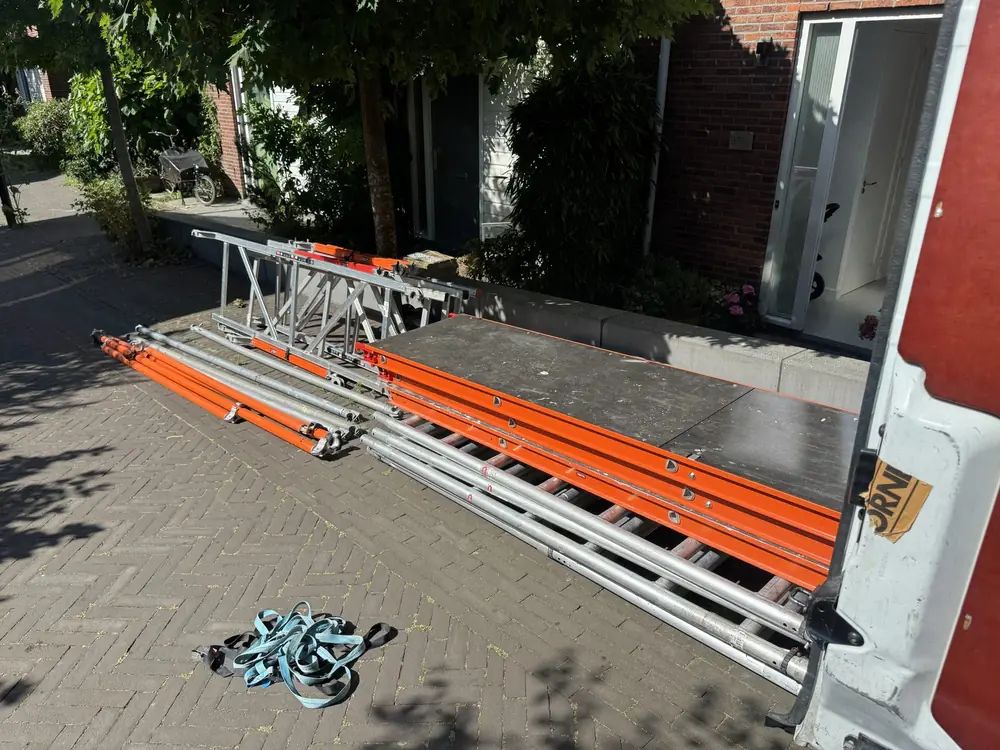
Scaffold parts in the load space of a van, the set you have dropped on a dry spot for wet work

Once the job is done we come and fetch the build again, as soon as you have taken it apart and laid it complete on the drop off spot. Rinse the tubes and the decks with clean water first, because traces of cleaning product have no business drying on the material. Let the lot drain before you stack it. The amount for the outward and return trip differs per province and sits with the fixed rates for delivery.

Working safely on a wet deck while cleaning the facade

Each square metre of deck under your feet may carry 200 kg, which is load class 3 within EN 1004. On a clean you rarely get near it, unless you work as a pair and full cans and buckets of water stand there too; water weighs more than people reckon. Spread the load along the length of the deck rather than heaping it into one corner. Where that upper limit comes from is spelled out in the explainer on the mobile scaffold standard.

The real hazard here is right under your soles. A deck carrying water and a soapy product turns treacherous, certainly at the spot where you keep turning to reach the bucket. Wear footwear that keeps its grip, wipe the deck dry between passes and put nothing down that you have to step over. Keep the brakes on while you are up there and never shift the build with a person or with material aboard. Walk the stabilisers round again after each move.

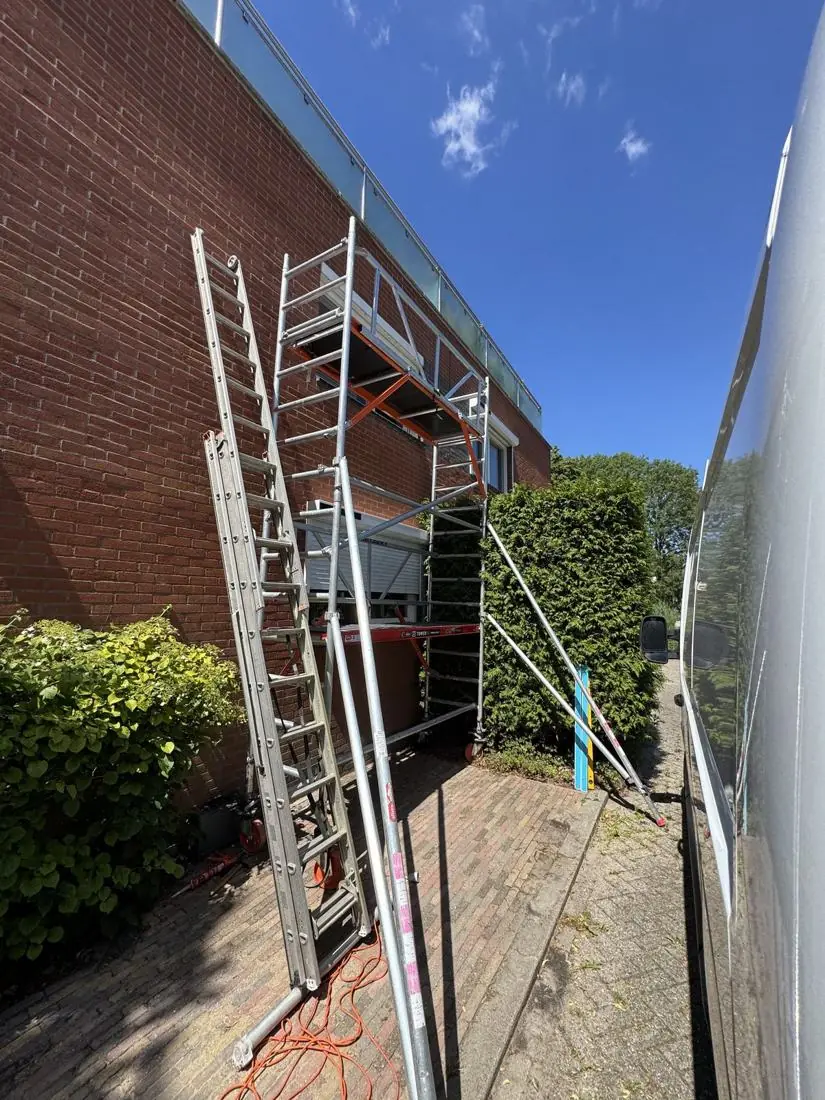
Mobile scaffold pitched in a side passage with a separate ladder against the wall, each deck square metre good for 200 kg

Below the build wet jobs also ask for care. Rinse water runs down, a hose lies about and there is often an extension lead running to a small pump. Keep electrics high and dry, let nobody walk under you while you rinse, and stop when it blows, because then the product drifts as a mist across the garden. Agree who keeps an eye on the hose from below, so it never pulls tight between a wheel and the wall. The further rules sit at working safely at height.

In 5 steps

How hiring a mobile scaffold works

1
Choose working height

Pick the height that suits your job.

2
Book online

Sorted in 60 seconds, price shown instantly.

3
We deliver

At the agreed spot the next working day.

4
Assemble safely

Assembled by you, with a manual.

5
We collect

One call and we collect the scaffold.

Good to know

Practical tips for cleaning a facade

1

Wet the wall through before you put the product on. Dry brickwork drinks it straight in and it then soaks in unevenly, which leaves the bay patchy once it has dried.

2

Keep a bucket of clean water and a sponge on the platform for splashes on frames and glass. Dried cleaning product on a pane is a good deal harder to shift afterwards.

3

Lay an anti slip mat or an old doormat on the spot where you stand most. That is the square metre of deck that gets wet first and where you turn most often.

4

Do the lowest part of the wall last, once everything above it is finished. Everything you do higher up rinses down, and otherwise you clean the plinth twice inside the same rental period.

5

Do not run your hose tight along an upright but in a generous loop over the guard rail. It then does not tug at your arm and stays clear of the wheels when you move.

6

Reserve one rental day after your final rinse. You need it to see whether the wall has dried out evenly everywhere, and to treat again any bay that came out patchy.

Frequently asked questions

Frequently asked questions about cleaning a facade

Which mobile scaffold should I hire for cleaning a facade?+

Over two storeys the wide RS52 at 135 cm is the right thing to hire. On wet work more stands on the deck than on dry jobs: a can of product, a bucket of water, a low pressure sprayer and brushes on poles. A wide deck also leaves you a dry strip to stand on. If you reach the back elevation only along a narrow path, add the 75 cm version for that side.

How does a rental period for cleaning a facade run?+

Online you choose the model and the build height, and you enter which day everything may be dropped and when it gets collected again. The amounts are fixed and include VAT. On the chosen date the parts lie ready, you put the mobile scaffold up and clean bay by bay, and after the last rinse you set it all out dismantled. Look at the forecast for that week before you book.

How many days must you hire for cleaning a facade of two storeys?+

For one elevation of two storeys you usually hire two to four days. Putting the product on costs little time, but the soaking period per bay and the rinsing set your pace, and you can only move once a bay is finished. Add another day to assess the dried wall and touch up locally where needed. Right round a whole house that grows to something like a week of hire.

What does hiring a mobile scaffold for facade cleaning cost?+

The rental price consists of the rate for the scaffold model with the build you choose, plus a fixed amount per province for delivery and taking it away. The rates are shown including VAT on the page with the prices. Because the first day takes the brunt and the ones after it hardly register, one continuous period comes out better than two separate blocks. On a job with waiting time that really pays.

Which working height should you hire for cleaning a two storey wall?+

Count on 5.2 to 9.2 metres, depending on where the facade stops at the top and whether you take in the band under the gutter. Measure from the plinth, because that is usually where you start, up to the highest edge you still want clean. Which scaffold build suits is shown by the page about working heights. Hire a notch higher rather than lower, since a dirty band shows up all the more once dry.

Can I have the scaffold delivered on the day I start cleaning?+

It is possible, but a day earlier works better, because you then build calmly and start on the first bay the next morning. You pick the date yourself when you reserve. Driving over is allowed too: in Amsterdam, at Zeeburgerpad, you can take your hire set away free of charge by appointment if your transport can hold the parts. For a wet job running over several days almost everyone still has the tower delivered.

Is erecting part of hiring a scaffold for facade cleaning?+

No, putting it up and taking it down is your own work. You get the build sequence with it and a video stands ready that demonstrates every step; with two people this build is up in a morning. Plan that morning separately, because cleaning on your build day rarely comes off. A cherry picker, facade scaffold or system scaffold is not something you can hire from us, so on a wall of this height the mobile scaffold is the tool you work from.

Can I hire for longer if rain brings the cleaning to a halt?+

Yes. Flag the new return day the moment you realise, and the collection date moves with it, unless another customer is waiting on this tower straight away. On a facade clean that happens regularly, because rain during the soaking time washes your product off before it has done a thing. Anyone wanting to avoid that books a spare day from the outset. Handing the set back early is allowed too, so booking generously rarely works out badly here.

How much clear space does a hired scaffold need for a facade clean?+

Add the width of the base to the spread the stabilisers ask for on either side, and keep clear as well the strip along the wall that the rinse water runs into. On a clean you want no garden furniture, pots or bikes standing in that zone. Move it all away before the mobile scaffold is delivered, and put slabs or stout boards down on the spots where the wheels will come to stand.

May the hired tower stay up if it rains during the facade clean?+

The scaffold may simply stay standing, provided the stabilisers are firm and nothing is loose on the deck. The work itself you put down, because both applying and the soaking time of your product are pointless in the rain. Use such a day to sheet things up, to lay out your kit or to prepare the plinth. Since you set the return day, shifting costs you one extra day at most.

What happens with the deposit when you hire a scaffold for wet work?+

You settle a deposit when reserving, and that amount is transferred back within one working day of the return date once the parts have been counted. On cleaning you watch above all for product left behind: rinse the decks and the tubes of the hired tower thoroughly before you stack them. Dried on residue is harder to shift than you would think. How that is handled is described in the article on settling up afterwards.

Why do you not use a pressure washer when you hire a scaffold for this?+

Because high pressure wrecks two things: your wall and your stance. Water is driven inwards through the joints, soft pointing and render blow loose, and up on a tower the kickback of the lance pushes you away from the bay while you stand on wheels. Low pressure with plenty of water and a brush does the same job without damage. That is also why you plan more days here than for an ordinary wash with water and soap.

Hire a mobile scaffold for cleaning a facade today?

Calculate your rental price now or ask for free advice.

Rolsteiger van SteigerTaxi geleverd op locatie
Book it online

Your scaffold sorted in 2 minutes.

Choose your scaffold and working height, see the price instantly and book online.