
Knowledge base · reading time 10 min
How many days should I hire a scaffold?
The question of how many days you need a scaffold is really two questions: how long your job takes and how much slack you want. Because the first hire day costs the full rate and every following day counts as 5 percent of that day rate, booking too tightly is almost always more expensive than booking generously.
- How many days do you need a scaffold? Guide times per job, drying times, building and dismantling, and why booking generously costs very little.
- Every day after the first counts as 5 percent of the day rate.
- No, the hire day is the smallest unit and the first day costs the full rate.
- Yes, you can extend after the scaffold has been delivered.
Why the first day counts differently
The rate structure is simple: the first hire day costs the full day rate, every following day counts as 5 percent of it. That means most of your hire amount is fixed the moment you book a single day. The days you add after that change the total only slightly, which makes the question of how many days you need far less nerve wracking than it looks.
In practice that structure shifts your whole calculation. You do not have to work out whether you can just about manage in two days, because if it becomes three the difference is small. What you do watch is that the scaffold does not have to come twice. A second delivery means a second round of delivery, collection and assembly, which costs far more in time and money than a few extra hire days.
What the day rate itself is depends on the model and the height you choose. You work that out in advance in the configurator, or you look at it per model on the pricing page, so you know where you stand before you fix your period. Count the delivery charge separately, because it is independent of the number of days and does not change if you carry on longer.
Key facts
| Feature | Value |
|---|---|
| Core answer | Plan your days generously: an Every day after that has 95% off |
| Each extra day | 95% off: €2.50 to €16.25 a day |
| Assembly time | 15 to 45 minutes, no tools needed |
| Delivery | Ordered before 3 pm, delivered next working day |
| Deposit | Refunded within 1 working day of return |
Count building and dismantling in your period
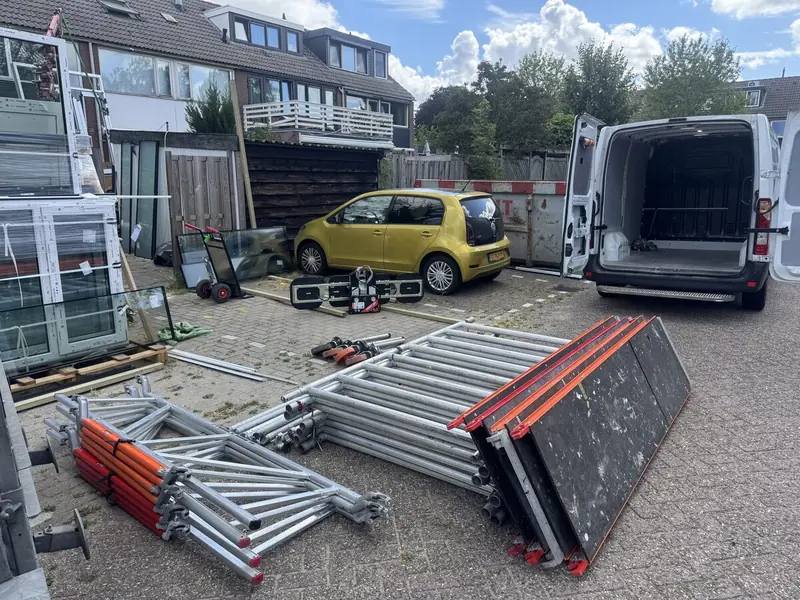
Steigertaxi delivers the scaffold in parts and does not assemble it for you. You build it yourself, with the manual and an instruction video to hand. That is perfectly manageable, certainly with two people, but it takes time on the day the scaffold arrives. Anyone who books a Monday delivery and expects to paint half a facade that same Monday is in for a surprise.
The same applies at the end. Dismantling is quicker than building, but the parts still have to be grouped and put ready somewhere the driver can reach them. If everything sits behind a locked gate, the collection cannot go ahead and it slips by a day. So count your working days plus a slice of the first and the last day. The assembly in steps and taking down and returning are each described separately.
If you move the scaffold during the job, from the front facade to the side wall for example, count those moments too. Moving is only allowed with nobody on board and an empty platform, and in the new position you level it and brake it again. That is a quarter of an hour each time that was not in your painting schedule.
Guide times per type of job
No table can say exactly how long your job takes, because that depends on the area, the weather and how often you have to come down. There are, however, rules of thumb that work well as a starting point. Look at the number of surfaces you finish rather than the number of square metres, because moving and climbing take up most of the time.
A short installation job is often done within a day, provided everything is ready to hand: the right plugs, a charged drill and someone keeping an eye from below. If it involves painting or anything that has to dry, you almost always run across several days. For work that depends on the season, such as facade maintenance, you would also rather pick a spell of settled weather.
- Fitting a light, camera or aerial: usually one day.
- Cleaning or inspecting a gutter: one day per elevation.
- Sanding and painting window frames: several days, depending on the number.
- Painting a whole facade in two coats: easily a week.
- Repointing or repairing rot: several days to several weeks.
Drying times and weather set your schedule
On paintwork you spend more time waiting than actually painting, and that waiting is what fills your calendar. A primer has to dry before the topcoat goes on, sealant and filler have to cure, and a facade wet with morning dew can only be treated later in the day. Those hours count within your hire period, even though you are not standing on the scaffold.
Rain can easily cost you a whole day, and in autumn the odds of that are higher than in June. So book a buffer if you are working in a wet season, and bear in mind that in winter you start later and stop earlier because of the light. What else matters in the cold months is set out under hiring a scaffold in winter.
If you are doing something that cannot be left half finished, such as cleaning a gutter ahead of a forecast storm, plan the surrounding days generously. You do not want the scaffold collected while the last stretch of gutter is still open. In a case like that, take two days extra rather than half a day too few, because a second delivery costs a multiple of it.
How the rate builds up over a longer period
Because every day after the first counts as 5 percent, your total grows far more slowly than the number of days. Four days of hire is therefore not four day rates, and a week is not seven. The table below writes out the arithmetic, expressed as a percentage of the day rate, so you can see what an extra day does to your total.
That ratio is exactly why hire companies advise booking generously. If you are torn between three and five days, those two extra days together cost a tenth of a day rate, and they leave you room to skip a rainy day without the schedule falling apart. The rates per model and per height are on the page about what hiring a mobile scaffold costs.
| Hire period | Arithmetic | Total as a percentage of one day rate |
|---|---|---|
| 1 day | 100 | 100 percent |
| 3 days | 100 plus 2 times 5 | 110 percent |
| 7 days | 100 plus 6 times 5 | 130 percent |
| 14 days | 100 plus 13 times 5 | 165 percent |
| 30 days | 100 plus 29 times 5 | 245 percent |
Thinking in days or in weeks
For a job of one or two days you think in days; for anything longer it is more practical to think in weeks. A week gives you room for a rainy day, a day when you do not get to the job at all, and the drying times between two coats. It also saves you working out every evening whether you will make it tomorrow.
For many jobs the tipping point sits around four days: below that you add single days together, above it you think in blocks of a week. The comparison between the two ways of counting is set out in the guide on hiring per day or per week. To see the amounts side by side, look at price per day and price per week, which show where the tipping point lies for your model.
What goes wrong when you plan too tightly
Booking too tightly rarely saves anything. The typical scenario: you booked two days, the first goes on assembly and stripping old paint, and on day two it rains. You are then left choosing between rushing the job and having the scaffold delivered all over again, and that second option is always dearer than the days you could simply have added.
There is a second risk as well. Anyone working under time pressure leans over the guardrail sooner, leaves a brace where it should have been moved, and climbs with too much material in hand. Time pressure at height is precisely the condition in which accidents happen, which is a reason to book generously that has nothing to do with money.
If you are stuck anyway and need a scaffold quickly, there is the route of hiring a scaffold urgently. It is more comfortable to avoid that situation by taking a day or two of margin when you book. The question is then no longer what is still available for tomorrow, only whether the weather is going to cooperate with you.
Extending while the scaffold is already up
If your job overruns, that need not be a problem. You can extend after the scaffold has been delivered; you say until when you need it and the collection is rescheduled for the new date. The extra days count in exactly the same way as the days you booked in advance. So there is no need to dismantle the scaffold simply because the original end date is coming up.
Do it in good time rather than on the morning of the collection day. The drivers are scheduled per day, and the earlier you say so, the easier it is to move. Two days ahead is comfortable, the same morning is tight. A quick message on WhatsApp is enough, and then it is settled before you climb back up to the platform.
Several jobs in one hire period
While the scaffold is standing there anyway, it is worth seeing what else you can take on. Extra days cost little, whereas a second hire period later means the full day rate and a delivery charge all over again. So walk round your facade before you book and make a list of everything that has to happen at height. There are usually more items on it than you expected, from a loose gutter bracket to a light that has not worked for a year.
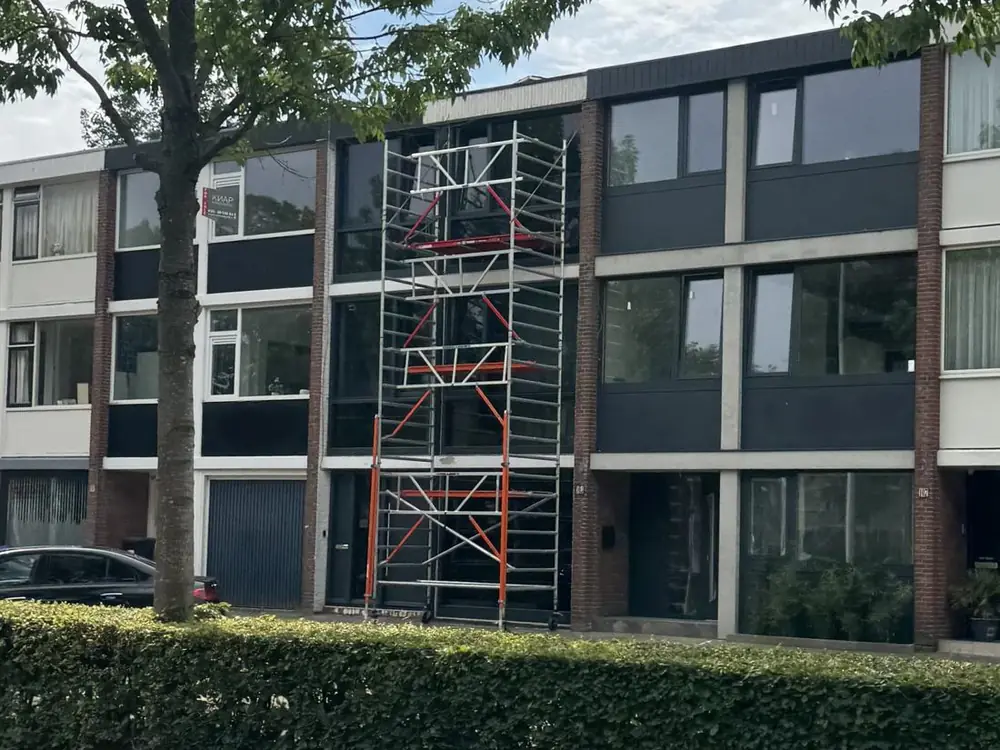
In practice people combine painting a facade with clearing the gutter, replacing an outside light and checking the roof edge. That is the same scaffold, the same build, and often only one or two extra days. On a mobile scaffold with a 245 cm platform you also have room to keep the materials for two jobs up there at once.
What to check before you fix your period
Before you fill in the dates, it helps to talk your job through out loud: when does the scaffold arrive, when are you actually standing on it, and when does it have to go. Especially if you are working at the weekend, you want the delivery and the collection to fall on working days that sit neatly around it. Write the days down on paper if it helps, and you see at once where it gets tight.
Orders placed before 15:00 are delivered the next working day, anywhere in the Netherlands. So count back from the day you want to start, and bear in mind that a Friday delivery means you are working through the weekend. What delivery and collection come to for your province is shown under delivery costs, and ways to keep your total down are covered under hiring a scaffold cheaply.
- How many days are you genuinely on the scaffold?
- Is half a day of building and dismantling in your plan?
- Have you counted drying times and one possible rainy day?
- Does the delivery fall on a working day before your start?
- Could a second job fit into the same period?
Frequently asked questions
What does an extra day of hire cost?
Every day after the first counts as 5 percent of the day rate. A week therefore comes to 130 percent of one day rate rather than seven times that amount. The exact total for your model and period appears in the configurator.
Can I hire for less than a full day?
No, the hire day is the smallest unit and the first day costs the full rate. So for a two hour job you book one day. Because following days add so little, many people book that short job with a day of slack straight away.
Can I extend if my job overruns?
Yes, you can extend after the scaffold has been delivered. Say so as early as you can and the collection is rescheduled for the new date. The extra days count in the same way as the days you booked in advance.
When will the scaffold be at my door?
Order before 15:00 and delivery follows the next working day, anywhere in the Netherlands. Count back from your start date so you are not forced to squeeze the assembly into your first working day. Free collection by appointment in Amsterdam is also possible.
Is a week much dearer than three days?
The difference is four extra days at 5 percent, so 20 percent of one day rate. For most jobs that certainty easily outweighs the risk of rushing the work or having to hire all over again.
Do I have to dismantle the scaffold every evening?
No, the scaffold may stay up as long as it is properly stabilised or anchored, the castors are braked and the platform is clear. Do watch the forecast, because in a storm you take it down or reduce it to a lower build.
What if I finish with the scaffold early?
Let us know and we will see whether the collection can be brought forward. It rarely pays to plan around that, because the following days are the cheapest part of the hire and margin is worth more than returning a day early.