
Knowledge base · reading time 10 minutes
Safe assembly according to EN1004
You receive the mobile scaffold in parts and assemble it yourself, with the manual and the instruction video to hand. This guide works through the assembly from the bottom up: the ground and the base frame, then the guardrails, the stabilisers and the check you run before every use.
- How to assemble a mobile scaffold safely to EN 1004: ground, base frame, guardrails, stabilisers and the check you run before every use.
- No, we deliver the scaffold in parts and you assemble it yourself.
- That depends on the model.
- The towers are in load class 3, so 200 kilos per square metre of platform.
What EN 1004 actually covers
EN 1004 is the European standard for mobile access towers. It sets requirements for the structure, for the lockable castors, for the height of the guardrails and for the order in which the tower is assembled. All our equipment is made by Altrex and is built to that standard. You receive the scaffold in parts and assemble it yourself. As long as you follow the supplied manual and the instruction video step by step, the result is an assembly that meets the standard.
The towers are in load class 3, which means 200 kilos per square metre of platform. Everything counts towards that figure: you, your colleague, your tools, your paint, your roof tiles or your solar panels. A bucket of mortar and a toolbox add up faster than most people expect. Work out in advance what is going up and spread it across the platform instead of stacking it in one corner. Load and weight on a mobile scaffold explains how to make that calculation.
The standard applies to the assembly as a whole, not to individual parts. A diagonal brace you skip because the tower already feels solid, or a guardrail you leave off because you are only up there for five minutes, takes the assembly outside the standard. The stiffness of a mobile scaffold comes from those braces and couplings, not from the weight of the structure.
Start with the working height and the width
Working height is platform height plus two metres, which is the reach of an adult standing on the platform. If the gutter you need to reach sits at six metres, you want a platform at roughly four metres. Choose on platform height alone and you end up two metres too high, working above your head all day. The working height overview shows which set-up belongs to each height, and calculating your working height works through the sum in full.
Our range covers working heights from 4.2 to 14.2 metres. Within that range you choose between two widths. The RS51 is 75 centimetres wide and fits through gates, garden paths and narrow passages. The RS52 is 135 centimetres wide and gives you more floor area for materials. Both have a platform length of 245 centimetres, so the difference is only in the width. You can compare the two on the mobile scaffold rental page.
Indoor work calls for different dimensions. The RS44 room scaffold fits through a standard interior door from about 70 centimetres, so you can roll it from room to room without dismantling it. If you work alone and stay below six metres of working height, the MiTower is designed to be put up by one person. Always measure the narrowest passage on the route to the work area, not just the door of the room itself.
Check the ground before you pick up a single part
A mobile scaffold puts its entire weight on four small contact points, so what lies underneath decides whether the assembly is sound. On paving and concrete you can usually start straight away. On grass, sand, garden soil or freshly backfilled ground a castor sinks in as soon as load is applied, and you only notice once the tower is three platforms high. Put base pads or sturdy planks underneath so the load is spread over a larger area.
Look at what you cannot see as well. Manhole covers, gullies, crawl space hatches and recently dug service trenches carry load differently from the paving next to them. A slight slope is taken up by the adjustable legs, but the fall of a steep driveway is another matter. If you are unsure whether the spot is suitable, read a mobile scaffold on uneven ground or send us a photo on WhatsApp and we will look with you.
- Is the ground level enough to adjust the legs within their range
- Does the surface still carry the load after rain, or does it turn soft
- Are there manhole covers, gullies or hatches under the set-up position
- Is there room to extend the stabilisers fully on all sides
- Are there cables, roof edges or canopies above the position
- Can you walk right around the tower at ground level to inspect it
Lay out the parts in assembly order
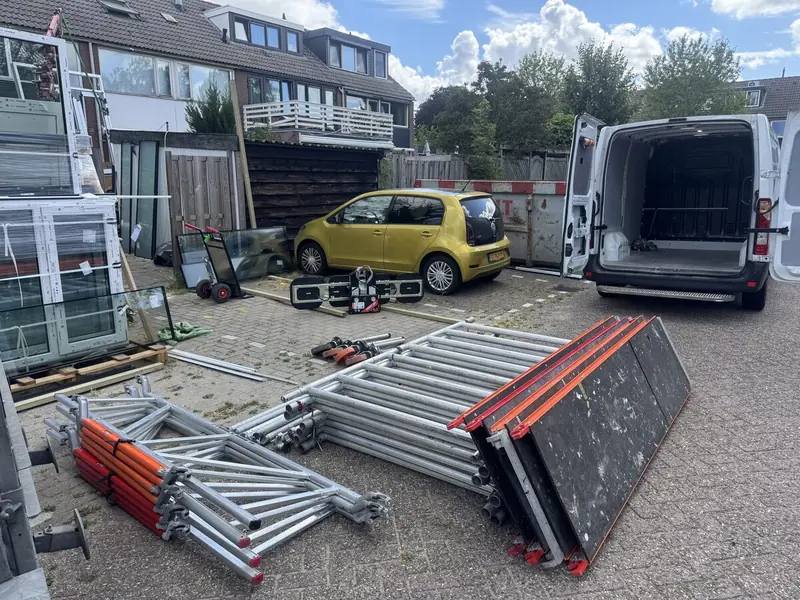
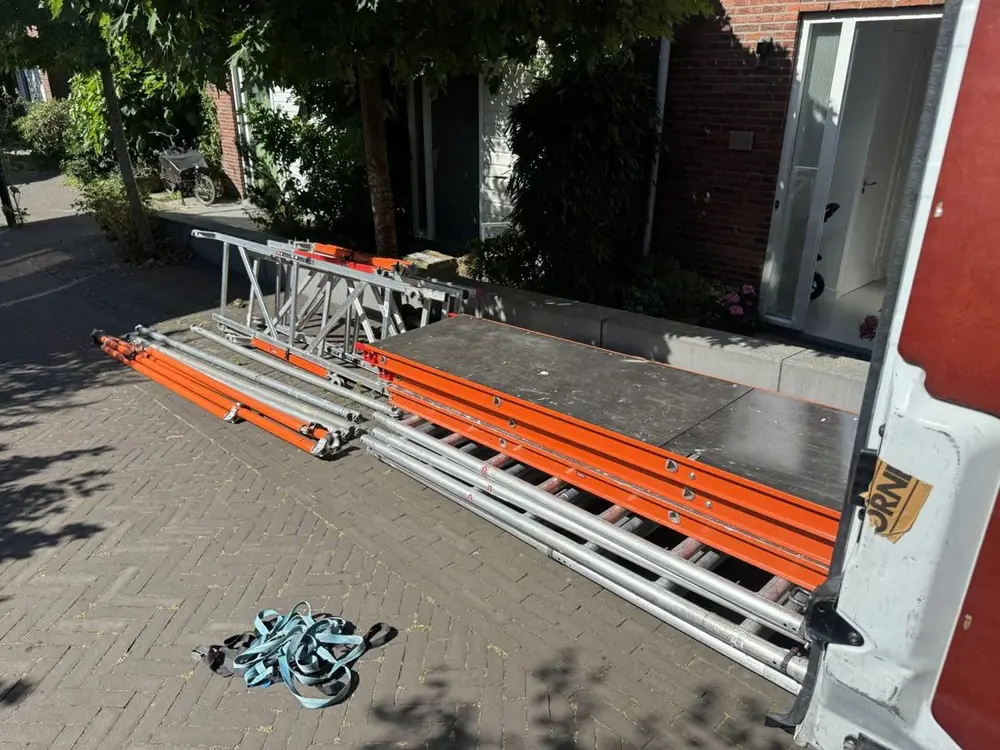
Most mistakes start when someone is missing a part halfway up and begins improvising. Unpack everything first and lay it out in the order you need it: base frame and castors nearest, then frames, braces and platforms, and finally the guardrails and toe boards. That way you never have to climb the tower with a component in your hand, and you can see at a glance whether anything is missing.
Check every part for visible damage. A bent frame, a castor whose brake no longer holds or a cracked platform does not belong in the assembly. If you find something, do not use that part and call or message us so we can arrange a replacement. The full sequence is set out in the step by step guide to assembling a mobile scaffold, which you can keep beside the manual.
- Count the frames, braces, platforms and guardrails before you start
- Set out the castors and check that every brake holds
- Lay the platforms with the hatches facing the same way so you do not have to turn them later
- Keep the manual and the instruction video within reach
- Clear a working strip of at least a metre around the tower
- Keep tools in a bucket or a bag rather than loose on the paving
Levelling the base frame and locking the castors
Start with the castors in the frames and the brakes applied, even though there is nothing to climb yet. A base frame that rolls away while you are aligning it is an easy way to trap a finger. Then adjust the legs until the base frame is level. Use an actual spirit level in two directions, along the length and across the width, rather than judging it by eye.
A few centimetres out of true at the bottom becomes a serious deviation at ten metres. Every error in the base frame multiplies as you build upwards. Check that all four legs genuinely carry load: if you can move one by hand, the weight is resting on three points and the tower will rock as soon as you step onto it.
Once the base frame is right, check that the castors are still locked. Adjusting the legs often turns a castor and releases the brake. This is also the moment to look at whether you will still be able to move the tower later without running into a wall, a downpipe or a parked car.
Building up to the next platform safely
From the first platform onwards you build from a position that is already protected. That is the core of the safe assembly method: you fit the platform and its guardrails first, and only then climb onto it to build the next level. You never stand on an open platform edge without something to hold on to.
Always climb on the inside, through the hatch and up the built in ladder. Climbing the outside pulls the tower towards you and is exactly the movement a mobile scaffold is not designed for. Close the hatch behind you once you are up, so there is no opening left in the platform to step into later. Haul tools up on a rope or have them handed to you instead of carrying them in one hand.
If two of you are working, agree who stays up and who passes parts from below. The person on top makes the connections, the person below keeps an eye on the stabilisers and the ground. Do not swap roles halfway without saying so, because that removes exactly the overview two people give you.
Guardrails, toe boards and the hatch
Every platform that is worked from gets guardrails on all four sides, including the short side you think you will never stand on. Toe boards close off the bottom edge so a screwdriver or a brush cannot roll off the platform. On a street or a path where people walk past, that is not a formality but the reason nothing reaches the ground.
Check each guardrail to see that the coupling is genuinely closed and not merely hooked on. A guardrail you can push up with a light tap is not locked. Walk the four sides once and put your hand on every connection point. It takes a minute and it is the cheapest check you can run. More on edge protection is set out in fall protection on a mobile scaffold.
Extending the stabilisers and anchoring to the facade
Stabilisers enlarge the supporting area and belong to the assembly from the height stated in the manual. Set them at a downward angle, let them make real contact with the ground and then tighten them. A stabiliser hovering just above the paving does nothing. If one lands on a lower strip, for example in a flower bed, put a pad underneath so it carries in the same way as the other three.
On tall set-ups or in exposed positions, anchoring to the facade may be required. When that applies and where the anchor points go is set out in the assembly diagram in the manual for the model you rent. Stabilising and anchoring a mobile scaffold covers the available methods and what to watch for on a facade you are not allowed to drill into.
Never move the tower with the stabilisers still extended, and never with anyone on it. Retract them, roll the tower to its new position, reassess the ground and extend them again. This is the step most often skipped, precisely because the tower only has to go two metres to the side.
The fixed check before every use
A tower that stood correctly yesterday is not automatically still correct today. Ground conditions change with rain and frost, castors work loose through vibration, and a guardrail someone removed to pass material up does not always go back. Walk the same round of fixed points every working day, from the bottom upwards, before you start work.
Keep that round short but always identical. That way you notice deviations because they differ from yesterday, not because you happened to look closely. The table below sets out the moments when a check is worth running and the points that matter at each of them.
| Moment | What you check | Why it matters |
|---|---|---|
| Before assembly | Ground, completeness of the parts, condition of castors and pins | A damaged part is better found at ground level than at height |
| After the base frame | Level along length and width, brakes applied, all four legs carrying | Every deviation at the bottom grows as you build upwards |
| At each new platform | Platform locked, hatch closed, braces clicked home | A loose platform can tip as soon as you step onto it |
| Before you climb | Guardrails all round, toe boards, stabilisers extended | This is your last view of the whole tower from the ground |
| Every working day | Ground after rain or frost, anchoring, brakes | The weather changes and the tower does not correct itself |
| After every move | Ground, level, brakes and stabilisers all over again | Moving the tower resets the whole set-up to the start |
| Before dismantling | Platform cleared, tools and materials taken down | Falling material is the biggest risk during dismantling |
Wind, rain and frost: when to stop
Always use the wind limit in the manual for the exact model supplied: one general wind force does not apply to every mobile scaffold. For the MiTower, Altrex specifies a maximum of 7.9 m/s, approximately Beaufort force 4. Stop earlier if gusts affect your balance, materials or the tower. Plywood and insulation sheets act as sails, so remove loose sheets and tarpaulins and descend safely.
Rain makes the platform slippery and changes the ground. A lawn that carried the load yesterday can give way under a castor after a wet night, so check the four support points before you climb. In frost there will be ice on the platform and on the ladder rungs, and it is cleared from ground level rather than halfway up. Renting a scaffold in winter collects the points to watch during the cold season.
If the tower stays in one position for several days, look at what has changed around it. A van now parked alongside, a skip, fresh paving or a trench dug next to the legs are all reasons to reassess the set-up before putting it back into use.
Moving and dismantling without risk
Move the tower from ground level, empty, with the stabilisers retracted and with someone watching the route. Push low down rather than above shoulder height, because a high push pulls the tower towards you. Look ahead for thresholds, hoses, cables and drainage gullies: a castor dropping into the rim of a drain sets the whole structure moving.
Dismantling follows exactly the reverse of the assembly order. Clear the platform first, hand down or lower the tools and materials, and only then remove the guardrails. Never throw parts down, not even a toe board that is already dented. Lay the parts out on the ground in the order they will go back into the van.
Put all the parts together in the agreed spot so our driver can collect them in one go. Returning the set complete and on time is what gets your deposit back within one working day of collection. Dismantling and returning a mobile scaffold explains how the return works in practice.
Check the official instructions for your model
The supplied model manual is authoritative for assembly order, stabilisers, load, maximum height and wind limit. For the MiTower, consult the official Altrex product specifications and the official MiTower manual (PDF).
For professional use, also consult the Netherlands Labour Authority guidance on mobile scaffolds. This guide helps with preparation but does not replace the product-specific manual or a workplace risk assessment.
Frequently asked questions
Can I have the scaffold delivered ready assembled?
No, we deliver the scaffold in parts and you assemble it yourself. The manual for your model comes with the delivery, and an instruction video online shows the sequence. If you get stuck, call or message us during assembly and we will work through it with you.
Can I assemble a mobile scaffold on my own?
That depends on the model. The MiTower is intended as a one person tower up to 6 metres of working height and is designed for it. An RS51 or RS52 goes more easily with two people: one on top making the connections, one below passing parts up and watching the set-up.
How much weight may stand on the platform?
The towers are in load class 3, so 200 kilos per square metre of platform. People, tools and materials all count towards that total. Spread the weight across the platform rather than concentrating it in one corner.
What should I do if a part is missing or damaged?
Do not use that part and contact us. We arrange a replacement, even if the tower is already partly built. An assembly with a missing brace or a cracked platform is no longer complete, however solid it feels.
How do I check that the tower is genuinely level?
Put a spirit level on the base frame in two directions, along the length and across the width, and adjust the legs until both read true. Then check that all four legs carry load; if you can move one by hand, the weight is resting on three points.
Do I have to check the tower again every day?
Yes, walk the same round every working day before you climb. Ground, brakes, guardrails and anchoring are the four points that change most often. After rain, frost or strong wind that round is particularly worthwhile.
What does it cost to rent a mobile scaffold?
That depends on the model, the working height and the number of days. The configurator shows the total price straight away, including delivery and collection, and the pricing pages set out what to expect per model. The first rental day is charged in full and every following day is 5 percent of that daily rate.