
See your price
Application

Installation work? Choose the right scaffold.

Installation work at height is rarely a single action. You set out a run along the wall, drill the penetrations, pull cable or pipe through, hang brackets and clips and finish off inside. Plenty has to go up with you: drums, cable shears, drills, terminal blocks and a bag of small fittings. A narrow deck fills up fast. So for installation work on a house or a commercial unit you hire the RS52: 135 cm across the boards, built to somewhere between 4.2 and 7.2 metres of working height.

  • Order before 3 pm, delivered tomorrow
  • Professional Altrex scaffolds
  • Up to 14.2 metres working height
  • Easy to assemble yourself
4,2 tot 14,2 mWorking heights available
12Provinces served
7Days a week
200 kg/m²Load class 3
In short
  • For installation work we recommend the Wide mobile scaffold.
  • For installation work you hire the RS52, whose deck measures 135 cm, because drums and hand tools take up room.
  • A build between 4.2 and 7.2 metres of working height covers the wall from ground floor up to the first floor.
  • The run decides how often you shift the tower, so map the penetrations and the connection points before you book.
  • First 24 hours from €175 incl. VAT and delivery; every day after that 95% off.
Key facts for this job
FeatureValue
Recommended scaffoldWide mobile scaffold (Altrex RS TOWER 52)
Working height for this job4.2 to 7.2 metres
Available working heights4.2 to 14.2 metres
StandardEN 1004, load class 3 (200 kg per m²)
DeliveryOrdered before 3 pm, delivered next working day
Each extra day95% off, from €8.75 a day
Why a mobile scaffold for installation work?

Safe, stable and professional work at height

On installation work you are not standing at one point, you are working off a line. The tray runs from the meter cupboard out through the wall, up the elevation and then horizontally to the spot where the unit goes. Every bracket is a stop, every penetration is a hole drilled from inside to out, and between them somebody has to be on the other side of the wall watching. On a narrow deck with a drum beside you that becomes a struggle: you need room to put a tool down without kicking it off the edge. Hiring a scaffold for installation work is a choice about floor area first and height second. Your rental period follows that line, not the metres of cable.

  • Wide deck for drums, cases and power tools
  • A run along the wall, not one point
  • Working height to just over seven metres
  • Dead working needs somebody inside the house
Read more about working safely →

Which mobile scaffold to hire for installation work at height

For installation work outdoors you want the Altrex RS TOWER 52, the wide version, 135 cm from rail to rail. That extra width is no luxury here. A drum of cable, a case of brackets, a cordless driver, a hammer drill for the penetration and a bag of clips all lie side by side without anything having to be shoved off the edge. Which other sizes are in the fleet you can read on the page about hiring a mobile scaffold.

If the passage to the back is too narrow for 135 cm, only the RS51 is left, 75 cm wide. You give up working room and the drum stays on the ground with just the cable going up. Where the installation work is indoors, in a tall hall or a stairwell, you take the RS44 room scaffold instead: it passes an interior door of roughly 70 cm and still reaches 3 to 4 metres. More on that choice is in the piece on choosing between the two.
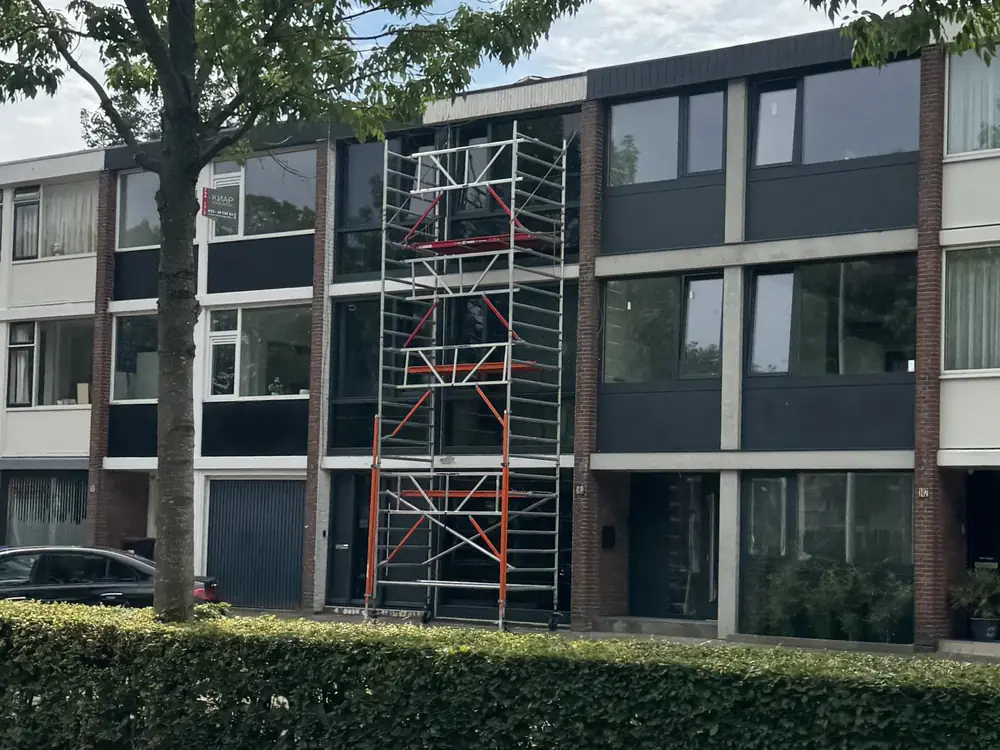
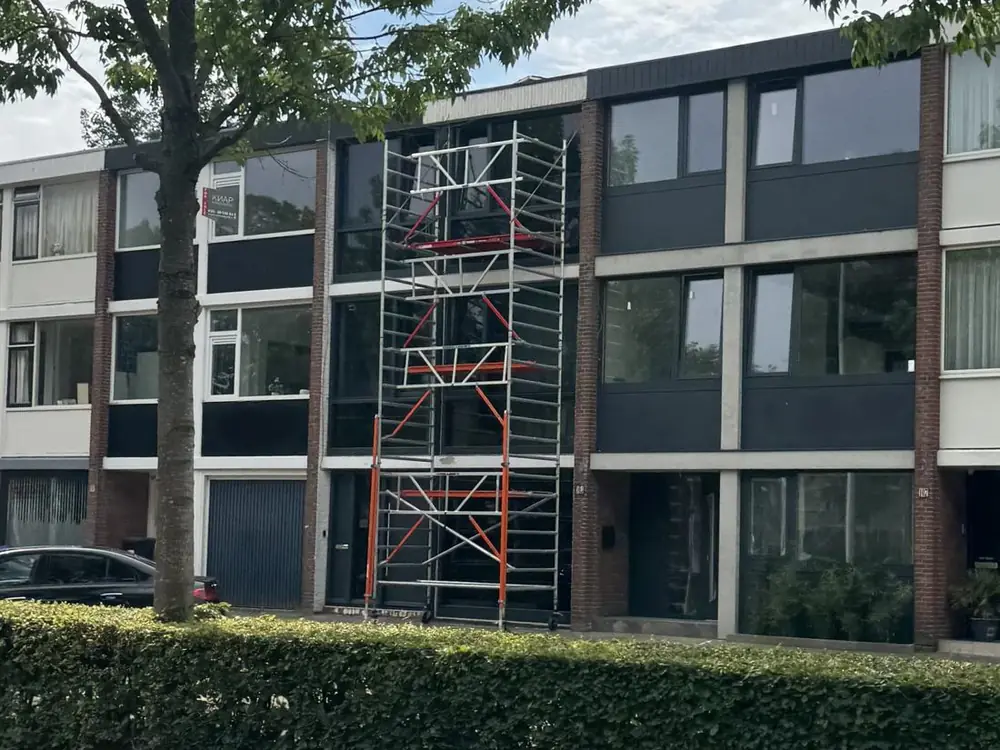
Wide mobile scaffold built up at a modern building, deck enough for drums and tools during installation work

If two of you are working, the wide deck wins every time. One holds the cable, the other drives the bracket, and you have to be able to pass each other without anybody being pushed against the rail. It counts with a heavier drum as well: that goes on the boards and not on a hook. Deck length stays 245 cm on both models, so with the RS52 you gain width, never extra length to work with.
Which working height to rent for installation work outside

The highest point on installation work is usually not the unit itself but the top bracket or the penetration just above it. Measure to that, not to the gutter. If the run climbs to the roof edge of a house of two storeys, you are around 7 metres. The RS52 reaches 14.2 metres as a model, but for this kind of work you stay in the lower part of that range and rent a build of 4.2 to 7.2 metres of working height.

Measure from the place the wheels will stand, and watch what lies under your run. A sunken cellar entrance, a garden falling away to the fence or a drive with a slope gives you half a metre of difference on its own. If the connection point is on the first floor with the penetration just under the frame, count the sill height in. What a chosen build means in practice is set out under the build that reaches 7 metres working height.

Mobile scaffold erected along a side elevation, the working height that reaches the top fixing point of a run

Renting too low is more of a nuisance on installation work than on painting. You cannot reach across with a long handle: a penetration is drilled square to the wall and a bracket is screwed at eye level, or the tray sits crooked. Stand short and the line ends at a point you cannot finish off neatly, and you still have to arrange a second build. So pick the build on the highest fixing point and not on the average.

Hiring a scaffold for installation work: the pitch along the run

On installation work the standing place follows the line you are laying, and that nearly always starts at the meter cupboard or the service box. Often that is the side elevation, a drive or the path beside an extension. Walk that run once with your head tipped back and count how many pitches it holds. Only then do you know whether you have enough flat ground to roll the tower from point to point without dismantling it every time.

A wide 135 cm pitch needs more room at the foot than a narrow one, because the stabilisers angle outwards and have to be able to spread fully. Along a side elevation that is exactly where the obstacles sit: the gas meter housing, an outside tap, the condensate drain from an air conditioner, a downpipe with a bend and the edge of a veranda roof. Measure that strip before you book, because a wide tower that will not pass the house costs you a day.

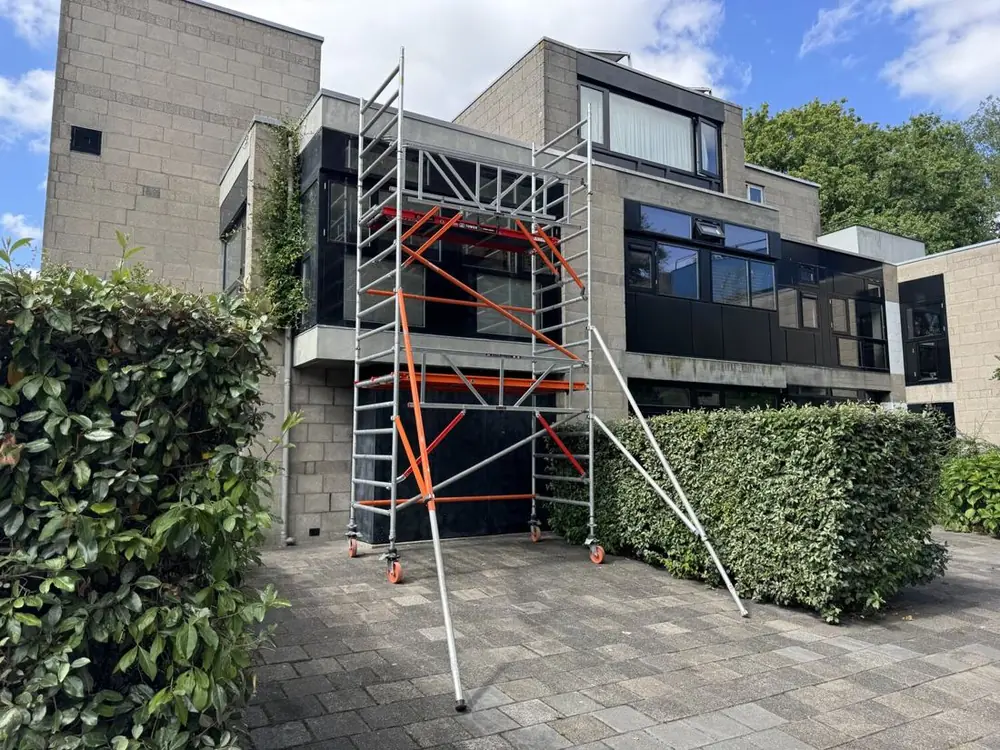
Stabilisers of a wide mobile scaffold fully spread, the strip along the side elevation that has to be clear

Think about your power supply on the ground as well. The extension lead or the generator cable must not run under a wheel or be pulled tight between the wall and a leg; lay it in a generous loop that follows the direction of travel. Keep the route to the meter cupboard clear too, because you walk inside several times that day to switch and to measure. On sloping ground, look at the piece on stabilising and tying in.

How many rental days for a run along the wall

For a run along one elevation with a couple of penetrations and a connection, count on two to three rental days. Day one goes on building, setting out and drilling the penetrations, day two on pulling and bracketing, and day three on connecting, testing and clearing up. Each pitch costs you time on top, because shifting a wide tower is more work than shifting a narrow one: stabilisers in, roll, spread again and only then climb.

There are waiting moments in it that have nothing to do with your own pace. A penetration you seal with mastic or foam has to cure before you finish round it, and that time is on the tube. If somebody has to be at the meter cupboard inside to isolate, you work to their diary. And in the rain you simply stop electrical work on the outside. Take those three things into account when you fix your rental period.

Mobile scaffold standing at a house, in place through the rental period while the run is installed

On this job booking generously actually pays. The full rate covers 24 hours, and every rental day you add after that carries 95 per cent off. A margin of a day or two costs you little, while a second delivery on an overrunning job costs you far more time. With an inspection or a handover behind it, that extra day is earned back at once. What the rental price for your build comes to is shown on the page with the rates.

Which mobile scaffold suits installation work?

Kamersteiger RS44
  • Working height up to 4 metres
  • Compact and narrow
  • Great for indoor and small jobs
View and calculate →
Smalle rolsteiger RS51
  • Working height up to 14.2 metres
  • Narrow (75 cm)
  • Ideal for narrow passages
View and calculate →
Most chosen
Brede rolsteiger RS52
  • Working height up to 14.2 metres
  • Wide platform (135 cm)
  • Extra stability and workspace
View and calculate →
1-persoons steiger MiTower
  • Working height up to 6.2 metres
  • Very compact
  • Quick and easy to assemble
View and calculate →

Installation work from a deck of 245 by 135 cm

Per pitch you finish a stretch of 245 cm, and on a horizontal run that is exactly your module. So set your fixing points out in steps that fall inside that length and you never leave a bracket hanging halfway. Where the line climbs vertically you do the whole stretch to the top in one pitch. Count in advance how many times you have to shift; that number decides your days more than the metres of cable do.

With 135 cm of boards you can take the drum up instead of leaving it below. That saves pulling over a sharp edge and it saves walking. Lay it against the rail side, not by the hatch opening, and chock it so it does not roll while you unwind. Going up with it: a hammer drill with a long masonry bit, a driver, brackets and plugs in a tray, cable ties, a vacuum hose and your test meter.

Mobile scaffold built against a front elevation; each pitch takes you through 245 cm of the run

What catches people out is the penetration. From outside you are through the cavity in half a minute, but inside you come out behind a kitchen unit, against a pipe or just under a skirting. So measure on both sides and have somebody inside watching while you drill. Angle the hole slightly down towards the outside so no water runs in. That costs you five minutes and stops you having to make a second hole from the scaffold.

Delivery and build when you hire the RS52

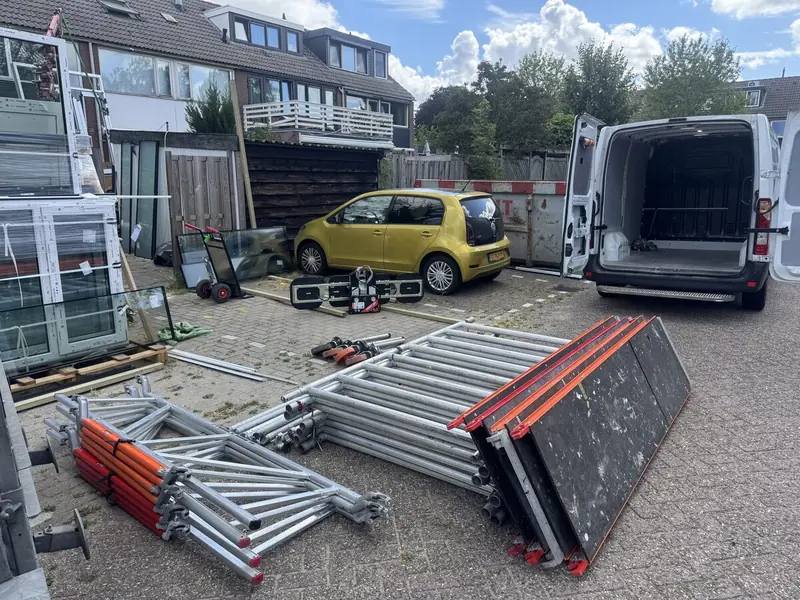
The RS52 comes to you as one complete set of parts, counted out. On a wide build that is a substantial stack, so point out a spot beforehand where it will not be in the way: the drive, a piece of lawn or the path beside the extension. Do not lay it on the run itself, because that is where you will be working. Order on a working day, keep it inside 15:00, and the RS52 parts stand at your address one working day later.

Both dates, arrival and collection, are ones you name yourself, and on installation work you tune those to the people who have to be inside. Putting it together is down to you; nobody comes out to assemble it. For a wide build to just over seven metres two of you need about an hour. The manual and the assembly video walk through the order step by step, and that order matters more than speed at this height, because a part you forget sits at the bottom.

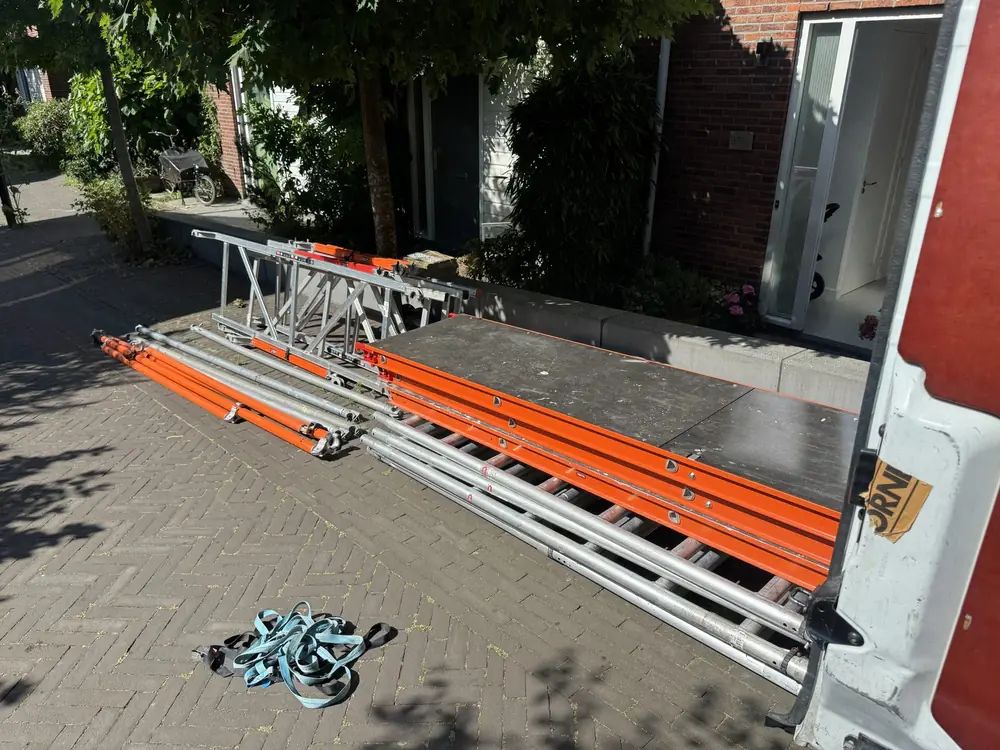
Scaffold parts in the back of the van, ready to be delivered on site for installation work

Bringing and collecting we charge as one fixed price per province, including VAT; for your address the amount is listed on the page with the delivery charges. Working near the city, you can also come and get the set yourself: without charge, once you have made an appointment, at Zeeburgerpad in Amsterdam. A wide set does not fit in every van, though. Afterwards we pick it up again, dismantled and stacked where the driver can reach it with the van.

Working safely and dead on the mobile scaffold

A drum weighs more than you think, and on installation work there is sometimes a second person on the boards as well. So it helps to know that each square metre of your deck carries 200 kg, which is what load class 3 in EN 1004 sets. Even so, add it up: two people, a full drum, a case of brackets and a cordless drill puts you nearer that limit than painting ever does. Spread that weight over the whole deck instead of piling it by the hatch.

The basic rules do not change because you are working with cable. Wheels braked the moment anyone goes up, and nobody on the tower while it moves: take the drum off before you shift it as well. Stop in a hard wind, certainly if you have a long support or a length of tray to raise, which acts like a sail. After every move, check all four stabilisers before you take the first rung, because on a wide build they are not optional.

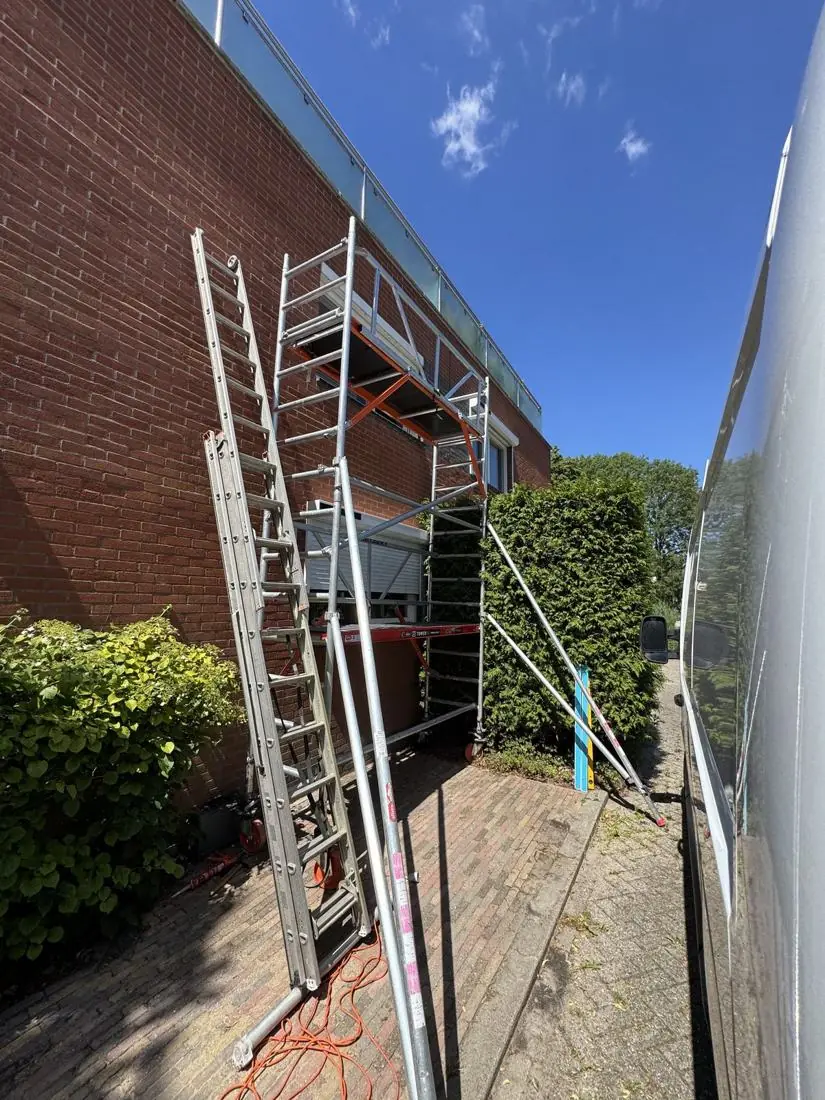
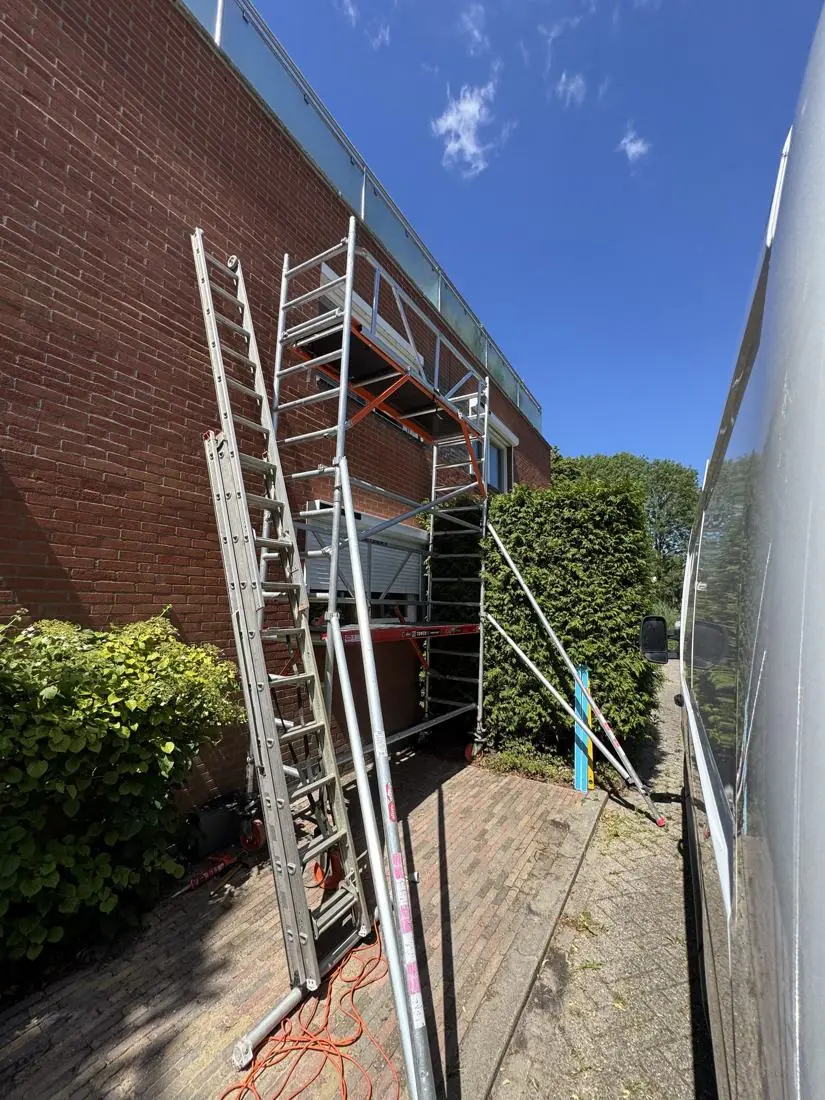
Erected mobile scaffold against a brick wall, stabilisers down and a loose extension ladder alongside, its deck carrying two hundred kilos

The risk that belongs to this job is the voltage. Isolate at the consumer unit, put a notice on it and measure for yourself that the point you are working on really is dead; somebody else in the house can switch the circuit back on. An aluminium tower conducts, so keep clear of an overhead line or a shared service head on the wall. Keep the zone below you free as well: a falling hammer drill is no small matter. The rules are on the page about the requirements for working at height.

In 5 steps

How hiring a mobile scaffold works

1
Choose working height

Pick the height that suits your job.

2
Book online

Sorted in 60 seconds, price shown instantly.

3
We deliver

At the agreed spot the next working day.

4
Assemble safely

Assembled by you, with a manual.

5
We collect

One call and we collect the scaffold.

Good to know

Practical tips for installation work

1

Set the whole run out with a line and a marker before you build the tower. From the ground you see at a glance whether the line runs true and where it wanders; from the deck you never do.

2

Drill every penetration on one day, even if you are pulling later. Then you only have to arrange access with somebody inside once, and the scaffold is not standing idle waiting for a key.

3

Hang a bucket or a cable tray on the rail for plugs, clips and screws. Small parts that roll about on a wide deck vanish between the boards and end up three metres below in the grass.

4

Take a second extension lead so you can feed the drum on the platform without a cable running along the ladder. Tripping over a lead on a climbing route is one of the daftest accidents there is.

5

Photograph the wall before you start and draw your run on the picture. At handover, or at a fault years later, you know exactly where the cable passes behind the brackets, long after the tower has gone.

6

Plan your collection day one day after the final test. If something does not work when you switch on, you are still at the same height next morning instead of juggling a ladder.

Frequently asked questions

Frequently asked questions about installation work

Which mobile scaffold do you hire for installation work on the wall?+

Take the RS52, the wide tower with a 135 cm deck. Plenty goes up on this job: a drum, a case of brackets, two drills and quite often somebody helping you. On a narrow deck you spend the whole day shuffling things about. If that width will not pass the way through to the back, it becomes the narrow RS51 and the drum stays on the ground, with only the cable going up.

How does hiring a scaffold for installation work actually go?+

Online you fix the model and the working height, pick a delivery date and a collection date, and see what it costs including VAT at once. The scaffold parts come to you, you build and work your run, and when you have finished you break it down and pile the parts up again. We then drive off with them. The neatest trick is to let your delivery day coincide with the day the cable arrives.

How long should you hire a mobile scaffold for a run along the wall?+

Two to three days for one elevation with a few penetrations and a connection. Setting out and drilling takes a day, pulling and bracketing a day, connecting and testing another half. Shifting a wide tower comes on top of that. If it is several elevations or a commercial unit with a longer run, hire it for a week straight away and work without pressure instead of counting every morning whether you will make it.

What does hiring an RS52 cost, and how does the discount after day one work?+

The rate depends on the model and the height of your build; bringing and fetching is added per province. You see those amounts including VAT before you commit. What matters on installation work is how the rental adds up: only day one weighs in full, and the days behind it barely move the total. A week of scaffold hire therefore costs little more than three days, and that gives you air when an inspection or a delivery of material slips.

Which working height to rent for installation work up to the roof edge?+

Take your measurement from the ground the wheels stand on up to the highest fixing point in your run, usually a bracket or a penetration just under the roof edge. On two storeys you come out around 6 or 7 metres, and then you rent a build that makes 7.2 metres of working height. If you hesitate between two builds, take the roomier: a wall of two storeys often measures higher than it looks. That saves you a second build day.

Is the tower delivered on the day you choose when you hire?+

Yes, you decide the delivery date and the collection date. On installation work that helps, because you do not want the tower outside for a week while you are still waiting on material. Let the set turn up the day before you start, and there is plenty of time to build. We deliver on working days only. Plan the collection after your final test, so you never end up without a scaffold halfway through.

Do you build the scaffold when you hire it for installation work?+

Erecting is not part of the rental. We hire out the parts and drive them to you, but we assemble nothing on site. For a build to just over seven metres two of you should allow about an hour, plus the same again to take it down. That hour belongs in your planning, not in your installation time. A facade scaffold or a cherry picker we cannot supply, so on this job the mobile tower at this height is the practical answer.

Can you hire for longer if the connection is ready later than planned?+

You can, just pass it on in good time. Installation work often hangs on other people: an engineer who has to call, a delivery that moves or an inspection that will not fit. As long as the tower is not held for a following booking, we shift your collection day. Cleverer still is to set that date generously from the start, because bringing it forward is always allowed and an extra day of hire barely registers.

How much clear ground along the wall do you need to hire this?+

Count 135 cm for the tower itself, add how far the stabilisers reach out on either side, and on top of that a path to roll it along the run. In practice that is a clear strip a couple of metres wide the length of the elevation. Gas meter housing, outside tap, planters and bikes you clear beforehand. A wide pitch that jams halfway on an obstacle costs you half a day and sometimes an extra rental day.

Can you carry on in the rain, or does that cost you a day?+

The tower can stay where it is; you decide whether you carry on. Drilling and bracketing are fine in the wet, but making a connection or opening an enclosure you would rather do dry, and on a wet deck you are handling tools with wet hands. Use a day like that to pull inside, prepare the consumer unit or measure the next stretch. Since an extra rental day weighs little, you never have to work live in bad weather.

When do you get the deposit back on a hire like this?+

You settle it when you book, and once everything has been checked it is back with you inside 1 working day. On installation work it usually goes wrong on trivia: a frame support that ends up behind the fence, or cable ties left round a guard rail. Walk the parts as you dismantle and cut off whatever you fixed on yourself, and the tower goes through the check in one pass, so the money comes straight back.

May you work close to a service head on an aluminium tower?+

Aluminium conducts, so keep your distance from anything that might be live: an overhead line, a service box on the wall or an old outside light whose circuit you do not know. Isolate, check with a meter and only then start. The mobile scaffold itself is not the danger, the proximity is. If in doubt, move the pitch a metre, or leave that part of the job to somebody with the right authorisation.

Hire a mobile scaffold for installation work today?

Calculate your rental price now or ask for free advice.

Rolsteiger van SteigerTaxi geleverd op locatie
Book it online

Your scaffold sorted in 2 minutes.

Choose your scaffold and working height, see the price instantly and book online.