
See your price
Application

Interior work? Choose the right scaffold.

Interior work is seldom one job and usually a list: a light fitting over the dining table, a smoke alarm on the landing, a rail above the window and a grille in the bathroom. They all sit just too high for a step stool, and they are scattered through the house. For a list like that you take the Altrex RS44 room scaffold: 3 to 4 metres of reach and a base that passes an interior door of around 70 cm. Below: the route, the hire days it costs and what to watch per room.

  • Order before 3 pm, delivered tomorrow
  • Professional Altrex scaffolds
  • Up to 14.2 metres working height
  • Easy to assemble yourself
4,2 tot 14,2 mWorking heights available
12Provinces served
7Days a week
200 kg/m²Load class 3
In short
  • For interior work we recommend the Room scaffold.
  • Interior work calls for the RS44 room scaffold: it reaches 3 to 4 metres and slips through an interior door of about 70 cm.
  • The route weighs heavier than the height, because the hall, the bend at the stairs and the thresholds decide what fits.
  • Count on two to three hire days as soon as your list is spread over several rooms, a landing or two floors.
  • First 24 hours from €50 incl. VAT and delivery; every day after that 95% off.
Key facts for this job
FeatureValue
Recommended scaffoldRoom scaffold (Altrex RS44)
Working height for this job3 to 4 metres
Available working heights4.2 to 14.2 metres
StandardEN 1004, load class 3 (200 kg per m²)
DeliveryOrdered before 3 pm, delivered next working day
Each extra day95% off, from €2.50 a day
Why a mobile scaffold for interior work?

Safe, stable and professional work at height

With interior work most of the time goes into moving about, not into the job itself. Hanging a light fitting takes twenty minutes, but you spend an hour on the way there: along the hall, round the stair rail, over a threshold and past a cupboard that will not quite shift. A tower that cannot get through is worthless for this, however sturdy it may be. So when you hire, you look at width and weight first and only then at height. Hiring a scaffold for interior work means a model you set up afresh in each room, that one person can lug about, and that leaves your house undamaged as you go from space to space.

  • Passage from about 70 cm in the interior door
  • Rebuilt in each room by one person
  • Working height 3 to 4 metres up to the ceiling
  • Wheels and base that leave your floor intact
Read more about working safely →

Which room scaffold to hire for interior work at home

For interior work you end up at the RS44 room scaffold, the indoor model from Altrex. It manages a working height of 3 to 4 metres, which is enough under practically every ceiling in a house, and its base is narrow enough to pass an interior door of some 70 cm. On this kind of job that last point is the real selection criterion, because a tower stuck in the hall is of no use to anybody. The versions on offer appear with the room scaffolds from the rental fleet.

An outdoor model offers no way round it. The RS51 and the RS52 only begin their reach at 4.2 metres, weigh considerably more, and their base wants a clear floor you simply do not have in a hall or a bedroom. A tower like that would also have to be assembled outside, after which you would never get it in through the front door. Where the differences sit is set out in the comparison of a mobile scaffold and a room scaffold.
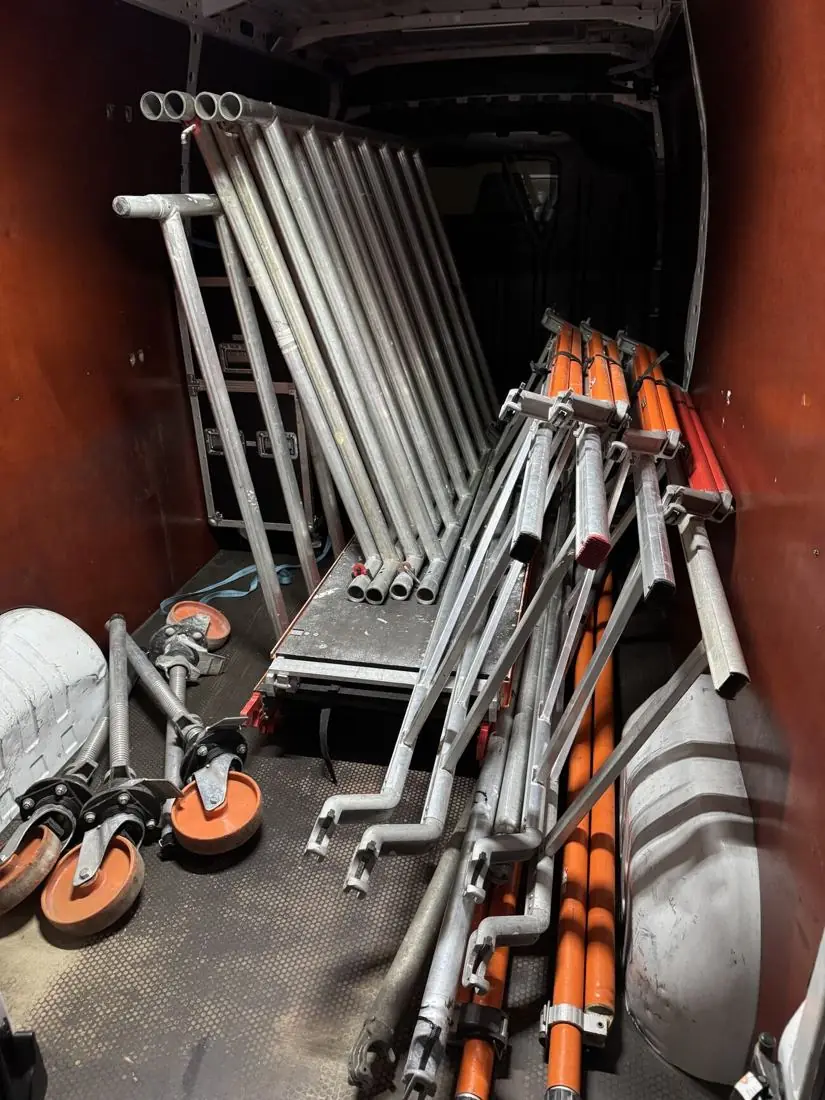
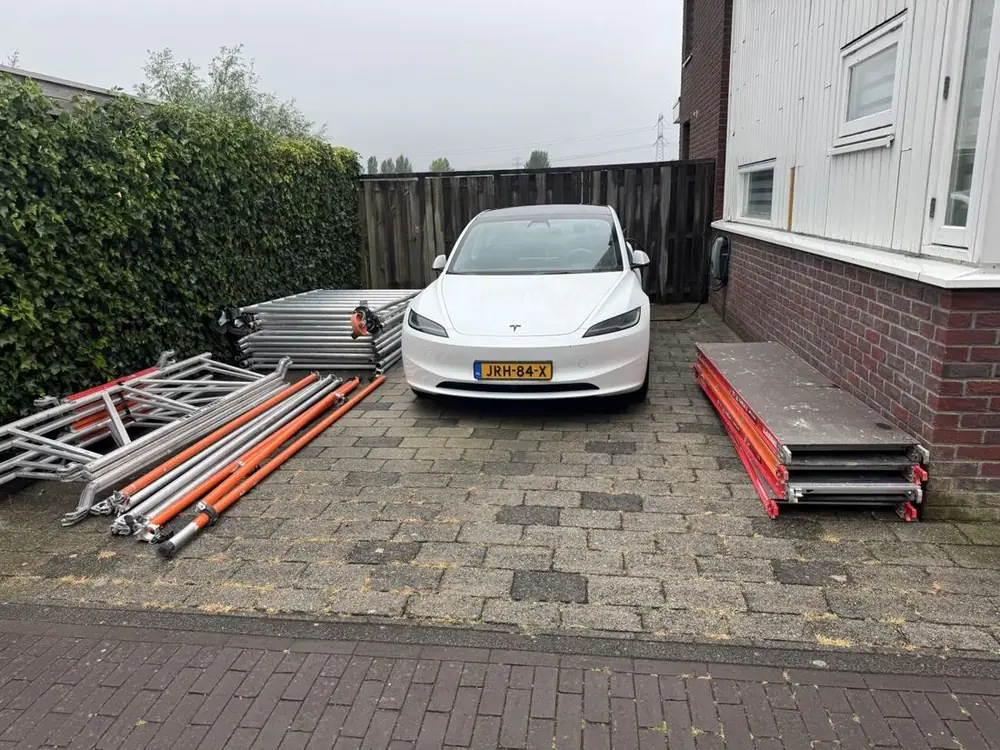
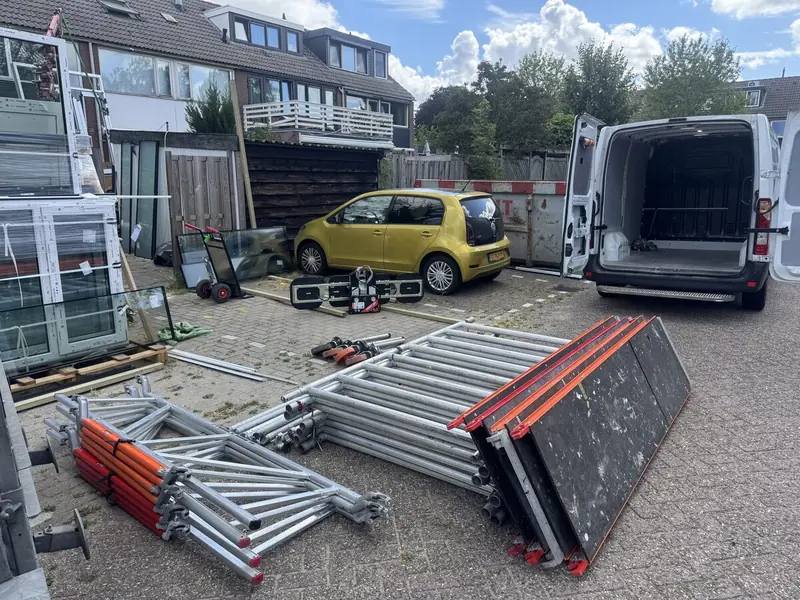
Bundled set of scaffold parts ready for transport, the loose pieces you rebuild in each room for interior work

When booking, think about how often you will pick this thing up. On interior work you build again in every room, so each part passes through your hands several times. A light set you can shift single handed does more for you by the end of the day than an extra square decimetre of deck. Fixed prices including VAT and online booking settle the rest of the choice quickly. Should you continue outdoors later, you can hire a mobile scaffold alongside and keep that booking separate.
What working height to hire for interior work at ceiling level

The highest point on interior work is nearly always the ceiling, or a fixing point just below it. In a post war house that hangs at 2.6 metres, in a property from around 1900 at 3.5 metres. So reckon on 3 to 4 metres of working height; your deck then sits somewhere at 1 or 2 metres. The last stretch you bridge with your own length: standing on the floor of the room scaffold, a drill in your hand still gets you nearly two metres higher.

Measure per room, because within one house the height varies more than people expect. A lowered ceiling in the kitchen, a step up to the conservatory or a thick underlay in the bedroom shifts your figure by half a metre, and then you are short in the wrong space. Note the largest measurement you come across and book on that, since building lower is always possible. What you have to assemble for it stands on the page about a working height of 4 metres.

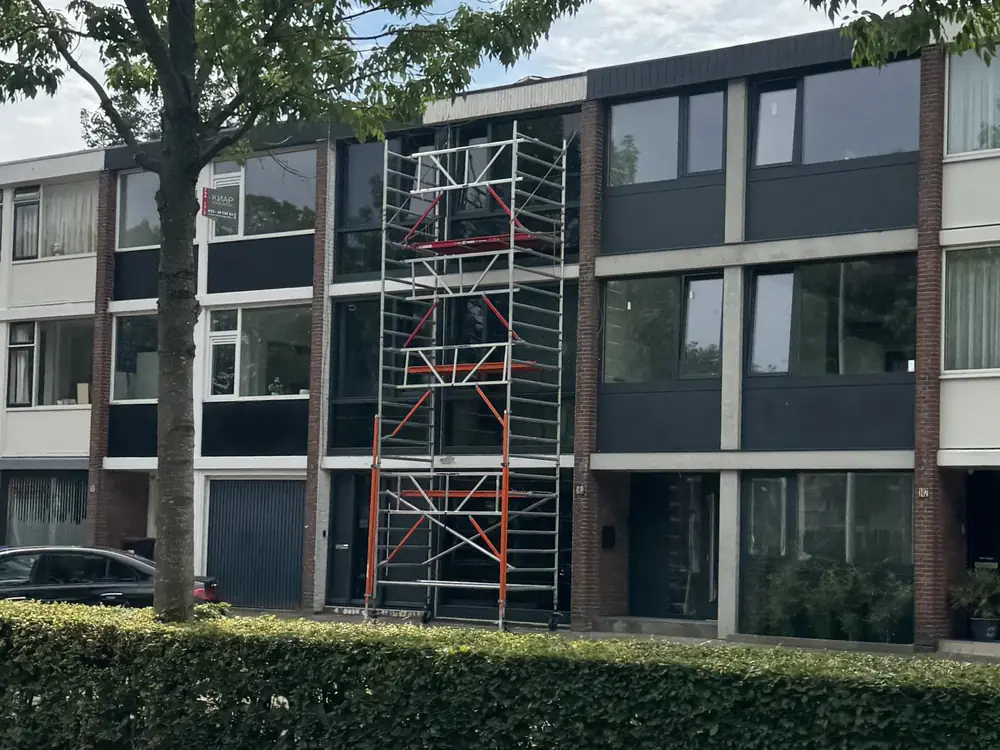
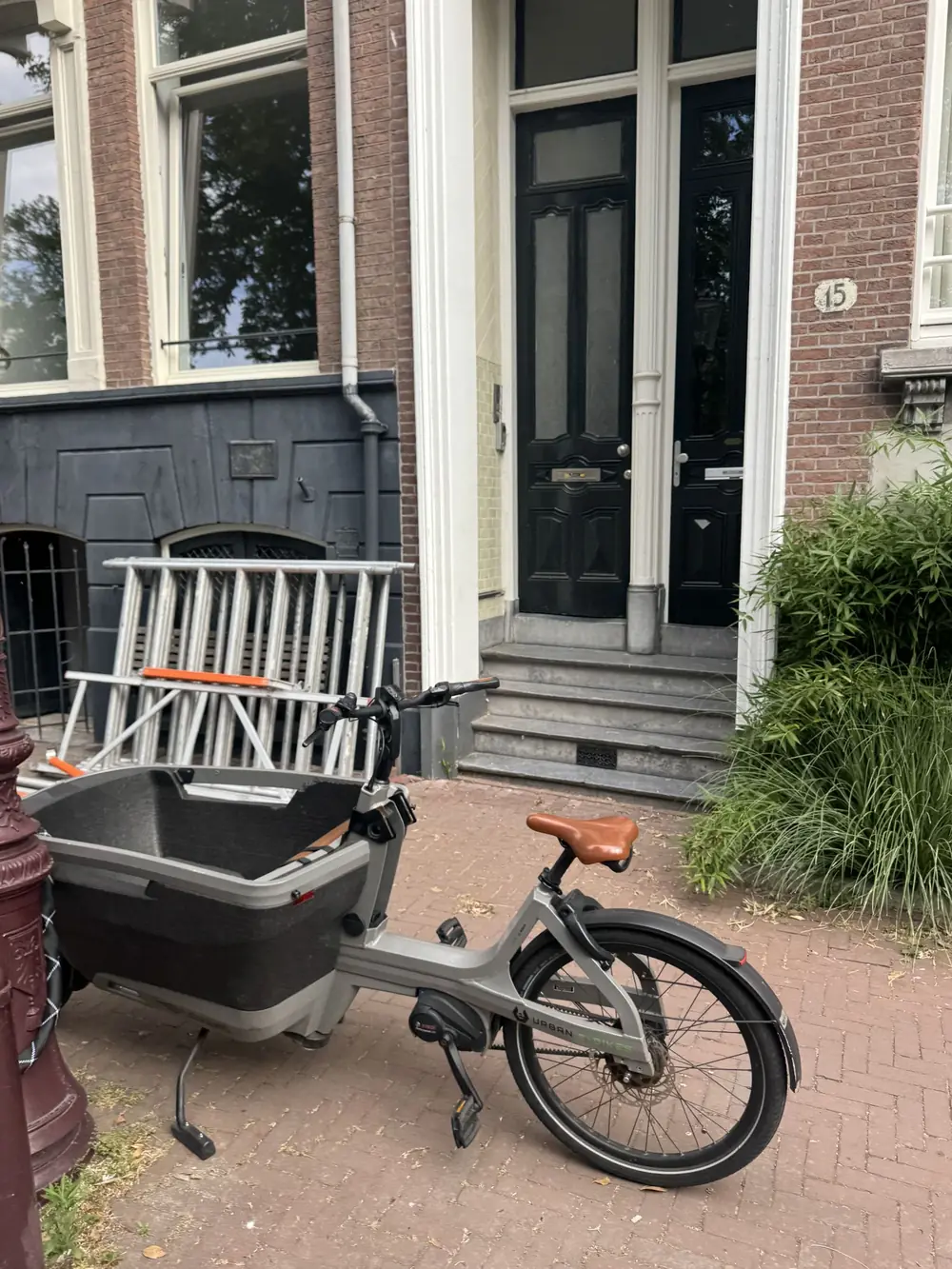
Scaffold frames propped against a house front on the pavement, the parts you carry indoors and build up yourself

Stand too low and you are fiddling with straight arms above your own head at something that has to be exact, and on fixing jobs that goes wrong faster than on rough work. A plug driven into the ceiling at an angle or a rail hanging a centimetre out of true costs you more time than the whole build of the tower, and usually a second hole as well. If your interior work spans a stairwell, look at a set up over a stairwell.

The route through the house: doorways, thresholds and turns

Walk the route through your house once before you order anything, and simply begin at the front door. Measure the width of every opening at its narrowest, so between the handle and the post opposite, and check whether a door swings fully clear. Then comes the hall: is there a bend, does a coat rack stand there, and will the longest tube go round the corner of the stair rail? On interior work the planning trips over the hall more often than over the room you finally have to reach.

After that the thresholds count. A sill between hall and living room, a rise into the extension and a step down to the utility room are each a moment where you take the tower apart or lift it. Reckon on starting again per floor, because an assembled room scaffold does not go up the stairs and will not fit in a lift either. That costs you half an hour each time. If you are unsure about the measurement, the guidance on mobile scaffolds and doorways takes you further.

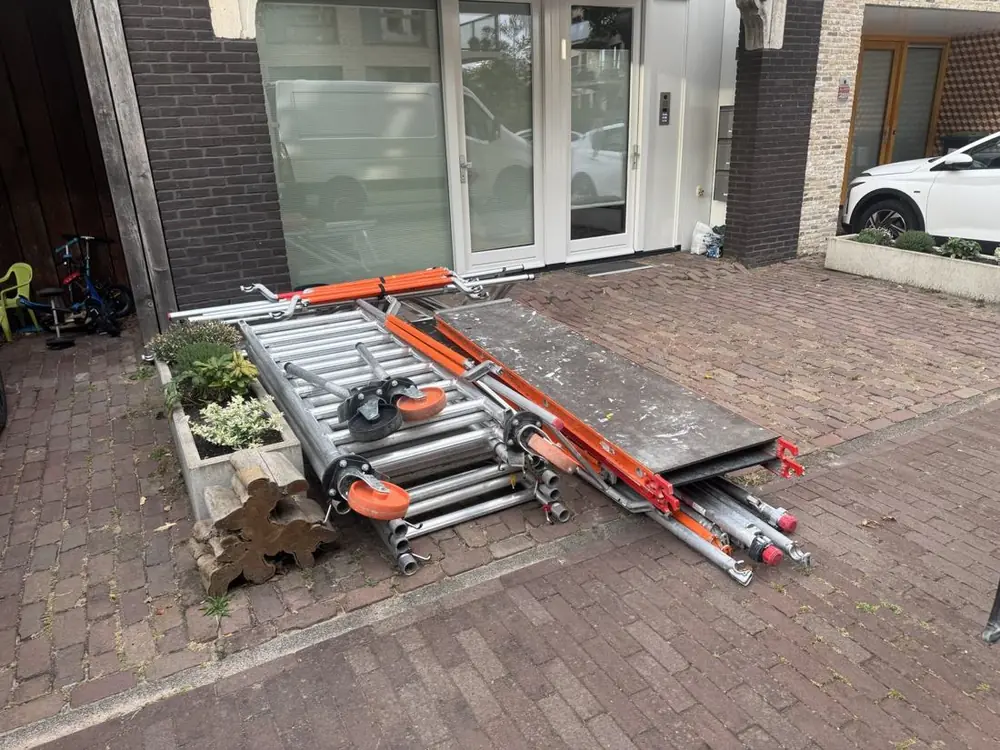
Loose scaffold parts stacked by a front door, the point where your route for interior work through the house begins

In the room itself you look at the floor and at what stands on it. Lay hardboard, thin plywood or a tarpaulin under the wheels, because a poured floor or laminate will otherwise pick up pressure marks. Slide furniture towards the middle, take down a pendant light that hangs in your way and leave a clear metre round about for yourself and the stabilisers. A room cleared beforehand saves you half an hour per position, and across a full day of interior work that mounts up.

How many days should you hire a tower for interior work

Interior work is often a collection of small jobs, and that is exactly why the hours mount. Two light fittings, a smoke alarm, a rail and a grille in the bathroom may be three hours of handiwork between them, but with four builds, moves and take downs added on they fill a whole day. Spread that list over the ground floor and the first floor and you are quickly at two to three hire days without having dawdled anywhere.

There are also waiting moments you cannot plan away. Chemical anchor has to cure before you hang anything heavy on it, sealant needs time, and sometimes you are waiting on a second pair of hands or on a fitting still to be delivered. Put those moments at the end of a day in your schedule, and the tower is still standing in exactly the same spot the next morning, with nothing to line up again.

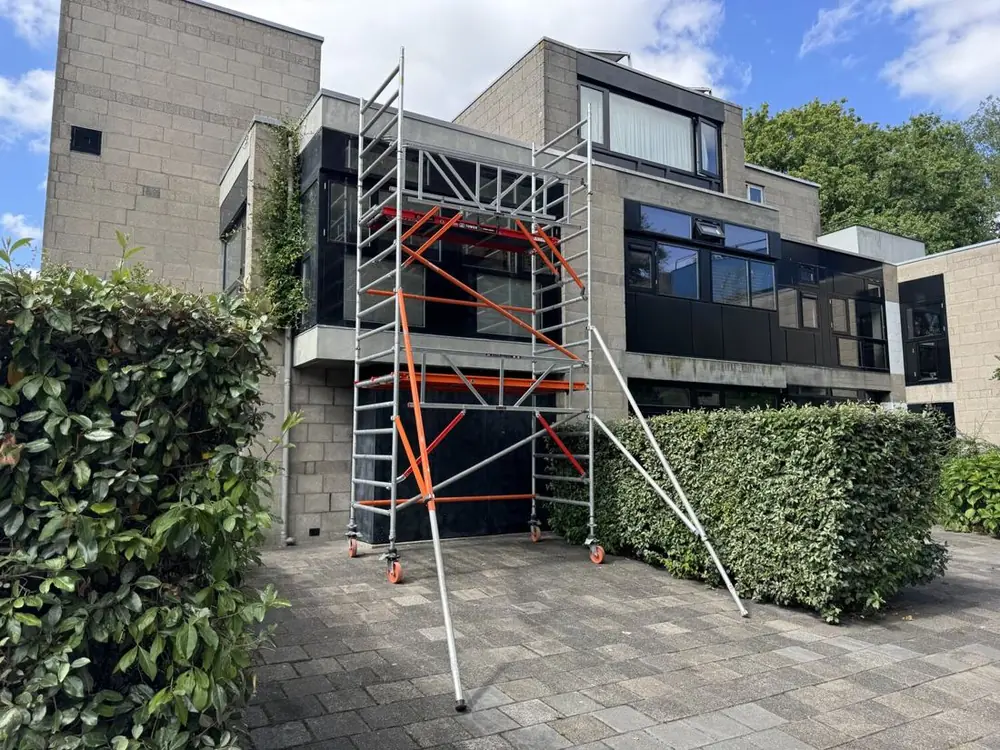
Mobile scaffold assembled with a low deck, the set up you make again in every room during interior work

The fact that you may book generously helps with that. The full rate applies to the first twenty four hours and 95 per cent comes off every day thereafter, so a spare day costs you hardly anything. Book too tight and the rail on the landing is still not up when the van is already at the door, and then you are shuffling dates anyway. Better to set your end date a day wide than a day sharp. For a realistic picture, see judging your hire period.

Which mobile scaffold suits interior work?

Most chosen
Kamersteiger RS44
  • Working height up to 4 metres
  • Compact and narrow
  • Great for indoor and small jobs
View and calculate →
Smalle rolsteiger RS51
  • Working height up to 14.2 metres
  • Narrow (75 cm)
  • Ideal for narrow passages
View and calculate →
Brede rolsteiger RS52
  • Working height up to 14.2 metres
  • Wide platform (135 cm)
  • Extra stability and workspace
View and calculate →
1-persoons steiger MiTower
  • Working height up to 6.2 metres
  • Very compact
  • Quick and easy to assemble
View and calculate →

Interior work room by room from a platform of 245 cm

The deck measures 245 cm along its length, and on interior work that is often just enough to cover a whole wall or half a room width without moving. So plan your points per position: the fitting, the alarm and the hole for the cable that fall in the same strip get done one after another. Anyone who moves per job instead of per strip spends half the day pushing wheels about and has depressingly little of the list finished by late afternoon.

Make sure you take everything up in one trip. On interior work that means a drill with the right bits, plugs and screws, a spirit level, a pencil, the fittings themselves and something to catch the dust in. Put small items in a tub rather than loose on the floor of the deck, because a plug that falls three metres is never found again in a furnished room. Carrying a spare bit up saves a descent as well.

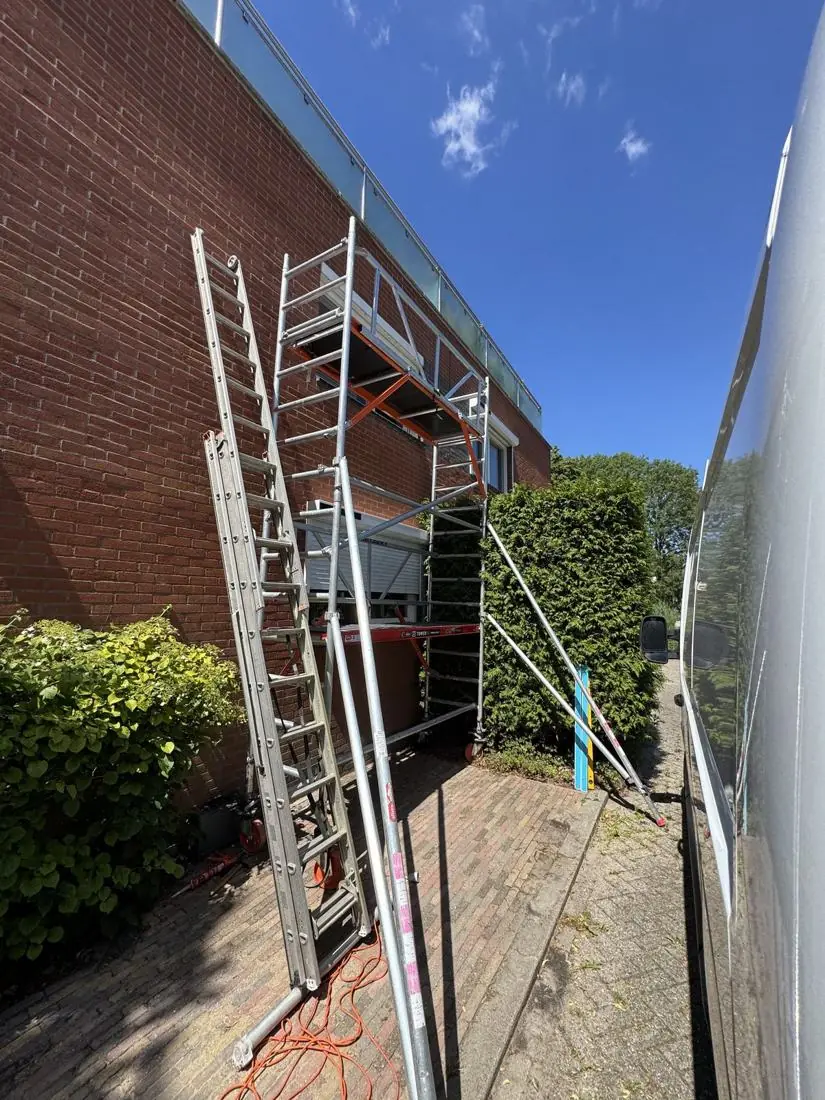
Tower built up in an alley beside brickwork, its 245 cm deck the strip you cover from one position

Moving indoors takes more handling than outdoors. You clear your tools away, lift the protective sheet with you, roll along a stretch and set the brakes again before climbing on. In an average room reckon on about three positions and finish each space entirely before you take the tower apart and carry it to the next door. If the task is hanging curtain rails, the window layout decides where the tower goes in turn and how often.

Hiring a room scaffold with delivery on your own date

What gets dropped off is a full, counted set of separate tubes, decks and braces. For interior work that is the only usable form: loose, you take everything along in turn to the place it is needed, and only there do you put it together. The driver unloads at the point you indicate, generally at the kerb, on the drive or just behind the door. Book on a working day and in any case before 15:00, and it is all there the day after.

You decide when the set arrives and when it goes back again. Take the day before your first working day, because carrying in and building costs an hour and you would rather not shave that off your job time. Assembly is your part of the deal, and the manual and the film set out the order the parts go in, so you never have to unbuild halfway. Run through the steps in the guide to putting a tower up once before you start.

Scaffold parts delivered on location, the way the set for your interior work is dropped off at the door

Once your interior work is done we come back for the set. You take the tower apart, bring the parts out room by room and stand them ready in full where the van can pull up. Count them off while dismantling and you will not miss a brace still lying behind a cupboard in the bedroom, saving a trip through the whole house. The amount for bringing and collecting depends on your province and is stated with the costs of delivery and collection.

Drilling and mounting safely on a hired tower indoors

The floor you stand on is tested to EN 1004 and belongs in load class 3, which means it may carry 200 kg on each square metre. Interior work rarely comes near it, not even with a cordless drill, a carton of fittings and someone alongside holding a rail steady. Do make sure you spread heavy items across the deck rather than putting everything down in the same corner, and certainly not right by the rail where you are standing yourself.

The fixed rules hold indoors as well, with their own accent. Set the wheels on the brake before climbing on and remember that such a brake grips less on a smooth floor than on block paving. Wheeling happens with a bare deck and nobody aboard, not even over that one metre to the next point. Wind plays no part inside, but a door that bangs shut in a draught startles you just as much, so hold it with a wedge.

Wheels and stabilisers under a mobile scaffold, the part that rests on a protected floor during interior work

The genuine risks of interior work sit in what surrounds you. Cables and pipes run above your head, so take the circuit off before you drill into a ceiling. Below your deck stands furniture that a tool falls hard onto, and dust makes a floor slippery. Keep that zone clear, put a sheet over what cannot be moved and do not let the household walk through while you work. The rules one after another are at the rules for work at height.

In 5 steps

How hiring a mobile scaffold works

1
Choose working height

Pick the height that suits your job.

2
Book online

Sorted in 60 seconds, price shown instantly.

3
We deliver

At the agreed spot the next working day.

4
Assemble safely

Assembled by you, with a manual.

5
We collect

One call and we collect the scaffold.

Good to know

Practical tips for interior work

1

Make a list first of every point in the house that sits too high and put them in order per room. Then you know exactly how often the tower has to be built and moved.

2

Measure your narrowest passage with the handle included and not just the frame. Those few centimetres decide whether the room scaffold reaches the back room along the hall or not.

3

Lay the parts out in the hall in the order of assembly. You start again in every space, and that order saves you a quarter of an hour of sorting each time.

4

Switch the circuit off before you drill into a ceiling where wiring may run. It costs two minutes and it is the one risk on this job you have entirely in your own hands.

5

Keep a tub or bucket on the deck for plugs, screws and drill bits. Small items that fall three metres are practically impossible to find again in a furnished room.

6

Book the collection day for the day after your last job. You then keep a morning free to dismantle, carry the parts outside and clear away the floor protection in your own time.

Frequently asked questions

Frequently asked questions about interior work

Which scaffold should I hire for interior work in a house?+

The RS44 room scaffold is the logical model for interior work. It manages a working height of 3 to 4 metres, enough for any ordinary ceiling, and slips through an interior door about 70 cm wide. That lets you set it up afresh in each room without wrecking your house. An outdoor model only starts at 4.2 metres and is too heavy and too broad for indoors. To be safe, walk your route, note the narrowest spot and hold that against the model.

How does hiring a room scaffold for interior work go in practice?+

You book online by model and working height and pick a delivery day and a collection day yourself. We drop the complete, counted set of your tower at the door, you carry the parts in, build them up and work through your list room by room. On the final day you dismantle and stand everything ready outside, after which we take it away again. Everything is fixed including VAT, so nothing is added afterwards.

How many hire days are enough for a list of interior work?+

For a couple of points in a single room, one day does it. If your list runs across several rooms or over two floors, you are better off hiring the room scaffold for two to three days. Building and dismantling per space takes more time than the jobs themselves, and a curing anchor or a missing part can swallow half a day. An extra day is therefore nearly always the cheapest choice, as it barely counts in your period.

What do you pay to hire a tower for interior work?+

Your rental price is built from the model and the working height you state, and beside that you pay a fixed amount in your province for bringing and collecting the tower. You see both figures including VAT on the price page before you confirm. Because only a fraction of the rate counts after day one, a roomier period is seldom an expensive choice on this kind of job. You never know in advance how many points will be added.

What working height do I hire for interior work at the ceiling?+

For interior work you hire a tower with 3 to 4 metres of working height; the deck then ends up at 1 or 2 metres. Start your tape on the floor where the wheels land and stop at the point you have to reach. Repeat that per room, because an old property and a converted kitchen can differ by half a metre. The overview of working heights lists the build per size. Between two sizes, take the highest that still clears your ceiling.

Can I have the parts delivered when I hire a room scaffold?+

That is yours to decide. Choose delivery and the driver unloads on your chosen date at the front door or on the drive; what that costs is fixed per province. Carrying it inside is down to you, and that works well with a set made of separate pieces. Prefer to call by, and your tower stands ready at no charge by appointment at our address in Amsterdam. Do bear in mind that loose parts ask for a fair bit of load space.

Is assembly included in the hire, or do I do it myself?+

Yes, that belongs to your side of the arrangement. We bring and collect, but carrying, building, moving and dismantling you do yourself, with the manual and the instruction film beside you. On interior work that happens more than once, since you begin again in each room. We do not deliver assembled towers, and facade scaffolds or cherry pickers are not part of our range in any case. For work at a ceiling indoors none of that is needed.

What if my interior work overruns and I want to hire for longer?+

Raise it the moment you notice you need more time. We then set the collection day later, unless the tower has already been promised to someone else. On this kind of list things run on because a job gets added or a part has not arrived. You determine the collection date yourself, so building in a margin straight away is easiest. Handing it back early is possible too, with nothing to arrange and a shorter period as a result.

How much room do I need to clear if I hire a tower?+

Count on a band of roughly a metre all round, so the stabilisers fit and you can still pass. In a furnished room that means furniture towards the middle and loose items out. Think of the lane you move the tower along as well, because that has to stay free. If a space is completely full, empty it before the delivery arrives, or your working day starts with dragging cupboards instead of with your first point.

Can you hire a room scaffold if you are working single handed?+

Yes, and on interior work that is the normal situation. The RS44 room scaffold you hire consists of parts one person can carry, and the build height stays low enough that you pass everything up from the ground or from the first deck. What you do notice alone is the number of trips up and down, so lay the parts out per room in order. For lifting a heavy fitting a second person remains welcome.

How soon is the deposit back once the hired tower has gone?+

The deposit is settled at booking and returns to your account within one working day of the set being counted in. On this kind of job, watch the small parts above all: pins and screws vanish easily behind a cupboard or under a sofa. Walk through the rooms where the tower has stood before you carry the parts outside, because one missing piece holds your money up longer than the whole hire period took you.

Can I move the tower from room to room fully assembled?+

Within a roomy space you can simply wheel the tower along, but through a doorway or round a bend in the hall it will not go. Reckon on dismantling and rebuilding per room, and certainly when you move to another floor. In practice that is not so bad, provided you lay the parts out in the right order. Plan your list space by space rather than job by job and you only build once per room.

Hire a mobile scaffold for interior work today?

Calculate your rental price now or ask for free advice.

Rolsteiger van SteigerTaxi geleverd op locatie
Book it online

Your scaffold sorted in 2 minutes.

Choose your scaffold and working height, see the price instantly and book online.