
Knowledge base · reading time 11 min
Does a mobile scaffold fit through a door and in a car?
Almost every hirer asks the same thing: will this get through my door, my gate or my hallway? The answer rests on two measurements, the width of the frame and the length of the platform. Know those two, measure your openings, and you know which model works and which to skip.
- Does a mobile scaffold fit through a door, gate or in a car? See the widths per model, which openings to measure and when delivery is smarter.
- Usually not.
- You can if the base is narrower than the clear opening and no threshold is in the way.
- Two makes it considerably easier, especially for the 245 centimetre platforms.
What a standard interior door actually measures
A standard interior door starts at around 70 centimetres of clear opening. That is the figure everything has to pass through: frames, platforms, guardrails and braces. Measure the clear opening rather than the door leaf: the frame, the stop bead and a door standing open on its hinges each take a few centimetres off. Take the figure between the inside faces of the frame, at hip height, with the door open.
Exterior doors and gates usually give more clear width, but they bring their own obstacles: a threshold, a protruding bolt, a door closer or a bike that permanently lives in the hallway. Walk the route once the way the scaffold will travel it, from where the lorry stops to where the scaffold will stand, and measure the narrowest point along the way.
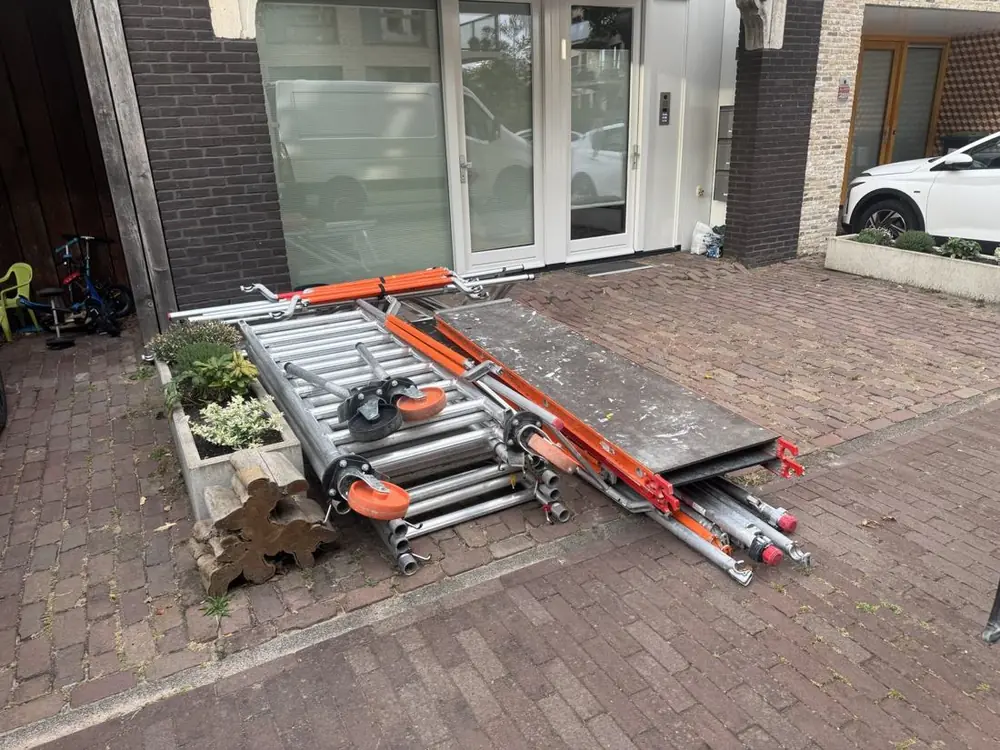
The figure you end up with decides not only the model but also how much work this becomes. If the scaffold will not pass as a whole, you carry it in sections and assemble it on the spot. That is always possible, it just means more walking back and forth than simply rolling an assembled base through. The measurements per model are listed at mobile scaffold dimensions and sizes.
Key facts
| Feature | Value |
|---|---|
| Core answer | The loose parts fit through any door; the RS44 even fits assembled |
| Room scaffold (RS44) | Fits through a standard doorway |
| Platform width | 75 cm (RS51) or 135 cm (RS52) |
| Platform length | 245 cm |
| Assembly time | 15 to 45 minutes, no tools needed |
The RS44 room scaffold is built for interior doors
For indoor work the RS44 room scaffold is the model designed around this question. It fits through a standard interior door from roughly 70 centimetres, so you can move from room to room without dismantling each time. That makes it the obvious choice for ceilings, stairwells, tall walls and anything indoors that sits above arm's reach. You move it on its castors, which saves a lot of lifting in a house with many doors.
That narrow build has practical consequences up on the platform as well: you have less room to set down tools and material than on a wide mobile scaffold. For indoor jobs that is rarely an issue, because you usually work with a roller, a brush and a bucket rather than heavy materials. So choose your model on the opening, not on a wish for as much platform as possible.
What you get and where the room scaffold is at its best is set out on room scaffold hire. If you are torn between an indoor and an outdoor model, mobile scaffold or room scaffold puts the two side by side on space, height and use. If one job takes you both inside and outside, a stairwell first and then the front facade, two short hires usually beat one compromise that suits neither.
The narrow RS51 is 75 centimetres wide
The RS51 is the narrow mobile scaffold, with a frame width of 75 centimetres. That is narrow enough for most garden gates, side paths and wide back doors, but it is wider than the 70 centimetres of a standard interior door. Outdoors that 75 centimetres is the useful size: you get past a fence, between two houses and around the corner of an extension.
When measuring, do not settle for the bare wall dimension. A downpipe, an outside tap, a meter cupboard hatch or a sunken paving slab can make the effective opening narrower than the drawing suggests. Allow a couple of centimetres of margin on both sides so you can steer the scaffold without scraping the wall. Measure at the height where the castors and lower frames pass, because that is where the width sits.
Where the RS51 belongs outdoors and when you use it inside is covered at mobile scaffold hire and in using a mobile scaffold indoors. The latter also deals with floors, ceiling height and thresholds. If you plan to use the RS51 indoors, check the ceiling height of the room it will stand in above all, because a scaffold you cannot raise upright is of no use to you.
The wide RS52 at 135 centimetres
The RS52 is 135 centimetres wide. That gives you nearly twice the platform of an RS51, which is welcome when paint, tools and material are up there with you, or when two people work together. The trade-off is that this width does not pass through an ordinary gate. Expect to bring it to the working position along a drive, an open side of the property or across the pavement.
Both mobile scaffolds have platforms of 245 centimetres. The RS52 differs only in width, which is why in small gardens it fails at the gate rather than along the path. If you are working on a facade with a lot of joinery, or you are taking material up, the wider version is the more comfortable choice, provided you can get it there.
For a flat, a walkway or a courtyard reachable only through a stairwell, the opening weighs heavier than the comfort. Which scaffold for a flat explains how to make that call when the route to the work is the limiting factor. In short: first pick the model that will actually get there, and only then the height and width you would have preferred.
Measure these openings before you order
Measuring takes five minutes and saves you improvising on delivery day. Take a tape, walk the whole route and write down the clear opening at each point. Note the height as well, because a low passage under a canopy or a carport is just as decisive as a narrow gate. Note the figures on your phone so you have them to hand when you order.
Work through the points below as you go. If anything comes in under 80 centimetres, you know you are carrying sections in and can plan time for it. A fuller preparation, including what else you want standing ready, is in the mobile scaffold hire checklist. Do that walk-round well before the delivery day, so you can still switch model without disturbing your planning.
- The clear opening of the door or gate, measured between the frames
- The narrowest point of the side path, downpipe included
- The height under any canopy, carport or overhang on the route
- Turning room in the hallway or on a landing for 245 cm sections
- The height of thresholds and sills you have to roll over
- Where the lorry can stop and how far the carry is
Openings and models side by side
The table sets out, per type of opening, what you measure, where it usually fails and which model normally suits. Use it as a first sort and then measure anyway, because every house has its own surprise: an extended kitchen, a sloping wall under the stairs, or a gate that no longer opens fully because the hinges have dropped. Measure anyway, even when the table is clear.
If you land on the edge, take the narrower model or plan on carrying sections in. That last option is no disaster, it costs at most a quarter of an hour extra during assembly and the same again when you take it down. What a room scaffold costs is shown on the room scaffold hire cost page, so you can weigh that choice on rate as well.
| Opening or space | What you measure | Where it fails | Model that usually fits |
|---|---|---|---|
| Standard interior door | Clear opening from about 70 cm | Frame width | RS44 room scaffold |
| Wide interior or back door | Clear opening and threshold height | Frame width of 75 cm | RS44 or RS51 |
| Garden gate or side path | Narrowest point between wall and fence | Frame width of 75 cm | RS51 |
| Drive or open side | Width of the passage | Frame width of 135 cm | RS51 or RS52 |
| Hallway with a right-angle turn | Turning room at the corner | Platform length of 245 cm | RS44, sections carried separately |
| Stairs or stairwell | Room on the landing | Platform length of 245 cm | RS44, sections carried separately |
The 245 centimetre platform is the real bottleneck
With narrow openings everyone looks at width, while length is far more often the problem. The platforms of the RS51 and the RS52 are 245 centimetres long. A board like that goes down a straight hallway without effort, but the moment you have to take a right-angle turn you need room on both sides to swing it. In a narrow hall with a door halfway along, that is where it stops.
The trick is to reverse the order: carry all the loose sections to the spot where the scaffold will stand and assemble it there. Frames, guardrails and braces are easy enough to handle individually, and the platform is the only part you really have to manoeuvre. Two people tilt a board around a corner, one person scrapes the wall. Clear the route of shoes, mats and anything else you would rather not step on while carrying.
The assembly step plan shows the order in which you need the parts. Follow that order while carrying them in and you avoid rummaging halfway through, with the stack already facing the right way. Put the platforms on top of the pile last, since you only need them once the base stands and the castors are locked. Stack the guardrails separately from the braces as well, so you are not untangling tubes halfway up.
Carrying upwards asks for more preparation still. A landing often gives less than two metres of turning room, where a 245 centimetre board refuses to cooperate. Measure the landing in both directions and check whether the handrail can come off, which sometimes buys the decisive ten centimetres. If the scaffold ends up over a stairwell, all its legs must also stand on a load-bearing, level surface; how to solve that is covered in a mobile scaffold over a stairwell.
In a car, in a van or delivered
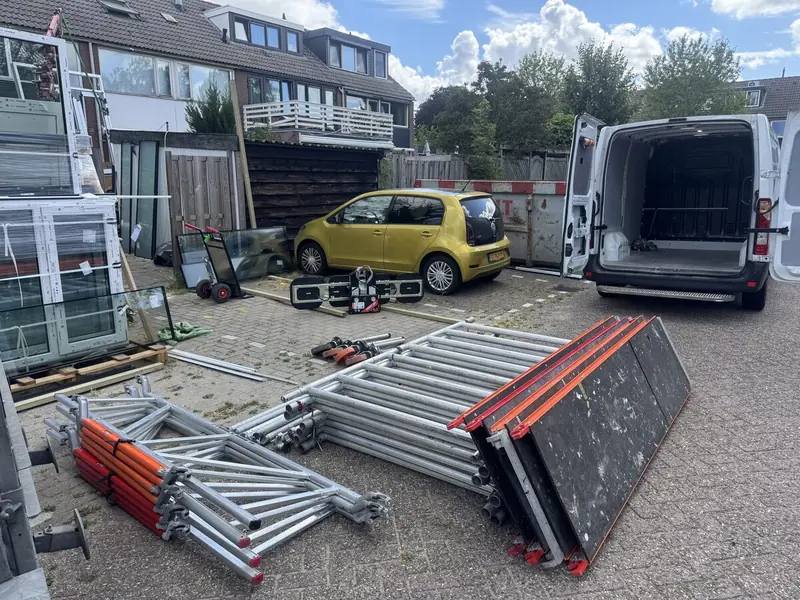
A complete mobile scaffold travels as loose sections, but length stays the deciding factor: 245 centimetre platforms do not fit in an ordinary car and rarely in an estate with the seats down. A van or a trailer is the usual answer, and even then you load and unload once or twice. Count on straps or ratchet ties to secure the sections as well, because loose frames slide about in transit.
If you have no trailer or tow bar, hiring a mobile scaffold without a trailer covers the options. Collecting yourself is free by appointment at Zeeburgerpad 89 in Amsterdam, provided your vehicle can take the lengths. If you are arriving in a borrowed van, measure the load floor and the opening at the rear doors first. Two trips with a car boot full of frames is rarely worth the saving.
In most cases delivery is simply less hassle. Order before 15:00 and the scaffold is ready the next working day, anywhere in the Netherlands. Delivery and collection together sit in a fixed amount per province, listed on the delivery cost page and per region on the delivery page. Do make sure someone is home and that the driver has somewhere to pull up.
Choosing working height when space is tight
If the opening decides your model, you want to know how high that model takes you. Working height is platform height plus two metres, the reach of an adult. Stand on a platform at three metres and you reach five. The range covers working heights from 4.2 to 14.2 metres, so even on a narrow route there are several heights available. A narrower model therefore does not automatically mean working lower.
For one-person work up to six metres working height the MiTower is a compact option, for instance in a garage, a hall or alongside a stairwell. What it does and what it is meant for is set out at MiTower hire. For the height that matches your space or facade, pick the size on the working height page. Both pages list the amounts per region.
If you are working on an upper floor, measure from the ground to the point you need to reach, not to the floor of that storey. How that converts per floor is set out in how high a scaffold for which floor. When in doubt take the next size up, because a scaffold that is just too low forces you to stretch, and stretching is exactly what a scaffold was meant to prevent.
Measuring mistakes that can cost you a day
Most mishaps come not from the wrong model but from a measurement taken slightly differently than intended. The points below are the errors that come back most often among people who end up swapping a model or pushing their job back a day. None of them takes long to check, which is precisely why it is a shame when they get skipped.
If measuring has not settled it, send your figures over with a photo of the opening. A photo often says more than a number, certainly with a threshold, a bend or a downpipe in shot. Via WhatsApp we will look with you and name the model that fits, and the contact page lists the other ways to reach us.
- Measuring the door leaf instead of the clear opening between the frames
- Forgetting that an open door takes up room of its own
- Measuring only the width and skipping the 245 cm platform length
- Not checking turning room at a corner or on a landing
- Overlooking thresholds and a sunken slab when rolling through
- Leaving no margin for a downpipe or a protruding bolt
Frequently asked questions
Does an RS51 fit through an ordinary interior door?
Usually not. The RS51 is 75 centimetres wide and a standard interior door starts at around 70 centimetres of clear opening. For indoor work the RS44 room scaffold is the model that does get through.
Can I roll an assembled scaffold through a gate?
You can if the base is narrower than the clear opening and no threshold is in the way. Keep a couple of centimetres of margin on both sides. If in doubt, carry the sections in loose and assemble at the working position.
How many people do I need to carry the sections in?
Two makes it considerably easier, especially for the 245 centimetre platforms. Frames, guardrails and braces are fine on your own. At a corner or on stairs a second person is more necessity than luxury.
Will a mobile scaffold fit in a van?
In most vans it will, because the load space is longer than 245 centimetres. Check the load floor and the opening at the doors. If in doubt, delivery at the fixed amount per province is the simplest route.
What if the scaffold turns out not to fit after all?
Get in touch before you start forcing anything. There is often a narrower model or a different route to the working position. Sending a photo with the measured opening is enough for us to find a solution together.
Do you assemble the scaffold if it has to stand indoors?
No, you assemble it yourself. The set comes with a manual and an instruction video so you can follow the sequence step by step. Steigertaxi never delivers assembled, indoors included.
How quickly can the scaffold reach me?
Order before 15:00 and it is delivered the next working day, anywhere in the Netherlands. Collecting it yourself is free by appointment. That is at Zeeburgerpad 89 in Amsterdam, provided your vehicle can take the lengths.