
Knowledge base · reading time 10 min
Mobile scaffold dimensions and sizes
With a mobile scaffold everything comes down to three measurements: how wide it is, how long the platform is and how high it reaches. Those three decide whether you can get it into position, how much wall you cover per setup and whether you stand high enough. Below are the dimensions of the models, what they mean in practice and which distances are worth measuring at home before you book.
- What are the dimensions of a mobile scaffold? Width, platform length, working height and the measurements that decide whether it fits your gate.
- The narrow RS51 is 75 cm wide and the wide RS52 is 135 cm wide.
- On both the RS51 and the RS52 the platform length is 245 cm.
- The range covers working heights from 4.2 to 14.2 metres.
The three measurements that decide the choice
Width decides whether the scaffold reaches its position. Everything you have to pass between the street and the wall, from a gate to a path between two fences, has to be wider than the scaffold itself. Platform length decides how much wall you cover in one setup, and therefore how often you move it during the job. Height decides whether you can reach the work. Remember that you measure that height from the spot where the scaffold will actually stand.
The three are connected. A narrower scaffold gets round the back more easily but gives less room on the platform. A wider one gives more space and stands more firmly, but comes to a halt at the gate. Measure first and choose afterwards and you avoid a surprise on the day the equipment is at the door and the gate turns out to be too narrow. A tape measure and ten minutes in the garden are the cheapest preparation of the whole job.
The range contains four models, each built around a different set of dimensions: the RS51, the RS52, the RS44 room scaffold and the MiTower. What separates them and what each is meant for is set out in what a mobile scaffold is. Working heights across the range run from 4.2 to 14.2 metres. Within that range you are choosing not only a height but a width that suits the route to the wall.
Key facts
| Feature | Value |
|---|---|
| Overview | RS51: 75 × 245 cm; RS52: 135 × 245 cm; MiTower: 75 × 120 cm |
| Platform width | 75 cm (RS51) or 135 cm (RS52) |
| Platform length | 245 cm |
| Available working heights | 4.2 to 14.2 metres |
| Room scaffold (RS44) | Fits through a standard doorway |
Width: 75 cm against 135 cm
The RS51 is the narrow mobile scaffold and measures 75 cm across. That is the width that gets you through most gates, along a path between a fence and a shed, and through a passage to a back garden. For terraced houses with a narrow rear access this is almost always the model you need, even if you would have preferred more room on the wall itself. Access is a hard measurement and working room is not.
The RS52 is the wide mobile scaffold and measures 135 cm. You notice those extra sixty centimetres immediately on the platform: there is room to set tools, paint and materials down beside you without stepping over them constantly. A wider scaffold also stands more firmly, because the base is larger. For work at the front of a house, on a drive or on open ground, the RS52 is the logical choice.
So the choice is rarely about preference and almost always about access. Measure the narrowest point on the route to the wall and choose on that. The difference between the two is set out further in mobile scaffold or room scaffold, and both models are booked through the mobile scaffold hire page. If you are torn between the two, take the narrow one: too wide stands still, too narrow merely works a little tighter.
Platform length: 245 cm and what it gives you
Both the RS51 and the RS52 have a platform length of 245 cm. That is the measurement which decides how much wall you finish per setup, and it matters more than people expect beforehand. At a little over two and a half metres you cover a set of windows or a solid stretch of brickwork without moving the scaffold, which saves several repositionings over a day. Every move also means clearing the platform first, so the time adds up faster than you expect.
That length is also the measurement you run into when transporting it. A 245 cm platform does not fit crossways in a van and certainly not in a car. Anyone collecting the scaffold needs a trailer or a van with enough load length. How to handle that without one is covered in hiring a mobile scaffold without a trailer. With delivery that measurement is irrelevant, because the equipment arrives on a lorry.
On the platform itself, that length means two people can work without getting in each other's way, provided materials are kept along the sides. What a longer platform gives you in daily use is covered in the mobile scaffold hire checklist, which also lists what to check on arrival. Lay tools and materials along the short ends so the middle stays free to walk through, which works better than piling everything on one side.
Keeping working height and platform height apart
The height measurement that causes most mistakes is the difference between working height and platform height. Platform height is the height you stand on. Working height is that height plus two metres, the reach of an adult standing on the platform. So work at six metres means a platform at four metres, not at six. Every height quoted for the range is a working height.
That two-metre difference is precisely one complete bay of frames and braces. Overlook it and you hire a scaffold one level higher than you need, or you build unnecessarily high when the lower setup would have been steadier and quicker. The distinction is explained in how high a scaffold needs to be per storey. The reverse happens too: somebody works in platform heights and finds themselves a level short on day one.
Measure the height of your work from the spot where the scaffold will stand, not from the street. A raised terrace, a sunken garden or a sloping drive shifts the whole sum. Which height suits which kind of job can be looked up on the working height page. On a drive with a fall, measure at the lowest point, because that is where the scaffold ends up standing.
The heights across the range side by side
The range covers working heights from 4.2 to 14.2 metres. At the lower end sits work in a garden, on a garage or on a low extension; at the upper end a facade of several storeys up to the roof edge. The MiTower is the one-person scaffold and reaches up to six metres of working height. Above that you are looking at the RS51 or the RS52. The difference between those two is then not the height but the width.
The table below shows which platform height belongs to each working height and which models reach it. Use it to work backwards from your job to the setup you need rather than the other way round, because the height of the work is fixed and the scaffold adapts to it. If you fall between two heights, take the higher one: too high you simply build a level short, too low is no use at all.
| Working height | Platform height | Models that reach it |
|---|---|---|
| 4.2 metres | 2.2 metres | MiTower, RS51, RS52 |
| 6 metres | 4 metres | MiTower, RS51, RS52 |
| 8 metres | 6 metres | RS51, RS52 |
| 10 metres | 8 metres | RS51, RS52 |
| 12 metres | 10 metres | RS51, RS52 |
| 14.2 metres | 12.2 metres | RS51, RS52 |
The room scaffold and the size of an internal door
For work indoors the width of a mobile scaffold is the obstacle, because 75 cm plus the clearance you need to steer will not pass every door frame. That is what the RS44 room scaffold is built for: it passes through a standard internal door from around 70 cm. That lets you roll from the hallway into the living room without dismantling anything. On a job covering several rooms that saves a good number of assembly and dismantling rounds.
It is therefore the model for ceiling work, a stairwell, high walls and anything indoors that sits above reach. You book it through the room scaffold hire page, and the comparison between indoor and outdoor use is set out in mobile scaffold or room scaffold. Indoors the clear height matters as well: under a standard ceiling you work from a lower setup than in a stairwell or a hall with a void.
If you still want a standard mobile scaffold indoors, measure not only the door but also the turning circle in the hallway and the clear height under a lowered ceiling or a stairwell opening. What else indoor use involves is covered in using a mobile scaffold indoors. Think about the floor too: a wooden or poured floor is better not loaded through four castors without something underneath them.
What to measure at home before you book
Measuring takes five minutes and prevents the most tiresome situation there is: a complete set of scaffold components at the door and a gate that turns out to be four centimetres too narrow. Walk the route from the street to the spot where the scaffold will stand and measure every narrowing along the way. The narrowest point governs, even if it is only half a metre long. Note the measurements on your phone so you have them to hand when you book.
Always measure the clear opening rather than the nominal size. A gate described as 80 cm quickly loses several centimetres to a hinge, a bolt and a leaf that does not swing fully open. The same goes for a path with a water butt or a cycle rack on it, which is far easier to move beforehand than with a frame in your hands. Measure the height of the opening as well, because a low gate or a cross beam is just as much an obstacle.
- The narrowest passage on the route, measured obstacle to obstacle
- The clear height under a canopy, a carport or a balcony
- The turning circle at any point where you have to make a corner
- The distance from the wall to the first fence or hedge
- The height of the work, measured from where the scaffold will stand
- The load length of your car or trailer if you are collecting
Space all round: stabilisers and swing
The width of the scaffold is not the space it occupies. Stabilisers angle outwards and need floor space on all four sides, and the higher you build the further they reach. A spot exactly as wide as the scaffold is therefore too tight in practice. Allow room on both sides and at the front and back as well. Walk that space before the equipment is delivered rather than on the morning of the assembly.
That matters most in narrow back gardens, between a wall and a fence, and on a drive beside a parked car. Move whatever can be moved before you start: the car, the skip, the planters. How far the stabilisers have to reach is covered in stabilising and anchoring a mobile scaffold. On a drive a parked car is the most common obstacle, and it usually sits exactly where a stabiliser has to go.
Look up as well. A projecting roof edge, a canopy over the front door or a balcony decides how close to the wall you can get. How high you are allowed to build in total is covered in how high a mobile scaffold may be. A roof edge projecting half a metre keeps the scaffold away from the wall and increases how far you have to reach.
Dimensions and the weight the platform carries
A platform 245 cm long sounds like plenty of room to put things on, but the size says nothing about what it may carry. Our equipment is made by Altrex and built to EN 1004, with platforms in load class 3. That works out at 200 kg per square metre. For two people with tools that is ample, provided the weight is spread. The size of the platform therefore tells you about working room and nothing about strength.
Spreading is where the dimension does come into play. A stack of tiles on half a square metre is a very different load from the same weight distributed along the length of the platform. So make real use of those 245 cm: lay materials out lengthways and put the heaviest items over a frame. More on this is in loading and weight on a mobile scaffold. It pays off when moving as well, because a cleared platform rolls far more easily.
Dimensions, transport and storage during the job
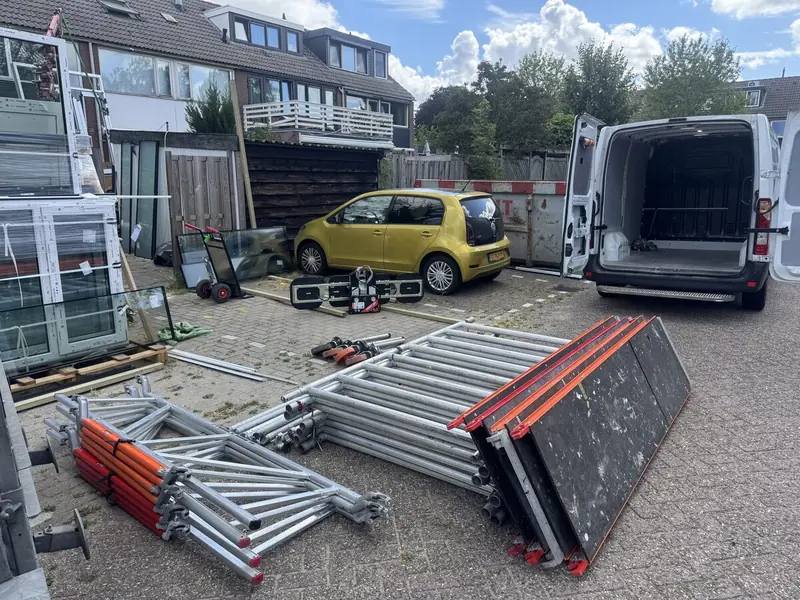
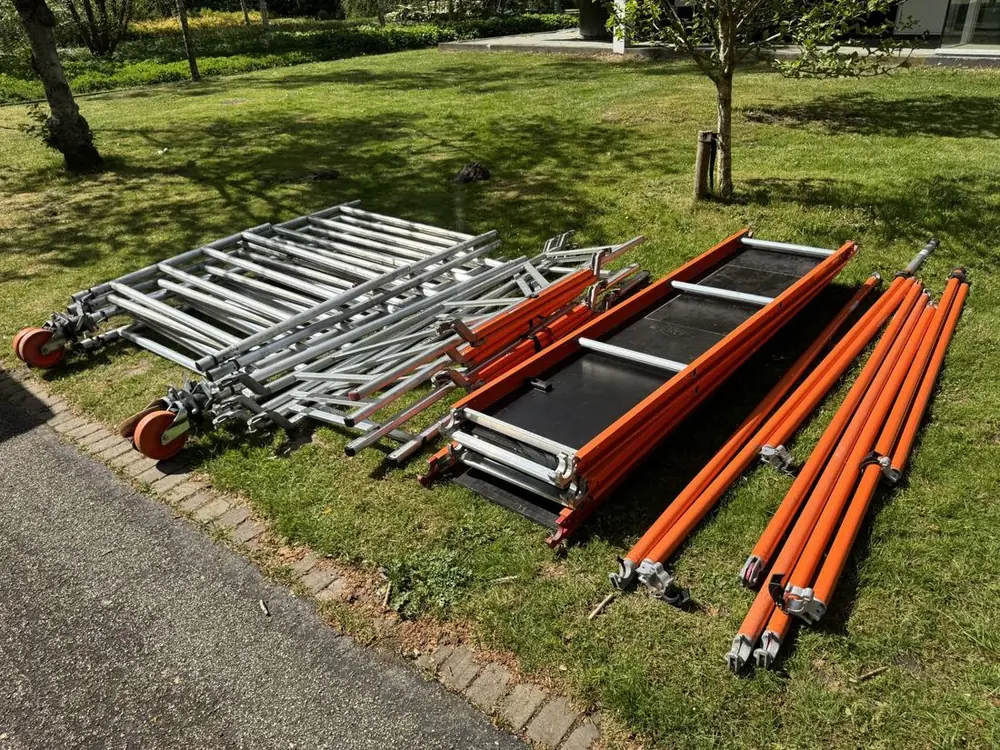
The dimensions of the individual components decide how you transport the scaffold and where you can keep it between working days. The platforms, at 245 cm, are the longest item; frames and braces are shorter but come in quantity. With delivery none of that is your concern, since the equipment is brought and collected again. Order before 15:00 and it is at your door the next working day, anywhere in the Netherlands.
If you collect from Zeeburgerpad 89 in Amsterdam yourself, the load length of your trailer or van is the governing measurement. Measure it before you make an appointment. Collection is free, but the deposit is higher on collection than on delivery; the amounts per model are on the deposit page. On delivery the deposit is 500 euro for the RS51, the RS52 and the MiTower, and 150 euro for the room scaffold.
- Platforms of 245 cm set the minimum load length
- Frames and braces are shorter but travel in quantity
- Stack the components by type so loading and unloading goes faster
- Strap the load down so frames do not slide against each other
- Find a spot out of the wind and out of sight for between working days
Working from measurement to model
The order that works best in practice is: measure the access first, settle the height second, pick the model last. If only 75 cm will pass, it becomes the RS51 and the only remaining question is how high. If there is room to spare, the RS52 is the more comfortable option. If the work is indoors, the room scaffold is the answer. That order stops you choosing on height and only then discovering the model cannot get past.
For a short one-person job at limited height the MiTower is a compact option, with a working height up to six metres. The comparison with a standard mobile scaffold is in mobile scaffold or MiTower, and the model itself is on the MiTower hire page. If you are still unsure, send a message on WhatsApp with the measurements you took. With the width of the access and the height of the work, an answer takes about a minute.
Frequently asked questions
Exactly how wide is a mobile scaffold?
The narrow RS51 is 75 cm wide and the wide RS52 is 135 cm wide. For indoor work there is the RS44 room scaffold, which passes through a standard internal door from around 70 cm. Always measure the clear opening at the narrowest point of your route.
How long is the platform of a mobile scaffold?
On both the RS51 and the RS52 the platform length is 245 cm. That covers a solid stretch of wall per setup without moving. It also sets the minimum load length if you collect the scaffold yourself.
How high do the scaffolds reach?
The range covers working heights from 4.2 to 14.2 metres. The MiTower reaches six metres of working height; above that you use the RS51 or the RS52. Remember that working height is platform height plus two metres.
Does a mobile scaffold fit through an ordinary garden gate?
Usually yes with the RS51 at 75 cm, provided the gate actually leaves that opening when open. Hinges, a bolt and a leaf that does not swing fully back take several centimetres off. See also does a mobile scaffold fit through a door.
How much space do I need around the scaffold?
More than the width of the scaffold itself, because the stabilisers angle outwards and reach further the higher you build. Keep floor space clear on all four sides and move skips, planters or a car beforehand.
Which size do I choose for gutter work?
Work out the height of the gutter from where the scaffold will stand and subtract two metres for the platform height. Choose the width on the basis of the access to the rear. More on this is in choosing a scaffold for the gutter.
How much weight may go on the platform?
The platforms are built to EN 1004 in load class 3, which works out at 200 kg per square metre. Two people with tools sit comfortably inside that. Do spread materials along the length of the platform rather than piling them in one spot.