
Knowledge base · reading time 11 min
What is a mobile scaffold?
A mobile scaffold is a mobile aluminium tower on wheels that lets you work safely at height. It is delivered in parts, you assemble it yourself and you roll it along the facade to the next section of the job. Below you will find how such a tower is built up, which models exist, how to work out the height you need and what hiring one involves.
- What is a mobile scaffold, which parts does it have and which models exist? Working height, assembly, safety and hiring explained.
- The width.
- Our range covers working heights from 4.2 to 14.2 metres.
- No, the parts click together without tools.
A rolling work platform on wheels
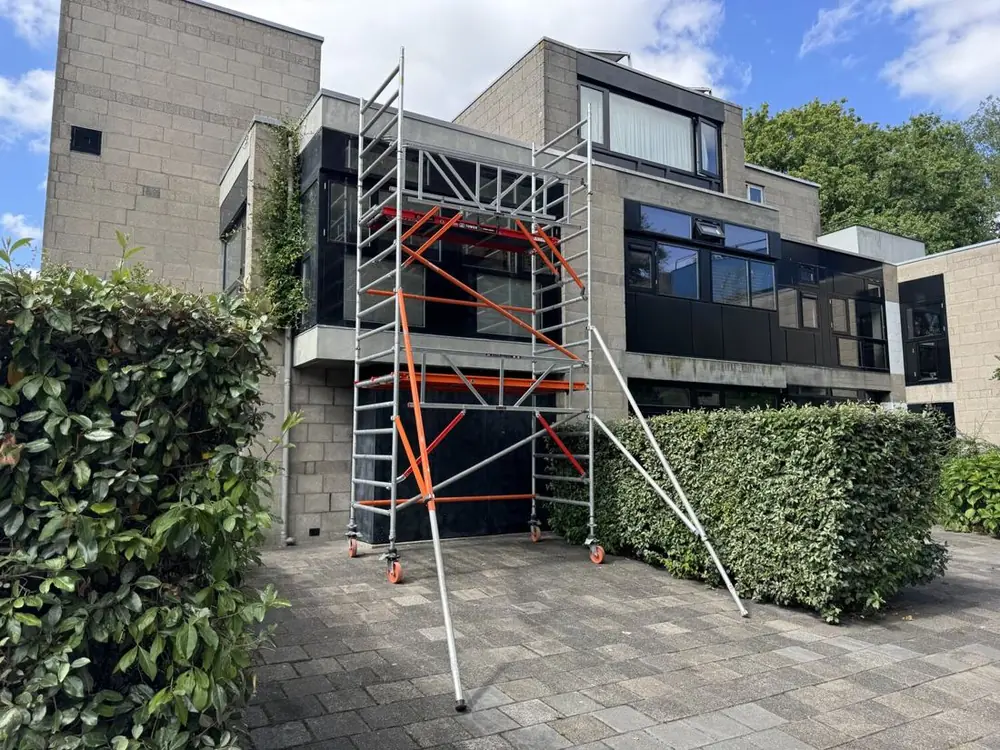
A mobile scaffold is an aluminium tower of frames, platforms and braces standing on castor wheels. The parts click together without bolts and without tools, so you go from a stack of components to a solid working platform in a short time. Where a fixed facade scaffold is built from loose tubes and couplers, a mobile scaffold is a complete system in which all dimensions already match. You choose a height and the parts that belong to it are fixed.
The difference with a ladder is the platform. You stand on a flat floor enclosed on all sides instead of on a rung, with both hands free and with room for tools and materials beside you. That lets you keep working in one spot instead of climbing down every few minutes, and you can take up items you would never carry safely on a ladder. That comparison is worked out further in ladder or mobile scaffold.
Mobile means that on flat, paved ground two people can push the assembled tower to the next section without taking it apart. Always do that with an empty platform: nobody on it, no tools and no loose parts. After moving it, put the wheel brakes back on and check that the tower still stands level before anyone climbs up. Look at the ground ahead of you as well, because a doorstep or a cable duct can stop a wheel dead.
Key facts
| Feature | Value |
|---|---|
| Definition | Mobile aluminium scaffold on castors, self-assembled without tools |
| Standard | EN 1004 |
| Load class | Class 3: 200 kg per m² |
| Available working heights | 4.2 to 14.2 metres |
| Models | Altrex RS Tower 51/52, RS44 and MiTower |
The parts a mobile scaffold is made of
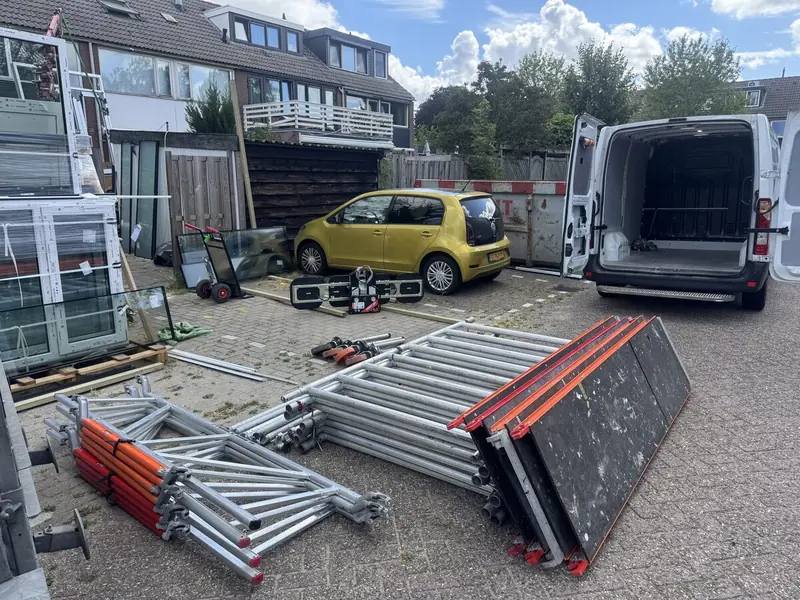
A mobile scaffold consists of a limited number of part types that you stack in varying order. The higher you build, the more frames and braces are added, but the principle stays the same. On delivery you receive everything that belongs to the chosen height, including the parts people tend to overlook while unloading, such as the toe boards and the base pads that go under the wheels.
A scaffold that is not complete should not be assembled. One missing diagonal brace takes the stiffness out of the tower, and a platform without a hatch pushes people into climbing on the outside. Count the parts on delivery, sort them by type and report it straight away if something is missing or damaged. The hire checklist walks through that inspection point by point.
- Aluminium frames with rungs you climb on the inside of the tower
- Platforms with a hatch, so you reach the next level through the floor
- Diagonal braces that stiffen the tower and keep it square
- Horizontal braces and guardrails all around the working platform
- Toe boards on all four sides, against falling tools
- Stabilisers that widen the base as you build higher
- Castor wheels with brakes, plus base pads for soft or loose ground
Platform height and working height are not the same
The platform height is the height of the floor you stand on, measured from the ground. The working height is the height you can still reach, and you calculate it as platform height plus two metres, the reach of an adult. Standing at four metres, you reach a work point at six metres. Manufacturers and hire companies almost always quote working height, so check for every figure you come across which of the two is meant.
Do not measure the height of your house but the height of the point your hands have to reach: the underside of the gutter, the top window, the joint of the dormer. Subtract the two metres of reach and you know the platform height you need. On working height you can see which scaffold matches each metre, and the pages per floor level help if you prefer to think in storeys.
Our range covers working heights from 4.2 to 14.2 metres. Below that you are usually quicker indoors with a low set-up or a room scaffold, above it you enter the territory of a fixed facade scaffold erected by a scaffolding company. If your job sits near one of those limits, first establish the highest work point and only then pick the model, because that order stops you hiring a tower that falls just short.
The four models we hire out
The RS51 is the narrow mobile scaffold at 75 centimetres wide and the RS52 the wide one at 135 centimetres. Both have a platform length of 245 centimetres, so your working bay is equally long and the difference is purely the width. An RS51 fits through narrow gates, between a facade and a fence or along a corridor. An RS52 gives you more room beside you for paint, tools and a second person, and stands on a wider base.
There is also the MiTower, a one person scaffold up to six metres working height, meant for short jobs you do on your own. And the RS44 room scaffold, which fits through a standard interior door from around 70 centimetres and can therefore be moved through a house without dismantling. If you are weighing up the first two, mobile scaffold or MiTower puts the choice side by side.
| Model | Type | Defining dimension | What it is meant for |
|---|---|---|---|
| RS51 | Narrow mobile scaffold | 75 cm wide, platform 245 cm | Tight passages, alleys and facades with little room beside them |
| RS52 | Wide mobile scaffold | 135 cm wide, platform 245 cm | More working room and materials on the platform, longer facade jobs |
| MiTower | One person scaffold | Up to 6 metres working height | Short jobs done alone, quick to assemble and move |
| RS44 | Room scaffold | Fits an interior door from about 70 cm | Ceilings, walls and indoor work, moved from room to room |
Altrex, EN 1004 and load class 3
Our equipment is made by Altrex and built to EN 1004, the European standard for mobile access towers. That standard sets out how such a tower is constructed and tested, and requires an assembly instruction stating the order and the parts needed for each height. What the standard covers and why you keep the instruction at hand is explained in EN 1004 explained.
Load class 3 means 200 kilos per square metre of platform. That is your own weight plus tools plus materials together, and it is more than ordinary painting or installation work asks for. Still use that allowance sensibly: spread the weight across the platform instead of piling everything in one corner, and hoist heavy items up rather than carrying them on the rungs. Loading and weight goes into this in more detail.
Aluminium is the reason you can put such a tower up yourself. The individual frames are light enough for one person to lift and place, the material does not rust and it simply dries off after a wet job. The difference with steel systems lies mainly in that weight and in the speed of assembly, as aluminium or steel scaffold sets out.
You assemble it yourself, in a fixed order
We deliver the scaffold in parts and do not assemble it for you. You put it together yourself using the manual and the instruction video supplied with the hire, and that goes faster than most people expect because no tools are involved. Work through the order exactly as the instruction gives it, because every level rests on the one below and a skipped brace only shows once the tower is standing.
The outline is the same at every height. You start at the bottom with the wheels and the first frames, you build on from the platform below each time, and you fit guardrails and toe boards before working on a new level. The full assembly step by step goes through the actions, including the points where people get stuck in practice.
- Fit the wheels into the first frames and apply the brakes immediately
- Level the bottom frames on base pads if the ground is soft
- Fit diagonal and horizontal braces before stacking any higher
- Lay the platform with hatch and close the hatch after climbing through
- Fit guardrails and toe boards all around the working level
- Extend the stabilisers and check the whole tower before you start
Stabilisers, wheels and the ground underneath
A mobile scaffold is a slim tower, so stability comes from the base underneath it. Stabilisers are the angled supports you extend at the bottom to widen that base. They belong with the scaffold, and from a certain assembly height the instruction prescribes them. Extend them until they touch the ground and the tower stands firm, and take them along when you push the tower to the next section.
The ground does the rest. Paving, concrete and asphalt are fine, while grass, sand and freshly turned soil give way under wheel pressure and call for base pads that spread the load. On a slope or a falling driveway you level the tower with the spindles before building any higher. Uneven ground describes the options per situation. After heavy rain, check again that the wheels have not sunk into the surface.
With higher set-ups and with facade work, tying in is added: you secure the tower to the building so wind cannot move it. When that is needed and where the ties go is covered in stabilising and tying in. In strong wind you stop working, clear the platform and if necessary dismantle down to a lower level. Do not leave loose materials lying on the platform overnight either.
Jobs a mobile scaffold gets hired for
Most hires go to facade and roof work on houses: painting a facade, taking on window frames, cleaning gutters and replacing fascia boards. Those are jobs where you spend hours at the same height and move along a few metres at a time, exactly what a rolling platform is made for. On a terraced house you can work along the whole front in a day that way, without dismantling in between.
Plenty of installation work is done from a mobile scaffold too: fitting solar panels, mounting outdoor lighting, hanging cameras and aiming aerials. One off jobs such as washing windows on a tall facade or putting up festive lighting come by often as well. On applications you can see which height and model usually suit each job. For that kind of mounting work, what counts most is having tools and components within reach on the platform.
Working indoors with a narrow or room scaffold
Indoors the limits are different. Wind is not the problem, door width, flooring and ceiling height are. The RS44 room scaffold is built for that: it fits through a standard interior door from around 70 centimetres, so you roll it from the living room into the hallway without taking it apart. An RS51 at 75 centimetres wide passes many openings, but not every door.
So measure the narrowest opening on the route, not only the room you have to reach. Stairwells, thresholds and tight corners often decide more than the job itself. Will a mobile scaffold fit through the door checks those dimensions, and using a scaffold indoors covers floor protection and rolling over delicate finishes. Measure the clear height under door frames and beams as well, because a tower that fits in width can still be too tall to roll.
Delivery, collection and the deposit
Order before 15:00 and the scaffold is delivered the next working day, anywhere in the Netherlands. Delivery and collection together sit in a fixed amount per province, so you know in advance where you stand and no distance based surcharge follows afterwards. What that amount is per province is shown on delivery costs and explained further under the cost of having a scaffold delivered.
You can also collect the scaffold yourself, free of charge and by appointment, at Zeeburgerpad 89 in Amsterdam. That saves the delivery amount, but you need transport that can take the frame lengths. If a trailer is not an option for you, read hiring without a trailer before booking a slot. The platforms are 245 centimetres long, so you need a load space or trailer that takes that length.
A deposit applies, and it differs per model and per collection method. On delivery it is 500 euro for the RS51, the RS52 and the MiTower, and 150 euro for the room scaffold. If you collect yourself it is 1000 euro for the RS51 and RS52, 750 euro for the MiTower and 150 euro for the room scaffold. After return the deposit is back within one working day, as the deposit for hiring a scaffold explains.
How the hire days are counted
The first hire day is charged at the full daily rate, and every following day costs 5 percent of that daily rate. A week is therefore only a fraction more than a single day, which makes the sum easy when you are in doubt: take a few extra days rather than losing your scaffold halfway through the job because the weather turned.
What a specific set-up costs depends on the model and the height. The configurator on prices works it out for you, and the pages on the price per day and the price per week show how the build up works. How many days are realistic for your job is covered in how many days to hire a scaffold. For a room scaffold or a MiTower, the rates are given on room scaffold hire costs and MiTower hire costs.
Choosing the right scaffold for your job
Four questions get you to the right model almost every time. How high is your work point, are you working indoors or outdoors, how much room is there beside and under the tower, and are you working alone or with someone. Those answers give you the platform height, the width and whether a MiTower is enough or an RS52 is needed. In any case, measure the route to the work area before ordering.
If you cannot decide, send a photo of the situation via WhatsApp together with the height you think you need. We look at it and tell you which model fits. If you would rather read first, the common questions are answered on frequently asked questions and the other guides are collected in the knowledge base. Calling or emailing works too, the details are on contact.
Frequently asked questions
What is the difference between an RS51 and an RS52?
The width. The RS51 is 75 centimetres wide and the RS52 is 135 centimetres, while both have a platform length of 245 centimetres. The narrow one gets through tight passages, the wide one gives you more working room and materials beside you on the platform.
How high can you get with a mobile scaffold?
Our range covers working heights from 4.2 to 14.2 metres. Working height is the platform height plus two metres of reach, so a platform at ten metres gives a working height of twelve metres. The MiTower is the exception and goes up to six metres.
Do I need tools to assemble a mobile scaffold?
No, the parts click together without tools. All you need is the manual and the instruction video that come with the hire, and preferably a second person to pass up the frames and check the assembly with you.
Does Steigertaxi assemble the scaffold for me?
No, we deliver the scaffold in parts and you assemble it yourself. With the hire you receive a manual and an instruction video showing the order step by step, so you know which braces and platforms go where.
How much weight is allowed on the platform?
Load class 3 allows 200 kilos per square metre. That is your weight plus tools plus materials together. Spread the load across the platform instead of stacking everything in one spot, and allow for what you still bring up during the job.
Can I collect a mobile scaffold myself?
Yes, free of charge and by appointment at Zeeburgerpad 89 in Amsterdam. You do need transport the frames and platforms fit into. Collecting yourself carries a higher deposit than delivery, namely 1000 euro for the RS51 and RS52.
Will a mobile scaffold fit through a normal door?
The RS44 room scaffold is made for that and fits through a standard interior door from around 70 centimetres. An RS51 is 75 centimetres wide and passes wider openings, but not all of them. Measure the narrowest door on the route before choosing.