
See your price
Application

Washing windows? Choose the right scaffold.

Washing windows is not heavy work, but there is a great deal of it in a row. An ordinary house runs to fifteen or twenty panes, and each one takes you only a couple of minutes. The gain therefore sits in your route along the elevations and in how briskly the set-up shifts. For the upper panes of a normal house you hire the narrow RS51, 75 cm across, in a build that carries you to 6 to 8 metres. Below is how to divide such a round up.

  • Order before 3 pm, delivered tomorrow
  • Professional Altrex scaffolds
  • Up to 14.2 metres working height
  • Easy to assemble yourself
4,2 tot 14,2 mWorking heights available
12Provinces served
7Days a week
200 kg/m²Load class 3
In short
  • For washing windows we recommend the Narrow mobile scaffold.
  • Washing windows starts with a count per elevation, because that number decides how often the hired tower gets moved in a day.
  • The RS51 at 75 cm is light enough to roll on your own and fits through the gate to the back garden.
  • A build reaching 6 to 8 metres puts the top rail of the highest panes right in front of you.
  • First 24 hours from €150 incl. VAT and delivery; every day after that 95% off.
Key facts for this job
FeatureValue
Recommended scaffoldNarrow mobile scaffold (Altrex RS TOWER 51)
Working height for this job6 to 8 metres
Available working heights4.2 to 14.2 metres
StandardEN 1004, load class 3 (200 kg per m²)
DeliveryOrdered before 3 pm, delivered next working day
Each extra day95% off, from €7.50 a day
Why a mobile scaffold for washing windows?

Safe, stable and professional work at height

A wash round is about numbers. Twenty panes at three minutes each add up to an hour of actual work, but fifteen rounds of climbing down, releasing brakes, rolling and setting the stabilisers again put a whole day behind you. So with washing windows you look at your route first: which elevation to start on, how many panes per set-up, and where the bucket ends up. A light tower you can roll a window width on your own beats a heavy arrangement that needs a second pair of hands each time. Add that you work with a bucket of water and go up and down with wet hands. Hiring here is about the number of stops, not about the kit.

  • Washing windows on fifteen to twenty panes
  • A route round front, side and back elevations
  • A light tower one person can roll alone
  • Reaching the head of the top storey panes
Read more about working safely →

Which mobile scaffold to hire for washing windows all round

Anyone doing a whole house is better off with a light tower, and that is the RS51 at 75 cm wide. What decides it is not deck area but weight, because with twenty panes you shift it ten times or so. In the hire fleet this model runs from 4.2 metres up to 14.2, and a wash round takes the build reaching 6 to 8. It also rolls through a gate a metre wide to the back. You will find it among the other mobile scaffolds for hire.

If you are on your own and it stops at the panes on the first storey, take a look at the MiTower as well. That tower is also 75 cm wide, built for one person, and runs to 6.2 metres of working height, which on most terraced houses reaches the top of the first floor. For the upper panes of a three storey house it leaves you short, and no amount of stretching makes that up. Compare the two beside each other through hiring a MiTower.
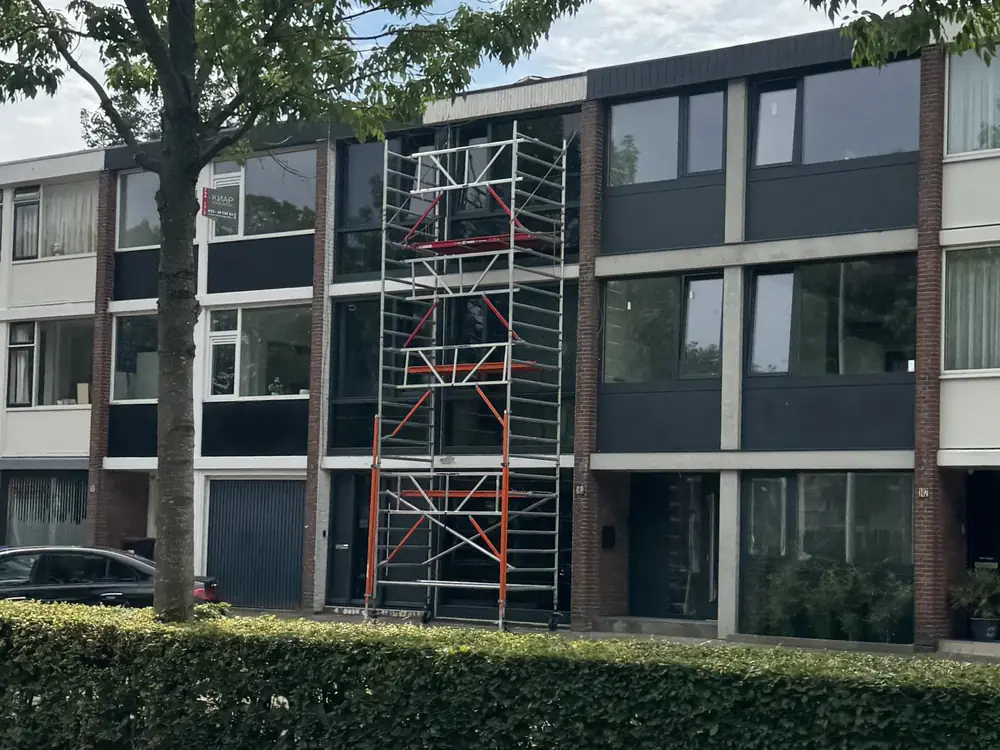
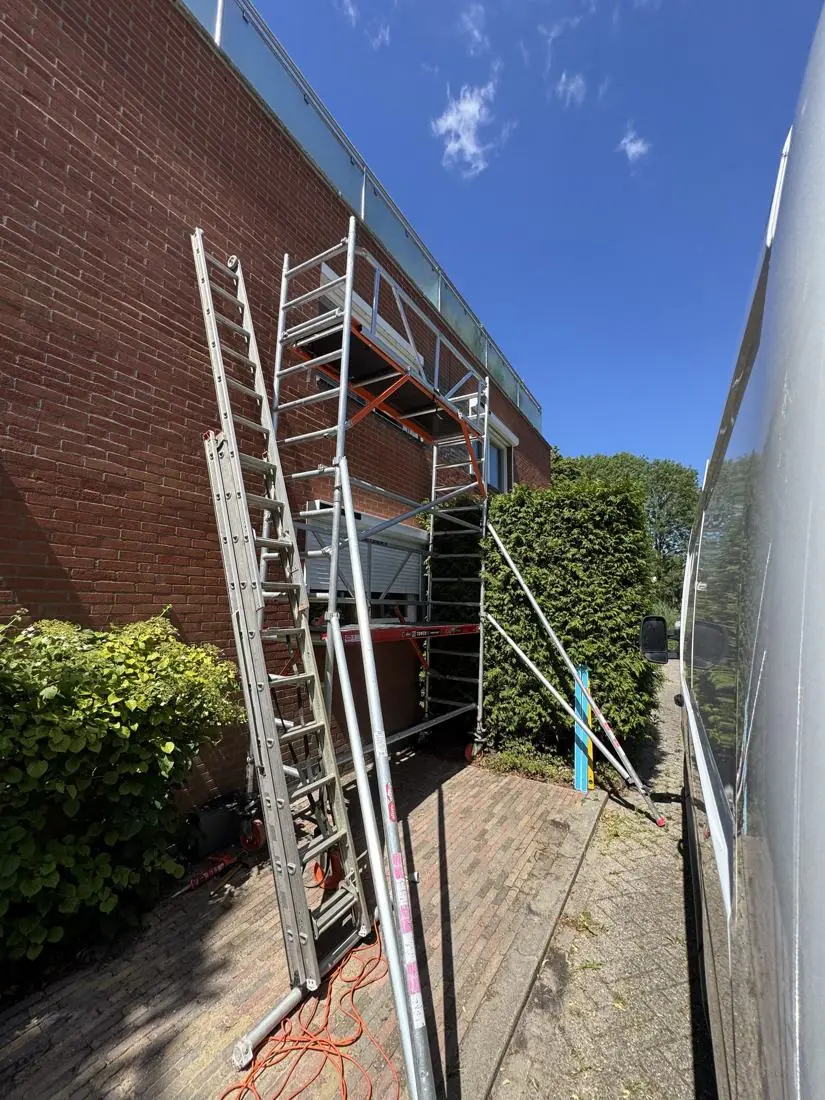
Mobile scaffold built up beside a modern house, the light tower you nudge along pane by pane on a wash round

The wide RS52 at 135 cm is usually overkill on this job. Washing windows means carrying up a bucket, a squeegee, a scrim and a cloth, and that fits without trouble on a deck measuring 75 by 245 cm. You pay for the extra width in weight and in parts to carry through the garden. Only when two people work up there at once, or when you combine the wash round with other facade work, does the wide version start to earn its place.
Hiring the working height that reaches the top windows

The highest point of a wash round is the head of the top pane, plus the strip of frame where dirt gathers. In a terrace of two storeys topped by a loft, that point sits at 6 to 8 metres. Work it out from the deck you will be standing on and add the roughly 2 metres your arms cover on top, which puts the platform on this job somewhere between 4 and 6 metres. That is the figure you tick when you book.

Measure per elevation rather than once for the whole house. At the back the garden often sits lower than the pavement at the front, and an extension or a terrace on posts moves your starting point again. Take in whether dormer windows are on your list, because those ask more height than the ordinary storey windows below them. The page on seven metres of working height sets out what that build brings within range, so you pick correctly instead of finding yourself a storey short on the day.

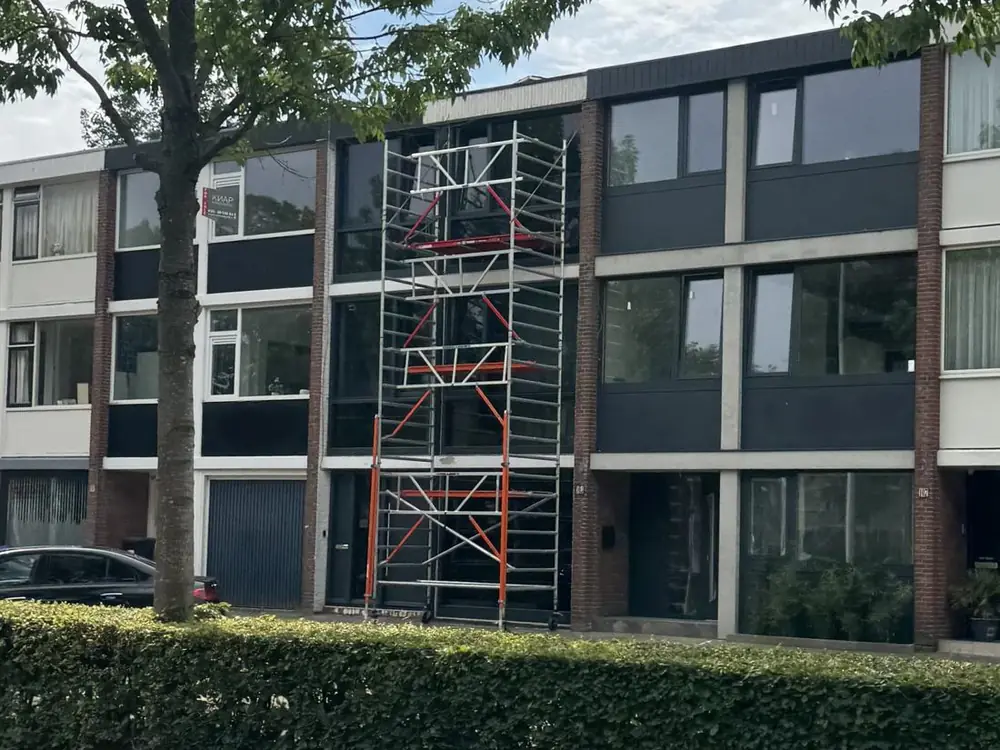
Mobile scaffold reaching above the topmost panes on a front elevation, the build that brings the head within reach

Choose too low and you feel it in your arms. You end up squeegeeing with the head of the pane above you, water runs down your sleeve, and the top twenty centimetres keeps the streaks you cannot see from the ground but will see in the first sun. That costs you a second round later. So take the build that sits a touch more generous; in hire terms it changes little and on the glass it changes everything.

Where the hired tower stands during your window washing round

When you are washing windows the tower never stays long in one place, which is exactly why you walk the route once beforehand. See where the ground is hard and where you cross grass, because wet soil under four castors turns into a mud track within two set-ups. Look at where the gate is and how wide it is, because that decides whether you roll the tower through in one piece or have to strip it halfway. A route you know in advance saves an hour of pushing and lifting.

At the foot you need the same space at every stop: the width of the tower plus the stabilisers standing out at an angle. Under windows, though, you find precisely the things that do not go with that, such as a border of perennials, a raised sill, a water butt or a bike rack. Move that lot before the day starts, because dragging things aside between stops costs minutes you see again at the end. If the garden slopes away, read how to set a tower on ground that is not level.

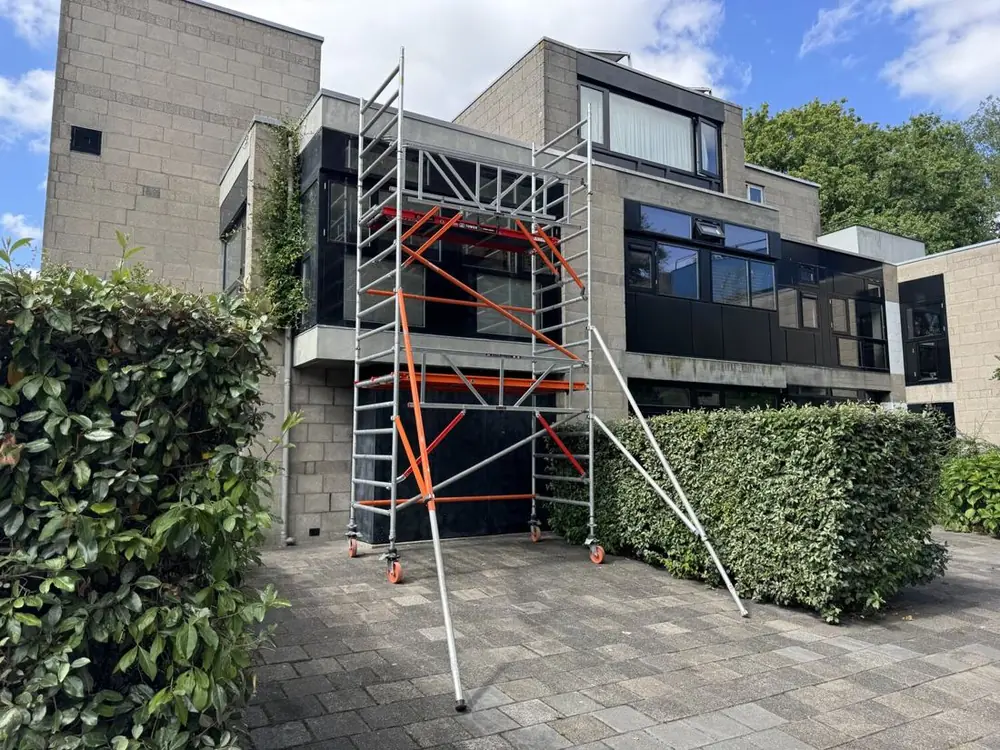
Four stabilisers spread wide beneath a hired tower, the clearance each stop along the elevation demands

On the street side part of the arrangement lands on the pavement. Keep a way past for pedestrians, particularly with a bucket of water above your head, and mind parked cars that dirty water can splash. With a flat or a maisonette something else comes in: you need permission to stand on the ground where the tower goes. Ask about that before you book the mobile scaffold rather than on the morning of the delivery, because a refusal at the gate wastes a whole hire day.

How many hire days a full window washing round takes

For an ordinary house a single hire day is often enough, provided you count the building and the dismantling in it. Reckon roughly like this: two people stand the tower up in about two hours, after which a pane takes a few minutes and every move ten to fifteen. Twenty panes over three elevations then fills a good working day. Working alone, or having to take it apart more than once to get through a gate, makes it two days.

That estimate goes with a booking sitting a shade wider than your plan, because nobody gets far washing windows in pouring rain. You can simply leave the arrangement standing on a bad day. Only that opening period is charged at the full rate; each further date you add to it comes with 95 per cent off. A day of slack therefore costs almost nothing when you hire a mobile scaffold, while it can save you a second build. What the tariffs per model do is shown on the page with hire prices.

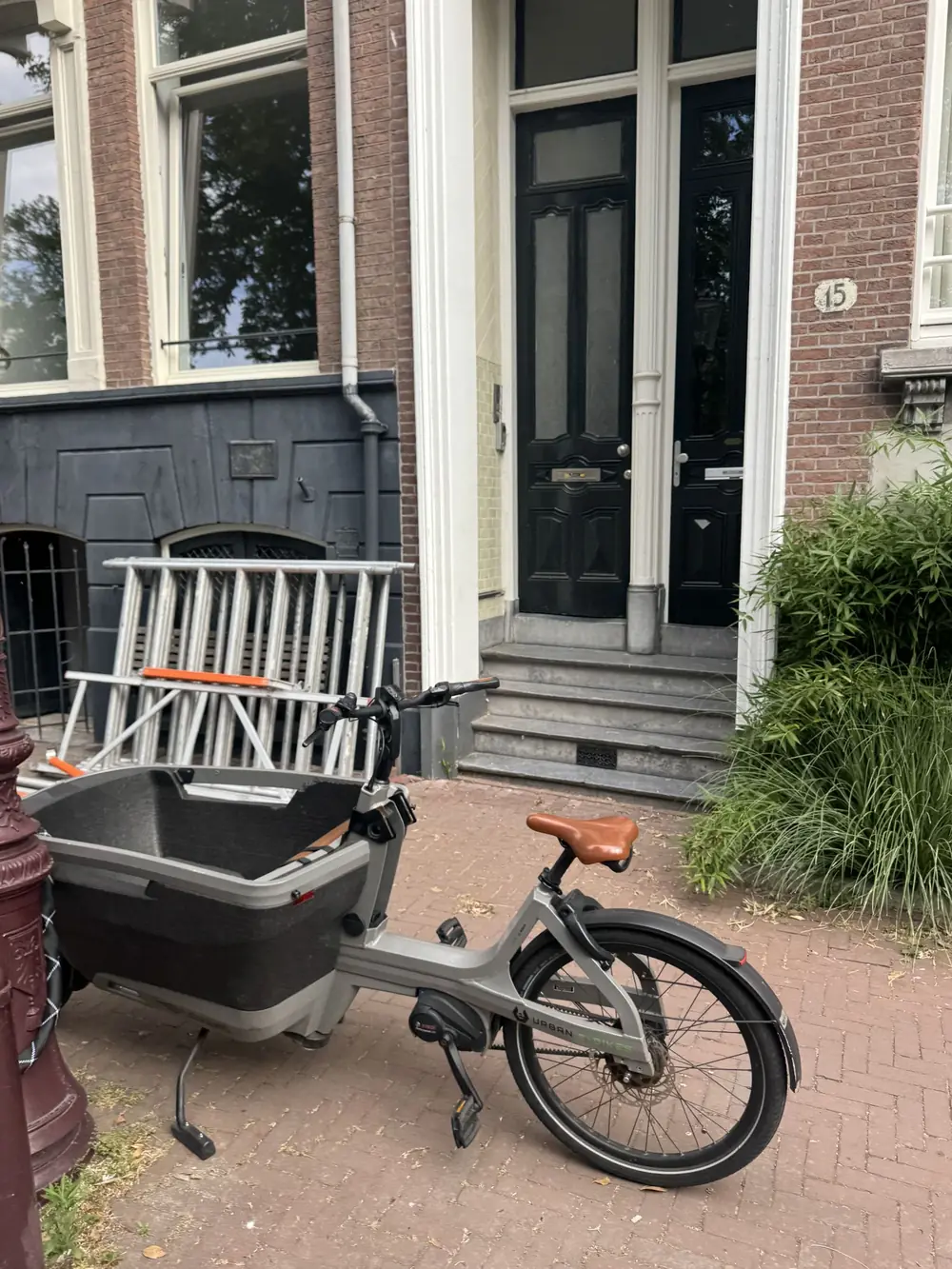
Frames waiting at the kerb outside a brick house, the hire set a single day covers including building and dismantling.

There is another reason not to book tight: people extend this job as they go. Standing up there anyway, you want to wipe the frame edge, glance into the gutter or take in the top lights at the back. That costs half a day extra, and you do not want to squeeze it out of a tight hire period. So put your collection day one behind the last pane on your list. If the round goes faster than expected you simply report the tower back early.

Which mobile scaffold suits washing windows?

Kamersteiger RS44
  • Working height up to 4 metres
  • Compact and narrow
  • Great for indoor and small jobs
View and calculate →
Most chosen
Smalle rolsteiger RS51
  • Working height up to 14.2 metres
  • Narrow (75 cm)
  • Ideal for narrow passages
View and calculate →
Brede rolsteiger RS52
  • Working height up to 14.2 metres
  • Wide platform (135 cm)
  • Extra stability and workspace
View and calculate →
1-persoons steiger MiTower
  • Working height up to 6.2 metres
  • Very compact
  • Quick and easy to assemble
View and calculate →

Washing windows from the platform: route and number of set-ups

A platform 245 cm long covers two windows at once on most elevations, sometimes a window with a top light beside it. Before you start, count how many panes each elevation holds and halve it: that is your number of stops. A terraced house with six windows at the front and eight at the back comes to seven set-ups. Work each elevation in one direction only, from corner to corner, so no clean pane ever ends up behind you again.

At every stop take everything up in one trip: your bucket, the squeegee, a scrim, a dry cloth and a scraper for a spot of paint. Stand the bucket in a corner where your foot cannot catch it as you step sideways. Working from the top down keeps dirty water off panes you have just finished. And do not save the last two windows of an elevation for the end of the day, or you will be peering at streaks in the dark.

Hired tower standing against a side elevation, the position from which two panes come within reach at once

Here lies the difference with two related jobs. With limescale, green growth or cement haze on the glass you are into cleaning windows with ingrained deposits and you stand still for minutes per pane with a product. If it is only the glass and not the frame and rebate, look at glass washing as a job in itself. On a plain wash round the route counts; on those two the standing time per pane counts, and that decides your hire days as well.

Hiring a mobile scaffold with delivery before your washing day

We bring the mobile scaffold round as loose parts, complete and counted, and you assemble it yourself; the booklet in the set and the video online take the sequence one step at a time. Point out beforehand where that stack may land: best of all by the elevation you start on, so you are not walking round the house with an armful of tubes. If your reservation is in on a working day and beats 15:00, everything is on your kerb the working day after.

The arrival date is yours to name and so is the date it goes away again, and on a wash round the forecast makes that choice for you. Have it brought a day before you mean to start: then you assemble at a quiet moment and on the day itself you only have to place the first set-up. With your own transport you may collect the parts by arrangement at no charge in Amsterdam, provided the whole set fits in your van or on your trailer.

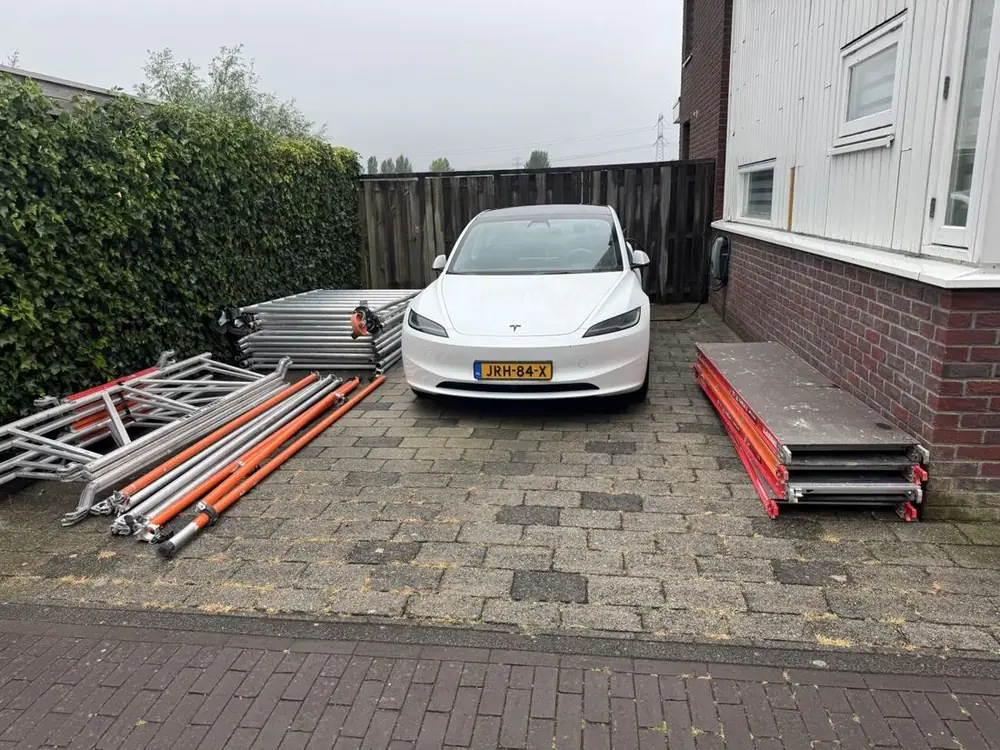
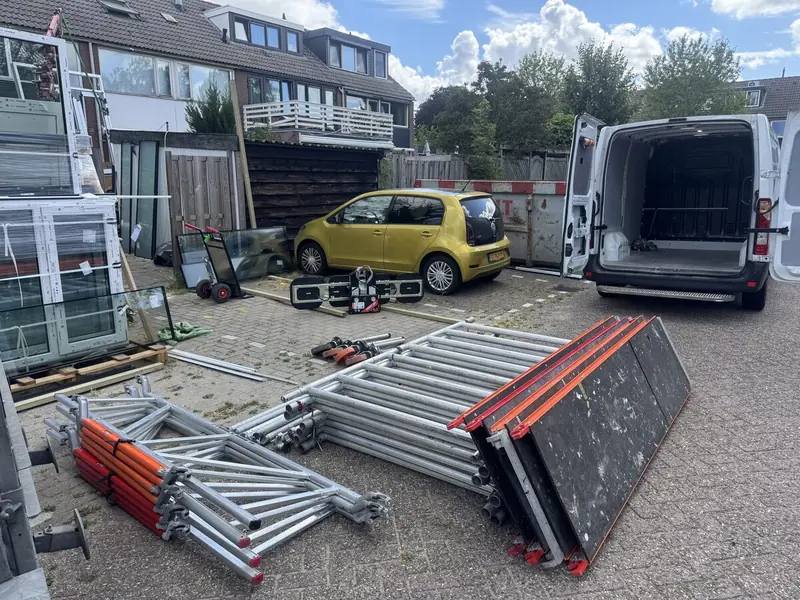
Scaffold parts delivered on site, the counted set you build up at the start of a washing day

Once the last pane is done, take the tower apart and bring everything to one point the van can reach. Leave no tubes in the border or behind the shed, because the set goes back counted and searching on collection day costs everyone time. So walk your route back once as you dismantle, gate and side path included, and stack the boards where the driver can see them. What bringing and fetching come to together differs per province; those amounts stand on the page with delivery costs.

Washing windows safely on a wet hired platform

The deck you squeegee from belongs to load class 3 under EN 1004 and so carries 200 kg per square metre. For a wash round that is ample: you, a full bucket and a few cloths stay well under it. Weight, in other words, is not the thing to worry about on a hired platform here. Water is. Knock a bucket over up there and the floor is slippery at once, and you notice it only at the moment you step sideways.

Brake the castors before you climb, even if you stay only two panes up. Never roll the tower with somebody on it, and not with your bucket still up top either; the half minute you save that way is exactly the moment it goes wrong. In strong wind you stop washing, however harmless the job looks. At each new stop go round all four stabilisers again. What else belongs to it stands with the arrangements for working at height.

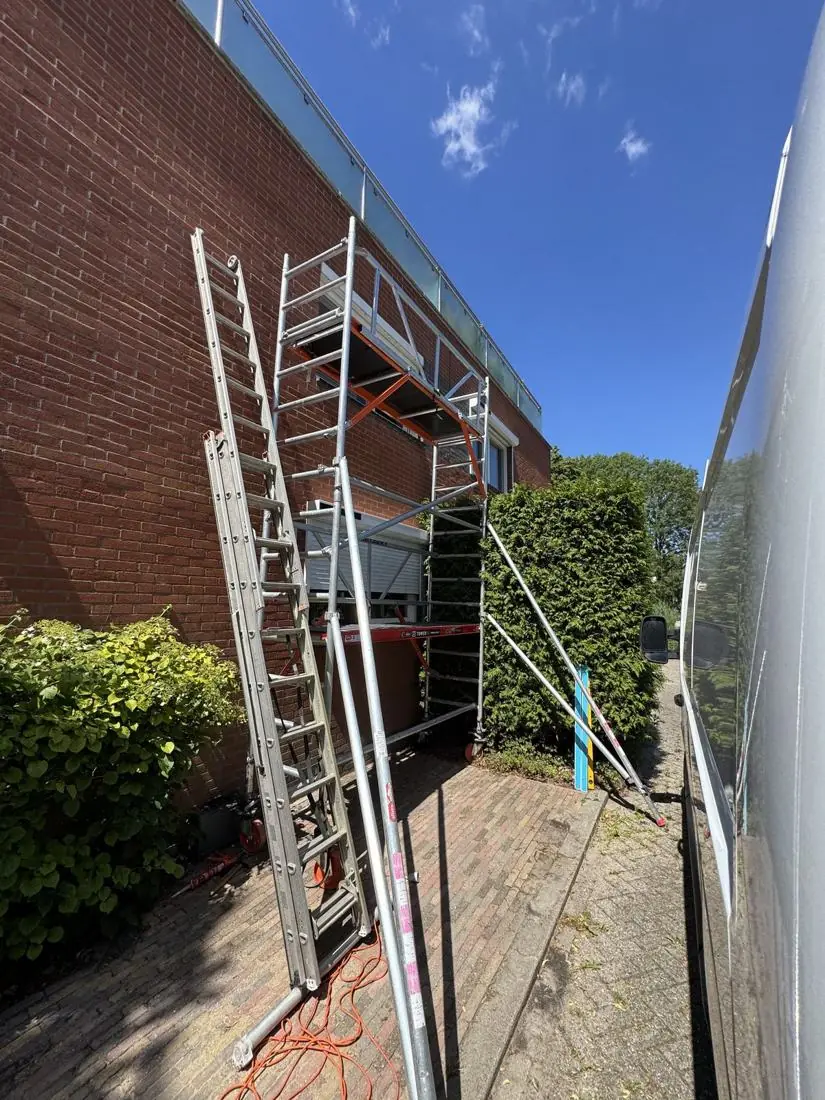
Hired tower up against a brick wall, its boards railed round, with a loose ladder leaning on the same wall alongside.

Finally, think about what happens below you. Dirty water falls, and it lands on paving, shrubs or a parked bike, so keep that zone clear and warn the household before you begin. Do not leave loose items on the edge of the platform, because a squeegee tumbling down takes a roof tile or a pane with it easily. Dry your soles before you go into the ladder and you stand firm on every rung, which matters more at the end of a round than at the start.

In 5 steps

How hiring a mobile scaffold works

1
Choose working height

Pick the height that suits your job.

2
Book online

Sorted in 60 seconds, price shown instantly.

3
We deliver

At the agreed spot the next working day.

4
Assemble safely

Assembled by you, with a manual.

5
We collect

One call and we collect the scaffold.

Good to know

Practical tips for washing windows

1

Count your panes on paper before you reserve, per elevation and per storey. That list translates straight into the number of set-ups, and from there you know whether a single hire day will cover it.

2

Fill your bucket half way at the bottom rather than to the brim. It is far lighter to carry up the ladder and you slop much less water out on the way to the platform.

3

Take the sunny elevation either first or last, but avoid washing windows in full afternoon sun. Water dries there faster than you can squeegee it away and the glass keeps the streaks.

4

Hang a bucket hook or a karabiner on the guardrail of the hired tower. Your bucket then sits outside your walking line instead of on the floor where you have to step over it.

5

Walk your gate and your garden path with a tape before you book. Knowing the tower passes through in one piece saves you half an hour of dismantling per elevation.

6

Take the top lights, the gutter edge and the frame rims in the same hire day. You are standing there anyway, and building a second time for those few spots costs far too much time.

Frequently asked questions

Frequently asked questions about washing windows

Which mobile scaffold should I hire to wash every window on a house?+

In by far the most cases that is the RS51, 75 cm wide. On a wash round you move the tower again and again, so light weight counts for more than a roomy floor. The width also takes it through an ordinary gate to the back garden. Working alone and staying under 6.2 metres, a MiTower shifts more easily still. The wide RS52 only earns its keep when two of you are up there at the same time.

How does hiring a tower for the wash round actually work?+

When you reserve you pick the model and the build yourself, and you name the days the tower may arrive and leave. We drop the parts, you assemble, you do your round along the windows and then take the tower apart again. On the date you chose we call by to collect everything. For a normal wash that makes hiring a matter of booking, one day of work and done, with no visit from us in between the two trips.

How many hire days does washing all the windows take?+

For an average family house that is one day, building and dismantling included. If your house has a lot of panes, three storeys, or a back garden reached only through a narrow gate, allow two. Working on your own, add half a day in any case, because raising and rolling a mobile scaffold goes much faster with two. An extra day costs little on the hire and gives your planning some air, which is worth having when the forecast turns during the week.

What is the rental price of a tower for one wash round?+

You pay according to the model and to the build you set it in, plus an amount for bringing and collecting in your province. Everything stands online including VAT, so you work the sum out beforehand yourself. On a one day job what matters most is that the opening period weighs heavily and an overrun day barely adds to it. Fixing two days of tower hire straight away is therefore hardly visible in the total, and it takes the pressure off a single morning.

Which build should I hire to reach the topmost panes?+

With a house of two storeys and a roof you are at 6 to 8 metres of working height. You measure from the ground under your castors to the top of the highest pane you intend to wash. If a dormer is in your round, that point sits higher than you would guess at first sight, so hire the build that covers it rather than the one that just misses. The article on choosing a scaffold for washing windows lists the builds in a row.

Can I have the hired scaffold delivered on the morning I wash?+

You choose the delivery day yourself, but plan it a day earlier. The parts still have to be built up, and with two people that runs to about two hours. Start only after the delivery and a good part of your washing day goes on assembling the tower. So let it come the day before, and the first set-up is standing when you walk outside with your bucket. On the hire that earlier date costs you almost nothing.

Do I build the tower myself after hiring, or do you come and do it?+

Assembly stays with you. We deliver a complete set and drive it away again later, but the assembling, the rolling and the taking down are yours, with the video and the booklet to hand. On a wash round that is no hardship: you raise it once and only shift it for the rest of the day. Our hire range holds mobile towers alone, so there is no system scaffold, no facade scaffold and no cherry picker to book instead.

What if the wash round overruns and I need the tower on hire longer?+

Just tell us and your collection date moves with it, provided the tower is not already down for the next customer. Washing windows usually overruns because the number of panes disappoints, or because you decide on the way to take the frames and top lights as well. Since later days barely register, booking generously beforehand beats shifting afterwards. Reporting back early needs no separate arrangement, and you keep the days you did not use out of the bargain.

How much room do I need at the spots where the hired tower stands?+

Per stop you need the width of the tower with room around it for the stabilisers, on level ground that carries the weight. Because a wash round slides along the whole elevation, that clear strip has to run the full length and not only at the first point. So walk your route beforehand with a tape and move bikes, planters and garden furniture aside. On the day itself the hired tower then only has to be rolled and braked, which is what keeps twenty panes inside one shift.

Can I keep hiring if it rains on my washing day?+

The mobile scaffold can simply stay where it is; washing itself makes little sense in rain, because you will not get the glass dry without streaks. Usually you shift half a day and pick it up later. Since you set your own collection date, such a shift costs you only one discounted day of hire. When in doubt take a two day period from the start, so a wet morning never forces you to rebook, and treat the second date as cover rather than as extra work.

How long before the deposit comes back after the hire?+

As soon as the set is returned and proves complete, we transfer your deposit back within a working day. On window washing things rarely go wrong, but do watch where you put parts down: a brace left in the grass or a stabiliser standing behind the shed holds the handling up for no reason. So walk the garden once before you report the tower ready for collection, and count the braces against the delivery note while you are stacking them by the kerb.

Can I wash windows on my own from a hired tower?+

Yes, the washing itself is fine alone. For the building you had better ask somebody along, because parts have to be handled at height and that is safer and quicker with two. A narrow mobile scaffold can be rolled single handed, provided you clear the platform first and pull the stabilisers in. Working truly alone, keep your phone on you and tell someone you are up there. For the hire itself it makes no difference whether one person works or two.

Hire a mobile scaffold for washing windows today?

Calculate your rental price now or ask for free advice.

Rolsteiger van SteigerTaxi geleverd op locatie
Book it online

Your scaffold sorted in 2 minutes.

Choose your scaffold and working height, see the price instantly and book online.