
See your price
Application

Chimney work? Choose the right scaffold.

Chimney work is a collective term: one person wants to know why there is damp in the breast, another needs a cap, a third watches pointing drop out of the head. For the hire that matters less than you would think, because the height and the model hang on the chimney rather than on whichever job comes out of it. On an ordinary mid terrace you land on the wide RS52, standing at 8.2 to 12.2 metres. This page shows how that choice is made and where a tower stops.

  • Order before 3 pm, delivered tomorrow
  • Professional Altrex scaffolds
  • Up to 14.2 metres working height
  • Easy to assemble yourself
4,2 tot 14,2 mWorking heights available
12Provinces served
7Days a week
200 kg/m²Load class 3
In short
  • For chimney work we recommend the Wide mobile scaffold.
  • Most chimney work is done from the RS52, a deck 135 cm wide standing at 8.2 to 12.2 metres.
  • Take your measurement to the topmost brick and every job on that chimney fits inside one and the same hired build.
  • A tower brings you alongside the roof edge; a stack out in the middle of the slope stays beyond it.
  • First 24 hours from €175 incl. VAT and delivery; every day after that 95% off.
Key facts for this job
FeatureValue
Recommended scaffoldWide mobile scaffold (Altrex RS TOWER 52)
Working height for this job8.2 to 12.2 metres
Available working heights4.2 to 14.2 metres
StandardEN 1004, load class 3 (200 kg per m²)
DeliveryOrdered before 3 pm, delivered next working day
Each extra day95% off, from €8.75 a day
Why a mobile scaffold for chimney work?

Safe, stable and professional work at height

Anyone taking on chimney work, or having it done, usually finds out what is really wrong only from close up. From the pavement a head can look respectable while at a metre you see that the joints are empty, that the cap sits askew or that the lead around the base has curled up. The first step is therefore not ordering materials but arranging somewhere to stand and look calmly at what you have. That is what hiring a tower gives you, along with the chance to press straight on once you know what has to happen, without booking a second period a fortnight later and building the whole thing again.

  • See at close range what the head actually needs
  • Looking and working inside one hire period
  • Fix the height without knowing the job yet
  • Know where a hired tower stops reaching
Read more about working safely →

Chimney work: which mobile scaffold to hire for a house

While you still do not know what has to happen, you carry more up than on a job that is pinned down: something to look with, something to clean with, and often material as well in case it turns out to be simple. That argues for the wide Altrex RS52, 135 cm across the boards with a platform 245 cm long. Hiring a tower for chimney work means, in practice, hiring the room to make decisions at height rather than on the ground.

For a tight route to the back there is the RS51, which passes almost anywhere at 75 cm. You give up working room for that, and you notice it the moment two people are standing up top or a bucket joins them. So pace out the narrowest pinch on your route first, with a tape rather than by eye, and only then decide on the width of the build you hire. All the sizes and reaches sit together on the page about towers available for hire, with the achievable builds beside each model.
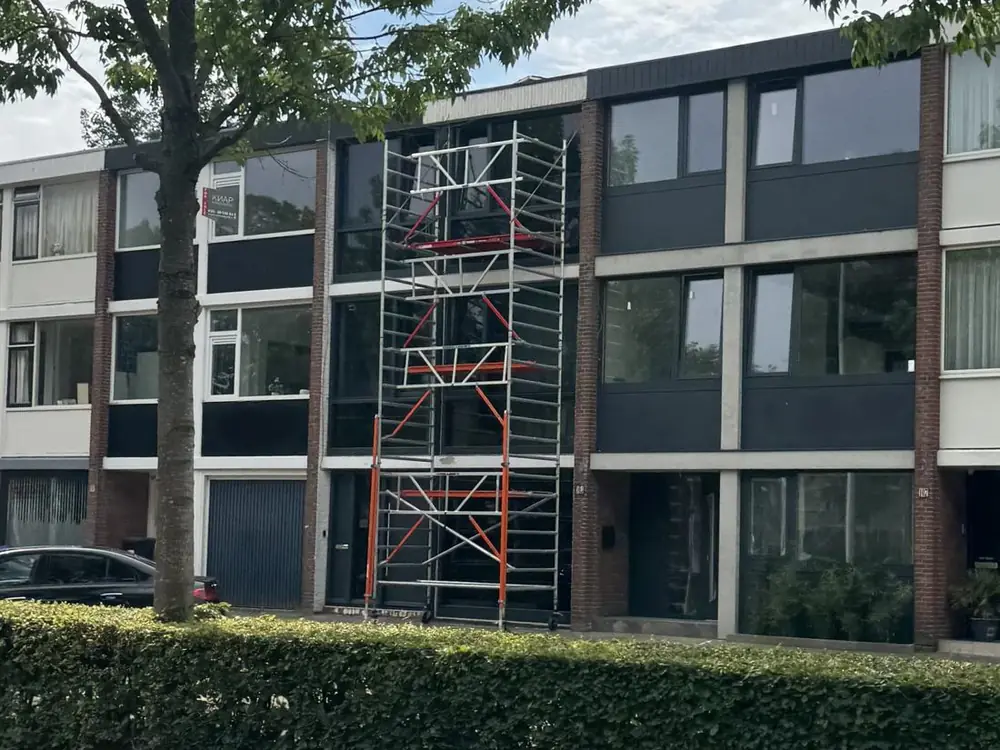
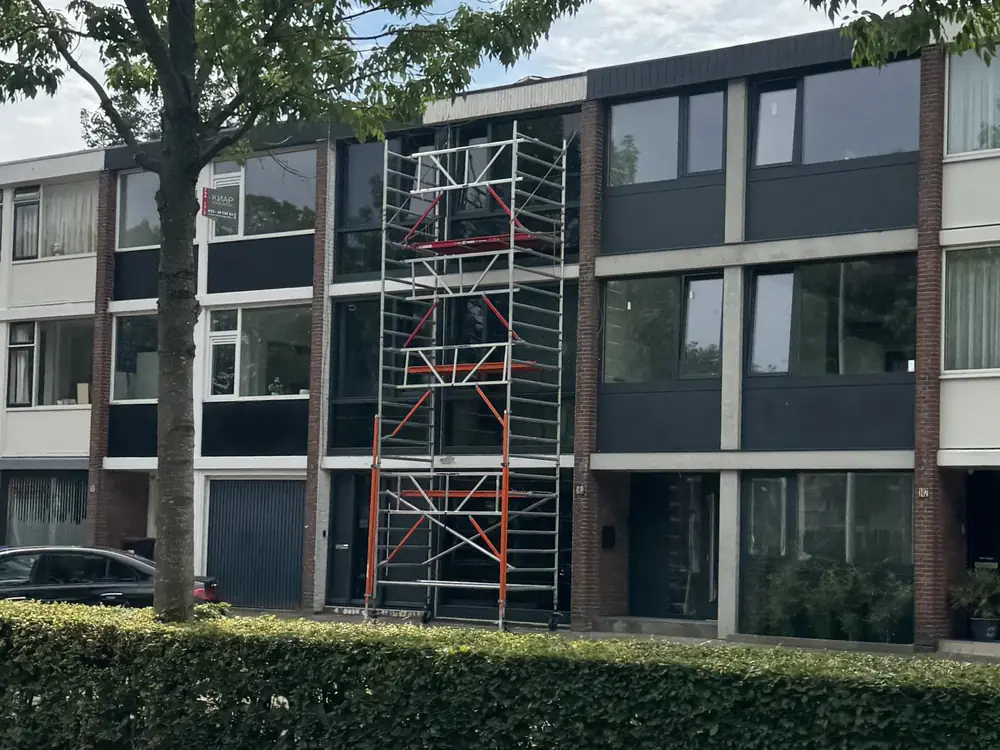
Mobile tower assembled against a front elevation and reaching past the gutter, the usual arrangement for chimney work

The other models drop out for a head on a roof. The RS44 room scaffold takes you 3 to 4 metres up and belongs indoors, being narrow enough from roughly 70 cm to be wheeled through an internal doorway. A MiTower is a one person build stopping at 6.2 metres, which falls short of a two storey roof however handy it may be elsewhere. Which leaves the RS52, buildable as a model to 14.2 metres, so even a taller house than average is covered without anyone having to improvise.
Chimney work sets the working height you hire, not the job

The convenient thing about chimney work is that the measuring point never changes, whatever the job turns into: the topmost brick of the head. Measure to that and your build is right whether you are looking, pointing, fitting a cap or checking lead. On an average mid terrace that gives a working height of 8.2 to 12.2 metres, with the boards at a little over 6 to a little over 10 metres. The gap is reach: a platform height plus about 2 metres is what you can work to.

Those figures jump in steps because a tower grows by whole lifts of roughly two metres at a time. So you do not pick nine and a half metres exactly, you pick the next build above it. If in doubt take the taller one, because from a deck set too low you can look but not work, and you discover that only once it stands. The page of working heights gives the platform height for each build.

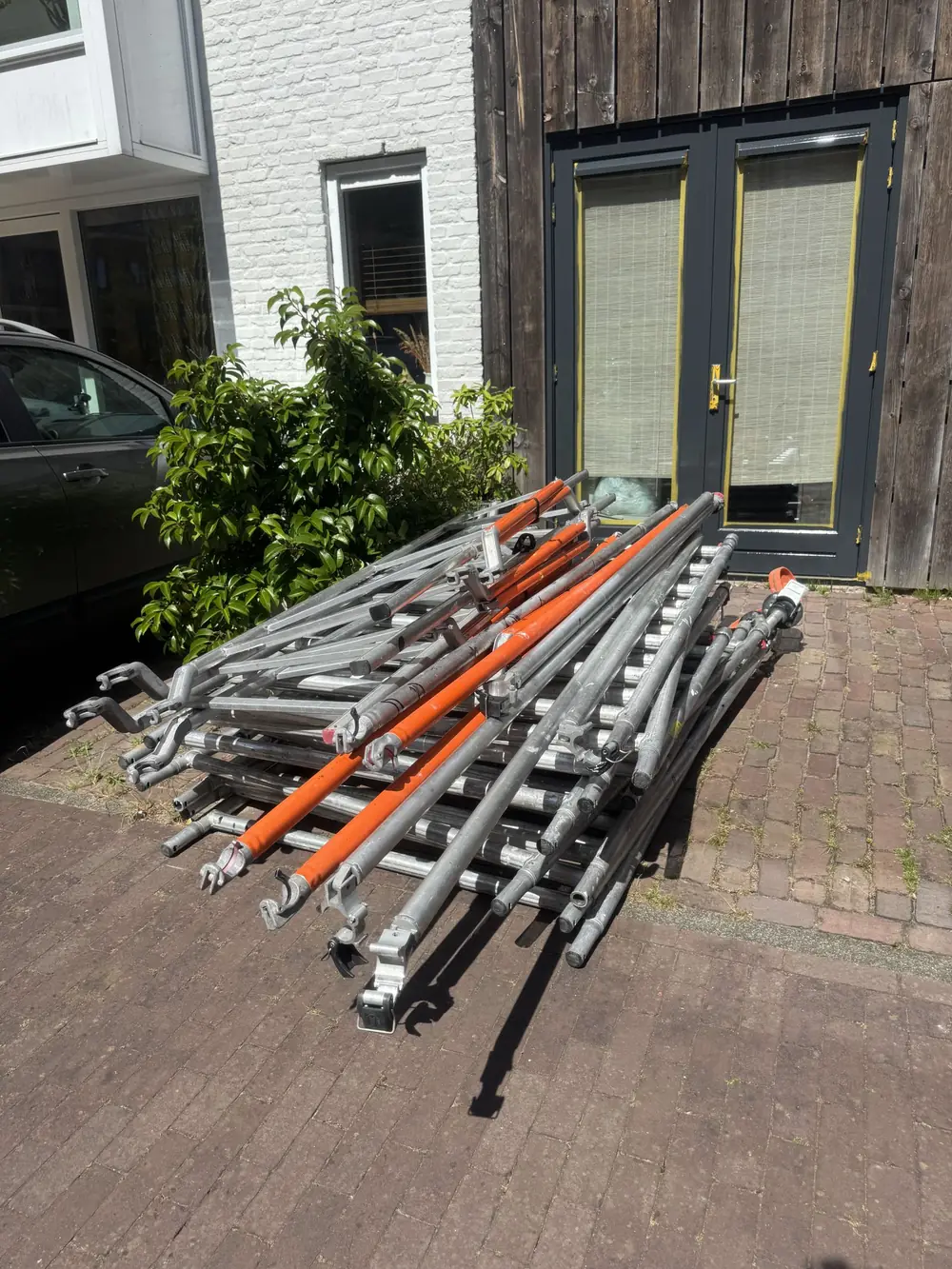
A pile of frames and tubes on a drive, each lift you add taking the chimney build two metres higher.

Start measuring on the ground where the wheels will end up, not on your threshold. A back garden often lies below the level of the street, and on a corner house the ground can differ from one side of the building to the other. If you do not know how tall the head is, stand opposite and compare it with a second floor window or with the dormer beside it. Better to have a lift in hand than to abandon a job halfway up because you cannot quite reach the top course.

Where a hired tower can stand for chimney work

Where the head sits on the roof decides whether a tower is the right tool at all. If the chimney rises out of the flank wall or close to the roof edge, the build goes along that elevation and you work from the boards towards it. If it stands in the middle of a pitched slope, or right on the ridge of a deep house, a stretch of roof lies between you and the head that you may not walk on. Check that point before you reserve anything, because it decides whether hiring is worthwhile.

Under the tower belongs firm, level ground with room for the four stabilisers. Paving, a drive or well compacted gravel will do the job; a lawn that gives way after a wet week will not. Watch for level changes between terrace and garden, and for everything built against the wall: a conservatory, a rear extension, a bike store or a dense hedge you cannot simply remove. Obstacles of that sort sometimes mean building on the far side of the house altogether, with a longer carry between the tower and your materials.

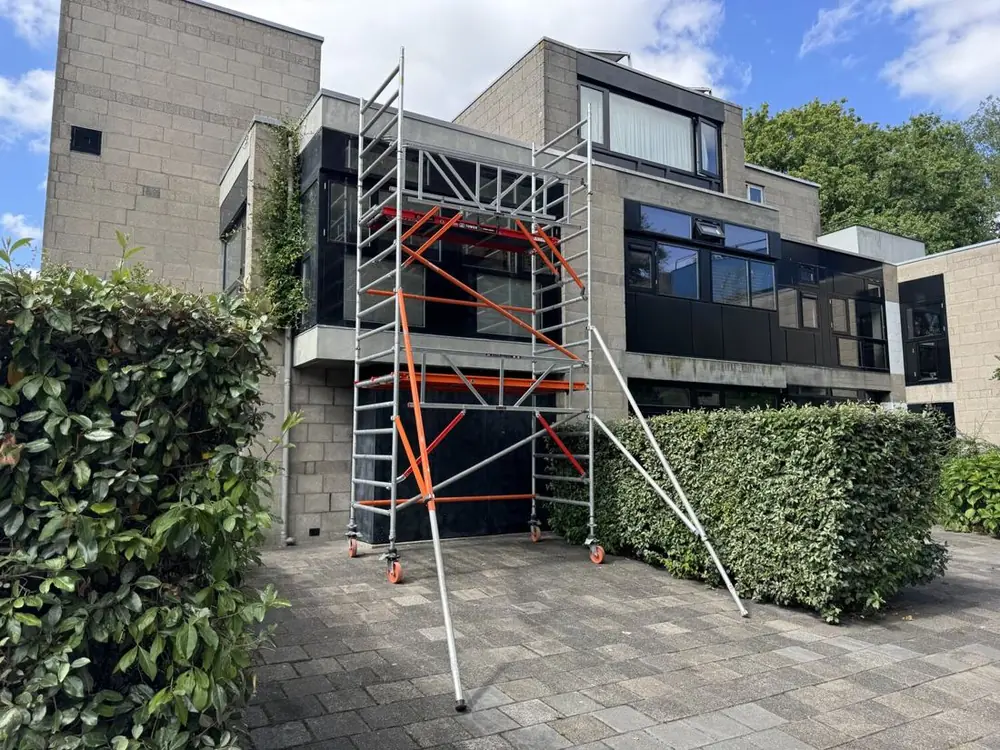
Stabilisers extended under a built tower, the flat ground you have to find alongside the house

If the build ends up in the street the council has a say: many streets allow a parking bay or part of the footway to be used, but not without telling anyone first. Arrange that well before the delivery date, especially in a busy area where every space is already taken by somebody. Keep the zone under the boards clear as well, because on almost any chimney work something eventually comes down, whether grit, a washer or a piece of old sealant.

Chimney work of unknown scope and the hire period

On a job you cannot yet describe, reserve a stretch rather than a day. Begin with a half day for the build and an hour to study the head properly; only after that do you know whether an afternoon will cover the lot or whether materials have to be ordered in first. For most chimney work practice lands on two to four days, in which waiting for mortar, sealant or an ordered cap counts every bit as much as the work on the head itself.

That approach stays affordable because full charge falls on the opening day and night alone, with 95 per cent off every further hire day that follows it. Setting a generous period therefore costs very little, whereas ordering twice means paying twice for the journey and putting the tower up twice, with everything that involves. What a build comes to per model and height appears at the tariffs for hire, VAT included and with nothing surfacing afterwards.

Tower left standing along a side elevation, the way a hired build stays in place across a run of days

Where you already know what is wrong, the planning can be sharper. Chopping out and refilling joints carries a different duration from bolting a cap down, and simply assessing a head costs a fraction of either. The page on repairing a chimney from a tower names what is realistic step by step, including the curing time you cannot make up. Plan those days loosely rather than tightly, and the final day of the hire stays a calm one instead of a rushed one.

Which mobile scaffold suits chimney work?

Kamersteiger RS44
  • Working height up to 4 metres
  • Compact and narrow
  • Great for indoor and small jobs
View and calculate →
Smalle rolsteiger RS51
  • Working height up to 14.2 metres
  • Narrow (75 cm)
  • Ideal for narrow passages
View and calculate →
Most chosen
Brede rolsteiger RS52
  • Working height up to 14.2 metres
  • Wide platform (135 cm)
  • Extra stability and workspace
View and calculate →
1-persoons steiger MiTower
  • Working height up to 6.2 metres
  • Very compact
  • Quick and easy to assemble
View and calculate →

What a hired mobile scaffold will and will not reach

From the boards you work on everything you can touch from the roof edge: the brickwork of the head, the joints, the flaunching, the cap and the lead abutment around the base, provided it is on your side. Inspecting the head, photographing it and taking dimensions off it are all perfectly possible from there as well. That is exactly why many people hire for a day before ringing a builder: with figures and pictures a conversation about the head becomes far more concrete and frequently cheaper.

What you do not do is step off the deck onto the roof slope to gain the last metre. Roof tiles are not made to carry your weight and a pitch is not a walkway, however short the distance across it looks. Just as firmly, you never tie the tower to the chimney or pull yourself up on it, because a head that needs attention is by definition not to be trusted. There is more on that under a mobile tower and a pitched roof.

Built mobile tower next to a house with a tiled roof, standing at the edge rather than out on the slope

If part of the work remains out of reach from below, that is the signal that this one calls for other equipment. We supply no facade scaffolds, nothing in system scaffolding and no cherry pickers, so at that point you look elsewhere. Worth knowing, though: for the yearly once over of a head near the roof edge the build is normally ample. The page on inspecting a chimney from a tower goes through it part by part.

Chimney work planned around delivery, hire dates and your own build

The tower arrives in pieces, counted and complete, and putting it together afterwards is done with the manual open and the assembly video within reach. Two people take a half day over that at these heights, and that half day is planned apart from the work on the head. Get the order in before 15:00, on a day that we work, and everything waits on your kerb or your drive the working day after.

Which day the delivery happens and when the set goes back you enter while booking, and for chimney work that choice hangs mostly on the weather. Rain barely hinders judging a head, but mortar, sealant and paint want dry conditions, and at 12 metres it always blows harder than down in the garden. So look further than a day ahead when you pick dates, and put your start at the beginning of a settled spell rather than at the tail end of one.

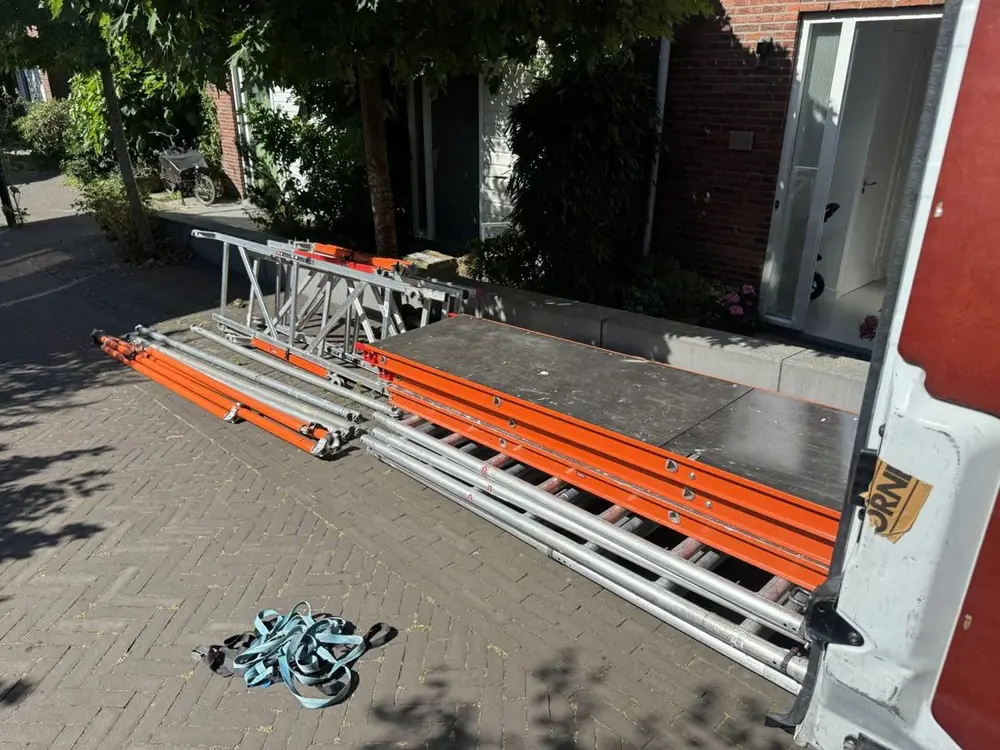
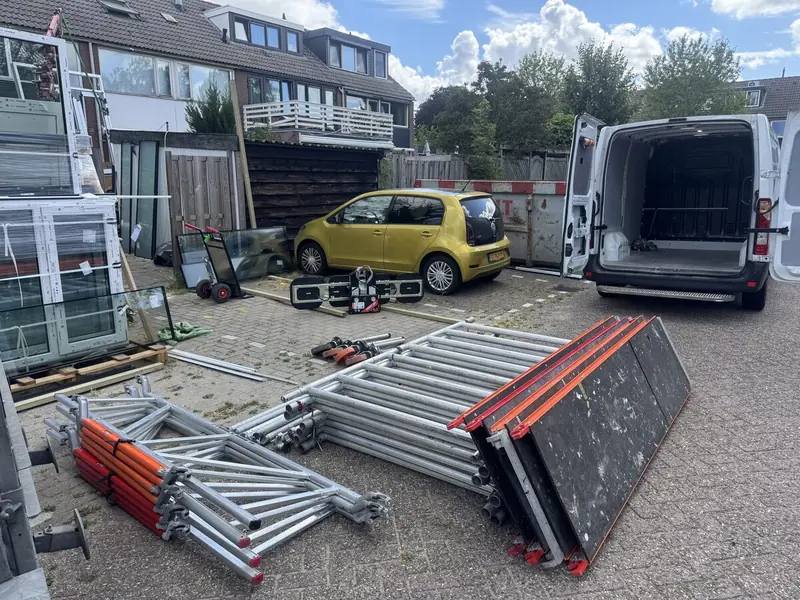
Boards, orange braces and tubes put down in the street beside an open van, counted and complete for you to build.

Afterwards you take the tower apart, gather the components and we come to collect them; building and stripping are not things we do for you. The cost of the journey is fixed per province and shown with VAT at what the delivery costs per province, so it goes into your budget straight away. Anyone arriving with a trailer can take a set away free of charge from Zeeburgerpad 89 in Amsterdam, by appointment, provided the whole lot fits into a single run.

Safe chimney work from a tower out of the hire fleet

The decking here is EN 1004 material in class 3, which puts the ceiling at 200 kg for a square metre. The trap on this kind of job is taking everything up because you are unsure: tools, a bag of mortar, a cap, a bucket of water and a second person who also has to stand somewhere. Make two trips rather than one, and keep enough of the deck free that you can turn round on it without kicking into anything.

At this height wind counts for more than it does on wall work lower down. Above the roof edge there is nearly always more of it than there is down in the garden, and anything with a flat face moves with it, from a cap to a sheet you happened to put down. Brake the wheels before you climb, never shift the build with a person or anything else on it, and walk round the stabilisers after each move to see that all four touch down again.

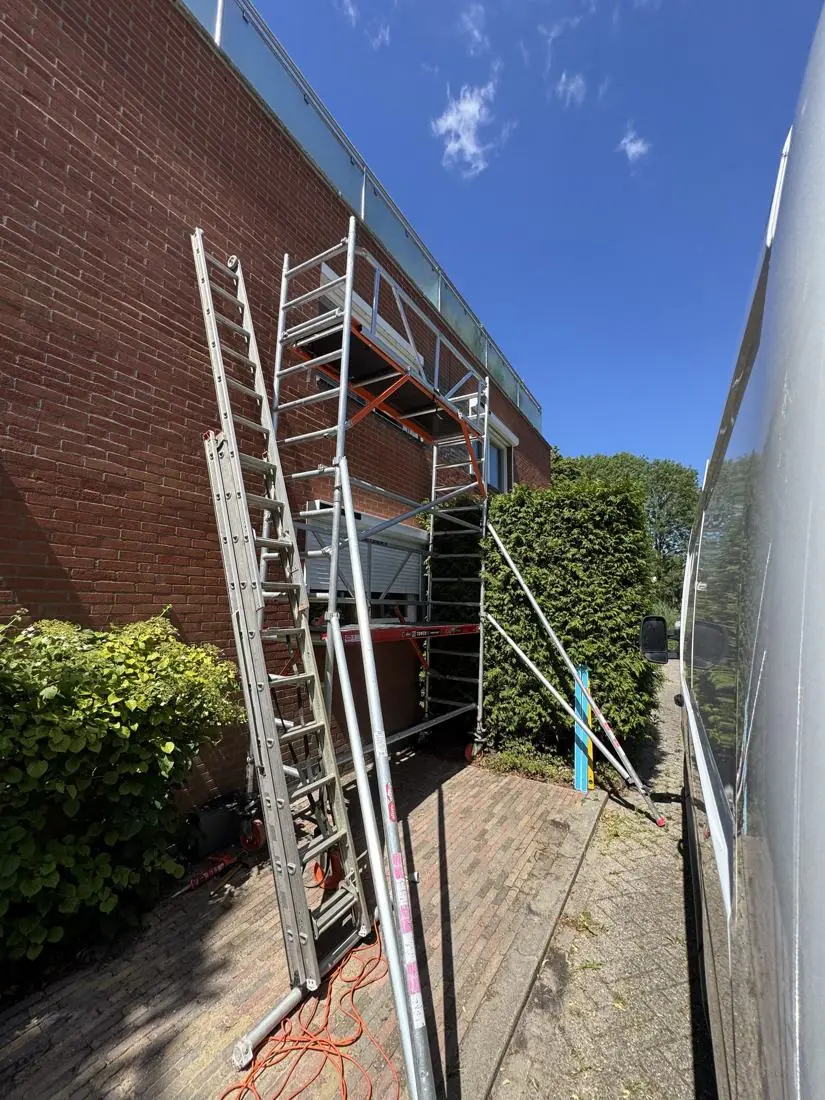
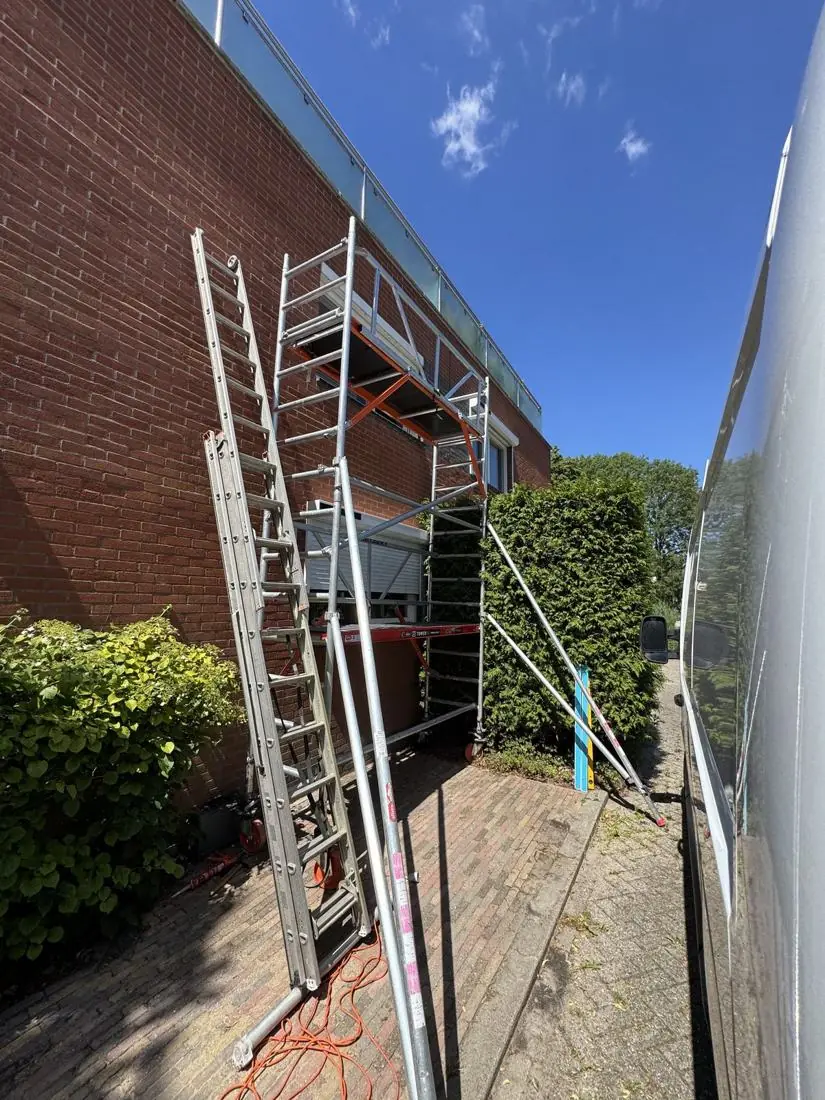
Hired tower built in a passage against brickwork, its stabilisers down, with a loose extension ladder propped on the wall alongside.

Watch what is going on beneath you as well. On work at a head something comes down sooner or later, and the people walking past have no idea. Cordon the area off, tell the neighbours what is happening, and do not work above a shared path without somebody keeping an eye on it or a length of tape across the entrance. The general requirements for working at height sit in the knowledge base with what to postpone in wind and rain.

In 5 steps

How hiring a mobile scaffold works

1
Choose working height

Pick the height that suits your job.

2
Book online

Sorted in 60 seconds, price shown instantly.

3
We deliver

At the agreed spot the next working day.

4
Assemble safely

Assembled by you, with a manual.

5
We collect

One call and we collect the scaffold.

Good to know

Practical tips for chimney work

1

Take a photograph of the chimney from across the road before you reserve. It shows how far the head clears the tiles, which side of the roof it stands on and what condition it is in.

2

Carry binoculars and a tape up on your first hire day. With decent pictures and the outside dimensions you can order material without having to climb a second time to check something.

3

Keep the assembly sequence open on your phone while you build. If a lift has to be added halfway because the head turns out to stand higher, you know exactly which part goes where.

4

Choose a start day at the beginning of a dry spell. Assessing can be done in anything, but as soon as mortar, sealant or paint is involved the weather decides whether a hire day is usable.

5

Set up a fixed corner on the ground with everything you might conceivably want. On chimney work you rarely know in advance what will be added, and ten trips up and down cost more than the job.

6

Put the collection date one day past the moment you reckon on being finished. If the head asks for more than you thought, nobody has to telephone and the tower is simply still standing.

Frequently asked questions

Frequently asked questions about chimney work

Which mobile scaffold is best to hire for chimney work on a house?+

In most cases the RS52 with its 135 cm deck. On work at a head you seldom know beforehand exactly what will be needed, so you want spare boards for tools, for materials and for a second person. Where that width cannot get past the house, the 75 cm version is what remains, and you give up working room in exchange for getting there at all. Measure the passage before you hire a mobile scaffold at all, which saves disappointment on the day of delivery.

How do you hire a scaffold when the fault is not yet known?+

Exactly as for a job that is settled. You choose a model and a build height online on the basis of the head, nominate the day the scaffold arrives and the day it goes, and pay in advance. The difference lies in your planning: take a longer stretch, since you decide up on the boards what has to be done. Because the days after the first hardly register on the bill, that slack costs almost nothing and leaves you room to move dates about.

Chimney work on a house: how long does the tower stay on hire?+

Two to four days is a realistic range. Judging a head takes an hour, but repairing pointing, bolting a cap down or working along the lead asks a good deal more, and waiting time for curing mortar or for an ordered part is added on top of that. Start with a morning of building and then judge from the deck itself what is actually required. The page on keeping a chimney maintained gives a closer estimate of hire days.

Chimney work: what sets the rental price of the tower you hire?+

It comes out of two things, the model and the height you stand it at, and then a fixed provincial figure covers the journey out and back. Figures appear online with VAT alongside them, so the total is known before you commit to any dates at all. On a job of unknown scope it pays to book generously from the start, because a spare day of tower barely moves the total while a second booking certainly would.

Which working height should you hire for work on a chimney head?+

On a mid terrace of two storeys you usually arrive at a working height of 8.2 to 12.2 metres, with the deck of the scaffold hanging at a little over 6 to a little over 10 metres. Your tape runs from the ground beneath the wheels up to the topmost brick of the head, not to the gutter. Since a tower rises in lifts of roughly two metres, you take the next build above whatever you measured rather than the one below it.

Do you collect the tower yourself, or is it delivered when you hire?+

Delivery runs on the day you nominate, and taking the scaffold away again afterwards sits inside that same fixed provincial amount. Collecting it in person is equally possible, by appointment and at no charge, as long as your transport handles a complete set in one go. For chimney work most people have it brought, because a build reaching above the roof edge consists of a great many separate parts. The delivery day can also be timed to land alongside your materials.

Who builds the tower when you hire one for chimney work?+

No, the building stays with you. We set a counted set down at your place and drive it away again afterwards, while assembling, rolling and stripping the tower is your own work. Allow a few hours with two people at these heights and plan it apart from the job on the head, or you begin the awkward part of the day already tired out. We deliver nothing ready built, and there are no cherry pickers on hire from us either.

Can you hire the tower for longer if the chimney work turns out worse?+

Yes. Let us know and the collection day is moved, provided no other customer is waiting on that build. With chimney work it happens often, since a head that looks reasonable from below regularly needs more attention at close range. Anyone preferring to stay ahead books a day or two extra from the start and simply hands the tower back early when it turns out well. Extending a hire is rarely a problem.

How much room does hiring a tower beside a chimney take up?+

You need a level spot the size of the scaffold plus whatever the stabilisers project all round it, and on top of that a route along which the parts can reach that spot in the first place. The route is often the deciding factor: a gate a metre wide, a narrow strip along the boundary, or steps down into the garden. Walk it once with a tape before hiring the tower and you know at once which width works and where it pinches.

Can a hired mobile scaffold reach every chimney on every roof?+

No. A tower brings you alongside the roof edge, so you reach heads standing in the flank wall or close to that edge. A chimney out in the middle of a pitched slope, or well along the ridge, stays out of range, because walking across tiles is not an option and a slope is not a working platform. Look from the street first, and only then decide whether hiring a tower makes any sense in your particular case.

After the hire ends, how quickly does the deposit come back?+

A deposit is paid at the booking and returns to you within 1 working day of the set coming back, once every component has been checked off against the list. On this kind of job look out for mortar, sealant and drilling dust on the boards of the scaffold; that rinses off easily on your final hire day while it is still fresh. Check too that no brace or cap nut has been left lying somewhere in the garden or behind the hedge.

Which chimney jobs fit inside one hired build?+

Practically all of them, so long as the head stands near the roof edge. The same scaffold at the same build height serves for assessing the brickwork, for pointing, for putting a cap on the head and for taking an old one off. That is precisely why a generous hire period pays for itself: you can look, order and then carry the work out in one continuous go. Each individual job has a page of its own, such as the one on swapping an old cap for a new one.

Hire a mobile scaffold for chimney work today?

Calculate your rental price now or ask for free advice.

Rolsteiger van SteigerTaxi geleverd op locatie
Book it online

Your scaffold sorted in 2 minutes.

Choose your scaffold and working height, see the price instantly and book online.