
See your price
Application

Inspecting a chimney? Choose the right scaffold.

Inspecting a chimney is looking and recording, nothing more. You want to see whether the joints in the stack are still closed, whether the cowl sits straight, whether the mesh is intact and how the lead around the base is lying. For that you have to get above the gutter, and on two storeys that means a reach of 8 to 12 metres. Hiring the wide model gives you a settled place to look and photograph from, usually for no more than a day or two. Two people manage the build in a morning.

  • Order before 3 pm, delivered tomorrow
  • Professional Altrex scaffolds
  • Up to 14.2 metres working height
  • Easy to assemble yourself
4,2 tot 14,2 mWorking heights available
12Provinces served
7Days a week
200 kg/m²Load class 3
In short
  • For inspecting a chimney we recommend the Wide mobile scaffold.
  • Anyone inspecting a chimney hires the wide 135 cm model and builds it up to somewhere around eight to twelve metres.
  • What you hire here is not load capacity but a vantage point: the standing position decides which faces of the stack appear.
  • One or two hire days will do, since looking involves no drying time at all and nothing to wait for.
  • First 24 hours from €175 incl. VAT and delivery; every day after that 95% off.
Key facts for this job
FeatureValue
Recommended scaffoldWide mobile scaffold (Altrex RS TOWER 52)
Working height for this job8 to 12 metres
Available working heights4.2 to 14.2 metres
StandardEN 1004, load class 3 (200 kg per m²)
DeliveryOrdered before 3 pm, delivered next working day
Each extra day95% off, from €8.75 a day
Why a mobile scaffold for inspecting a chimney?

Safe, stable and professional work at height

With a chimney the question is not what you carry up but where you stand. The stack sits on the roof slope rather than on the wall, so you always look at it at an angle. The higher your build and the closer to the gutter, the more of the flanks and the lead around them you see. On a ladder that fails: one hand is busy, you dare not zoom in calmly and you cannot step two paces sideways. Anyone hiring a tower for inspecting a chimney is really paying for calm and for a decent viewing angle. Height and standing position weigh heavier here than what fits on your floor.

  • Angled view of a stack on the slope
  • Camera, torch and notebook all within arm reach
  • Short hire period without drying or waiting
  • Eight to twelve metres of hired reach
Read more about working safely →

Which mobile scaffold to hire for inspecting a chimney

For looking at this height the RS52 at 135 cm wide is the pleasantest hire, even though you carry almost nothing up. You stand still for long stretches, rest a hip against the guardrail and hold a camera or phone in two hands; a narrow deck makes you fidgety doing that. There is also room for binoculars, a notebook and a mirror on a stick. The extra width also gives a tripod somewhere to stand. What else is in the range sits on the overview of mobile scaffolds available to hire.

Looking with two of you makes that width more welcome still. On this job one person points out what strikes him while the other photographs, and passing each other on a 245 cm deck should simply be possible without anybody hanging off the rail. That deck length also sets how far you can shuffle sideways to get a different angle on the stack without moving the whole build. Two metres across sometimes gives a completely different picture.
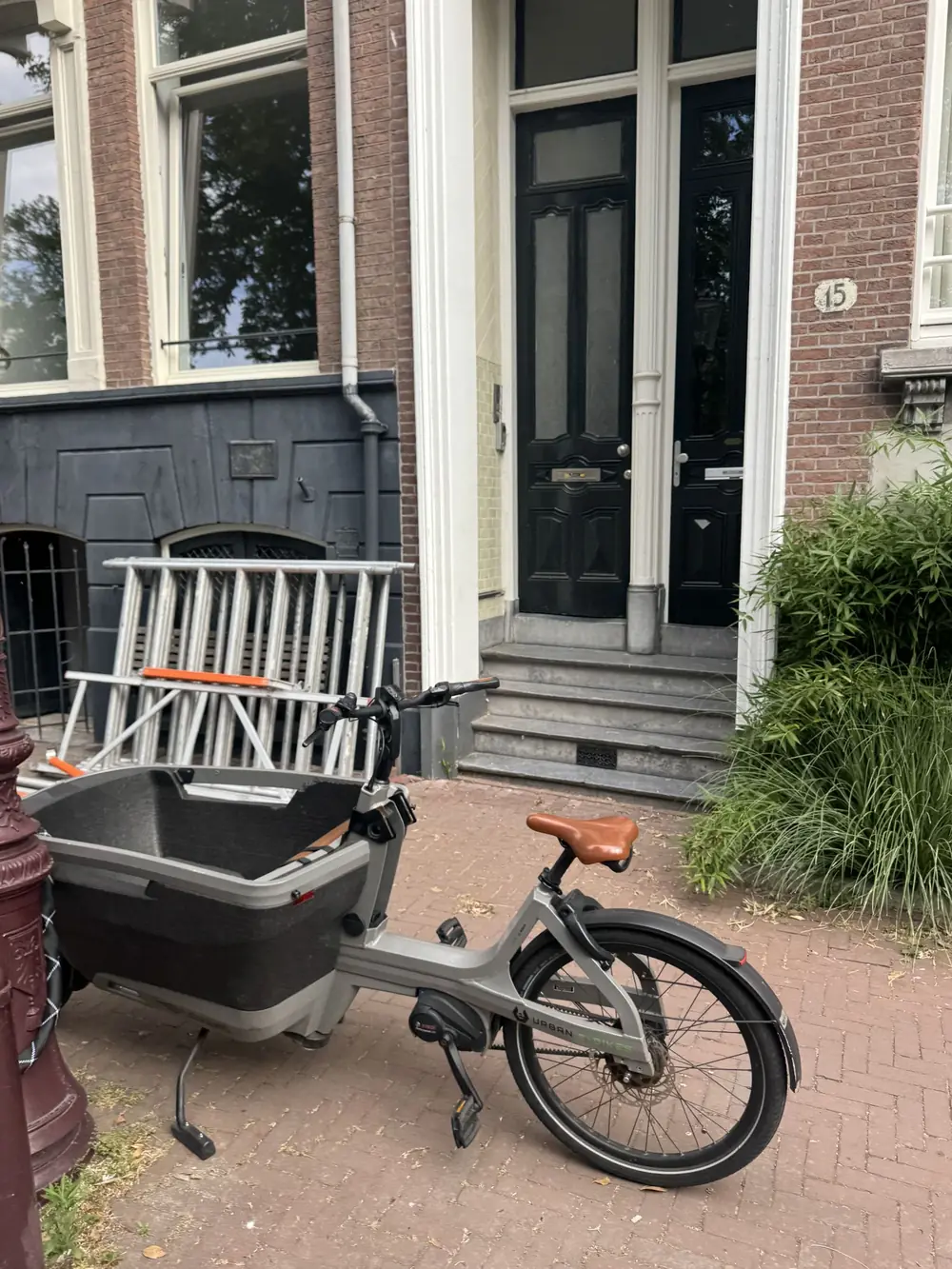
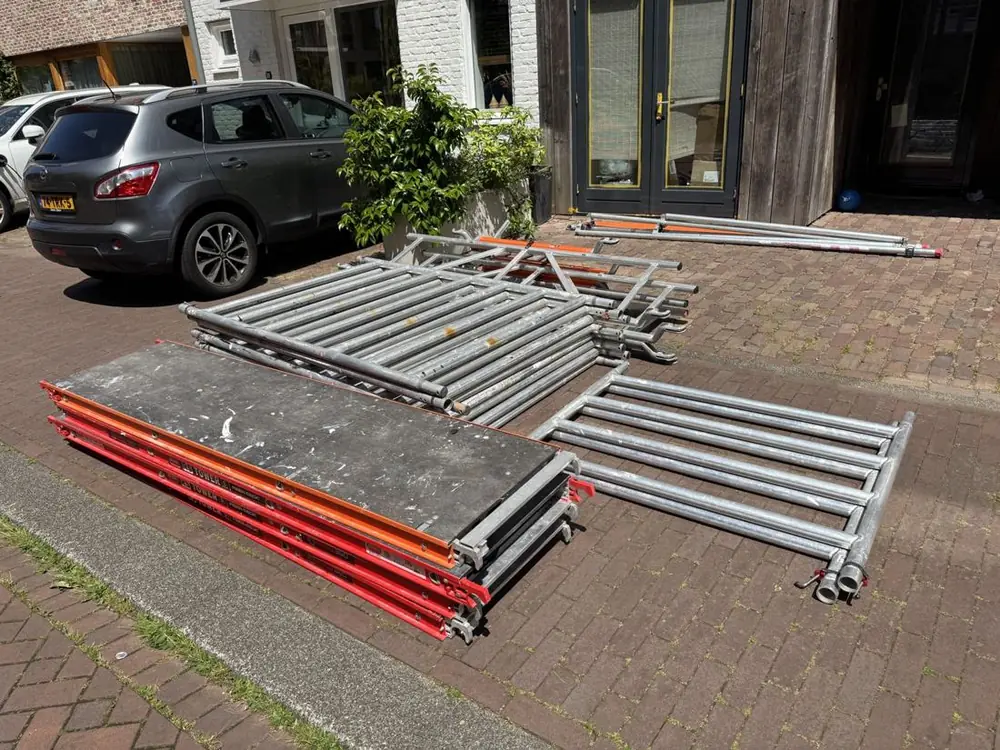
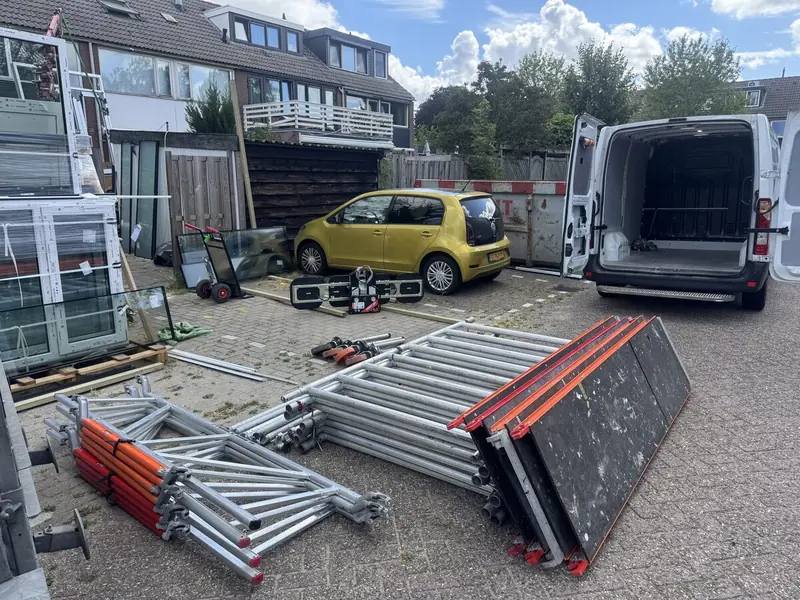
Frames and a brace left on the pavement outside a house, the hire set you build before any look at height.

The narrow RS51 at 75 cm stays a perfectly good alternative when the only route to the right side of the house runs down an alley or through a gate. You trade away some elbow room, but your viewing angle does not change. A room scaffold such as the RS44 drops out here: it reaches 3 to 4 metres and is made for indoor work, and from there you see nothing of a stack at all. For roof work the numbers only start counting above the gutter.
Hiring enough working height to see across the roof slope

When inspecting a chimney you do not measure to a point you must reach but to a point you want to see over. That is the gutter, and everything you hire above it gives you a flatter view onto the roof slope and so more sight of the base. For a two storey house that works out at a reach of 8 to 12 metres. Ridge stacks are the awkward ones to hire for. What such a build involves is on the page about ten metres of reach.

Take the platform height, allow roughly two metres of reach on top of it, and you have the working height, except that here you are not using those two metres to reach but to see over. If you want to judge the stack properly from above, your eyes belong level with the roof edge or just past it, and that alone is half a build. Start the tape on the paving under the wheels, and count in a drive that falls away or a garden path that has sunk.

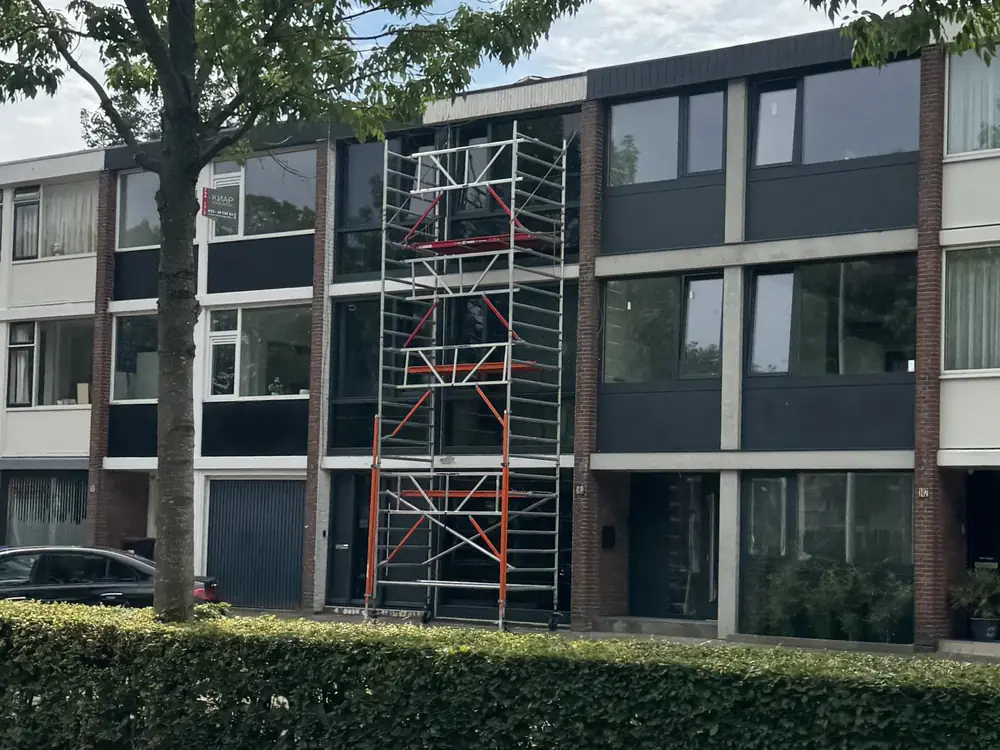
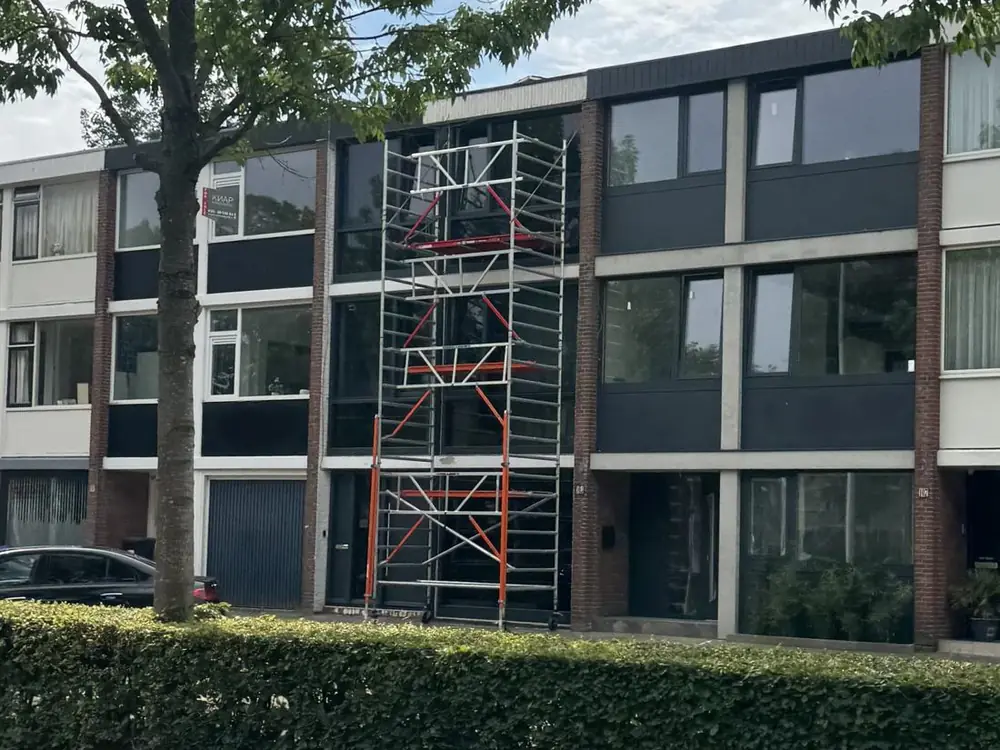
Mobile scaffold standing at a front elevation with its top platform near the roof line, the vantage point you hire

Hiring too low wastes the day. With your head under the gutter you see the bottom course of tiles and nothing else, and of the stack only the upper half against the sky. You will have hired, built and struck without an answer to your question. For a house with the ridge above the second floor pick on the generous side. The frames for that last metre barely register; a wasted day certainly does. Measure once from the ground and once from the pavement, since the two rarely agree.

Where the hired tower stands decides what you can see

Find out first where the stack sits on the roof. On a mid terrace it often sits on the party wall and so close to one side; on a detached house it is regularly halfway along the ridge. The further from the roof edge, the more acute your view and the less of the lower courses you see. So put your build against the elevation nearest the chimney, even when that is the least convenient side of the house.

After that comes the ordinary question: can the build actually stand there. You want flat ground under the feet, and space all round for four stabilisers that at this reach swing out a fair way. A viewing spot that fits nowhere is not a viewing spot. On a side elevation watch the boundary, a shed or the neighbours' drive, because the good position sometimes sits just on somebody else's land. For a garden that is not level there is the guide to uneven ground under a tower.

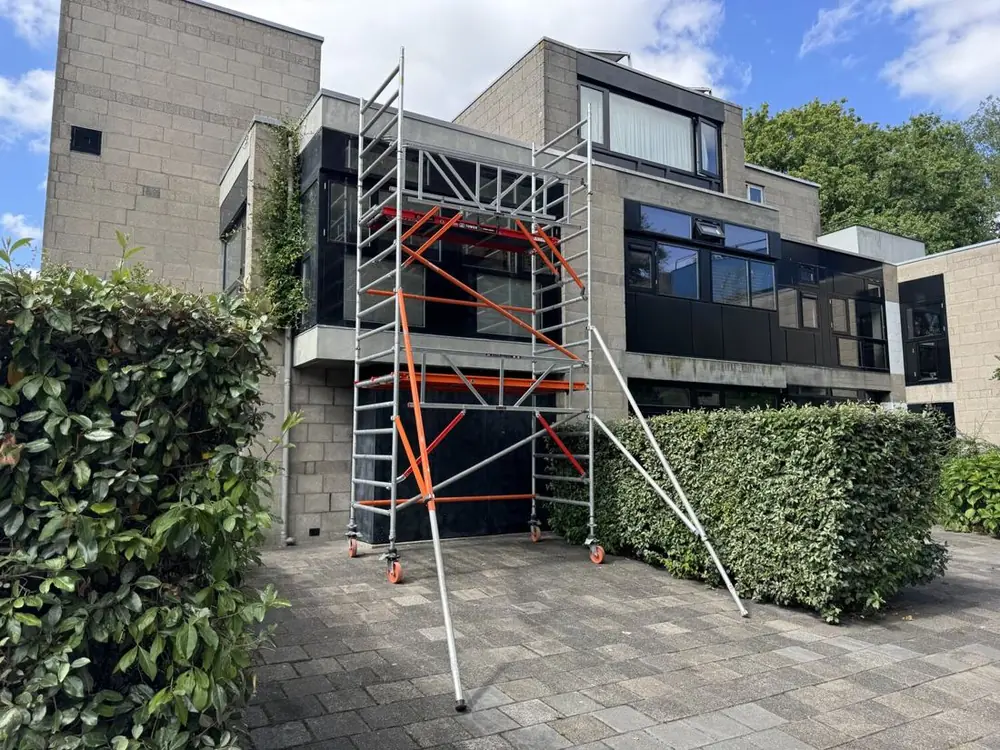
Stabilisers reaching outward beneath an assembled mobile scaffold, the clear ground every viewing position requires

Count on a complete picture costing two standing positions. From the front you see the front face of the stack and part of one flank; for the other flank you roll or rebuild round to the side. The back face often stays invisible, and that is not a shortcoming of your build but of where the chimney sits. Inspecting a chimney all round is worth planning before you fix a hire day, because a second position costs half a day rather than half an hour.

One or two hire days for a chimney inspection

Looking costs little time. Once the build is standing you are done with the stack, the cowl and the lead in half an hour, photographs included. Putting it up costs more than inspecting a chimney does, and on this job that is the only thing that shapes your plan. For a single stack on an ordinary house one hire day is therefore often enough, provided you keep that day genuinely free for building, looking and striking. Do not assume you will fit an errand in as well.

Booking two days makes sense as soon as you want more than one face. Looking from two elevations means rebuilding in between, and that costs an extra half day. The weather counts too: with rain on the lens and grey light on the brickwork you simply do not see a hairline crack. A day with low sun tells you far more, and with a generous reservation you can wait for it calmly instead of forcing it. Sunshine straight on the brick flattens every shadow you were hoping to read.

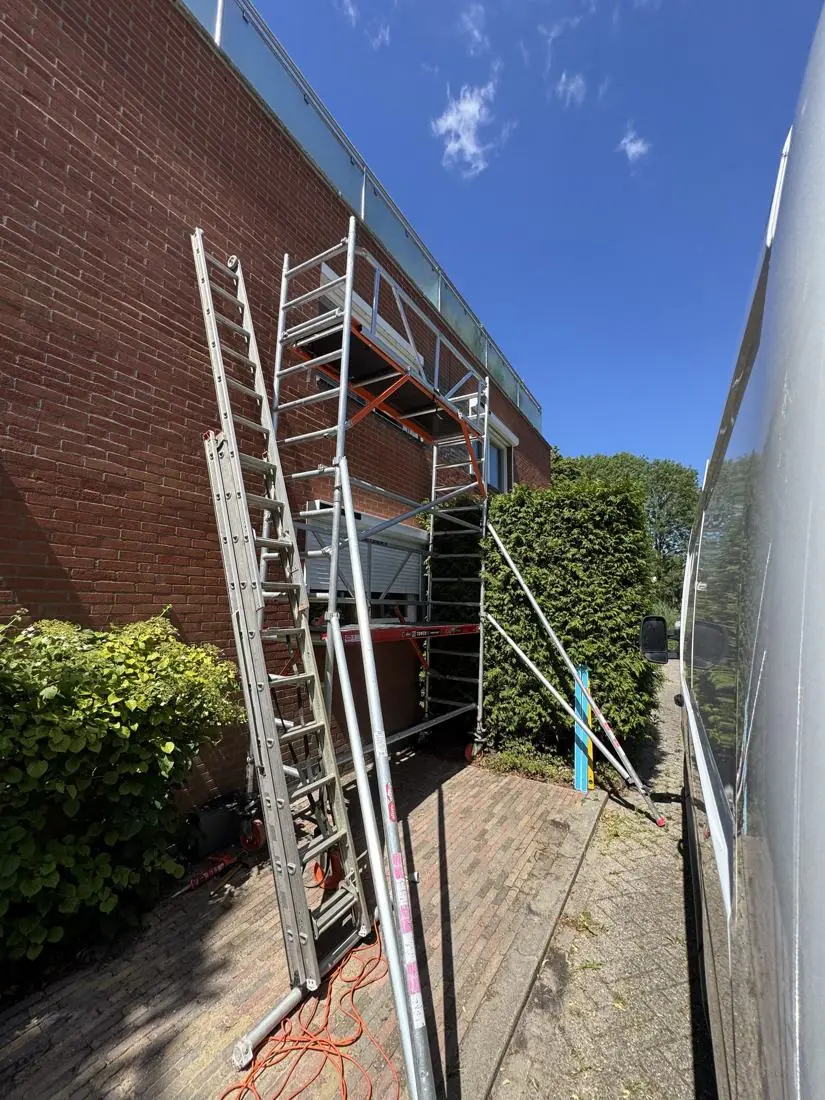
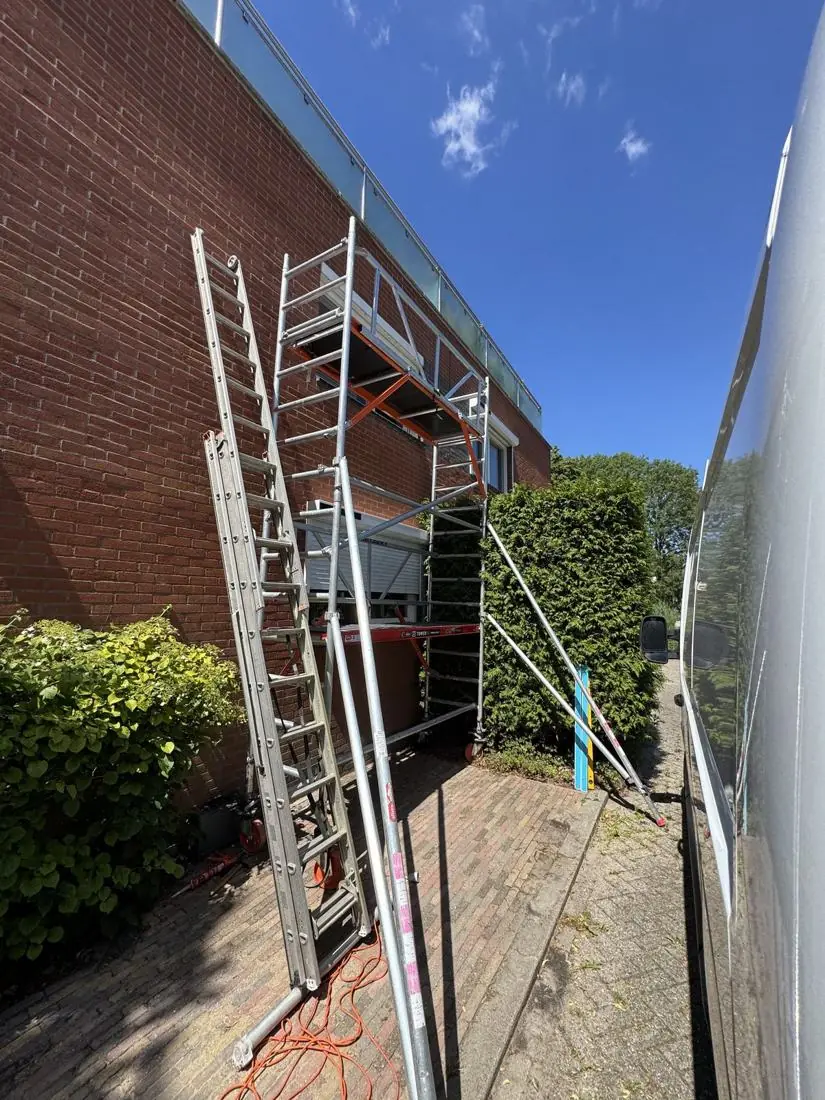
Assembled mobile scaffold with guardrails alongside a house, the build you hire for a single short visit

That second day is financially mild. Day one carries the standard rate and everything you book behind it runs at ninety five per cent off, so a reserve day hardly shows in the rental price. What you do feel is a journey that has to be made again because you thought you had finished early and then wanted the other elevation after all. Reserve with a day in hand and return early if you like. Estimating such a short period is covered in the piece on the number of hire days.

Which mobile scaffold suits inspecting a chimney?

Kamersteiger RS44
  • Working height up to 4 metres
  • Compact and narrow
  • Great for indoor and small jobs
View and calculate →
Smalle rolsteiger RS51
  • Working height up to 14.2 metres
  • Narrow (75 cm)
  • Ideal for narrow passages
View and calculate →
Most chosen
Brede rolsteiger RS52
  • Working height up to 14.2 metres
  • Wide platform (135 cm)
  • Extra stability and workspace
View and calculate →
1-persoons steiger MiTower
  • Working height up to 6.2 metres
  • Very compact
  • Quick and easy to assemble
View and calculate →

What the platform honestly shows you of the stack

Be honest about what inspecting a chimney from a hired build actually gives you. From a tower along the wall you see the face turned towards you, usually a fair part of both flanks, and the top edge if you stand high enough. What you do not see is the back, the lead on the roof side and the top of the cowl when it rises above your eye line. That comes with the job; it does not make your findings worthless, but it does make them incomplete.

So take out of it what is there. Zoom in with your phone rather than trying to get closer than the build allows, use a mirror on a stick to look behind the cowl, and shoot an overview and then a detail of each face. Write down what you see while you are still up top, because on the ground you no longer know which crack belonged to which angle. A second person watching from the street with binoculars often catches the bit you miss.

Mobile scaffold erected along a side elevation, the second hire position needed for a further flank

What you never do is step onto the tiles to see that last piece after all. A tiled roof is no walkway, you go through it or you slide off, and the tower you hire is meant as a working place at the edge and not as a step onto the slope. If it will not come out that way, the moment has arrived to have someone look who works with roof ladders and a harness. That is not weakness but the limit of what a mobile scaffold offers.

Delivery and build day when hiring for a short inspection

The parts arrive loose, counted and complete, and the stack needs a spot to lie for a while. A back garden delivery means every frame goes through the gate. On this job that is seldom a problem, since you usually build the whole thing the same morning and the pavement is clear again. Wrap the reservation up on a working day before three and the parts are with you the next working day. That way you can plan inspecting a chimney the moment you see something you do not trust.

You name the arrival date and the departure date yourself; on a short hire you would rather put those around a dry day. Two people and a clear morning is the honest minimum. Bear in mind that building at this height takes two people half a day, while the looking takes half an hour. So do not attempt it alone at the end of the afternoon. The order is set out step by step in the build plan for a mobile tower, with a video alongside.

Loose scaffold components on the street beside a dwelling, the counted delivery you build the same morning

Finished looking, you dismantle everything and put the parts together; the collecting is ours. Go through your photographs before you strike, because a forgotten corner otherwise means building again. Count the parts while you stack, and you will not be hunting a brace in the hedge afterwards. The parts go back exactly as they came, so a missing brace is easier to spot on your own stack than on ours. Transport carries a fixed amount per province, and that sits on the page about what bringing and fetching a set costs.

Looking safely from the tower without stepping onto the tiles

The floor takes 200 kg per square metre, load class 3 in the EN 1004 standard. On a visit like this you use a fraction of that, since it goes no further than a camera, binoculars and perhaps a tripod. That is not a free pass, though. The temptation is exactly to go up three at a time to look; keep it to two. What the class means is explained further in the note on that standard.

The risk when inspecting a chimney is not weight but posture. You stand still, you peer, and almost without noticing you lean out over the rail for a slightly better view. Do not: move the build a metre instead, even though that costs ten minutes. Brake the wheels before you climb, never roll it while somebody is up top, and reset the four stabilisers after every move before you go back up. That check returns at each viewing position.

Assembled mobile scaffold with guardrails and a ladder run inside the frames, the safe way up on hire

Watch the wind as well, and what goes on below you. At twelve metres there is more wind than at street level, and a phone slipping out of your hand lands on the pavement where people walk. Use a wrist strap and stow loose things before you climb down. Beyond that the usual agreements from the rules on working at height apply, even for half an hour up there. Being up briefly makes the height no lower. A hired tower asks the same discipline for thirty minutes as it does for three days.

In 5 steps

How hiring a mobile scaffold works

1
Choose working height

Pick the height that suits your job.

2
Book online

Sorted in 60 seconds, price shown instantly.

3
We deliver

At the agreed spot the next working day.

4
Assemble safely

Assembled by you, with a manual.

5
We collect

One call and we collect the scaffold.

Good to know

Practical tips for inspecting a chimney

1

Look up an aerial photograph before you reserve to see exactly where the stack sits on the roof. If it stands near the side wall, it is immediately clear which side of the house you must clear for the build.

2

Take a phone with a decent zoom and photograph each face separately while inspecting a chimney. Images you can enlarge afterwards give you more than trying to get nearer than your hired build allows.

3

Look shortly after a long wet spell, while the brickwork is drying out again. Damp patches that fade slowly point to bricks taking up water, and on a bone dry day you see none of that.

4

Have somebody watch from the pavement opposite with binoculars while you are up top. At that distance the set of the cowl and the top edge of the stack actually stand out rather better.

5

Write three lines per face on your phone before you climb down: joints, cowl, lead. On the ground the picture fades fast, and those notes decide whether you need a tradesman on the roof.

6

Book two hire days straight away if you want to look from two sides. Rebuilding to the other elevation costs half a day, and you rarely manage that within the same day as the build.

Frequently asked questions

Frequently asked questions about inspecting a chimney

Which scaffold should you hire for inspecting a chimney?+

The wide 135 cm version works most comfortably here, not because of weight but because of calm. You stand still for long spells with a camera in both hands and want to shift along without hanging on the guardrail. Looking with two of you makes that deck better still. If the only way to the right elevation is a narrow gate, you hire a mobile scaffold 75 cm wide instead; your view of the stack does not change for it.

How does hiring a tower work if you stand on it for one day?+

Online you pick the version and the reach, say yourself when the set arrives and when it leaves, and pay one fixed sum, VAT included. You choose both dates yourself, so a single day of hire is entirely normal here. We put the counted parts down; you build, look, photograph and strike, after which we come and fetch everything. For a short visit people often put delivery and collection on consecutive days. More about how that runs is under the common questions about hire.

Is one hire day enough for inspecting a chimney properly?+

For a stack you can see from one elevation that is usually enough. Count the day honestly though: half a day building, half an hour looking, then dismantling. An extra day of hire is the cheapest insurance on this job. If you want to look from two sides, or you doubt the weather, book two days on hire. With a stack in the middle of a large roof, hiring longer helps little, because then the distance to it limits you and not your time.

What does hiring cost for an inspection of one or two days?+

The rental price you pay depends on the model chosen and the reach you build to; transport there and back carries a fixed amount per province besides. The rates stand with VAT on the page with hire prices. On a visit like this most of your cost sits in that opening day, because the days after it weigh lightly. Booking a spare day is cheaper than having a set brought a second time, and it saves you building twice on the same spot.

Which working height do you hire to see over the roof slope?+

For two storeys you choose a build that makes 8 to 12 metres. You measure not to a working point but to the gutter you want to see over, and add something to look into the roof slope. Measure from the ground under the wheels and take the build above when in doubt, because height is precisely what you hire here. The overview per reach sits on the page listing working heights.

Is the tower brought on your inspection day, or do you collect the hire yourself?+

Both happen, and on short jobs most people have it brought. We deliver on the day you name and take the hired tower away again afterwards, for which a fixed amount per province applies. Collecting it yourself is possible too: make an appointment and load the parts at no extra cost at Zeeburgerpad 89 in Amsterdam, provided your transport is big enough. For a twelve metre build that is a considerable load of frames.

Is building included in the hire, or is that your job?+

Building is your job, and a short hire changes nothing about that. We bring and fetch, you build and strike, with the manual and the video to hand. On a looking job that is worth knowing, because the building takes longer than the looking. Plan two people for it and start in the morning. We do not stock cherry pickers or facade scaffolds, which makes a mobile tower the ordinary route at this height. Three on the deck also means three sets of feet in your way.

What if you find more than expected and want to hire the tower longer?+

Then we move your collection day, unless the set is already promised to a following customer. On visits like this that happens regularly: you climb up for a cowl standing askew and then see the pointing is due as well. If your tower stays put you can carry straight on the next day without building again. When you really want to start work, look at the page on chimney repair from a hired build.

How much clear ground must there be beside the house for the hire?+

Reckon on the width of the model you hire plus the stabilisers reaching out on either side; on a build towards twelve metres they go a good way. In practice that means a flat patch of about three metres square with no car, bin or garden bench on it. If the good viewing spot sits exactly on the boundary, speak to the neighbours before the tower is delivered; half a metre across can already change your view.

If it rains on inspection day, can you hire the tower a day longer?+

Your hired build may stay standing and you simply look a day later; only in a storm do you keep off it. Wet brickwork is not always a drawback, since damp patches that fade slowly tell you something about bricks taking up water. What does disappoint is grey light, in which a hairline crack vanishes completely. Keep the hire to daylight hours, because low light hides exactly what you came up for. Because you set your own end date, shifting a day costs you patience rather than your whole plan.

What does such a short hire mean for your deposit?+

A short period changes nothing there: you settle the deposit at booking and have it back one working day after the counted set returns. On looking work the hired scaffold parts rarely get marked, but a clamp or a brace does sometimes stay behind in the grass. So go through the stack once more before the van pulls up. Rain on the parts is no issue for the deposit; missing pieces are. The settlement is described in this piece on the deposit.

Do you really see every side of the chimney from a hired tower?+

No. You would rather know that beforehand than halfway through your hire day. You see the face turned towards you and usually part of both flanks; the back and the lead on the roof side stay out of view. A second build against another elevation takes you a long way, but complete is rare. Stepping off the tower onto the roof to see the last bit is not an option.

Hire a mobile scaffold for inspecting a chimney today?

Calculate your rental price now or ask for free advice.

Rolsteiger van SteigerTaxi geleverd op locatie
Book it online

Your scaffold sorted in 2 minutes.

Choose your scaffold and working height, see the price instantly and book online.