
See your price
Application

Repairing a chimney? Choose the right scaffold.

Repairing a chimney starts with the pointing: raking out weathered joints, bedding back bricks that have begun to shift, and closing the head off on top. That asks for two free hands, a tub of mortar going up and a bucket of rubble coming down. You also want to get right around the head. On a two storey house that puts the 135 cm wide RS52 in front, built to somewhere between 8 and 12 metres working height. Below you read why that model suits, which hire period to book and where the tower lands.

  • Order before 3 pm, delivered tomorrow
  • Professional Altrex scaffolds
  • Up to 14.2 metres working height
  • Easy to assemble yourself
4,2 tot 14,2 mWorking heights available
12Provinces served
7Days a week
200 kg/m²Load class 3
In short
  • For repairing a chimney we recommend the Wide mobile scaffold.
  • For chopping out and repointing a stack head you hire the RS52, with 135 cm of clear width between the guardrails.
  • Mortar, chopping tools and a bucket for the rubble stand side by side on that wide deck instead of between your boots.
  • Three to four hire days is honest when repairing a chimney, because raking out, filling and curing will not be compressed.
  • First 24 hours from €175 incl. VAT and delivery; every day after that 95% off.
Key facts for this job
FeatureValue
Recommended scaffoldWide mobile scaffold (Altrex RS TOWER 52)
Working height for this job8 to 12 metres
Available working heights4.2 to 14.2 metres
StandardEN 1004, load class 3 (200 kg per m²)
DeliveryOrdered before 3 pm, delivered next working day
Each extra day95% off, from €8.75 a day
Why a mobile scaffold for repairing a chimney?

Safe, stable and professional work at height

Repairing a chimney sends material in two directions at once. Mortar and bricks travel up, grit and shards come down, and that traffic on its own rules a ladder out. You need one hand for the bolster and one for the hammer, so you have to stand somewhere without holding on. A stack head has four faces, and the worst of them is usually the one that catches the weather, which is seldom the face towards the street. A wide tower gives you a flat deck that takes the tub and the buckets, with guardrails a rope and a hook can hang from. The height you book hangs on the topmost brick, not on the gutter.

  • Bolster and hammer ask for two free hands
  • Mortar upward, raked out grit downward in buckets
  • Measure to the topmost brick of the head
  • Reach all four faces when repairing a chimney
Read more about working safely →

Which mobile scaffold to hire for repairing a chimney

Repairing a chimney is haulage work in miniature. Up go a bolster chisel, a breaker or a club hammer, a tub of mixed mortar, a pointing iron and an empty bucket for everything you rake out. All of that suits the wide Altrex RS52, which measures 135 cm between the standards. Hiring a tower for chimney repointing is therefore mainly a question of deck area: it should all sit beside you without you stepping over it every few minutes. The full range of mobile towers for hire sets the widths out side by side.

The narrow RS51 at 75 cm reaches the same heights, but it forces a choice on you: either the mortar tub stands next to you or the rubble bucket does. Pointing has you reaching for both in turn, and every time something has to go, that costs a trip down. Take the narrow build only where the passage to the back of the house lets nothing wider through. Measure that gate or that garden path before you commit, because a 135 cm set will not squeeze along it.
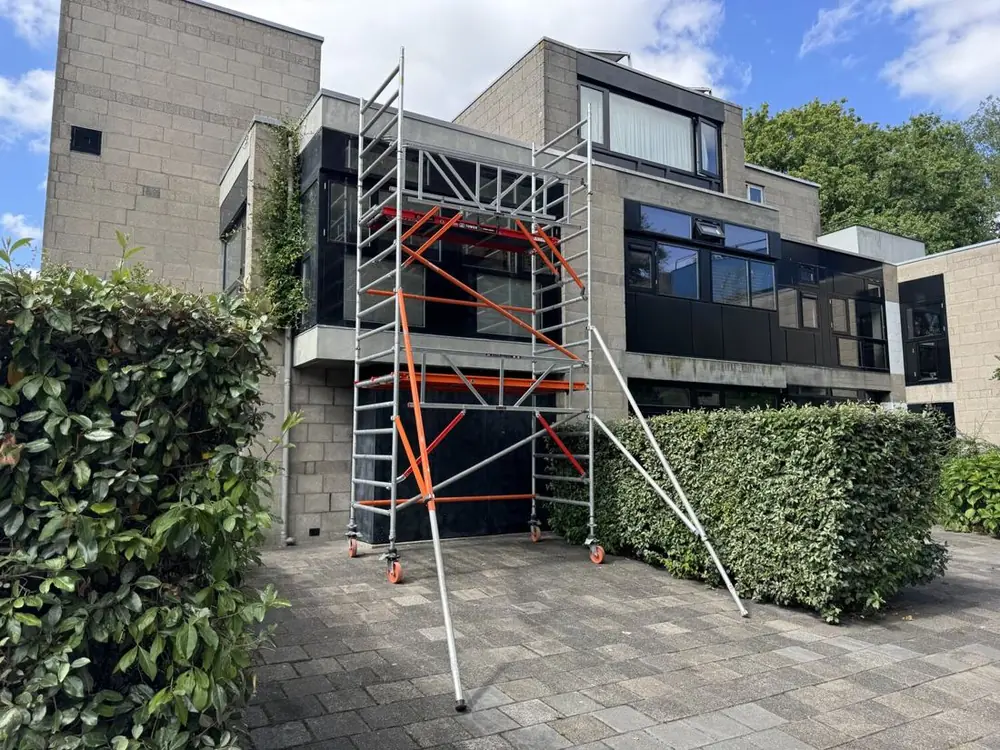
Assembled 135 cm wide tower standing next to a dwelling, the deck width that repointing a chimney head demands

The remaining models are out of the running for this. The RS44 room scaffold stops at 3 to 4 metres and is meant for indoor jobs, where it rolls through an interior door from about 70 cm. The MiTower carries one person and reaches 6.2 metres, which covers a light fitting or a canopy but not a head standing above the ridge. The RS52 can be built on as far as 14.2 metres, comfortably clear of the roof of an ordinary terraced house.
Which working height you hire to reach the stack head

The measuring point on this job sits higher than on any other job against a wall: not the gutter and not the ridge, but the topmost brick of the head. That is where the last joint gets raked out, so that is where you want your shoulders to clear. Two storeys plus a head give a band running from 8 to 12 metres working height, depending on how far the chimney rises above the tiles. The deck then hangs at 6 to 10 metres.

Those two bands differ for one reason: working height is reckoned as platform height with some 2 metres of reach added. Start the tape on the ground where the castors will stand, and that surface almost never lines up with your doorstep. Back gardens frequently sit half a metre below the pavement, while a raised terrace works in your favour. If you want a worked reference, look at a ten metre build for chimney work and read off the platform height.

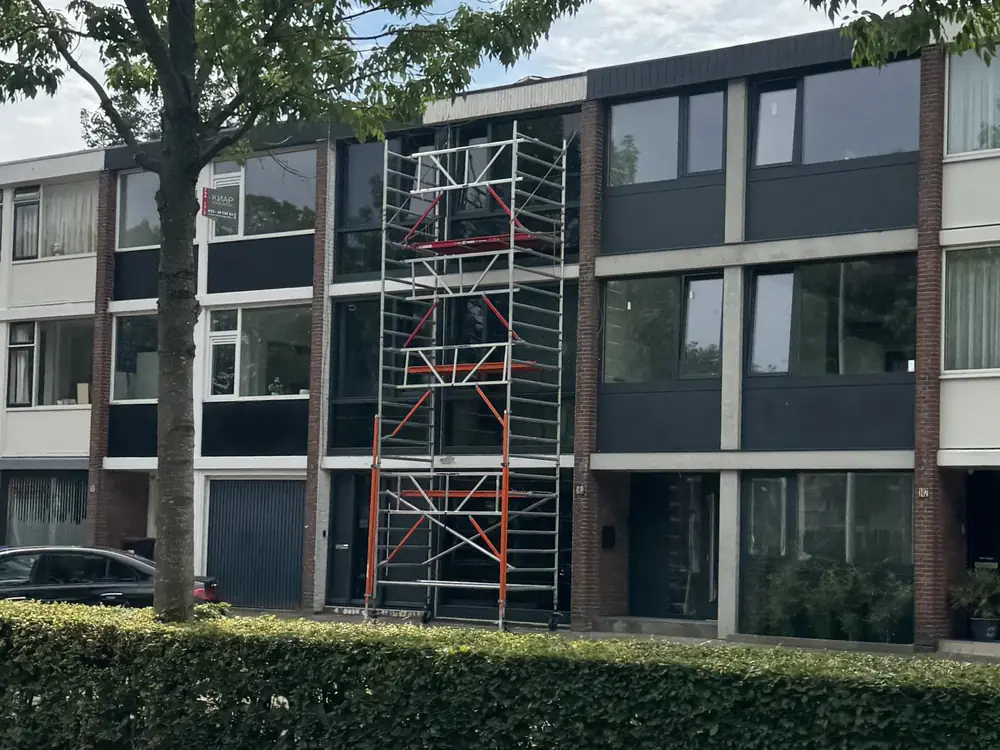
Mobile scaffold built along a front elevation to just past the gutter line, the height band chimney repointing asks for

Booking too low shows in your shoulders within the hour. If your head only just clears the top edge, you swing the bolster above eye level, the grit lands in your collar and the top row of joints stays uneven. That top row has taken the most weather and deserves you standing square to it. One extra lift costs half an hour of assembly; having to book again because you could not reach the head costs a week of planning. Judge the rise against a window on the second floor.

Where the hired tower stands when repairing a chimney

The head sits on the roof and the tower stands on the ground, and those two seldom line up. Put the build along the elevation where the chimney breaks out nearest to the roof edge: on a gable end house that is the side, on many mid terraces the back. If the head stands squarely in the middle of a pitched slope, no mobile scaffold gets near it sensibly and you need other equipment. Establish that first, with a photograph taken from the far pavement if need be.

Under the four legs belongs flat, load bearing ground, with more room around it than the build itself takes up, since the stabilisers splay outwards. In a back garden that usually means laying a couple of slabs first or sliding a stout board under one foot. Then look at what stands along that elevation: a shed, a water butt, a rear extension, or a conifer that has grown just a little too wide. Working out over the top of a lean-to roof is not on.

Stabilisers splayed outward at the foot of an assembled mobile scaffold, the ground clearance a chimney job needs beside a wall

Last of all, keep the strip beneath your deck clear. Raking out produces falling grit however carefully you go about it, and a brick you take hold of wrongly arrives below at speed. Park no bicycles, garden chairs or cars there, and warn the neighbours where you share a path or a communal garden. Should a leg or two finish up on the footway or inside a parking bay, check with the council beforehand what your street permits.

How many hire days repairing a chimney really takes

For an ordinary head on a terraced house, three to four hire days is a fair reckoning. The first half day disappears into assembly and into studying the head from close to, because only from a metre away do you see which joints are genuinely loose and which bricks move. Then comes the raking out, dusty work that runs slower than you expect, and only on clean, dampened joints do you start filling. If bricks have to go back in, everything slides another half day.

Hire a mobile scaffold for four days and there are still waiting moments in the job that working harder will not claw back. Mortar wants neither blazing sun nor steady rain, and once filled, the head has to cure quietly before you finish or cover it. If it freezes, or a stiff wind gets up at ten metres, you shift a half day and lose nothing but the date. Set your end date on the moment you are certainly done, then, rather than on the moment the job could theoretically be finished.

Mobile scaffold left standing against a side elevation, the sort of position a hired tower holds for several days

The shape of the tariff works for you here, and it is worth understanding before you pick dates. Your first twenty four hours stand at the whole tariff, and each further date on the booking is reduced by 95 per cent. A curing day therefore barely registers on the bill, whereas a booking cut too fine has the van arriving while the top joints are still open. What each model and build height comes to, VAT included, sits with the rental prices for every tower.

Which mobile scaffold suits repairing a chimney?

Kamersteiger RS44
  • Working height up to 4 metres
  • Compact and narrow
  • Great for indoor and small jobs
View and calculate →
Smalle rolsteiger RS51
  • Working height up to 14.2 metres
  • Narrow (75 cm)
  • Ideal for narrow passages
View and calculate →
Most chosen
Brede rolsteiger RS52
  • Working height up to 14.2 metres
  • Wide platform (135 cm)
  • Extra stability and workspace
View and calculate →
1-persoons steiger MiTower
  • Working height up to 6.2 metres
  • Very compact
  • Quick and easy to assemble
View and calculate →

Raking out and repointing from the hired scaffold platform

With 245 cm of platform length you have more deck than head alongside a chimney, which means one position lets you finish two faces completely. Rake both of them out first, brush them clean and damp them down, then fill them in a single round. That way no mortar is stiffening while you are still chiselling. For the two remaining faces you move the tower, ideally at the start of a half day rather than in the middle of fresh mortar.

Take up in one trip what is needed above: bolster, hammer, brush, water and a modest quantity of mixed mortar. Small batches beat a full tub here, because that tub gets no lighter upstairs and has to come down again eventually. The raked out grit goes into a bucket you lower down the standard on a rope. Tipping it over the edge looks faster right up to the point where you are picking grit out of the gravel.

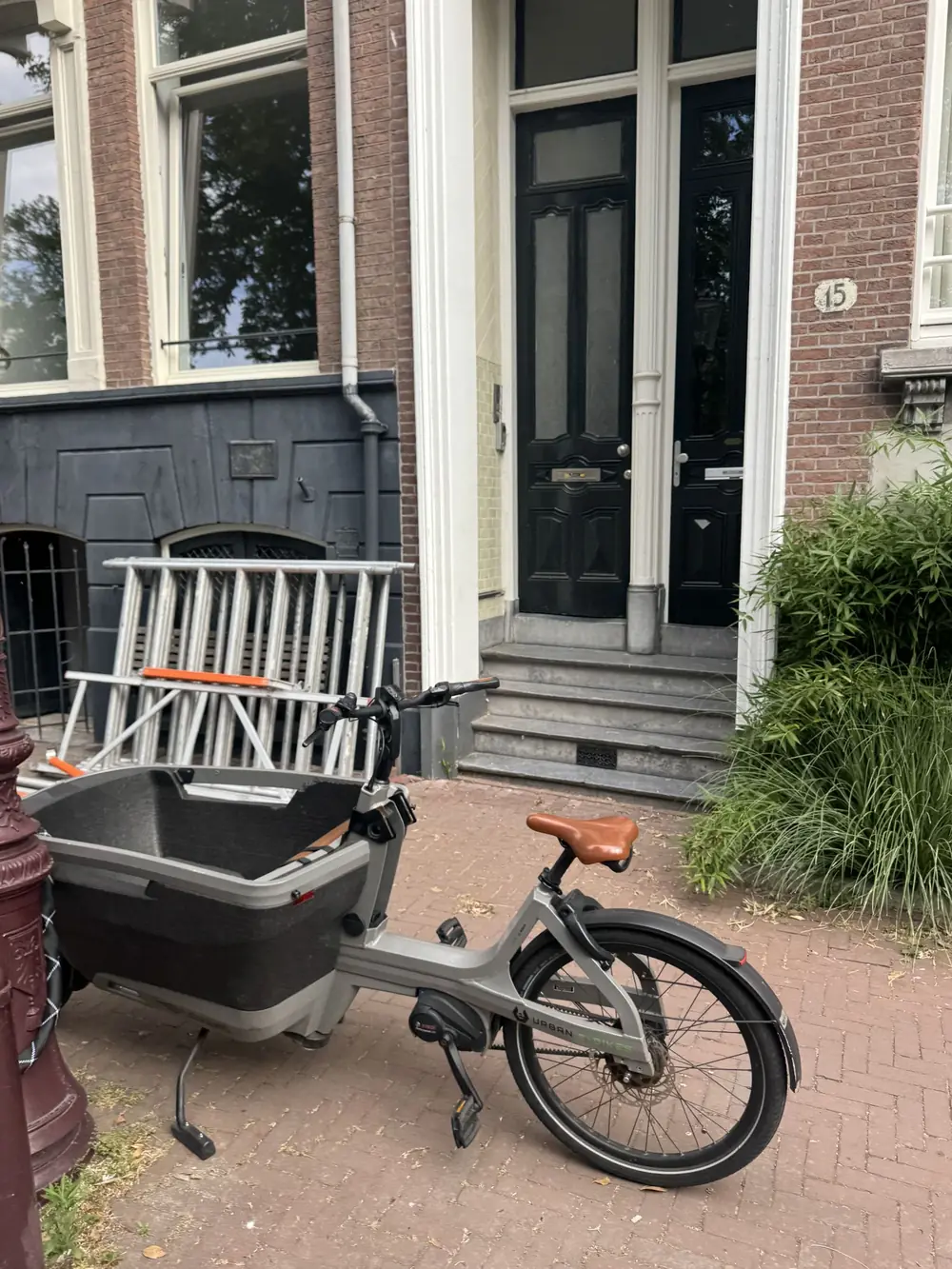
Scaffold frames on the footway outside a brick house, the hire set you build once and move only once.

What nearly everyone underestimates is the number of ladder trips. A forgotten trowel, topping up water, a brick that turns out to need replacing after all: on this job you go up and down ten times. So lay out a fixed corner below with everything you might want, and hang your buckets ready before you climb. If you are taking in the roof abutment on the same visit, check what renewing the lead flashings asks of your build.

Scaffold hire with delivery for repairing a chimney

The tower turns up in pieces, counted and complete, with nothing bolted together yet. Say in advance where that pile of components may land, because on this job the strip along the elevation is already claimed by your tub, your bags of mortar and the rubble buckets. A driveway, or a slice of front garden nobody walks along, beats the route you will tread ten times an hour. Order it before 15:00 and, provided that day is one we work, the parts arrive on the next.

Two dates you enter yourself when booking: the one for delivery and the one for collection. On masonry you consult the rain radar before you pick them. Ask for the components a day ahead of the first chopping day, which lets the tower go up unhurried and lets you begin the moment it stays dry. Assembly is your side of the arrangement: you do it with the manual open beside you and the build video on your phone. Two people are occupied with that for a half day.

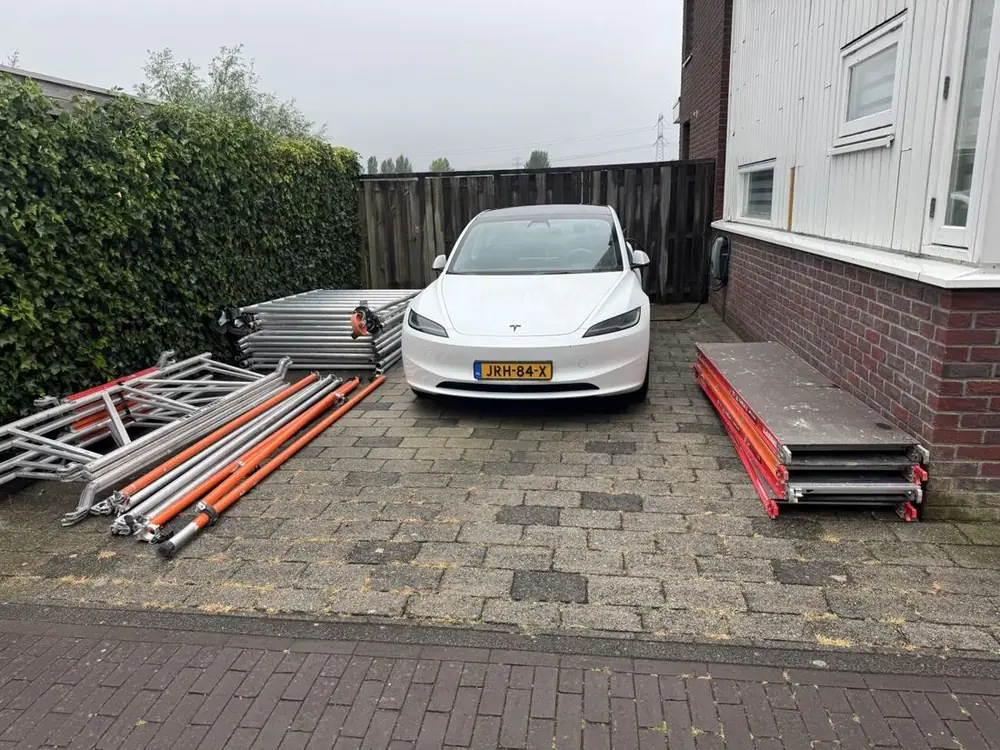
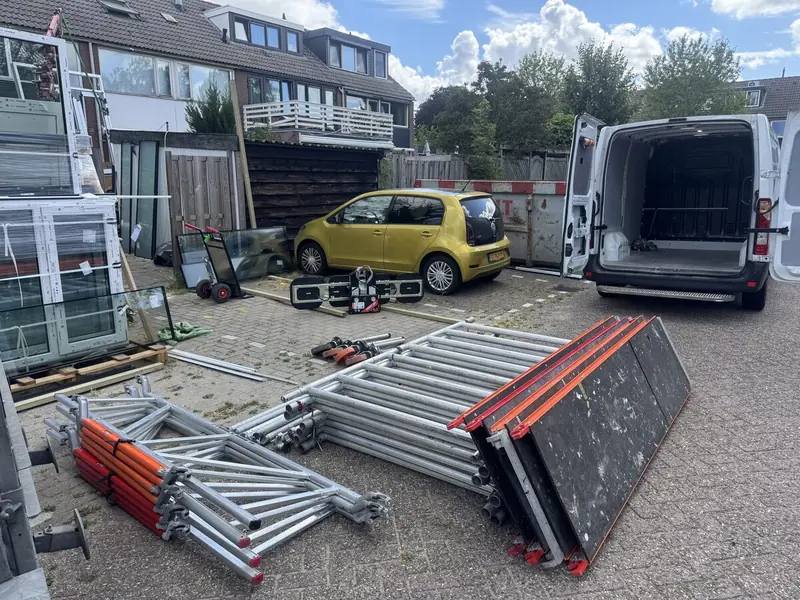
Counted set of scaffold parts delivered on site, laid out for the hirer to build up before chimney repointing starts

Once the work is done you unbolt the build and stack tubes and decks tidily on the drive, and we come past to load it all again. Rinse decks and tubes before spilt mortar turns rock hard, because chipping dried mortar off costs more effort than the pointing itself did. Tally the components while you dismantle, which is how you spot a brace still lying in the grass. What the run comes to where you live sits under delivery charges per province.

Repairing a chimney safely on a hired mobile scaffold

Load class 3 applies to this decking, an EN 1004 classification that permits 200 kg for each square metre of platform. Chimney repair creeps nearer that ceiling than painting does, because two people together with a tub of mortar, a bucket of soaked grit and an opened bag of cement mount up fast. Spread the weight over the deck rather than piling it against one guardrail, and lower full buckets down as soon as they become heavy.

A chimney changes nothing about the ordinary rules. Lock the castor brakes before you take the first rung, only push the tower along when the deck is entirely empty, and come down as soon as it genuinely starts to blow. Above the roof edge there is more wind than there is down in the street, which you notice at once with a bucket hanging off your forearm. After every move, check that all four stabilisers are out again and truly bearing on the ground.

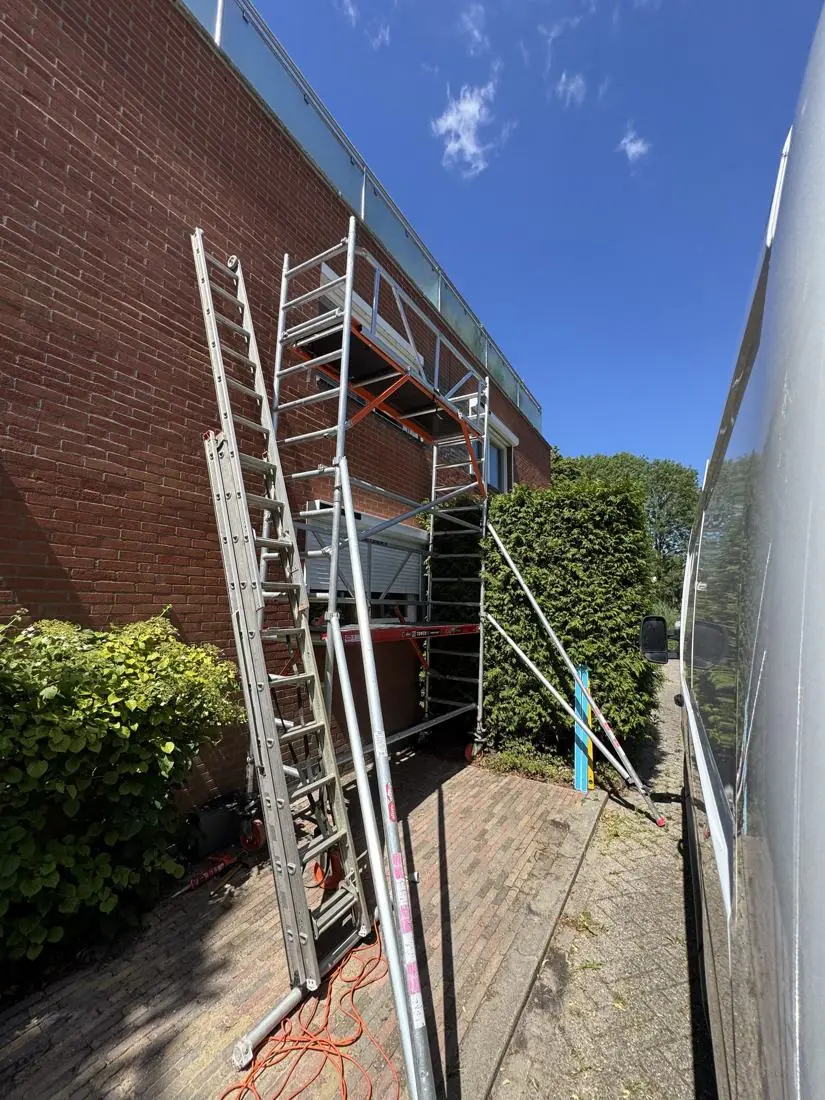
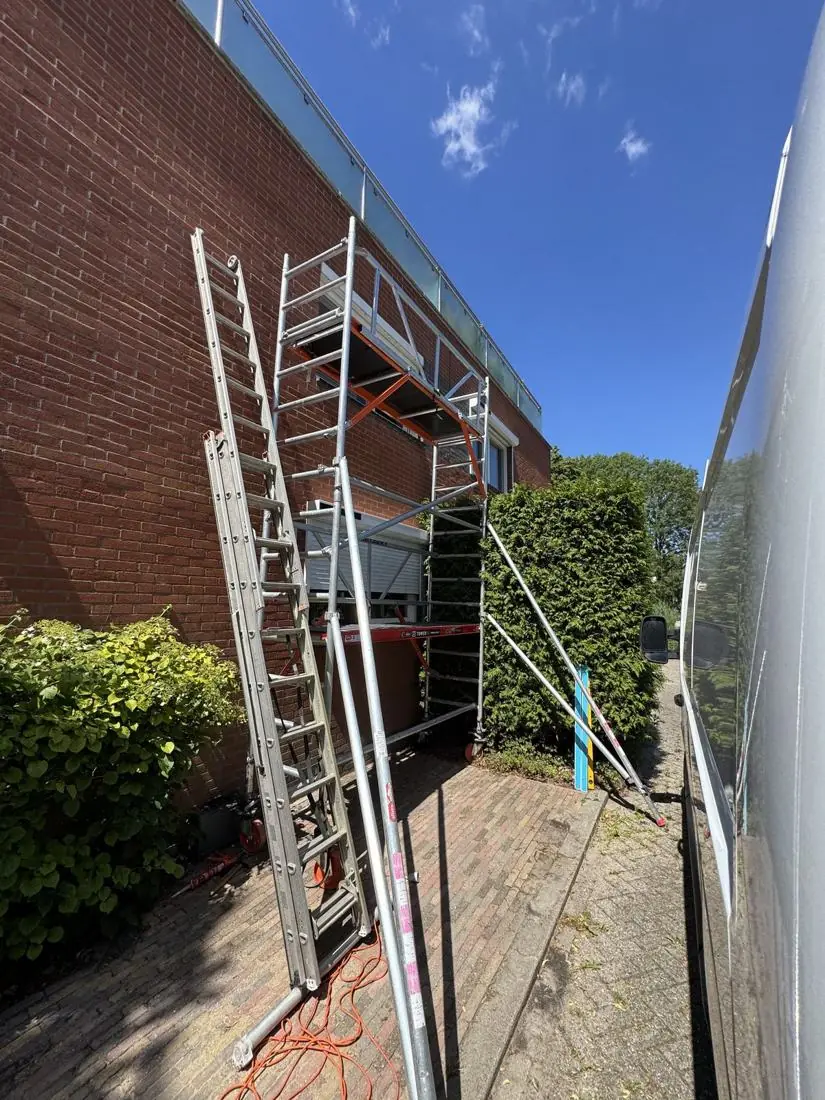
Rolling tower built against a brick wall with stabilisers down, a loose ladder propped on the bricks a pace away.

One hazard belongs to this job alone: the chimney itself is not sound. You are up there precisely because bricks are loose and the pointing is falling apart, so never treat the head as a handhold, as a support or as an anchor for a line. Nor should you step off the deck onto the tiled slope to reach that last bit, because roof tiles are not made to carry you. The wider picture sits with the rules that govern work at height.

In 5 steps

How hiring a mobile scaffold works

1
Choose working height

Pick the height that suits your job.

2
Book online

Sorted in 60 seconds, price shown instantly.

3
We deliver

At the agreed spot the next working day.

4
Assemble safely

Assembled by you, with a manual.

5
We collect

One call and we collect the scaffold.

Good to know

Practical tips for repairing a chimney

1

Photograph the elevation from the far pavement before you book. That picture shows at a glance how far the head clears the tiles and which build height you should be hiring for.

2

Hang two buckets on the guardrail, one holding mixed mortar and one for the grit. While both stay inside arm's reach you never have to climb or descend with your hands full.

3

Roll out a sheet below your working position, on the spot where the grit will land. Sweeping it out of gravel or from between paving slabs costs more time than laying that sheet down.

4

Start on the face of the head that turns away from the sun. The heaviest damage usually sits there when repairing a chimney, and you want that face done before your hire days run short.

5

Mix half a tub of mortar per round instead of a full one. Half you can carry up on your own; a full one asks for a second pair of hands or another climb.

6

Set the collection date at least a day beyond the last joint you fill. Fresh masonry cures better in peace than under the rattle of a tower that is already being taken down.

Frequently asked questions

Frequently asked questions about repairing a chimney

Repairing a chimney: which mobile scaffold do you hire for it?+

For a head on a house of two storeys you take the wide 135 cm build, the RS52. You want that width because mortar, chopping tools and the rubble bucket all stand on the deck while you turn around them with a loaded trowel. The narrow 75 cm tower stays a fallback for a cramped passage, since up there you spend the day shifting your own kit about. Work out first which route the parts take to the back of the house, because that weighs heavily.

How does hiring a mobile scaffold for chimney repointing actually work?+

Online you pick the build and the height, choose a delivery day plus a collection day and pay up front with VAT included. After that the parts stand on your ground, you put the tower together yourself and start on the head, and on your final day everything lies dismantled ready for the van. There is nothing more to the hire than that, other than you deciding which morning the raking out begins and when the last joint is filled.

How long is a tower normally on hire while the pointing is put right?+

Three to four days is an honest estimate for an average chimney. Raking out weathered joints eats time, filling only runs smoothly once everything is clean and dampened, and afterwards you want the head to cure quietly before the tower disappears. If loose bricks join the list, or the lead around the abutment has to come in too, add a day without hesitation. Masonry at height overruns far more often than it gains, so it pays to reserve that extra hire day in advance rather than ring up later.

What is the daily rental price of a tower used on a chimney?+

What you pay comes out of two things: which build you take and how high you stand it, and on top of that a fixed amount per province covers bringing the scaffold round and fetching it back. Figures are shown online with VAT already in them, so you know where you stand before you reserve. On this job the ratio between the days stands out: the first counts heavily and the ones you hang behind it hardly register. Booking generously on one occasion beats booking briefly on two separate ones.

Which working height do you hire for a chimney on a terraced house?+

For a head on a terrace you sit between 8 and 12 metres working height, which puts the deck of the scaffold somewhere between 6 and 10 metres. Your tape starts on the ground under the castors and ends at the topmost brick you still have to tackle, so not at the gutter. Where the chimney towers well above the ridge, you take from the upper part of that band. Every build is listed on the page of working heights if you are unsure which lift to take.

Does the hired tower arrive by van, or is collecting it yourself an option?+

We bring it on the day you pick: the parts then stand beside the elevation the chimney rises above, and after your last day of pointing they go away again for a fixed amount per province. Free collection by arrangement is possible at Zeeburgerpad 89 in Amsterdam, 1019 AD, so long as your vehicle swallows an entire set. For a tower heading towards ten metres most hirers choose the van anyway, since such a set runs to dozens of parts.

Does the hire include putting the scaffold up when a chimney is repaired?+

No, that part sits with the customer. Assembling, moving and later taking apart the tower are your tasks; we make sure the counted set turns up and disappears again afterwards. The manual supplied walks you through the order of work, and with two pairs of hands you are busy for a good few hours before you touch the first joint. We deliver nothing ready assembled, and cherry pickers or facade scaffolds are not part of what we hire out.

What if the chimney work overruns and you want to hire for longer?+

Say so as soon as you can see that more time is needed; we shift the collection day wherever the tower has not already been booked out to somebody else. On chimney jobs that happens regularly, because only from close up does it become clear how many bricks really move and how much pointing has to come out. Anyone who would rather stay ahead of it books an extra day at once, since you set the end date and handing back early is always fine.

How much clear ground goes under the tower you hire for this?+

Add to the base dimensions of the scaffold the splay of the four stabilisers all round, and keep a strip free besides for the grit to land on, plus a corner for the tub, the bags and the buckets. In a back garden that often means emptying a shed or moving planters. Sort that before the delivery day, because dragging garden furniture between stacks of tubes wastes time. Measure the space before you hire, not after.

Can you carry on working if it rains during your hire days?+

The tower can quietly stay standing; it is only the filling that gets postponed. Fresh mortar and persistent rain get on badly, whereas raked out joints will happily sit open for a day as long as no water runs into the flue. Use such a day to chop further, to brush the head off or to check the lead. Because you fix the last hire day yourself, that kind of delay costs a day at most.

When you hire for chimney repair, what becomes of the deposit?+

A deposit is settled at the moment you book the tower. Once the set has been checked off on return, that sum comes back to you inside 1 working day, usually before the mortar in your head has hardened right through. On masonry watch two things: nothing may be missing from the set, and no caked mortar may be left on the decks or tubes. Damping down and rinsing on your last day saves argument later.

Can you reach all four faces of the head from one hired tower?+

Not from a single position. From the deck you generally reach two faces, after which you roll the scaffold round for the other two. Where the head stands right on the ridge or in the middle of the slope, you simply cannot get at it from below and something other than a mobile tower is called for. Look from the street first to see where the chimney leaves the roof, because that spot decides whether hiring makes sense.

Hire a mobile scaffold for repairing a chimney today?

Calculate your rental price now or ask for free advice.

Rolsteiger van SteigerTaxi geleverd op locatie
Book it online

Your scaffold sorted in 2 minutes.

Choose your scaffold and working height, see the price instantly and book online.