
See your price
Application

Replacing lead flashing? Choose the right scaffold.

Replacing lead flashing is precision work on a line that sits high up. Along a chimney, against the cheek of a dormer or where a wall meets the roof plane runs a narrow strip where water finds its way as soon as the lead splits. You work there with heavy rolls, a dresser and both hands, eight to twelve metres above the street. That is why you pick the wide 135 cm RS52 here and not the narrow version. What follows covers the build, the standing place and the number of rental days.

  • Order before 3 pm, delivered tomorrow
  • Professional Altrex scaffolds
  • Up to 14.2 metres working height
  • Easy to assemble yourself
4,2 tot 14,2 mWorking heights available
12Provinces served
7Days a week
200 kg/m²Load class 3
In short
  • For replacing lead flashing we recommend the Wide mobile scaffold.
  • For replacing lead flashing at eight to twelve metres the 135 cm wide RS52 is the obvious hire choice.
  • Lead is heavy and the joint sits high, so you want a roomy deck and a steady base beneath you.
  • Measure in advance how far the chimney stands from the facade, because that decides whether you can reach it.
  • First 24 hours from €175 incl. VAT and delivery; every day after that 95% off.
Key facts for this job
FeatureValue
Recommended scaffoldWide mobile scaffold (Altrex RS TOWER 52)
Working height for this job8 to 12 metres
Available working heights4.2 to 14.2 metres
StandardEN 1004, load class 3 (200 kg per m²)
DeliveryOrdered before 3 pm, delivered next working day
Each extra day95% off, from €8.75 a day
Why a mobile scaffold for replacing lead flashing?

Safe, stable and professional work at height

What makes this job unusual is that the working area is narrow but high. You do not need a whole facade, only a strip half a metre wide along the joint, but that strip lies above the gutter. Everything you do there has to be right first time: a piece of flashing lying wrong leaks only months later, and then you are back at ten metres. That calls for calm on your deck, room for your roll of lead and your tools, and a build that does not move with you when you swing a dresser. Hiring a scaffold for replacing lead flashing therefore means choosing width and stability over manoeuvrability.

  • Narrow line of work, but high above the gutter
  • Heavy rolls of lead belong on a wide deck
  • Eight to twelve metres up to the joint
  • Facade to chimney distance decides your reach
Read more about working safely →

Which mobile scaffold to hire for replacing lead flashing

At this height you go for the RS52, the wide version at 135 cm. Two reasons settle it. First you are standing high, and a broader base stands noticeably calmer at eight to twelve metres than a narrow one. Second you carry material up that has weight to it: a roll of lead half a metre wide weighs more than a tin of paint, and that roll needs somewhere to lie clear of your feet. What else stands in the hire range of mobile scaffolds is rarely a better answer for this job.

The deck that is 245 cm long and 135 cm deep gives you exactly what you need: your roll, your dresser, your mallet and the sealant gun on one side, room to kneel and dress on the other. On lead work you are often working low over your deck rather than upright, and then a narrow version is cramped. Two people on the same build, which is quite normal on this job, also fit here without stepping over one another or shifting tools about.
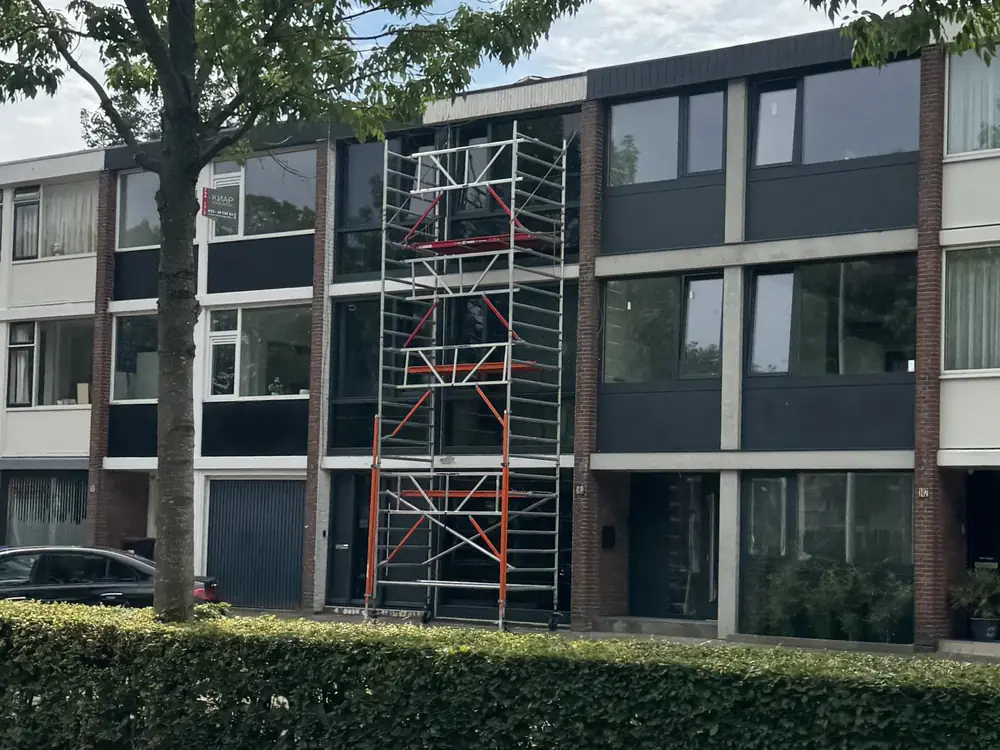
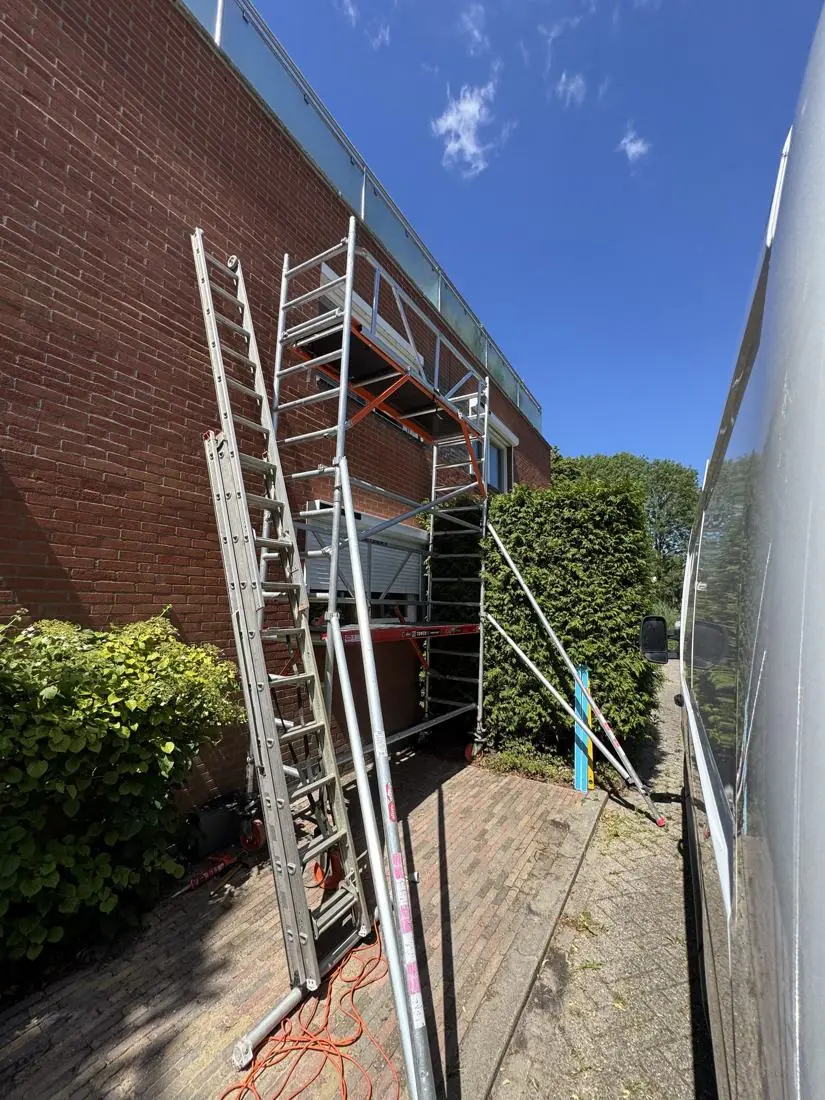
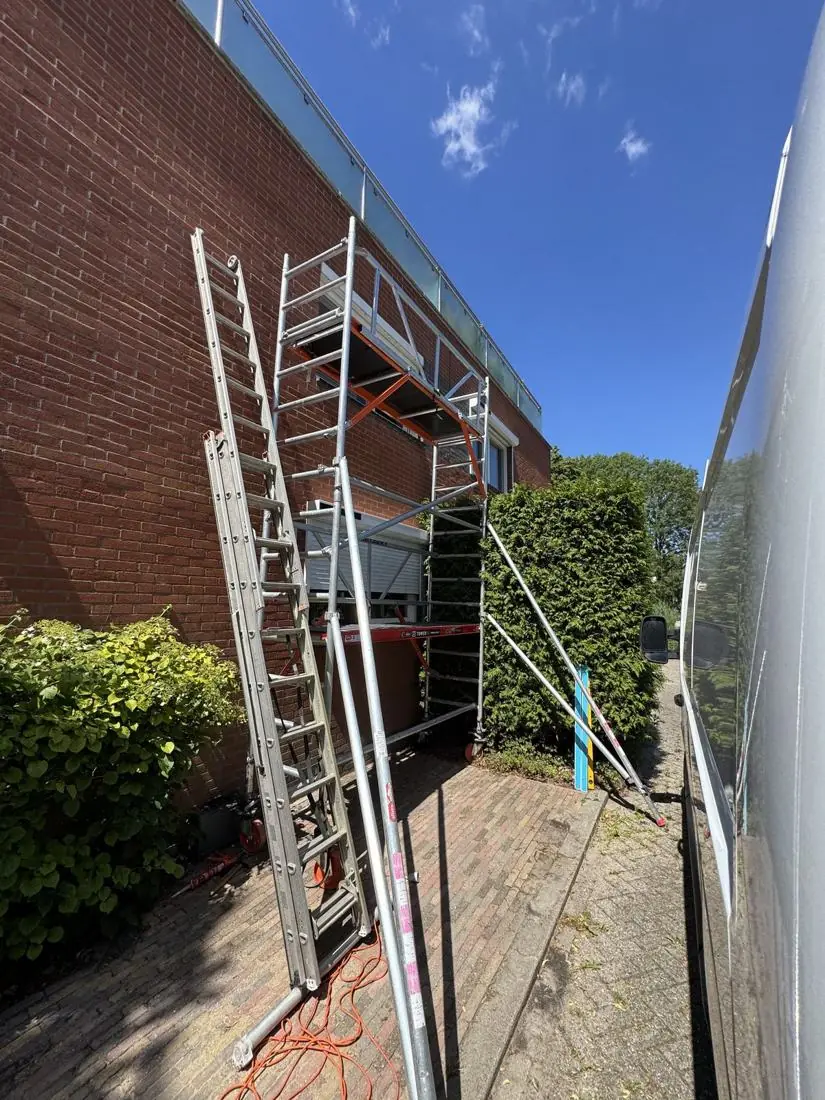
Wide tower standing up to the roof edge of a house, the build you use for lead work aloft

You only fall back on the narrow 75 cm RS51 when the way through to the facade really leaves no room. You give something up for it: less deck to put your material on, and a build you have to level even more carefully at this height. Where you have the choice, take the wide version and accept carrying a few more parts round the back. How high you may go with either model is at the maximum height of a mobile scaffold.
Which working height to hire for lead flashing on the roof

The point you have to reach is the joint itself: the bottom row of lead flashing along the chimney, the bead along the cheek of a dormer or the strip where the lead is let into the wall. On a house of two to three storeys that lies at eight to twelve metres, counted from the street where your wheels end up. Sits the joint at second floor level, then you are at the top of that range and you build on well past the gutter.

Translate that measurement into a build next. Your platform ends up at six to ten metres, and your arms add about 2 metres on top of that before you touch the joint. For lead work you would rather stand slightly lower than the maximum you can get to, with the joint somewhere at chest height. If the work is over your head you cannot put force behind it and you will never press the flashing tight into the joint.

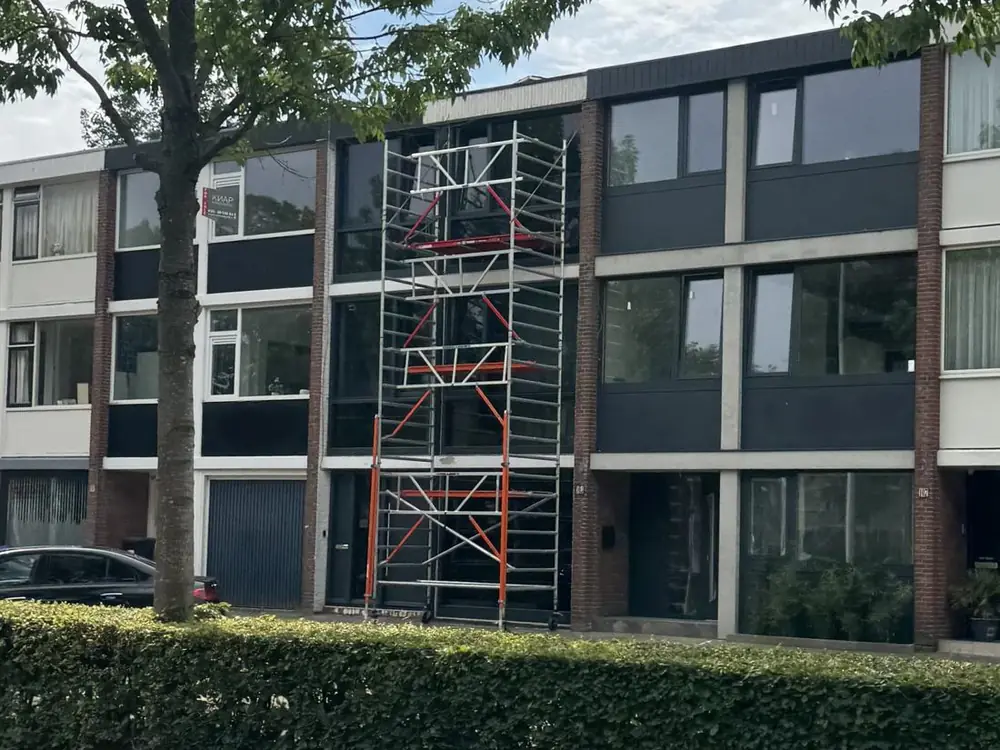
Tower built along a front elevation up past the gutter, the height at which lead joints are found

There is a second measurement that counts and is often forgotten: the horizontal distance. A chimney standing two metres back from the roof edge you can no longer reach from a build against the facade, however high you go. So measure not only upwards but backwards as well before you commit to anything, because that decides whether this work can be done from a scaffold at all. Which build belongs to this reach you see at twelve metres of working height.

Hiring a wide tower and setting it under the flashing

The standing place follows from the line you have to reach. Find the point on the ground directly under the joint first, and then look at whether there is space there for a build 135 cm wide plus the swing of the stabilisers. With a chimney near the ridge that often means you end up in the front garden or on the pavement. If that point lies above an extension, a conservatory or a garage, a build at ground level drops out and you have to look for another solution.

At this height the ground matters more than on a low job. A deviation of a centimetre down below becomes a hand's breadth up top, so level the build carefully and use all four stabilisers as this height requires. Do not set them half out because a paved path is just too narrow; move the whole build a metre instead, even if that costs you half an hour. Stabilising and anchoring says what else is needed as the height climbs.

Stabilisers of a mobile scaffold splayed on paving, needed for a build that reaches above the gutter

Finally think about the zone under you. The old lead you strip out comes down, and so do bits of mortar, pointing and sometimes a tile that works loose. Cordon that zone off, certainly where the build stands on a pavement or a drive people want to pass along. With lead flashing round a chimney more loose material falls than you reckon on in advance, so put a sheet down and talk to the neighbours about where their car goes during those days.

How many rental days to replace lead flashing on a chimney

The number of square metres is small, but the operations go slowly. Getting the old lead out, raking or cutting the joint, snipping new lead to size, dressing it until it follows the shape of the tiles, working it in and finishing off with sealant or mortar: per side of a chimney you are half a day gone before you know it. For a chimney you tackle all round, or a dormer with two cheeks, that soon runs to two or three days of work.

The build time comes on top of that. A ten metre build does not go up in an hour, certainly not if you still have to move it halfway to the other side of the chimney. Count that build day separately and do not count it as a day on which you get to the lead. Bear the weather in mind as well, because on wet tiles and with wind at ten metres you do not do this work. A spare day is therefore not a luxury here but simply part of your planning.

Mobile scaffold beside a house left standing for several days during work on a roof joint

Luckily that extra day weighs little. The opening 24 hours are billed at the full rate and every day that follows has 95% taken off, which keeps the rental price of a roomy period close to that of a tight one. Ordering again after a break, by contrast, costs you a whole first day once more plus two extra runs of the van to your address. Making a realistic estimate works with the rules of thumb for rental days beside you.

Which mobile scaffold suits replacing lead flashing?

Kamersteiger RS44
  • Working height up to 4 metres
  • Compact and narrow
  • Great for indoor and small jobs
View and calculate →
Smalle rolsteiger RS51
  • Working height up to 14.2 metres
  • Narrow (75 cm)
  • Ideal for narrow passages
View and calculate →
Most chosen
Brede rolsteiger RS52
  • Working height up to 14.2 metres
  • Wide platform (135 cm)
  • Extra stability and workspace
View and calculate →
1-persoons steiger MiTower
  • Working height up to 6.2 metres
  • Very compact
  • Quick and easy to assemble
View and calculate →

Replacing lead flashing from the 245 cm platform

Finish the joint side by side and not piece by piece. Stand on your deck, do the whole line you can reach from that stand, and only move once that side is done and watertight. With 245 cm of deck length you usually take a complete dormer cheek or half a chimney side in one go. A transition between two stands you never put in the middle of a joint, but on a corner or exactly where the pieces of flashing overlap generously anyway.

Make sure you have everything up before you start. Lead cut to size, a pair of grips, the dresser, a wooden mallet, sealant, a cloth and a bucket for the old material: every trip down costs you a few minutes at this height that you never win back. Pull the roll up on a line along the outside; climbing the ladder with it under your arm is asking for trouble. Lower the old lead the same way and do not throw it down, because it is heavy and bounces everywhere.

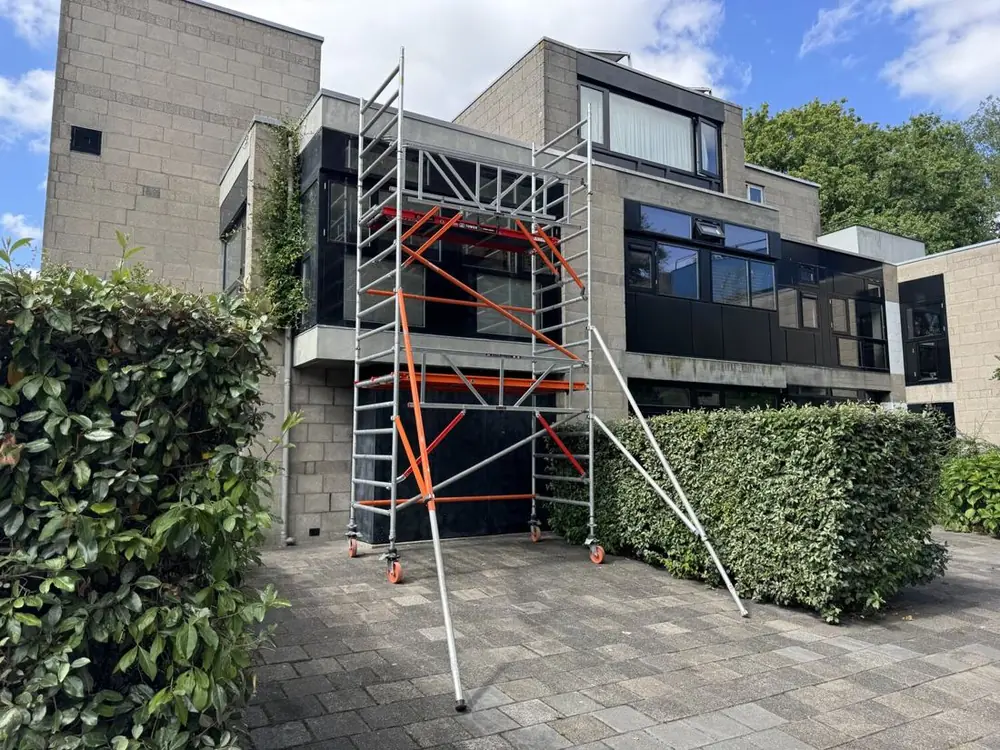
Tower against a side elevation with its platform high up, the stand you take per side of the joint

Bear in mind that from a build against the facade you cannot reach everything. The side of the chimney facing away from you is out of range, and that means moving or even a second build on the other side of the house. Take that into your planning, because such a move costs half a day. If you take the repair of other lead work with you, plan it in the same period, since you are up there anyway.

Delivery of the parts when you hire for lead work

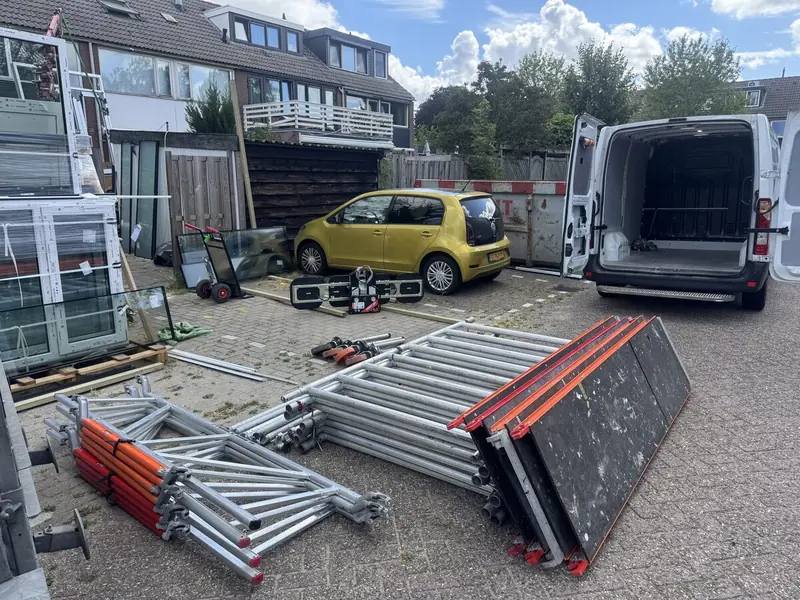
At this working height you get a fair number of parts delivered: uprights, braces, several decks, guardrails and the stabilisers, all counted and complete. It is clearly more material than for a low build, so genuinely set a place aside for it. A drive or a corner of the front garden suits better than a narrow path along the house, because you want to lay the parts out in order before you start stacking. That saves a lot of searching while you build.

Place your order midweek and make 15:00, and the delivery falls on the working day after. The arrival date and the date everything goes away again you fill in yourself, and with lead work you would rather put that first date just before a run of dry days. Building up is your own job, and at this height not on your own: bring somebody with you, keep the manual within reach and set the video beside it on your phone.

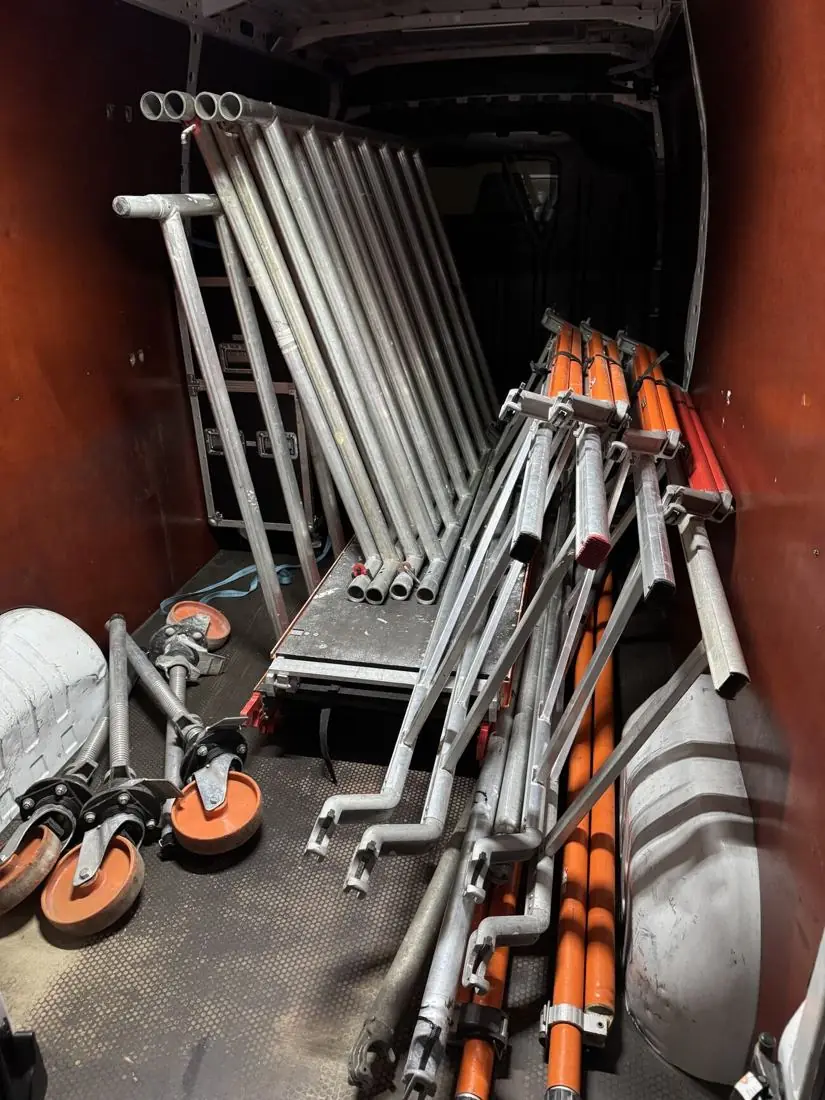
Scaffold parts bundled ready for transport, the material supplied for a build that goes up this high

Once the joints are finished you take the tower apart and stack the parts somewhere clear; we come to collect them on the day you gave us. Breaking down goes from the top downwards and at ten metres takes more time than the build suggests, so do not start it at five in the afternoon. The amount for the run in your province you can check under the costs of delivery, neatly including VAT and fixed in advance.

Working safely at height while replacing lead flashing

Load class 3 from EN 1004 puts the limit at 200 kg per square metre of deck. On lead work you come closer to that than on most jobs, because a roll of lead, a bucket of broken-out material, tools and two people add up fast. So spread the weight along the length of your platform instead of piling it in one corner, and lower the bucket as soon as it fills. What that class means is at loading and weight.

The standing rules weigh heavier up here than down below. Set the brakes first and only then climb on, let nobody and nothing stay aboard while you roll, and come down as soon as wind gets up. At ten metres you feel a gust you would hardly notice at three, and with a sheet of lead in your hands you are also holding something that can catch like a sail. In that case rather wait a day than try it anyway.

Mobile scaffold with a ladder running up inside it, the way up for work high at a roof joint

Watch as well for the temptation to step over the guardrail onto the roof plane. Tiles are slippery, certainly with a bit of moss or damp on them, and a build is no stepping stone onto a roof unless you arrange something extra for that. Stay on your deck and move once more rather than stretching for the last piece of flashing. The rest of the agreements are at what is expected of you at height.

In 5 steps

How hiring a mobile scaffold works

1
Choose working height

Pick the height that suits your job.

2
Book online

Sorted in 60 seconds, price shown instantly.

3
We deliver

At the agreed spot the next working day.

4
Assemble safely

Assembled by you, with a manual.

5
We collect

One call and we collect the scaffold.

Good to know

Practical tips for replacing lead flashing

1

Cut the lead to size down below and dress it there as far as you can. At ten metres you only want to offer up and fix, not wrestle with shears and a profile on a narrow deck.

2

Photograph the existing joint close up before you loosen anything. Once the old lead is out, nobody remembers exactly how deep the flashing sat in the joint and how much overlap there was between the pieces.

3

Take a bucket on a rope up with you for the broken-out material. Lumps of mortar and pieces of lead you throw down land exactly in the zone where your stabilisers and your parts stand.

4

Check before you build how far the chimney stands back from the facade. If that distance turns out too great your whole plan changes and another approach beats a build against the front elevation.

5

Do the side that catches the most rain first. If the weather turns halfway through, at least the face the water hits hardest already has its new lead flashing in place.

6

Ask for a collection day one day later than your last working day. Then after a shower you can still check from the deck whether the joint is really closed before the whole build comes down.

Frequently asked questions

Frequently asked questions about replacing lead flashing

Which mobile scaffold should I hire to replace lead flashing?+

In most cases the RS52 at 135 cm wide. You are standing high on this job, and a broader base gives more calm up there, while on the deck you need room for a roll of lead, tools and often a second person. Only if the way through to the facade turns out too narrow do you switch to the slim RS51 at 75 cm. So measure that gap before you reserve a mobile scaffold, because changing model afterwards costs you a day.

How does hiring a scaffold for work on lead flashing run?+

You reserve a model and the height you need online, give a date for the bringing and one for the fetching, and see the amount with VAT alongside straight away. On that first date the parts lie with you, after which you build the mobile scaffold up and start on the lead. As soon as everything is done you dismantle it and we take the material back. Count the build day into your period, because at this height it eats a large part of a day.

How many days should you hire such a tower at a chimney?+

For a chimney you tackle all round, or a dormer with two cheeks, allow two to three days. Breaking out, offering up and dressing goes more slowly than it looks, and per side you are half a day further on. Add the build and the breaking down to that, plus a spare day for rain or wind. Because the days after the first hardly add anything, you simply take that margin into your period when you hire.

What does hiring cost at this height and how does the discount rule work?+

The height you build to and the model together set the price of your tower, with the run to your address per province on top. The amounts with VAT you find on the page of rates. On a job like this what counts above all is that the first day weighs heaviest and that whatever you stick on behind it barely adds up. Take a roomy period and you pay little extra while keeping your planning intact.

Which working height do people hire for a joint on the roof?+

On a house of two to three storeys you come out at eight to twelve metres, with your deck at six to ten. Measure upward from the paving your wheels rest on to the bottom row of lead flashing. More important still is the distance from the facade to the chimney: if that stands too far onto the roof plane, you will not reach it from a mobile scaffold. The overview of working heights shows which builds exist in this range.

Can I have the scaffold brought or must I fetch it myself?+

For a build of this height nearly all customers choose delivery, simply because it involves a lot of parts. The driver comes on the day you name and pulls up again afterwards, at a fixed rate per province. Fetching it yourself is possible too: the complete tower can be collected at Zeeburgerpad in Amsterdam on appointment, without charge, though for that you do need a large van or a trailer, since the uprights are long and there are a good many of them.

Do you build the tower up if I hire it for this?+

Assembling belongs to your work. We bring the material and take it back afterwards; building, moving and breaking down you do yourself. At eight to twelve metres that is a job of a few hours and not one you do alone. We have no system scaffolds, facade scaffolds or cherry pickers standing; on a joint close to the roof edge a mobile scaffold therefore remains the usual tool. Work the step plan through calmly and skip no step.

Can I hire for longer if the lead work is not finished?+

That is possible. Ring us any time before the driver is due back and we shift that date, except when the same mobile scaffold is already scheduled for a following hirer. On lead work it happens regularly that there is more damage under the old sheet than expected, or that the weather throws a spanner in the works for a day. Handing it in earlier is allowed too, so if it goes well you are tied to nothing.

How much room do I need if I want to hire a tower here?+

Reckon on the build itself, the swing of the stabilisers all round and on top of that a clear zone where the broken-out material comes down. With a high build that is more than most people estimate. Look at what runs above your head as well, because a telephone cable or a projecting branch turns into a real problem at this height. Walk the spot once from end to end before you reserve a mobile scaffold, and no surprises await you.

Can I keep hiring on a day it is too windy to work?+

The build simply stays standing, but you do not go up on it that day. At this height wind is the decisive factor, and with sheets of lead in your hands it gets a shade nastier still. Take the loose material off your deck if a storm is forecast, and check the stabilisers again when you climb on. Because you set the collection day, a lost day costs you a day longer on the tower at most.

What happens to the deposit if I hire a mobile scaffold here?+

You settle a deposit amount at the reservation, and the money follows within 1 working day after we have checked the returned set. On lead work we look above all for mortar residue and smears of sealant on the deck boards, and for parts that have ended up among the building waste. A quick wipe while you break the tower down saves bother later. What else plays a part is at the deposit and the return check.

Can I reach a chimney in the middle of the roof from a tower?+

Often not, and that is the question you answer beforehand. A build stands against the facade and reaches to just above the gutter; everything lying further back on the roof plane stays out of reach of your arms. If the chimney sits close to the roof edge it usually works. So measure that distance before you go and hire. On a joint along a dormer or a wall a mobile scaffold is nearly always the right choice.

Hire a mobile scaffold for replacing lead flashing today?

Calculate your rental price now or ask for free advice.

Rolsteiger van SteigerTaxi geleverd op locatie
Book it online

Your scaffold sorted in 2 minutes.

Choose your scaffold and working height, see the price instantly and book online.