
See your price
Application

Repairing leadwork? Choose the right scaffold.

Repairing leadwork is nearly always spot work: a flashing lifted by the wind, a split in the collar around the chimney, a strip of lead that has worked loose beside the dormer. You need not open the whole abutment for it, but you do have to reach it, and that reach often sits at eight to twelve metres. For that you take a wide mobile scaffold with a base of 135 cm. This page sets out which build to order, how long you keep it and what has to stay clear underneath.

  • Order before 3 pm, delivered tomorrow
  • Professional Altrex scaffolds
  • Up to 14.2 metres working height
  • Easy to assemble yourself
4,2 tot 14,2 mWorking heights available
12Provinces served
7Days a week
200 kg/m²Load class 3
In short
  • For repairing leadwork we recommend the Wide mobile scaffold.
  • For a repair to the lead at eight to twelve metres you reserve the wide RS52 with its base of 135 cm.
  • A lifted flashing or a single leak is normally put right from one position, so two rental days are often enough.
  • Replacing the complete run of flashings is another matter: several positions along the elevation and therefore a longer hire.
  • First 24 hours from €175 incl. VAT and delivery; every day after that 95% off.
Key facts for this job
FeatureValue
Recommended scaffoldWide mobile scaffold (Altrex RS TOWER 52)
Working height for this job8 to 12 metres
Available working heights4.2 to 14.2 metres
StandardEN 1004, load class 3 (200 kg per m²)
DeliveryOrdered before 3 pm, delivered next working day
Each extra day95% off, from €8.75 a day
Why a mobile scaffold for repairing leadwork?

Safe, stable and professional work at height

On a lead repair you push, dress and tap with real force, and that only works if you stand still with both hands free. A ladder gives you none of that: nowhere to put your roll of lead, your dresser and your sealant, and no way of shifting sideways along the abutment. The damage usually sits above the gutter as well, against a chimney or beside a dormer, so you build higher than the roof edge. Hiring a scaffold for leadwork therefore means above all that you can hang the deck exactly under the damage, that you can stay there for as long as the joint needs, and that lead, sealant and dresser lie within arm's reach on the floor beside you.

  • One damaged flashing, not the whole run
  • Dressing and tapping asks for two free hands
  • The lead sits above the gutter, towards the ridge
  • Wide base of 135 cm on high builds
Read more about working safely →

Which mobile scaffold to hire for a one spot lead repair

For a repair to the leadwork you stand high and you take more up with you than a hammer. A roll of lead, a dresser, a block of hardwood to press with, sealant and a bucket for the old material. This is where the RS52 belongs, the wide type in the Altrex range whose base measures 135 cm. On that deck you lay your kit down beside you instead of pushing it into a pocket every time, and on this sort of work that saves more time than you would guess.

The narrow RS51 at 75 cm exists too, and it still passes a gateway where the wide one sticks fast. For repairing leadwork at eight to twelve metres you pick it only when the way through to the elevation truly allows nothing else. The higher you build, the more pleasant a wide base becomes: you can turn round up there while pressing a flashing into the joint, and the whole build feels far steadier underfoot when you are working with force.
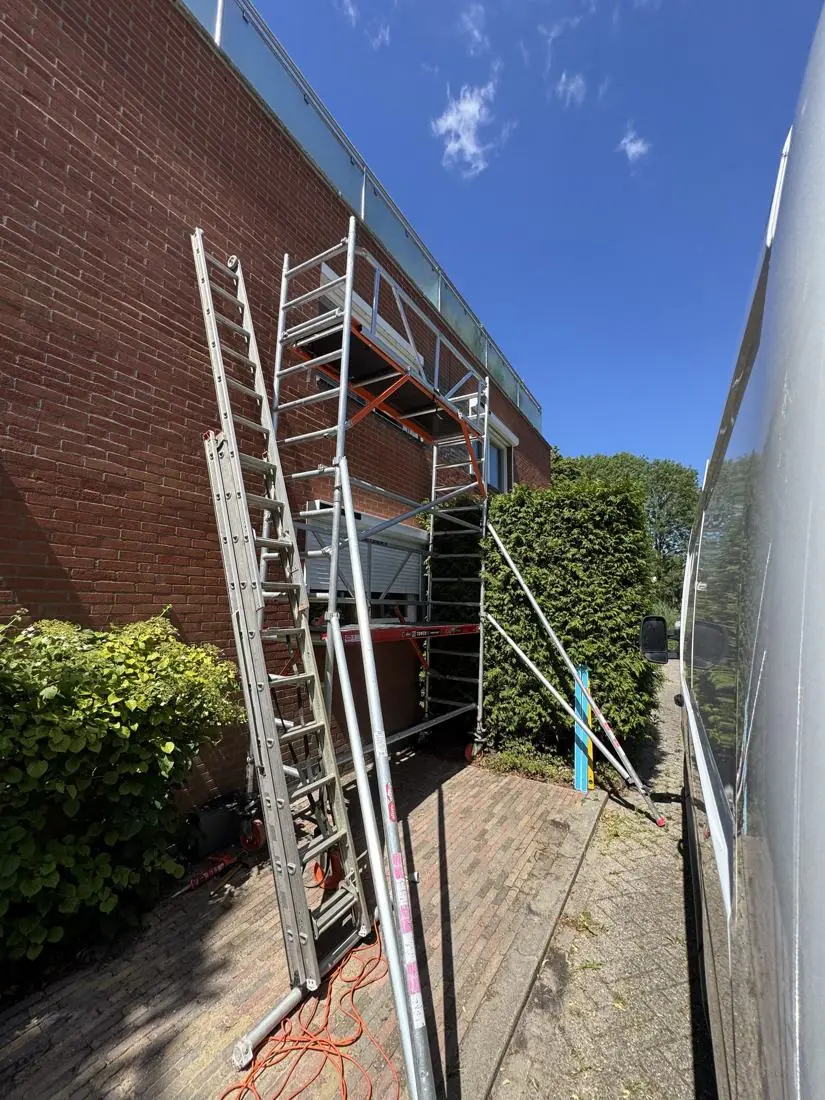
Wide mobile scaffold built along a side elevation to above the gutter, the position you hire for a lead repair

Which height each model reaches per build is worth reading before you go and hire a mobile scaffold. Watch the difference between what the series can manage at most and what you need for this repair: the RS52 runs on to 14.2 metres, but you order the build that suits your own roof edge. So you pay for and put up the height the lead asks for, not the outer limit the model reaches on paper. That saves parts to carry and time on the build.
What working height to hire for lead at a chimney abutment

The highest point on this job is rarely the roof edge itself. The lead sits where a chimney meets the tiles, along the side of a dormer or in a valley gutter, and that is usually a good way above the gutter. So measure not to the gutter but to the damage you mean to put right. Set the zero of your measurement on the paving or the grass where the wheels will rest as well: if the back garden lies lower than the pavement, that difference simply counts.

The working height you hire is the height of the deck plus roughly 2 metres of reach, because you are standing on it yourself. With the broken lead at ten metres you come out at a deck of about eight metres and reserve a build from the band of eight to twelve metres. Anyone who skips that sum and orders by eye ends up slightly too low and leans over the top rail while dressing, which is exactly what you want to avoid on this work.

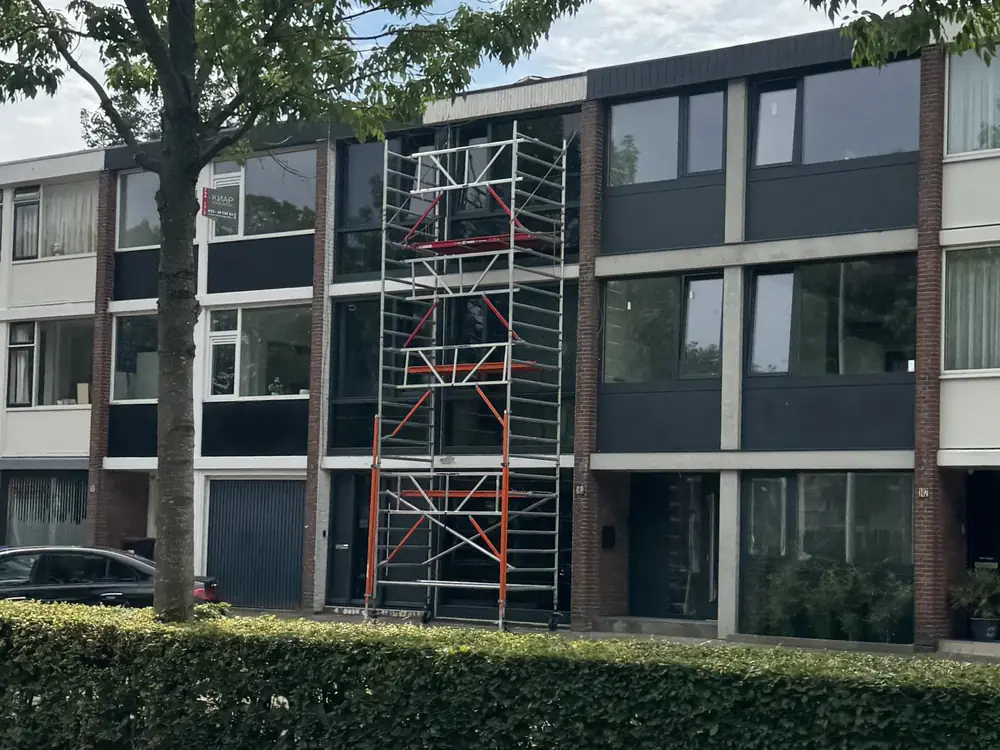
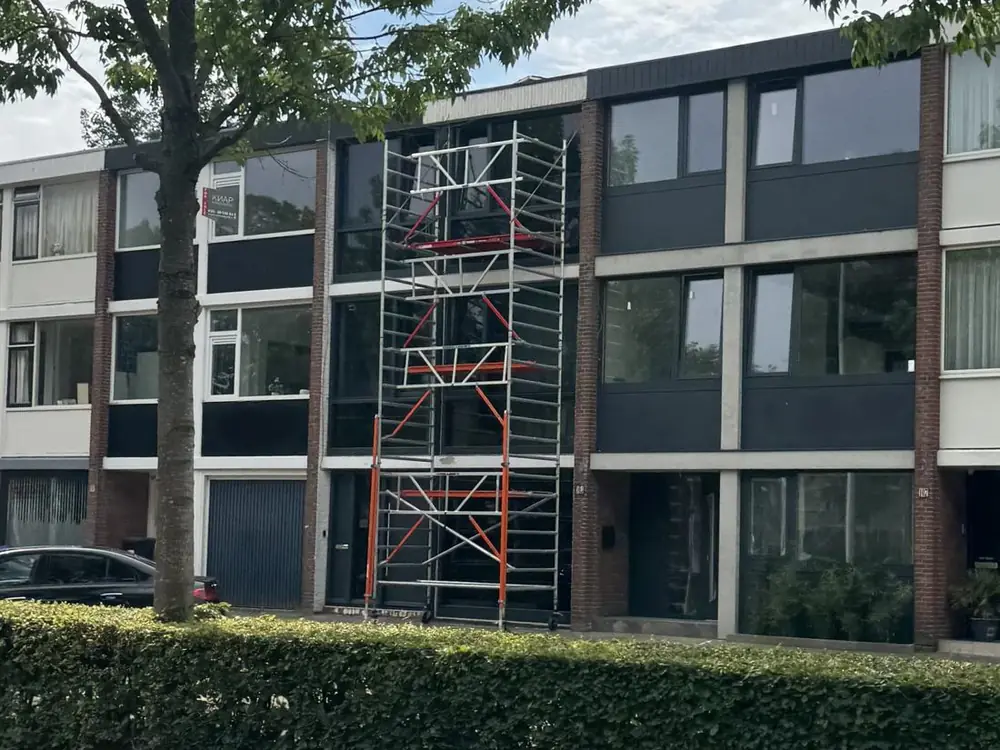
Mobile scaffold built against a front elevation well above the gutter, the height at which lead around a chimney sits

Hiring too short costs you quality straight away on lead. You will not get a flashing pressed flat if you are working at it from below, and it lifts again in the first storm. If you fall between two builds, reserve the upper of the two: a deck can always be hung a level lower, but you cannot conjure up an extra frame. How many frames such a build takes, and how much ground it swallows at the foot, is worked through on the page for a working height of ten metres.

Hiring a mobile scaffold for leadwork and picking its footprint

Lead tends to sit at the most awkward place on the house: against the chimney at the ridge, in the corner where an extension meets the elevation, or behind a dormer. The tower has to stand square underneath it, and that is usually where the border, the shed or the terrace is. Walk that spot before you reserve anything and see whether you can free an area of roughly two by three metres, the room the extended stabilisers claim included.

The ground has to carry and it has to be levelled. On grass or loose paving you put a solid board under each wheel so the tower cannot sink while you are up there tapping a flashing home with force. A difference in level you take up with the adjustable spindles and not with a stack of paving slabs. At this working height the stabilisers stand well out, so count on far more floor than the base measurement suggests at first sight.

Extended stabilisers at the foot of a built mobile scaffold, the floor room a lead repair at height asks of you

If the build stands on the street side or on a drive, look at whether people can still get past and whether the bin can still come out. On a job of a day or two you do not want to block the neighbours needlessly, and you want to walk past the feet yourself with a roll of lead under your arm. How to set a tall build down firmly, and what to watch with loose paving, is described in the article on stabilising and anchoring a mobile scaffold.

How many days you hire a mobile scaffold for leadwork

The repair itself is short work once you can reach it. Taking the old piece of lead out, cleaning the joint, cutting a new strip to size, dressing it home and sealing it costs you half a day at a single spot. The rest of your time goes on building, perhaps moving once and striking again. Count on two rental days: on the first you set the tower up and work through, the second you keep in hand for the finishing.

If you are replacing the complete run of flashings along a whole abutment, that is a different job and you hire for longer. There you shift the build several times and work through metre by metre, while a repair stays spot work in one place and you often keep standing where you are. What to plan for that larger job is on the page about replacing lead flashings. That distinction settles both your rental period and whether you have to be able to move in between.

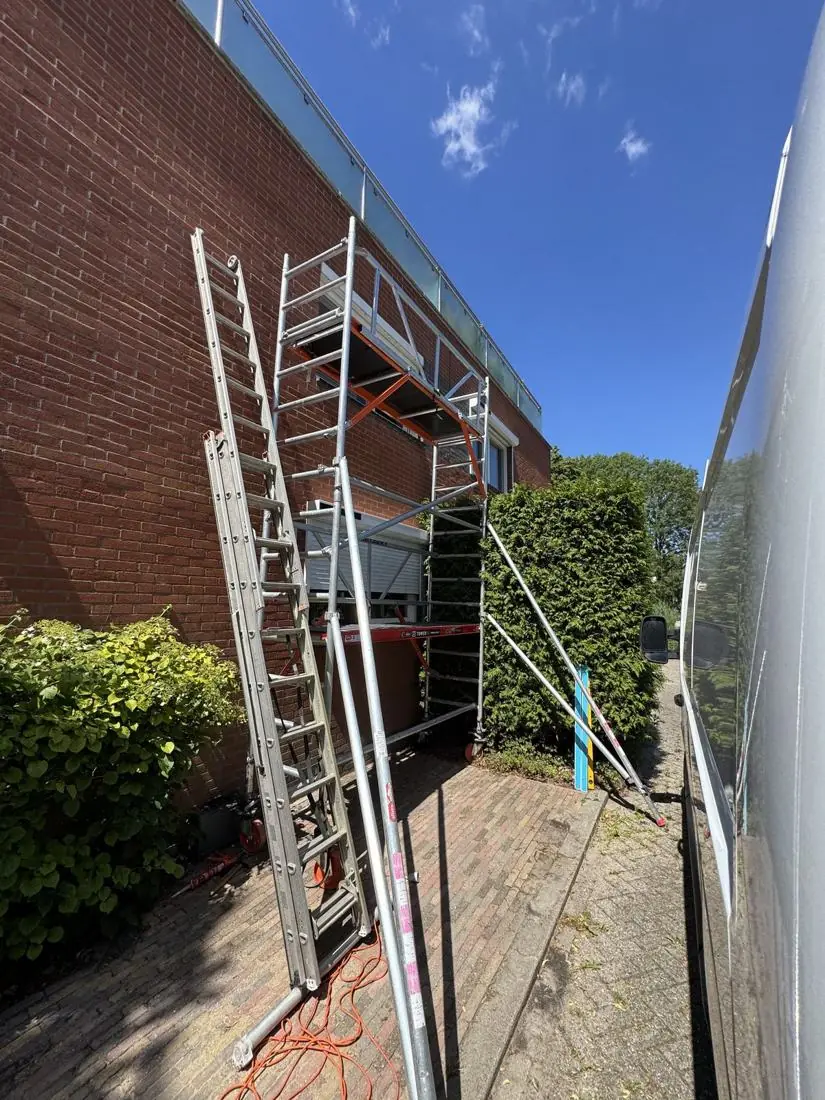
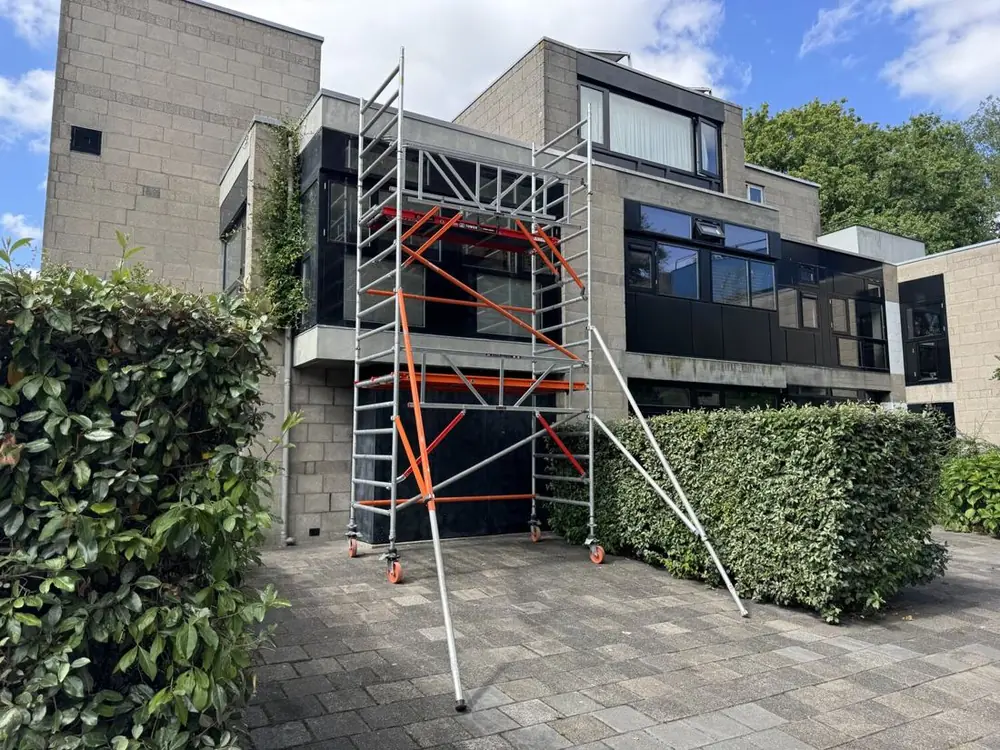
Built mobile scaffold beside a house, the position that stays up through your rental days until the lead is mended

Sealant and filler need time before they can take rain. So do not put your collection date on the evening of your working day but a day later, then you can climb up the next morning to see whether everything is sitting right and nothing has shifted. A spare day in your reservation barely weighs on the hire, while a tower that goes too early forces you to round the whole thing off in one afternoon.

Which mobile scaffold suits repairing leadwork?

Kamersteiger RS44
  • Working height up to 4 metres
  • Compact and narrow
  • Great for indoor and small jobs
View and calculate →
Smalle rolsteiger RS51
  • Working height up to 14.2 metres
  • Narrow (75 cm)
  • Ideal for narrow passages
View and calculate →
Most chosen
Brede rolsteiger RS52
  • Working height up to 14.2 metres
  • Wide platform (135 cm)
  • Extra stability and workspace
View and calculate →
1-persoons steiger MiTower
  • Working height up to 6.2 metres
  • Very compact
  • Quick and easy to assemble
View and calculate →

Repairing leadwork from a mobile scaffold deck of 245 cm

From one position you cover a strip of 245 cm, the length of the deck. For a loose flashing beside a dormer or a collar around a chimney that is plenty. If the leak sits just outside that reach, do not stretch for it but move the tower once. Hanging out sideways costs you more time in the end than striking and repositioning, and you will not get the lead tight against the surface in that posture in any case.

Take up in one climb what you need up there. Lead weighs a fair amount per running metre, so cut your pieces to size below and haul them up in a bucket or a bag instead of carrying them up the ladder under your arm. On the deck you lay the lead flat against the guard rail, so nothing can slide over the edge the moment a stiff gust runs along the elevation or you bend down for a second.

Mobile scaffold with deck and guard rails along an elevation, the working surface of 245 cm that holds lead and tools

What people misjudge is the stance of their own body. Lead is dressed with force from above downwards, and that only comes off if the deck hangs just below the work instead of beside it. So hang it first at the height you think you will be working at, climb up and check with a straight arm whether you reach the top of the damage. Re-hanging a deck costs five minutes; standing wrong costs you the whole afternoon.

Hiring a mobile scaffold with delivery for your lead repair

The scaffold arrives at your door as a complete, counted set of parts. Order before 15:00 on a working day and it all stands there the next working day. For a build towards ten metres that is a fair number of frames, decks and braces, so point out beforehand where they may lie: along the elevation, on the drive or in the front garden, and certainly not across the path you will be walking with a roll of lead under your arm.

You choose the delivery date and the collection date yourself when you book. On leadwork you look mainly at the wind for that, because a repair at this height is not one for a day when it blows hard. If you see two quiet days coming, have the set brought the day before. You then have an evening or an early morning to build in peace and start on your first flashing with dry material, instead of having to choose between building and working.

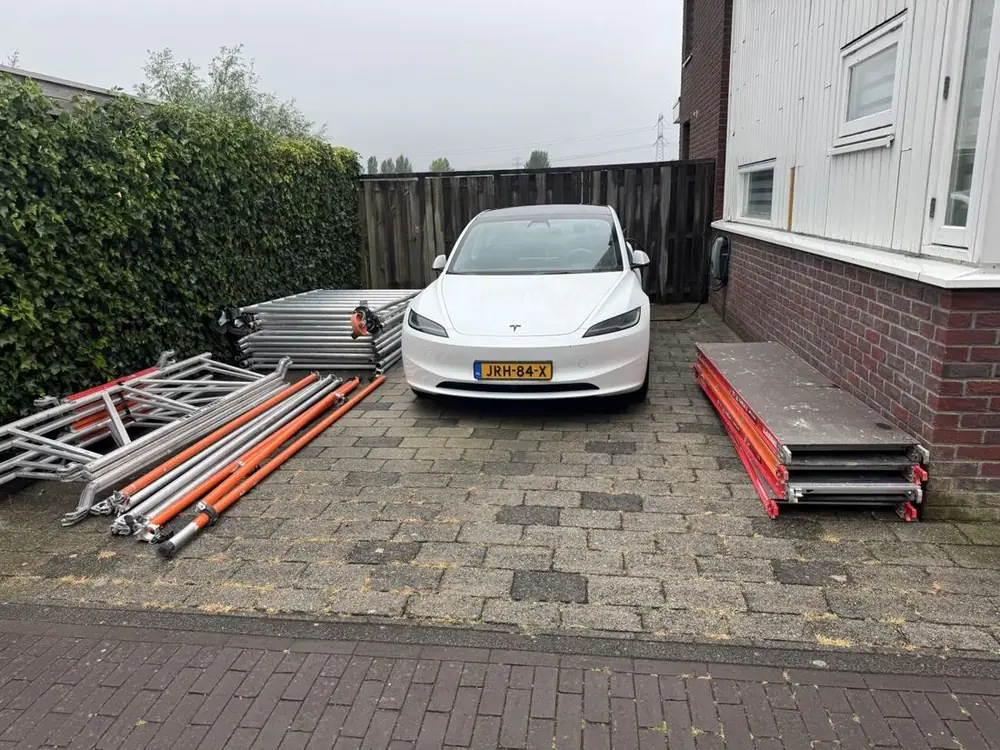
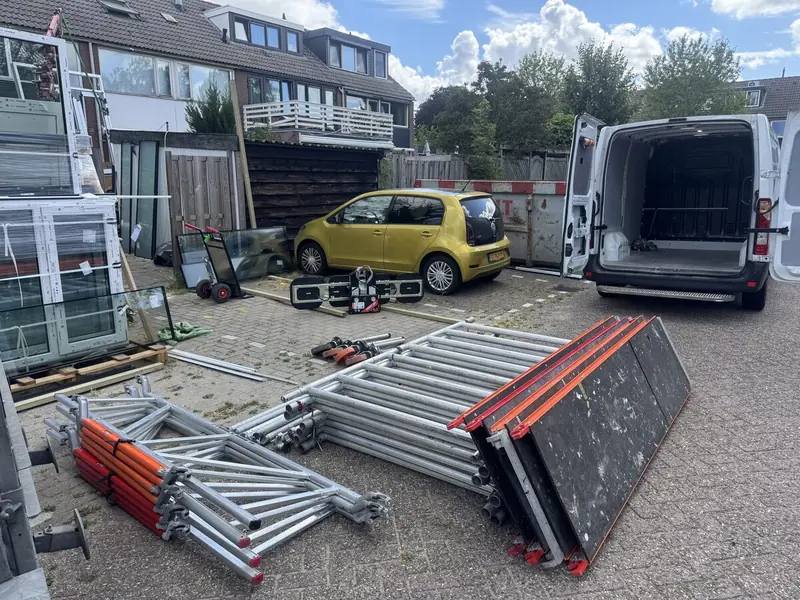
Set of scaffold parts delivered on site next to a house, brought in for a repair to lead high on the elevation

Building is your part of the arrangement: we drive the parts in and come back for them afterwards. Allow about two hours at this height and do it with two people, because someone below who passes material up works faster than dragging it all up on your own. Once the lead is finished the whole thing comes down in reverse order and you stack the loose parts neatly where they were dropped off, so nothing is left in a border or behind the shed.

Working safely at height while repairing leadwork on a tower

EN 1004 puts these towers in load class 3: 200 kg on every square metre of deck, you and your material together. On leadwork you will not get near that, but do count what goes up with you: a roll of lead, tools, a bucket of old material and sometimes a helper. Do not lay the heavy things all beside the hatch but spread them over both ends of the floor, and bring stripped material down at the end of the day rather than leaving it up there.

The moment you are standing on it, the wheels are braked and the stabilisers are out. You never move it with a person or with material on board, not even that one metre to the left. If it blows hard, you simply stop: at this height you feel every gust, and a loose strip of lead is exactly the sort of thing that gets torn out of your hands. Waiting for a calm day is not lost time on leadwork but plainly the sensible choice.

Mobile scaffold with a double guard rail and a stair inside the frame, the climb up to damaged lead

Watch what goes on below you as well. A hammer, a dresser and a piece of lead land hard, and on this job the tower often stands right beside a door or a garden path. Close that side off with tape or a cone, certainly if there are children playing outside. If you are working just after a shower, wipe the deck dry: wet aluminium with lead residue on your soles is a good deal more slippery than it looks.

In 5 steps

How hiring a mobile scaffold works

1
Choose working height

Pick the height that suits your job.

2
Book online

Sorted in 60 seconds, price shown instantly.

3
We deliver

At the agreed spot the next working day.

4
Assemble safely

Assembled by you, with a manual.

5
We collect

One call and we collect the scaffold.

Good to know

Practical tips for repairing leadwork

1

Cut the new lead to size on the ground against the old piece. Working a pair of snips up on the deck is awkward and your measurement rarely comes out right the first time.

2

Photograph the damage from the ground with the zoom on your phone before you hire anything. You then know how much lead to buy and at exactly what height you have to come out.

3

Hang a bucket on the guard rail for the old lead and the crumbs of mortar. Nothing in it falls down, and it all goes to ground in one go at the end of your working day.

4

Book your two rental days back to back rather than apart. You then build and strike only once, and on a build of this height that is by far the biggest part of the work.

5

Check the repair really is watertight before you take the tower down. A watering can over the abutment takes a minute, and you are still standing up on the deck anyway.

6

Note down where the damage sat before you let the set be collected. At the next round of maintenance you know which spot to look at and what height you came out at.

Frequently asked questions

Frequently asked questions about repairing leadwork

Which mobile scaffold is best to hire for repairing leadwork?+

For lead sitting at eight to twelve metres the wide RS52 at 135 cm is the obvious choice. Up there you need room for a roll of lead, a bucket and your tools, and a wide base stands more comfortably at that height. If the wide measurement will not pass down the side of the house, you take the narrow 75 cm version and stack your material a little tighter. Measure the narrowest gap before you reserve a tower.

How does hiring a scaffold for leadwork actually work?+

Online you pick the model and the build that suits your roof edge, you say which day the set may arrive and which day it leaves again, and you settle up at once at a rate with VAT already in it. We put the parts down at the agreed place, you build the tower and put the lead right, and afterwards you lay everything struck and complete together. On the day you chose we drive the set away again.

How many days do you need to hire the tower for a lead repair?+

Two rental days are usually enough for a single piece of damage. The work on the lead takes half a day and the rest of the time goes on building and striking a tower this tall. If there are two broken spots on different sides of the house, count on three days, because you have to move in between. Anyone tackling the whole run of flashings hires for longer, since that is covering distance rather than mending one point.

What do you pay when you hire, and what happens after day one?+

What you settle up follows from the model and the height of the build, and per province a fixed amount comes on top for bringing it and taking it away. The rental price including VAT is listed with every build on the prices page. Only that first 24 hours goes at the full rate, and each further day is charged with 95% off. Holding a tower for three days therefore comes out close to two, which gives your planning some slack.

Which working height do you hire if the lead is at the chimney?+

Measure from the foot of the future build right up to the lead itself, so not to the gutter, because at a chimney the damage lies a good deal higher. If you come out around ten metres, a build from the band of eight to twelve metres belongs with it, and you reserve that in one go for the whole job. If the tower stands in a garden lower than the street, add that difference and hire a size more generous.

Is the mobile scaffold delivered or can you collect it yourself?+

Both routes stay open on a build of this height. Choose delivery and we set the parts down on the day you picked, then come back for them once the repair is finished; bringing and collecting sit in one fixed price per province. You may also fetch the tower yourself, at no charge and by appointment, from Zeeburgerpad 89 in Amsterdam. The parts for a twelve metre build will not go in an ordinary car, though.

Do you build the mobile scaffold yourself when you hire it here?+

No, the building is yours to do. The set includes a build manual, a video online walks through each step, and two people get a tower of this height upright in roughly two hours. We deliver nothing assembled and we hire out no facade scaffolds or cherry pickers either. You decide at what height the deck hangs, which on a lead repair above the gutter is precisely the point, since that height differs per house and per chimney.

What if the lead repair runs on and you need to hire for longer?+

Almost always possible. Tell us while your collection day is still ahead of you and that date shifts back, provided the set is not booked straight out somewhere else. On leadwork that happens regularly: you take a flashing off and see the timber underneath has got wet too. Do not leave it until the last morning, because a tower already promised to the next customer cannot be held back for you, not even for one extra day.

How much clear space does the standing place of the tower need?+

Reckon on an area of roughly two by three metres, with no shrubs, wheelie bins or garden furniture in it. The stabilisers are worked into that measurement; on a tall build they stand a fair way out. The ground must be flat and load bearing, so on grass or sand you slide boards under the wheels. If you cannot free that room right under the lead, put the tower a metre to one side rather than skew on a slope and work that last metre sideways.

What happens to your rental days if the weather turns against you?+

Yes, and on this work that is often wise. In light rain you can still get on with the lead, but the deck turns slippery and sealant bonds badly to a wet surface. Strong wind is a real stopper: at this height you no longer climb up at all. Because you lay out your own rental period, you can happily leave the tower standing unused for a day and start the next morning with dry material; that still beats hiring twice.

Do you pay a deposit when hiring and when does it come back?+

Yes, on top of the hire you pay a deposit for the set, and that sum returns to your account inside one working day once the collected parts have been counted. So make sure everything lies together: on a job like this it is mainly small items such as a clamp or a brace that disappear under a shrub or behind the skip. Marks of use on a tower are no problem, but missing parts hold up the settlement.

Is hiring a scaffold for leadwork needed or will a ladder do?+

For a flashing you can just about touch from the gutter a ladder looks like enough, but repairing leadwork means tapping and pushing with force, and then you want both feet planted. At eight to twelve metres a ladder is also no place to put a roll of lead and your tools. Hiring a scaffold for leadwork costs you two days of planning and gives you a repair that stays put, even after it has blown hard a few times.

Hire a mobile scaffold for repairing leadwork today?

Calculate your rental price now or ask for free advice.

Rolsteiger van SteigerTaxi geleverd op locatie
Book it online

Your scaffold sorted in 2 minutes.

Choose your scaffold and working height, see the price instantly and book online.