
See your price
Application

Painting a facade? Choose the right scaffold.

Painting a facade is flat work. You go over every square metre with brush and roller, and not once but two or three times: a primer, a mid coat and the top coat. Every round runs past exactly the same standing places. That is why hiring a mobile scaffold here is a question of repetition. For a house of three storeys the wide RS52 with its 135 cm deck comes out best, built somewhere between 8 and 12 metres. What that means for your setups, your rental days and your planning follows here.

  • Order before 3 pm, delivered tomorrow
  • Professional Altrex scaffolds
  • Up to 14.2 metres working height
  • Easy to assemble yourself
4,2 tot 14,2 mWorking heights available
12Provinces served
7Days a week
200 kg/m²Load class 3
In short
  • For painting a facade we recommend the Wide mobile scaffold.
  • For facade painting over three storeys you take the RS52 with its 135 cm deck, in a build of 8 to 12 metres.
  • Reckon not per facade but per coat: every coat walks you past all the standing places you used before.
  • Five to eight rental days is normal, because between two coats the paint has to dry before you may carry on.
  • First 24 hours from €175 incl. VAT and delivery; every day after that 95% off.
Key facts for this job
FeatureValue
Recommended scaffoldWide mobile scaffold (Altrex RS TOWER 52)
Working height for this job8 to 12 metres
Available working heights4.2 to 14.2 metres
StandardEN 1004, load class 3 (200 kg per m²)
DeliveryOrdered before 3 pm, delivered next working day
Each extra day95% off, from €8.75 a day
Why a mobile scaffold for painting a facade?

Safe, stable and professional work at height

Painting happens in rounds, and that turns the mobile scaffold on this job into a fixed workplace rather than an aid. You put it down, paint a strip from top to bottom, roll on, and a day later you are back at the first standing place for the next coat. The smoother that circuit runs, the fewer days you need to keep it and the lower your rental price works out. On your deck there is also a tin of paint, a tray with a roller, brushes and abrasive paper, and you want to walk round all of that without kicking anything over. Hiring a scaffold for facade painting therefore means choosing on room, not only on height.

  • Deck room for a paint tin and roller tray
  • Working height to the top edge of the paintwork
  • The same standing places at every following coat
  • Rental days that include the drying time between coats
Read more about working safely →

Which wide mobile scaffold do you hire for facade painting

Anyone painting a complete facade carries more up than they expect beforehand. A tin of paint, a tray with a roller, two or three brushes, abrasive paper, a filling knife and a cloth all stand on your deck at once. On the RS52, the 135 cm wide version from Altrex, you set that down on one side and can still walk past it. That saves shuffling buckets at every strip. Which versions the mobile scaffold hire range holds is shown in the overview.

Paint with two of you and that width becomes decisive. One rolls the large face while the other cuts in around frames and junctions, and that only works pleasantly if you can pass each other without knocking something over. On the narrow RS51 at 75 cm it does not, and you spend the day waiting on each other. That narrower model comes into play only if the route to the facade is genuinely too tight for 135 cm.
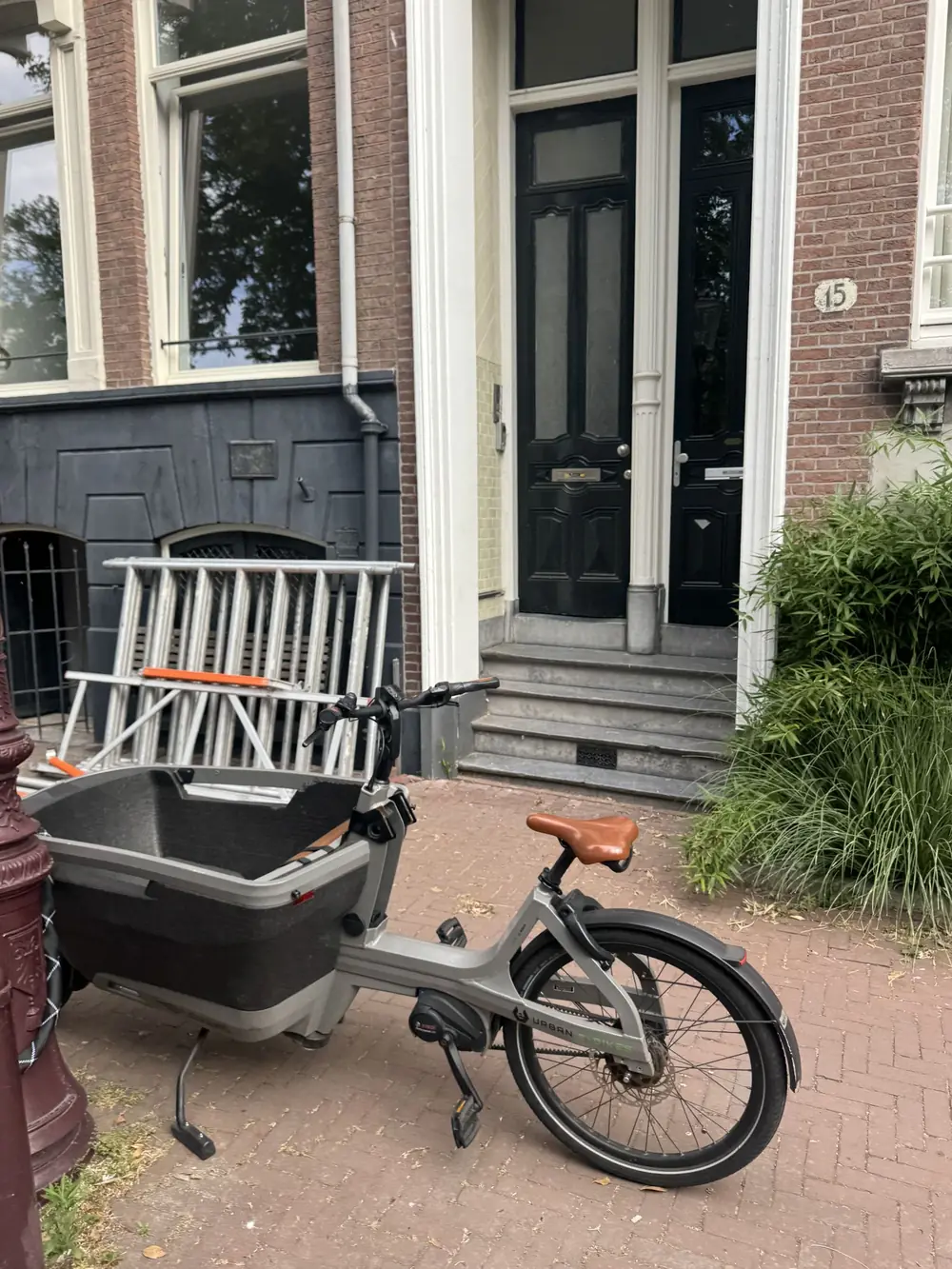
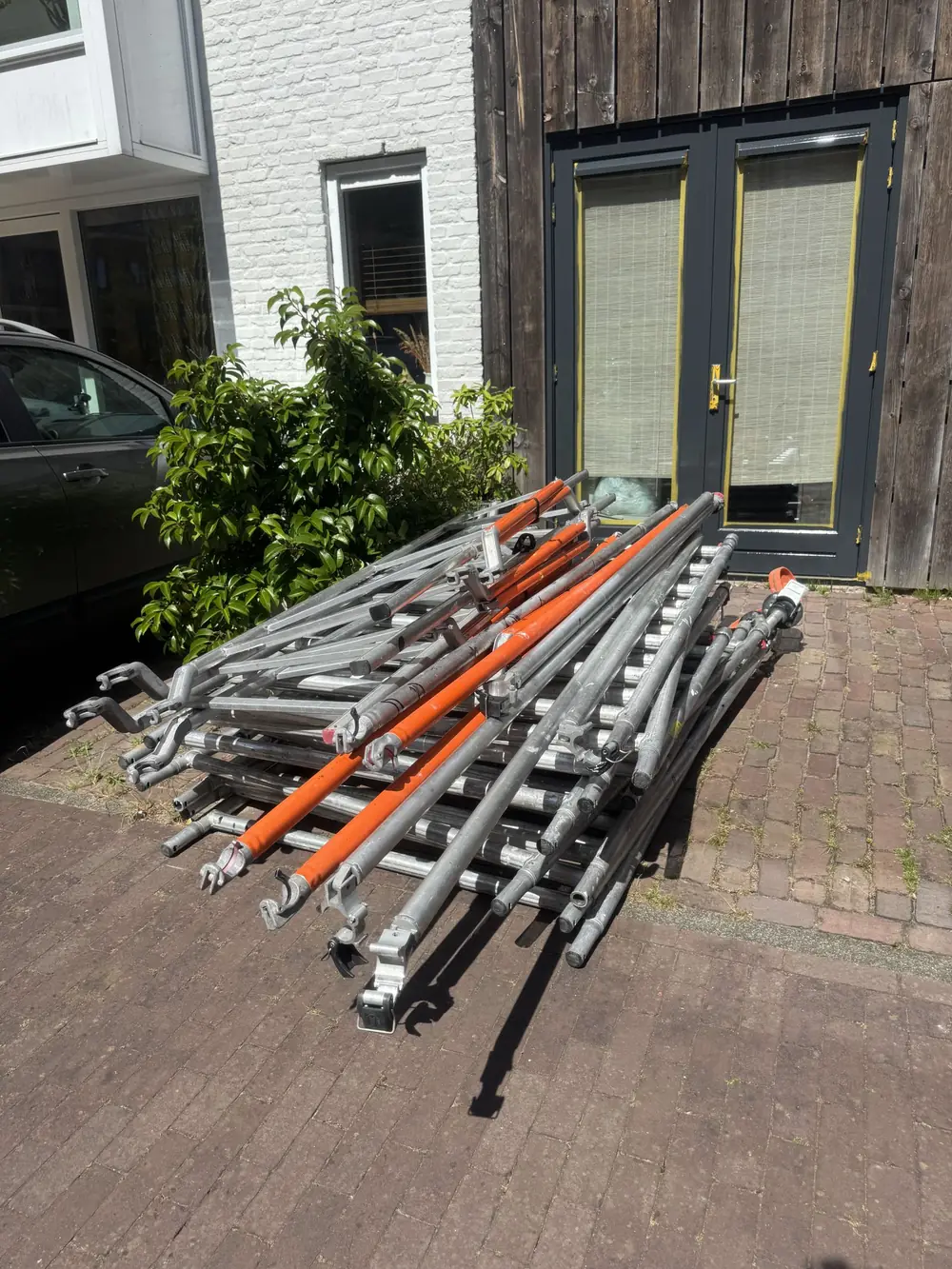
Loose frames against a house front behind a parked cargo bike, the hire kit for an Altrex RS52 measuring 135 cm

When you reserve, look separately at the model and at the build you order. As a model the RS52 can be carried to a working height of 14.2 metres and uses platforms of 245 cm, but at a house of three storeys you obviously do not order that maximum tower. You fix a build that reaches the top of the surface to be painted, in practice 8 to 12 metres, and here you need no more. Every dimension is listed in the piece on mobile scaffold sizes.
What working height to hire for a facade of three storeys

In painting the surface to be treated nearly always runs on to where the facade stops: the underside of the gutter, the junction with the fascia board or the point of a gable. That top edge sets your height, because a strip you cannot finish properly is visible from the street straight away. At three storeys your working height therefore lands somewhere between 8 and 12 metres. If a gable sits above all that, count it in before you fix the build.

The sum is simple: your platform height plus roughly two metres of reach gives your working height. For ten metres of working height your deck stands at around eight. When rolling you may count those two metres fairly fully, because an extension pole takes you a good way, but the brush edges and the junctions you want at eye level. So measure from the edge you still have to cut in with a brush. The build for ten metres of working height is set out on the matching page.

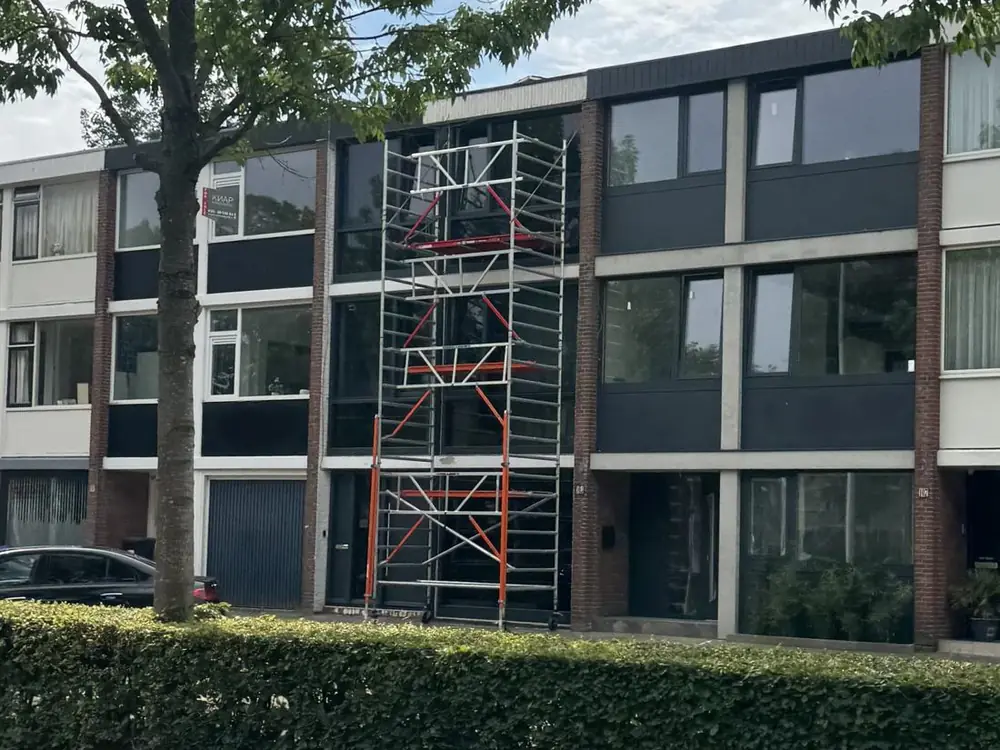
Assembled tower reaching up to the gutter on a front wall, the height painting three storeys of brickwork asks for

Always measure from the level the wheels will rest on, so not from your threshold or your patio. If the street lies lower than the front garden you can easily lose half a metre. Choose too tight and you finish that last strip with stretched arms, the coat goes thinner there, and on the second round you see exactly where you were straining. For a surface that runs up to the second floor, take one platform more.

Where does the mobile scaffold stand along the facade

Because you make the same circuit at every coat, you think here not in one standing place but in a series of them. Walk the wall and divide it up in advance into lengths that stay just inside the 245 cm of the deck. At each of those spots the ground has to be level and the four stabilisers have to come out fully. A tree, a tall hedge or an extension sitting exactly on such a boundary forces an extra setup later.

The ground matters more here than on short jobs, because the scaffold stands for days on end and keeps coming back to the same places. Setts and concrete stay under the wheels as they lie; soft ground and fresh topsoil sink a little further at every round, so your setup stands differently at every coat. If there is a path with a fall, adjust the legs per position and write down how you had them. There is more on that in the piece on uneven ground.

Stabilisers folded out on paving under a tower, showing how much level room each standing place along a wall takes

Under the setup you want room for your dust sheet on paintwork. Paint spatters further than you think, certainly when rolling, and off setts or a car it does not come away easily. Cover the plinth, the window sills and the paving before the first coat goes on, and slide that sheet along with every setup. If the tower stands partly on the pavement, clear it with the council and warn your immediate neighbours well before delivery, because they walk past it for days.

How many days do you hire the scaffold per coat

On facade painting you count not in square metres but in rounds. One round along an ordinary front wall costs you about a day with two people, moving the tower included. Put on a primer, a mid coat and a top coat and that alone is three working days, with the preparation still to come: washing down, sanding, spot priming, filling and masking. Five to eight days of hire is therefore a fair estimate for an average house, and at a corner property with two elevations it climbs further.

Between those rounds sits waiting time you have to plan round. Paint needs its overcoating time and on a cold, damp day you simply do not get it. Besides that it paints badly in full sun on a warm wall and not at all in rain, so now and then you lose half a day. Leave the mobile scaffold standing through those hours and use them for sanding, filling or preparing the next face of the wall.

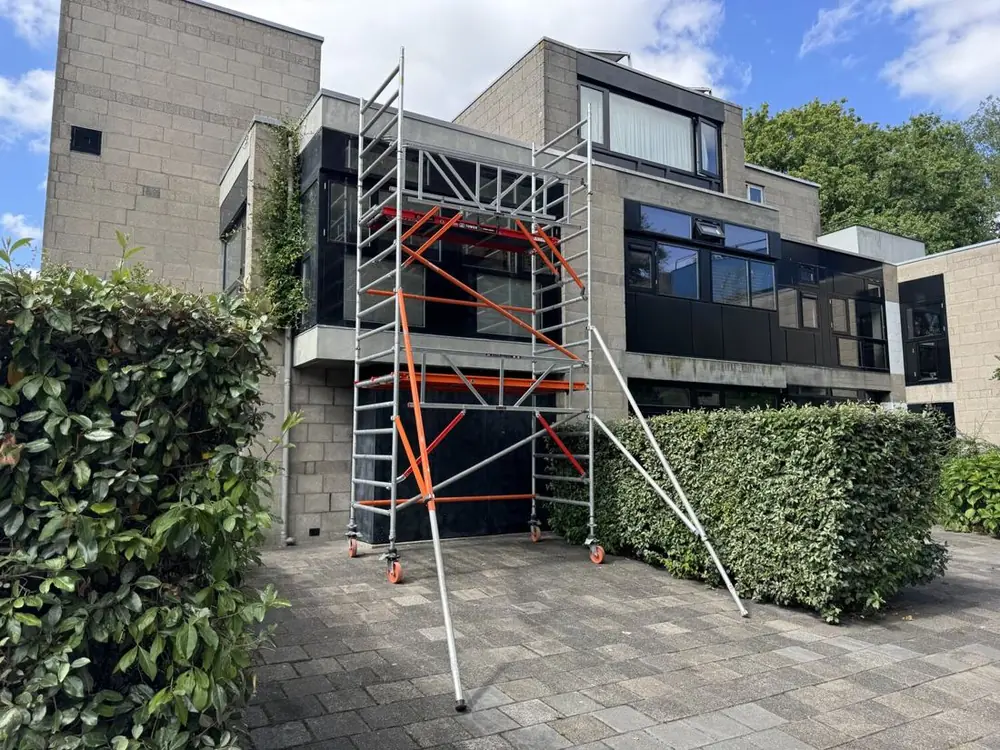
Tower along a side elevation, the setup you return to again at every following coat of paint on the wall

Those extra days weigh lightly in what you finally settle. The full rate applies over the first 24 hours; each day that follows joins the total with 95 per cent off. Two spare days for disappointing weather therefore cost you far less than a second booking, where you begin again with a full opening day and another transport comes on top. Building such a period for a job of several coats is worked out with rules of thumb in the explanation of rental periods.

Which mobile scaffold suits painting a facade?

Kamersteiger RS44
  • Working height up to 4 metres
  • Compact and narrow
  • Great for indoor and small jobs
View and calculate →
Smalle rolsteiger RS51
  • Working height up to 14.2 metres
  • Narrow (75 cm)
  • Ideal for narrow passages
View and calculate →
Most chosen
Brede rolsteiger RS52
  • Working height up to 14.2 metres
  • Wide platform (135 cm)
  • Extra stability and workspace
View and calculate →
1-persoons steiger MiTower
  • Working height up to 6.2 metres
  • Very compact
  • Quick and easy to assemble
View and calculate →

How much facade do you paint per setup of 245 cm

Your platform measures 245 cm, so per setup you treat one vertical strip of wall, a little under two and a half metres wide, from top to bottom. Finish that strip completely before you move: first cut in along frames, corners and the plinth, then roll the large face while the edge is still wet. That way the join stays invisible. Stop halfway through a strip and after drying that transition shows as a line down the whole wall.

Settle your strips on the first round and keep to them afterwards. On the second and third coat you roll the mobile scaffold back to the same places, so your joins fall on the same vertical line every time. Put those lines as far as possible on a natural break: a downpipe, a corner of the wall, the edge of a window opening. A wall ten metres wide gives four to five setups that way, and you multiply that number by the number of coats you apply.

Mobile scaffold against a wall, with a platform that covers roughly two and a half metres of facade per setup

Where people come unstuck is the carrying up. A half full tin, a tray and the roller pole are manageable, but a full tin up the ladder with both hands is asking for trouble. Hoist it on a rope or top up above from a smaller jug. Otherwise take only what you need in that one strip. If you take in the window frames in the same wall as well, allow half an hour extra per strip and add it to your total rental period.

What do you arrange for hire and delivery of the scaffold

We drop the mobile scaffold off as a counted set of loose parts. Choose a place for that stack in advance where it is not in your painting route, so not against the wall and not on the stretch of paving you want to cover. A garage, a carport or a corner of the drive is ideal. Place your order on a working day and get it in before 15:00, and the set can be lying there the next working day, on the date you gave yourself.

The assembly is your task. You get the manual with it and an instruction video is ready, and with two people you stand at height inside half a day. Plan that build a day before your first coat, because otherwise you only start painting once the sun has moved round the wall and you work half of it in the heat. Choose your delivery date with the forecast beside you as well, because a wall you cannot yet sand costs you a whole round.

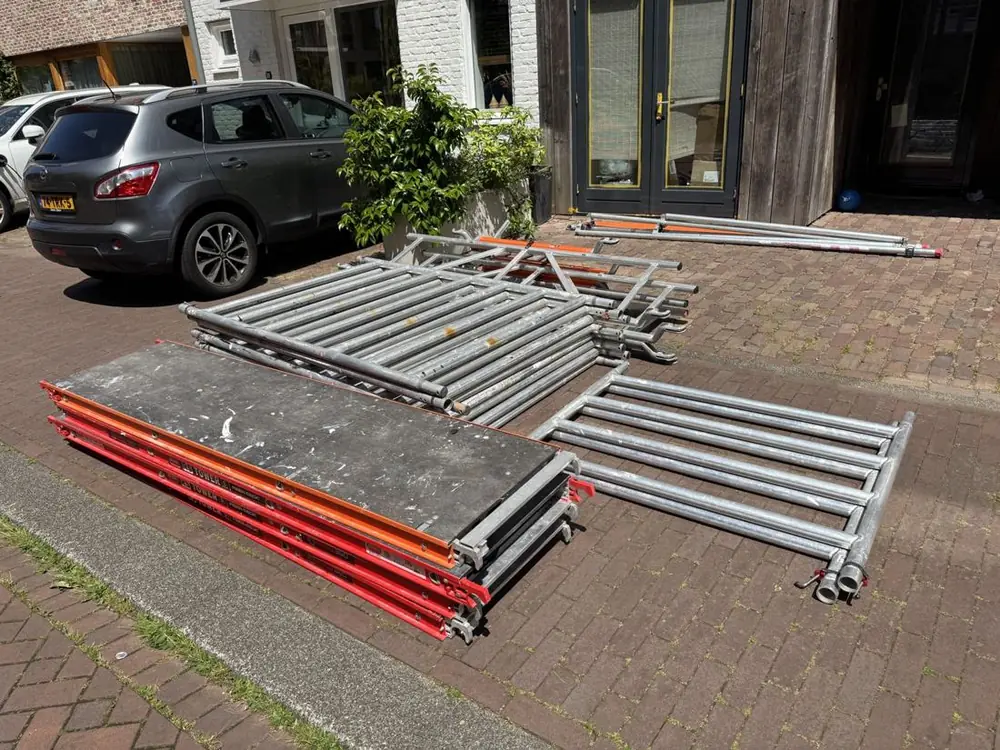
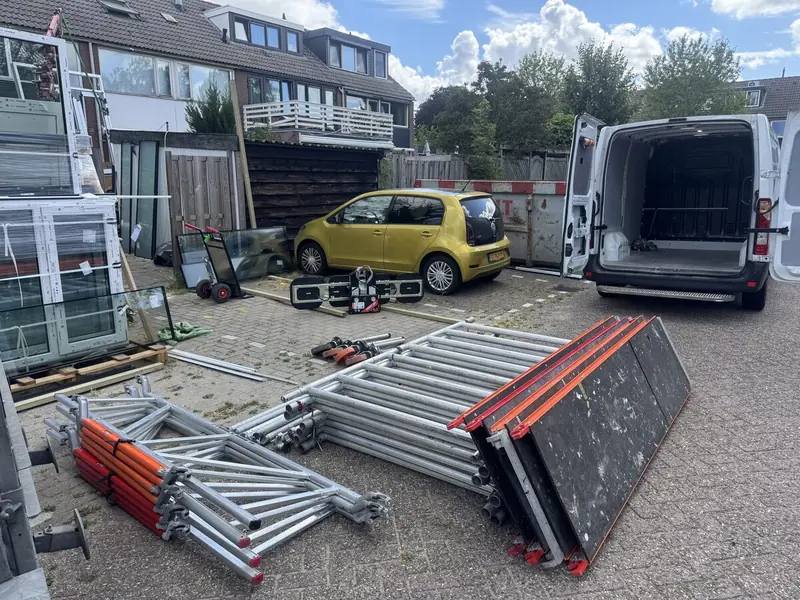
Loose scaffold parts lying in the street by a front door, waiting to be built up for facade painting

After the last coat you take the tower down and lay the parts out complete, after which we take them away again on the agreed day. Do that only when the paint has hardened through, or you will still press a dent into your fresh top coat with a tube. Wipe the platforms over with a cloth before you hand them back. Which amount applies for transport to your province is stated on the page with delivery rates per province.

How do you work safely on the scaffold while painting

These mobile scaffolds are made for 200 kg per square metre of platform, which is load class 3 as EN 1004 lays it down. For painting a facade that is ample, even with two of you up there and a filled tin beside you. Watch mainly how that weight is spread: two people plus all the material on the same side of the deck is less wise than spreading it a little. What that class exactly holds is set out in the notes on this scaffold standard.

The basic agreements stand undiminished. Brake the wheels before anyone climbs up, move the setup only when nobody is on it, take your tins and trays off before you roll as well, and climb down once the wind really picks up. On facade painting that wind limit is not purely a safety matter: in wind your paint dries away too fast and leaves and dust blow into the wet coat. Fix the four stabilisers again after every move.

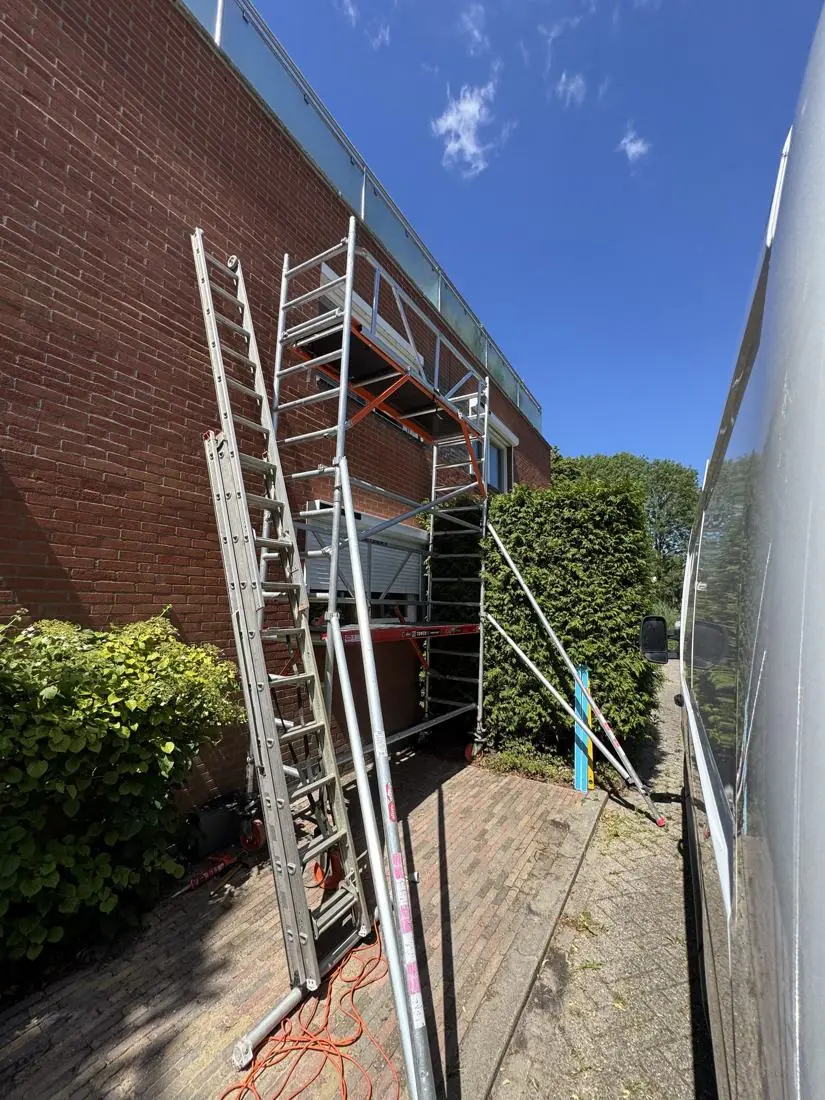
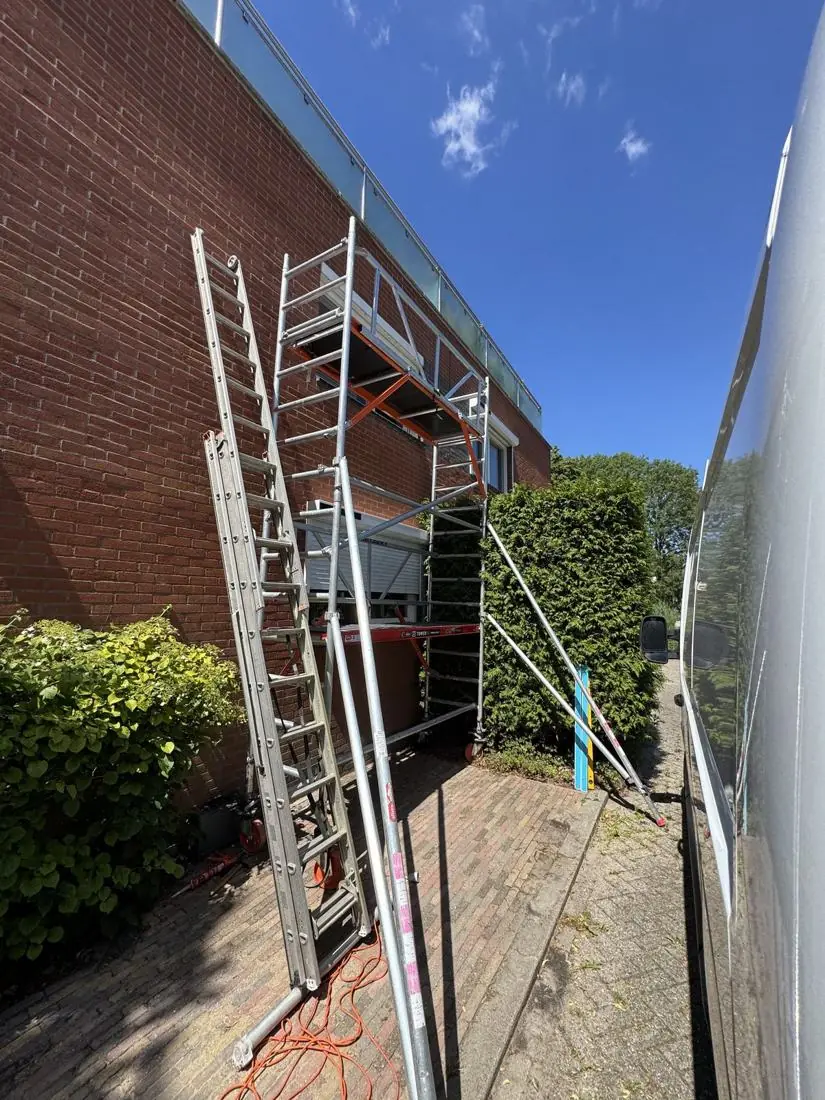
Tower built up in a narrow passage with a separate ladder leaning on the brickwork, decks in load class 3

The risk that truly belongs to paintwork is the floor under your feet. A spilled pool of paint or a soaked rag makes such a platform treacherously slippery, and you usually notice only when you step back to look at your work. So wipe spatters up at once and always stand your tin in a catch tray. Think as well about what happens below: a falling brush is a nuisance, a falling tin is downright dangerous. The further agreements are at the guidelines for work at height.

In 5 steps

How hiring a mobile scaffold works

1
Choose working height

Pick the height that suits your job.

2
Book online

Sorted in 60 seconds, price shown instantly.

3
We deliver

At the agreed spot the next working day.

4
Assemble safely

Assembled by you, with a manual.

5
We collect

One call and we collect the scaffold.

Good to know

Practical tips for painting a facade

1

Chalk a number on each standing place before the first coat goes on. On the second and third round you then roll the scaffold along exactly the same series of positions without thinking.

2

Hoist a full tin of paint up on a rope instead of lugging it with you. You keep both hands free on the ladder and nothing lands on the rungs or on the deck below.

3

Cut in all the edges of your strip first and only then roll the face. Work the other way round and the edge dries on, so the transition shows clearly in the coat.

4

Look every morning at the side of the wall that lies in shade and start there. On a sunlit wall the paint pulls away too fast and you see bands in the face on the next round.

5

Leave the mobile scaffold standing on your drying days and use them for sanding or filling. That way you make rental days productive that otherwise stood in your planning as waiting time.

6

Set your collection day at least a day behind your last coat. Fresh paint stays vulnerable, and a scaffold tube scraping past a freshly painted wall costs you half a day of touching up.

Frequently asked questions

Frequently asked questions about painting a facade

For a facade of three storeys, which mobile scaffold do you hire?+

For facade painting over three storeys the wide RS52 is the logical choice, with a deck of 135 cm. On this job you have a tin, a tray, brushes and sanding gear with you at the same time, and on a narrow scaffold you spend all day shifting them. Working with two of you makes that width doubly welcome. Only if the way through to the wall will not allow 135 cm do you move to the narrow version of 75 cm.

How does hiring a scaffold for facade painting work in practice?+

You choose a version and a build height online, state on which day the scaffold may arrive and when it leaves again, and pay a fixed amount including VAT. On the agreed day the parts lie at your house, you build up and paint your rounds, and at the end you set everything out dismantled for the van. What you must judge well in your planning is the drying time between two coats, because that decides how long you keep the tower.

How many rental days does painting a whole facade take?+

For most houses you hire a mobile scaffold for five to eight days. Count the number of coats you want to apply, allow roughly a day per coat for a complete wall and add the preparation and the drying time. Painting alone rather than with two of you adds days quickly. Because the mobile scaffold stays standing between coats anyway, you book those waiting days along with the rest instead of having it collected in between and ordering again later.

What does hiring a scaffold for facade painting cost per day?+

Your rental price depends on the version of the mobile scaffold and the height you fix, and besides that on transport to your province. The amounts sit together including VAT on the overview page with prices. Important on a job with several coats: only the opening day weighs in fully, while each day behind it barely shows in the total. Paintwork spread over a week and a half therefore works out better than you would first expect.

What working height should I hire if the facade runs up to the gutter?+

If the paintwork runs on to under the gutter of a house of three storeys, you fix a build between 8 and 12 metres and the platform itself stands at six to ten metres. Measure from the setts the wheels rest on to the last little edge you still have to cut in with a brush, so count a gable in. Which build of the tower suits which height sits clearly together on the page about working heights.

Can I have the scaffold brought, or do I fetch it myself?+

Delivery and collection in person are both fine. Have it brought and the set stands ready on your chosen day and goes with the van again after your last coat; a fixed rate per province applies for that. Would you rather fetch it? That can be done by appointment at no cost in Amsterdam, as long as your transport takes the length of the longest parts. On facade painting most people choose delivery of the mobile scaffold, because you would rather park your car outside the spatter zone.

Do you have to build it yourself when you hire a scaffold for painting?+

Yes, assembling, moving and dismantling belong to your part of the job; we take care only of the bringing and the fetching. Allow half a day on the first day for the build and only then start sanding or masking. Facade scaffolding, system scaffolding and cherry pickers are simply not in our hire range, so for painting the wall of a house the mobile scaffold stays the practical solution. Working on indoors? Then take a room scaffold from the hire range.

Can I hire for longer if a third coat of paint is added?+

Certainly. Report it and we shift your collection date, unless the mobile scaffold is already scheduled for someone else. On facade painting that happens regularly: a coat covers poorly, or the weather takes two days out. So book a day or two extra straight away, because moving back inside your reserved period costs you nothing and returning early is allowed as well. You then never have to break off halfway through a top coat because collection day has arrived.

How much clear space does a mobile scaffold need along the wall being painted?+

Besides the width of the mobile scaffold you must allow for what the stabilisers claim to left and right, and on paintwork your dust sheet and your material come on top. Reckon on a level, obstacle free run of a few metres across the full width, because you cover the same route again at every coat. Clear garden furniture, bikes and flower boxes away before the parts are delivered, then you shift nothing with a full tin in your hand.

Can I keep hiring if it rains for days during the painting?+

You leave the tower standing and move the painting. On a wet wall paint does not bond and in rain a fresh coat partly washes away, so those hours are lost. Use such a day for sanding under an overhang, for masking window frames or for touching up bare patches. Because you decide up to which day you keep it, a postponement like that as a rule adds no more than one extra day of hire to the bill.

When does the deposit come back after hiring for facade painting?+

A deposit runs alongside the whole time the mobile scaffold is with you, and once the returned set has been counted it comes back within one working day. On a painting job that turns mainly on paint: dried spatters on platforms and tubes count, just as much as missing parts. Laying a sheet on the deck and sweeping up at once saves a lot of bother. The explanation of the deposit sets out how it is settled.

Does the mobile scaffold have to pass all the standing places again at every coat?+

Yes, and that is exactly why this job takes so many days. Your deck covers 245 cm of wall, so a broad front elevation asks for four or five positions. At every coat you drive that series again, in the same order. Number the spots during the first round, then on the following coats you have nothing to measure out or guess. So reckon at hire with the number of positions times the number of coats, and add the drying time on top.

Hire a mobile scaffold for painting a facade today?

Calculate your rental price now or ask for free advice.

Rolsteiger van SteigerTaxi geleverd op locatie
Book it online

Your scaffold sorted in 2 minutes.

Choose your scaffold and working height, see the price instantly and book online.