
Knowledge base · reading time 13 min
What is EN 1004? The scaffold standard explained
EN 1004 turns up in product descriptions and quotations, yet what it means on a working day is rarely spelled out. Below is what the standard covers, what load class 3 means in kilos, which components belong to it, and which questions it deliberately leaves to you, starting with the ground under your adjustable feet.
- EN 1004 is the European standard for mobile scaffolds. What it covers, what load class 3 means in kilos, and what you still judge yourself.
- For work on your own home you normally have nothing to prove.
- No.
- No, keep the set together exactly as you received it.
What EN 1004 actually covers
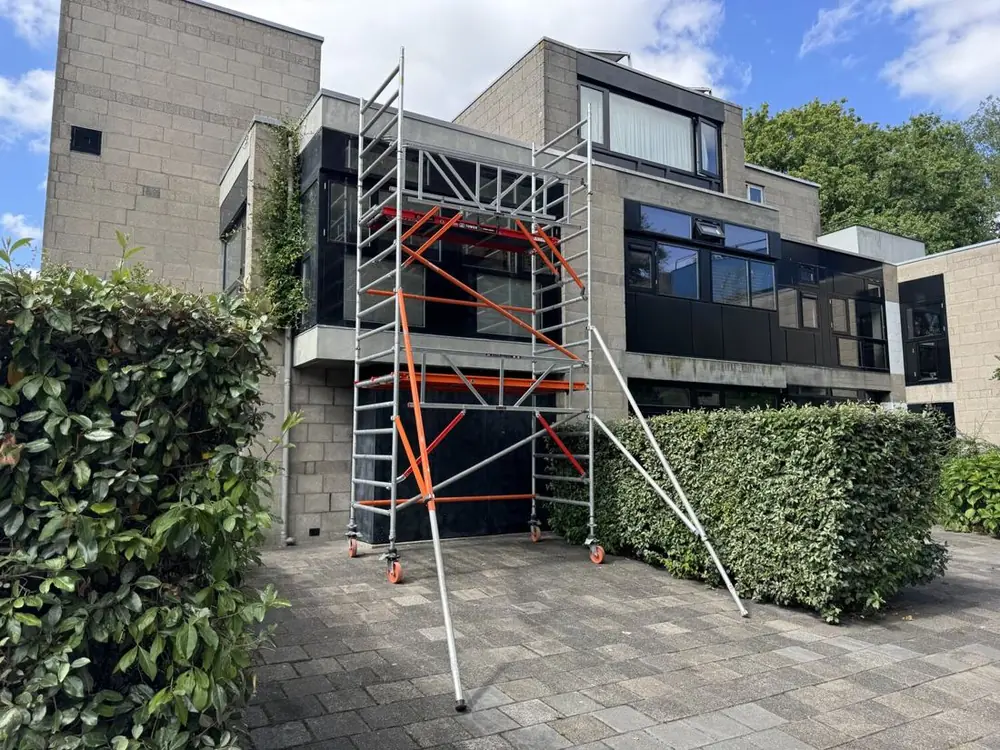
EN 1004 is the European standard for mobile access towers, known in everyday use as mobile scaffolds. The standard sets requirements for construction, strength, stability and safety, including the presence of guardrails and toe boards. It is about the equipment itself and about the way the parts combine into a structure that carries your weight without deforming or tipping. In other words, it is about hardware and about how that hardware is meant to fit together.
The key thing to understand is that a mobile scaffold is not a pile of loose parts you combine as you see fit. The standard assumes a calculated configuration: particular frames, braces and platforms belong together in a particular arrangement. Deviate from it and you are using equipment that meets the standard in a set-up that was never calculated, at which point the standard tells you nothing.
All our mobile scaffolds are original Altrex equipment built to EN 1004. What the brand adds on top of that is covered in the comparison of Altrex and other mobile scaffolds. The short version: parts that fit each other precisely, and a manual that belongs to the equipment you actually receive. That sounds obvious, but with loose second hand parts it is anything but guaranteed.
Key facts
| Feature | Value |
|---|---|
| Core answer | EN 1004 is the European standard for mobile scaffolds; all our equipment complies |
| Standard | EN 1004 |
| Load class | Class 3: 200 kg per m² |
| Models | Altrex RS Tower 51/52, RS44 and MiTower |
| Working height | Platform height + 2 metres |
Load class 3: 200 kilos per square metre
Our equipment is load class 3, which works out at 200 kilos per square metre of platform. That figure is the reason you can work on a mobile scaffold with tools and material rather than with yourself alone. One important detail: the 200 kilos includes the people on the platform. Two adults with a tool box are already close to that limit, so do the sum before you start stacking.
Spread the weight across the platform as well. Putting everything in one corner is not the same as laying the same weight out evenly, even though the total is identical. Place heavy items above an upright rather than in the middle of a span. What that means for a stack of cladding boards or a bucket of mortar is set out in scaffold loading and weight.
The load class says nothing about the ground the scaffold stands on. Those 200 kilos per square metre describe what the platform carries, not what your lawn or terrace can take. Those are two separate questions, and only the first is answered by the equipment. The second is yours to judge, every time, at the spot where the tower will stand.
Parts you find in a scaffold built to the standard
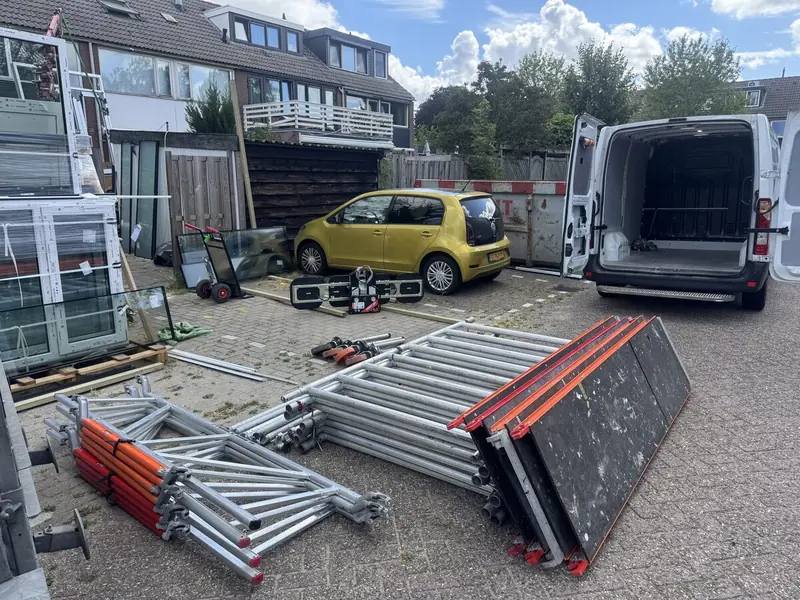
Unpack a mobile scaffold and it becomes clear how few parts you could leave out without noticing. That is no accident. Every component has a job in the structure, and it is precisely the least exciting looking parts, such as a horizontal brace, that keep the rest square. These are the components that appear in nearly every build: Learning what each one does is the quickest way to spot a set that is short of something.
The parts most often left in the pile are the toe boards and the last diagonal brace, because the tower looks perfectly fine without them. That is exactly the problem: you only feel the effect of a missing brace under load or sideways force, and by then you are already standing on it. Braces are not finishing touches, they are what makes the frame a frame.
Count the parts on receipt, before you start. A scaffold that turns out to be short of a component halfway through assembly is far more annoying than one you start building an hour later. If something is missing, report it straight away so we can sort it out before your job stalls. Sort them by type on the ground while you count, so an odd number in a pile stands out immediately.
- adjustable feet for levelling the structure
- castors with a brake, so the tower cannot roll away
- uprights and frames that build the height
- diagonal and horizontal braces that stiffen the structure
- platforms, usually with a hatch to climb through
- guardrails around the working platform
- toe boards along the edge of the platform
Why the assembly order is part of the standard
A mobile scaffold is calculated not only as a finished structure but as a process. While you assemble it you are standing on something that is not yet complete, and the order in the manual exists so that you never stand on a level that has no edge protection. That is why you climb up only after the guardrails of the level below are in place, rather than the other way round.
We deliver the equipment in parts and do not assemble it for you. You build the scaffold yourself, using the manual and the instruction video supplied with your booking. That manual belongs to the model you actually have in front of you, so follow it rather than a video for another brand. The step by step assembly guide walks through the sequence.
Dismantling follows the reverse order, and in practice that is where things go wrong most often. At the end of the day everyone wants to be finished, and the edge protection is the first thing to disappear. Keep to the order there too, and take the guardrails off the level you are standing on last rather than first. So take the guardrail off the level you are standing on last, rather than first.
What goes wrong when you leave a part out
A scaffold without toe boards works exactly as pleasantly as one with them, right up until a screwdriver rolls off the edge while somebody is standing underneath. Toe boards are there for the people below rather than for you, which is why they belong in the build and not on an options list. They also stop your own foot when you step backwards.
A missing diagonal brace is less visible and more dangerous. Without it the frame can deform within its own plane, rather like a rectangle collapsing into a parallelogram. Under a purely vertical load you will not notice, but you will as soon as you push sideways or the wind picks up. There is more on this under stabilising and anchoring.
A guardrail you take out for a moment to pass material up belongs straight back in. It sounds excessive, but handing things up is exactly when you lean forward with both hands full. That is the situation the standard and fall protection on a mobile scaffold are designed for. A few seconds of clipping a rail back in does not weigh against that one moment with your hands full.
What the standard covers and what you cover on site
The standard covers the equipment and the calculated configuration. Everything beyond that, from the weather to the pavement, stays your judgement. That distinction is not academic: it decides what you have to watch and what you can rely on. The table below sets out that division per topic, so you know which questions you have to answer yourself. Read it before you book rather than once the parts are lying on the pavement.
The right hand column is where most problems actually start. Equipment that meets the standard, delivered as a complete set, rarely fails. A tower standing on a settled paving slab, or one moved with somebody on it, does. The rules for working at height go further into that part. Almost everything in that column costs you a minute, and almost everything you skip costs you a day.
| Topic | Covered by the standard | What you do on site |
|---|---|---|
| Strength of the parts | calculated and tested equipment | replace nothing, improvise nothing |
| Platform loading | load class 3, 200 kg per m2 | add up yourself, tools and material |
| Edge protection | guardrails and toe boards belong on it | fit them and leave them fitted |
| Stability of the build | configuration with braces and stabilisers | assemble in the correct order |
| Ground conditions | not covered, it does not know your pavement | level the base and use base plates |
| Weather and wind | not covered | remove sheeting, limit height, stop in strong wind |
| Moving the tower | castors with brakes as a starting point | brakes off, nobody aboard, then lock again |
What EN 1004 does not solve for you
The standard is about the scaffold, not about the circumstances you use it in. It does not know your garden path, is unaware of the crawl space under the paving and holds no opinion about the wind on Thursday. That does not make it less valuable, but it does mean you cannot treat it as the answer to every safety question on a job.
It also says nothing about how much experience you need. What it does do is make assembly predictable: follow the manual and you end up with the structure that was calculated. That is precisely why following the manual carries so much weight, even when you feel you already know the pattern by heart from the last job. Even an experienced builder reaches for the manual again the moment a different model turns up.
Finally, the standard does not govern what equipment looks like after three years of hire. That is why we check our equipment between hires and supply complete sets. What we do there is described on about us. If something does not look right when it arrives, report it before you start assembling. The short list further down this guide covers what to check yourself on delivery.
Working height, platform height and the range we carry
Working height is platform height plus two metres, because an adult reaches roughly two metres above the platform. That is the rule you need to get from a gutter or a dormer to an actual model. If the gutter sits at six metres, the matching platform height is four metres, and therefore a tower you build to that height. Measure from the surface the tower will stand on rather than from the front door.
Our range covers working heights from 4.2 to 14.2 metres. The working height page lets you choose metre by metre and shows which model belongs to each. The difference between the narrow and wide versions is simple: the RS51 is 75 centimetres wide, the RS52 is 135 centimetres wide, and both have a platform length of 245 centimetres. That 245 centimetre platform length is identical on both, so your reach per set-up does not change with the width.
For interiors and for one person work there are other models. The RS44 room scaffold passes through a standard interior door from around 70 centimetres, which you will find on the room scaffold page. The MiTower is a one person tower reaching up to 6 metres working height, meant for work you assemble and carry out alone. Both are original Altrex equipment built to the same standard as the full size towers.
Checking that you received a complete scaffold
The standard only helps if the scaffold in front of you is genuinely complete. So go through the set on delivery, before you lift the first frame. It costs a few minutes and prevents you discovering halfway through that a brace is missing and spending the day on half a tower. Lay the parts out sorted by type while you do it.
This is what you check while unpacking, and it goes faster if you lay the bundles out by type. Compare the numbers against the height you booked, because the set is put together for that build. Work through the seven points below before you lift the first component off the ground. If something is missing, you would far rather know now than when you are four metres up.
If something is short or damaged, call or message straight away. The full list covering the whole hire period, from delivery to return, is in the mobile scaffold hire checklist. What still has to happen when you hand the equipment back is described separately in the guide on dismantling and returning. Do it before you lift the first frame, so you never have to dismantle halfway through.
- all frames and uprights for the height you booked
- the diagonal and horizontal braces belonging to that build
- platforms with a working hatch and a catch
- guardrails for every level you intend to work on
- toe boards all round, including the short sides
- adjustable feet that turn smoothly and castors whose brakes hold
- the manual, so the sequence is to hand
Self assembly with the manual and the video
You assemble the scaffold yourself. We drop the parts at the agreed spot and do not build it for you, so plan the assembly time into your day. With your booking you receive a manual and an instruction video that runs through the sequence, from the base frame with adjustable feet to the top guardrail. Watching the video before the equipment arrives is time well spent.
Working in pairs makes assembly noticeably faster, especially from the second platform level, because you can hand parts up instead of climbing down each time. Building alone is possible, but expect more trips up and down. For indoor work on your own the MiTower is often the more practical choice than a full size tower. Agree in advance who stands up top and who passes parts, so you are not negotiating every step.
If you are unsure during assembly whether something is seated properly, stop and check the manual rather than carrying on. If you cannot work it out, you can reach us on WhatsApp. Many separate questions about assembly, use and return are also answered under frequently asked questions. A brace in the wrong place takes two minutes to correct, three levels built out of true does not.
Hiring equipment built to the standard: delivery, deposit and return
Order before 15:00 and we deliver the next working day, anywhere in the Netherlands. Delivery and collection are covered by a fixed amount per province, so you know the transport figure in advance. What that means for your region is on the delivery costs page. Collecting the equipment yourself is free by appointment at Zeeburgerpad 89 in Amsterdam. We drop the equipment at the spot you give us when booking.
The deposit on delivery is 500 euro for the RS51, the RS52 and the MiTower, and 150 euro for the room scaffold. If you collect it yourself the deposit is 1000 euro for the RS51 and RS52, 750 euro for the MiTower and 150 euro for the room scaffold. It is returned within one working day after the equipment comes back, as explained under the scaffold deposit.
The hire period works simply: the first day is charged at the full rate and every following day costs 5 percent of that day rate. As a result, leaving a tower standing for a few extra days is rarely a problem and you do not have to rush a job. Current rates per model are on the prices page.
Frequently asked questions
Do I have to prove anything about EN 1004 on a job?
For work on your own home you normally have nothing to prove. Working for a client is different, since they may ask what equipment you use. Our equipment is original Altrex built to EN 1004, so you can state which model you hired and which build height you used.
Is a scaffold built to EN 1004 automatically safe?
No. The standard covers the equipment and the calculated configuration, not the circumstances. A tower standing out of level, a missing brace or strong wind still make the situation unsafe. Safety appears only when good equipment and correct assembly come together.
Can I combine parts from different scaffolds?
No, keep the set together exactly as you received it. The configuration is calculated with specific parts, so a frame or brace from another model does not belong in it. If something is missing, ask for the missing part rather than substituting something else.
Does the standard apply to the room scaffold and the MiTower too?
Yes, our equipment is original Altrex built to EN 1004, including the room scaffold and the MiTower. The difference lies in the dimensions and the intended use, not in the requirements for the structure. The room scaffold passes a 70 centimetre interior door and the MiTower reaches 6 metres working height.
How much does a scaffold built to the standard weigh?
That varies by model and build height, since you assemble it from separate frames and platforms. For transport the length of the parts matters more than the weight of any single component. If you choose delivery it does not arise at all, because we bring and collect the equipment.
What should I do if a part is damaged?
Report it before you start assembling, so as soon as you spot it while unpacking. Never build on with a deformed frame or a brace that does not click home, because that means departing from the calculated configuration. We will sort it out so you can carry on with a complete set.
Why is there a hatch in the platform?
The hatch lets you climb up inside the structure instead of on the outside. That is the intention: you climb on the inside and close the hatch again once you are up. It keeps you within the edge protection at the moment you are most exposed.