
Knowledge base · reading time 13 min
Altrex or another mobile scaffold?
When you hire a mobile scaffold you are not comparing brochures but a set of parts dropped at your address. We hire out original Altrex equipment built to EN 1004, yet the brand is only part of the story. Below is what the standard covers, how to recognise fit and wear, and which part of safety always stays with you.
- Altrex or another brand? What EN 1004 does and does not cover, how to spot fit and wear, and the part of safety no brand solves for you.
- We hire out original Altrex mobile scaffolds, a leading brand that meets the EN 1004 standard.
- The standard is the starting point and covers construction, strength and stability.
- No, keep the hired set together exactly as you received it.
What you are really comparing when you compare brands
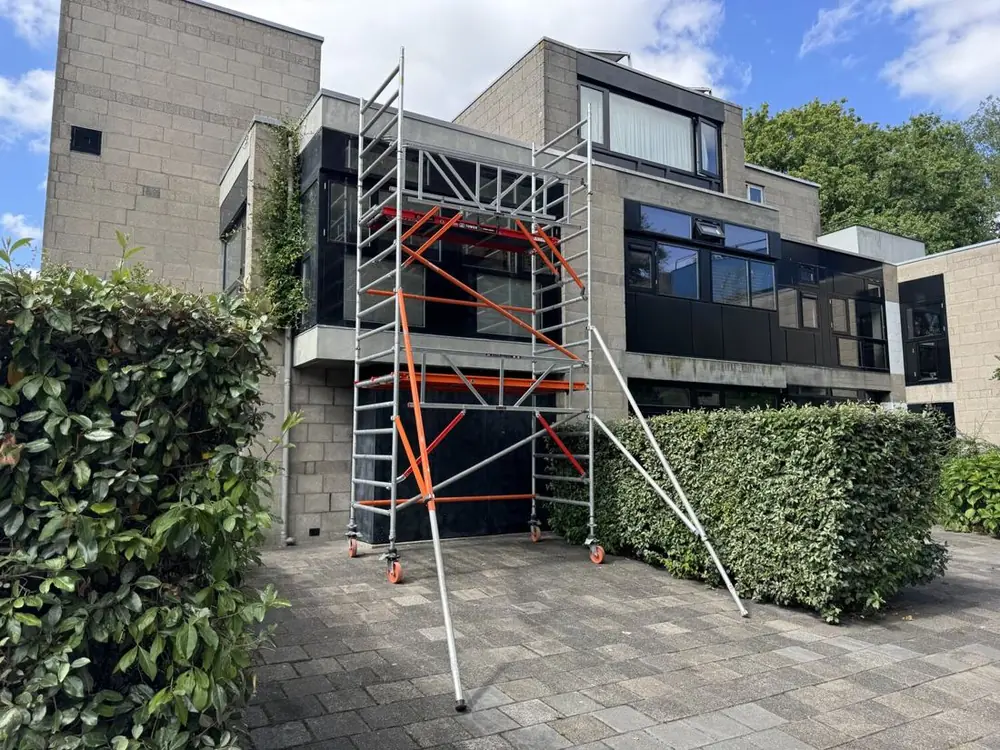
The question about brand nearly always comes from a different question: will I get a scaffold I am happy to stand on? When you hire, you are not comparing brochures but a set of parts dropped on a pallet at your address. What that set is worth depends on three things: whether it meets the standard, whether it is complete, and whether the parts go together smoothly when you are in a hurry.
Those three do not move together. A scaffold can meet the standard and still be a set where every brace has to be forced, and a set can be complete without including the manual that belongs to that model. So when you judge equipment it pays to look at those points separately rather than bundling them under the word quality.
We hire out original Altrex mobile scaffolds, a leading brand that meets the EN 1004 standard. Below is what that means in practice, what to check on any equipment at all, and where the brand question ends and your own way of building begins. That last part is what makes the biggest difference on a working day. Anyone judging only by the badge is looking at the easiest part of the question.
Key facts
| Feature | Value |
|---|---|
| Core answer | We deliberately hire out only Altrex: EN 1004, class 3, proven quality |
| Models | Altrex RS Tower 51/52, RS44 and MiTower |
| Standard | EN 1004 |
| Load class | Class 3: 200 kg per m² |
| Deposit | Refunded within 1 working day of return |
EN 1004 is the floor, not the ceiling
EN 1004 is the European standard for mobile access towers and sets requirements for construction, strength, stability and safety, including guardrails and toe boards. A scaffold that meets it has been calculated as a whole: particular frames, braces and platforms belong together in a particular configuration. What the standard does and does not cover is set out in the explanation of EN 1004.
A load class comes with it. Our equipment is load class 3, which works out at 200 kilos per square metre of platform, including the people standing on it. That figure decides whether you can work with tools and material or only with yourself, so it is one of the few hard numbers that genuinely tell you something. More on it under loading and weight.
The standard says nothing about how pleasant a scaffold is to build, how quickly a brace clicks home or what the parts look like after three years of hire. Two sets that both meet the same standard can feel very different on site. That is exactly the territory where the brand and the condition of the equipment matter, and what you should be looking at when hiring.
Fit: where you feel the brand in your hands
The difference between equipment that goes together well and equipment that does not shows within ten minutes. Frames that slide over each other without wrestling, braces that click audibly home instead of merely hanging on, hatches that stay shut as you climb through: those are the things that set your assembly time. They also decide whether you are tempted to leave an awkward part out.
That last effect is why fit is a safety subject rather than a comfort one. A brace that goes in badly is skipped sooner on a Friday afternoon than one that seats first time. Equipment that assembles smoothly therefore leads to more complete towers, and that effect outweighs any difference in specification between two models. So allow an extra half hour for a set that builds stiffly, because rushing and skipping sit very close together.
Look at the condition of the aluminium as well. A dent in an upright, a bent brace or a platform with play are all signs that a part has seen an impact. Such a component does not belong in a build, however sound the rest of it looks. How aluminium and steel differ in general is covered in the comparison of aluminium and steel scaffolds.
What to check on any mobile scaffold
Whether you hire from us, hire elsewhere or take something on second hand, the inspection is the same. You check whether the set is complete for the height you intend to build, whether the parts are undamaged, and whether the moving components do what they should. It takes a few minutes and happens on the ground, before the first frame goes up.
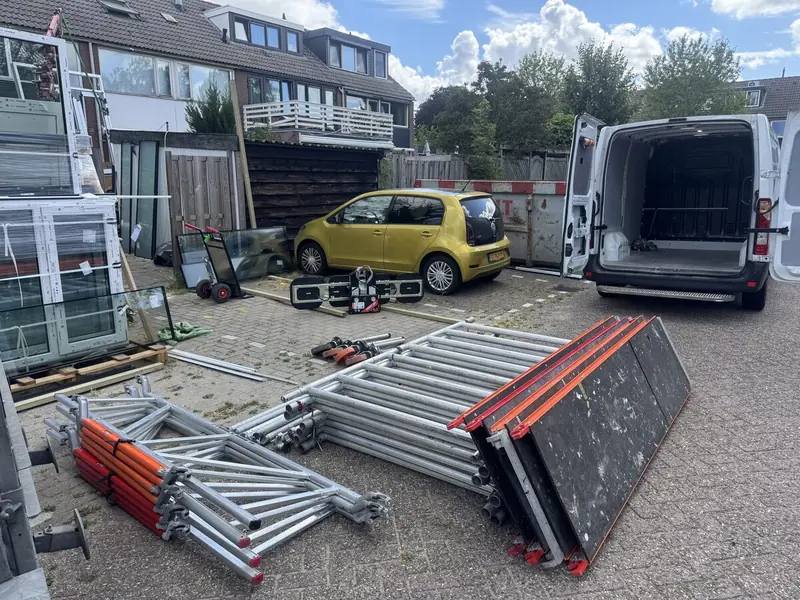
This is the round you make, and it is the same for every brand and every hire company. Lay the parts out by type on the ground rather than pulling them from the bundle while you build. The seven points below together cover everything you can judge without tools. Allow about five minutes for it and do it before you lift the first upright off the ground.
If something is short, report it before you begin assembling. Discovering halfway up that a brace is missing means either standing on an incomplete structure or lowering everything again. It is the sort of five minute check that people skip precisely on the days when they can least afford the delay it prevents. Count the bundles by type as you go, so an odd number of braces shows up immediately.
- enough frames and uprights for the height you booked
- all diagonal and horizontal braces, since those are most often short
- platforms with a hatch that closes and does not jam
- guardrails for every level you intend to work on
- toe boards all round, including the short sides
- adjustable feet that turn freely and are not fouled with dirt
- castors whose brakes genuinely hold rather than slip
What to look for and how to test it
A checklist only helps once you know how to test each point. Most of it you can judge with your hands in half a minute, without tools. The table below sets out, per component, where things go wrong and how you check it in practice, so you are not relying on how it looks from a distance. Do the check on the ground with the parts laid out, not while you are already building.
If you find something that is not right, do not use the part and ask for a replacement. Improvising with a clamp, tape or a component from elsewhere is exactly the point at which the calculated configuration stops being valid. When in doubt a phone call is easier than the risk of having to dismantle halfway through the job. Getting a replacement part costs a day at most, while dismantling a half built tower costs you the job.
| Component | Where it goes wrong | How you check it |
|---|---|---|
| Uprights and frames | dents, bent tube, play in joints | sight along the tube and lay it on a flat surface |
| Braces | does not click home, deformed hook | hook it in and pull on the far end |
| Platform | play, hatch jamming or not closing | open and close the hatch and load the deck |
| Guardrails | missing or not lockable | fit one and push it sideways |
| Toe boards | incomplete, usually the short sides | count them against the number of platform levels |
| Adjustable feet | thread fouled or damaged | wind fully in and fully out |
| Castors | brake slips, wheel does not run true | apply the brake and try to push the tower |
The Altrex models we hire out
The RS51 is the narrow mobile scaffold at 75 centimetres wide and the RS52 the wide one at 135 centimetres. Both have a platform length of 245 centimetres, so your reach per set-up is the same and the difference lies in the width of passage you need and the room you have on the deck. The dimensions per model are in the guide on dimensions and sizes.
For interior work there is the RS44 room scaffold, which passes through a standard interior door from around 70 centimetres. That lets you roll from room to room without dismantling, which saves a lot of time on ceiling work across several rooms. Take a look at the room scaffold. Working alone, the MiTower is often more practical: a one person tower up to 6 metres working height.
The full range covers working heights from 4.2 to 14.2 metres. Working height there is platform height plus two metres, because an adult reaches roughly two metres above the deck. The working height page lets you choose metre by metre which model suits your job, so you are not guessing between two build heights. If you fall between two heights, take the higher one and build a level lower if you need to.
Why brand weighs differently when you hire
Buying a scaffold means buying a set of problems with it: storage, maintenance, transport and keeping track of parts that disappear over the years. Brand weighs heavily there, because you work with the same set for years and need to be able to order individual components. The trade off is set out under hiring or buying a scaffold. Factor in that a purchased tower has to live somewhere all year, including the months you never touch it.
Hiring shifts the weighting. You use the set for a few days, so a ten year service life is not your concern. What is your concern: do you get a complete set, does everything fit together, and does the correct manual come with it. A good brand helps with that, but the condition the equipment is hired out in counts at least as much.
For companies working at height regularly the sum changes again, because frequency and administration come into play. That situation is described separately under hiring or buying for businesses. In both cases the comparison gets easier once you write down how often you genuinely need a tower in a year. Put a year of jobs on paper for that, including the days the tower merely stood there doing nothing.
What happens between two hires
Equipment that goes out on the road every week wears differently from a scaffold sitting in a shed. That is why we check our equipment between hires and supply complete sets, so you are not left with half a tower on delivery. What else we do, and where we come from, is described on about us. Wear also shows in the details first, such as the threads of adjustable feet and the hooks on braces.
For you that mainly changes the order of your working day: you do not have to plan around a set that might be incomplete, but you do still check it. Those two things are not in conflict. Count the parts on receipt and report anything that is wrong straight away, so it is resolved before you are standing at height.
The same applies on return. Dismantle in reverse order, bundle the parts at the spot where the set was dropped and keep the small components together. That keeps sight of what goes back, which also keeps the deposit settlement smooth. The full list is in the mobile scaffold hire checklist. Small parts are what go missing, and they go missing at the end of the day rather than the start.
Never mix parts, not even within one brand
The temptation is strong when a brace is missing and there is an old tower in the shed. Do not do it. The configuration is calculated with specific components in a specific arrangement, and a part that happens to fit does not therefore belong in it. Even within one brand, series differ in dimensions and in the way braces lock.
The same goes for parts you have modified yourself, from a board laid on a platform to a clamp holding something in place. Every modification takes the structure out of the arrangement it was calculated in. If something is missing, ask for the correct component rather than improvising, even when that costs you a day. A board you add yourself also counts towards the 200 kilos per square metre the platform is rated for.
The same discipline applies to the assembly itself. Keep to the order in the manual and climb up only once the edge protection of the level below is in place. The step by step assembly guide runs through that sequence, including the point at which the stabilisers go on. Do not skip the sequence because you know it, since that is exactly when a brace drops out of the series.
What no brand solves for you
A scaffold of any brand stands out of level if the ground is out of level, blows over if you leave it out in a storm with sheeting attached, and tips if you move it with somebody on board. The brand handles the structure, you handle the circumstances. That distinction matters, because it decides where your attention should go on the day itself.
This part always stays your responsibility, whatever equipment is standing outside your door and whoever delivered it. These are six things you handle on the day itself and that no manufacturer can take off your hands. Run through them before you first climb up and repeat them after every reposition. Together they take less time than unpacking your tool box does.
The first point is the most underestimated. A settled paving slab or a soft lawn does more to your stability than any difference between brands, and you solve it with adjustable feet and base plates. How that works per surface is covered under a mobile scaffold on uneven ground, and the wider framework under the rules for working at height.
- judging the ground and levelling the tower
- locking the castors before you climb
- fitting the guardrails and toe boards and leaving them fitted
- spreading the load and staying within 200 kilos per square metre
- stopping in strong wind and removing any sheeting
- never moving the tower with a person or loose material on the platform
Hiring from us: delivery, deposit and rates
Order before 15:00 and we deliver the next working day, anywhere in the Netherlands. Delivery and collection are covered by a fixed amount per province, so you know what transport does in advance. What that means for your area is on the delivery costs page. Collecting the equipment yourself is free by appointment at Zeeburgerpad 89 in Amsterdam, provided you have transport space for the long parts.
The deposit on delivery is 500 euro for the RS51, the RS52 and the MiTower, and 150 euro for the room scaffold. For self collection the deposit is 1000 euro for the RS51 and RS52, 750 euro for the MiTower and 150 euro for the room scaffold. It comes back within one working day after return, as explained under the scaffold deposit.
You assemble the scaffold yourself, using the manual and the instruction video supplied with your booking; we do not build it for you. The first hire day is charged at the full rate and every following day costs 5 percent of that day rate, so a job that overruns is rarely a problem. Rates per model are on the prices page, and for borderline cases you can reach us on WhatsApp or the contact page.
Frequently asked questions
Which brand of mobile scaffold do you hire out?
We hire out original Altrex mobile scaffolds, a leading brand that meets the EN 1004 standard. That applies across the range, including the room scaffold and the MiTower. The equipment is load class 3, which works out at 200 kilos per square metre of platform.
Is a premium brand necessary, or is the standard enough?
The standard is the starting point and covers construction, strength and stability. A quality brand adds fit, complete series and available spare parts, and you notice that mostly while assembling. In practice the condition of the equipment matters at least as much as the badge on it.
Can I combine a hired scaffold with my own parts?
No, keep the hired set together exactly as you received it. The configuration is calculated with specific components, so a frame or brace from your shed does not belong in it, even if it fits. If something is short, ask for the missing part instead.
How do I tell that a scaffold is worn out?
Look for dents in the tubes, bent braces, play in a platform and a hatch that jams. Also wind the adjustable feet fully in and out and test whether the castor brakes really hold. If a component leaves you unsure, do not use it and ask for a replacement.
Does the brand affect assembly time?
Yes, more than you would expect. Parts that slide together easily and braces that click audibly home save time and make people less likely to skip something. That effect on how complete the finished tower is outweighs most specification differences between models.
Do I get the correct manual with a hired scaffold?
Yes, your booking includes the manual and an instruction video belonging to the model you actually receive. Follow those rather than a video for another brand, because the sequence and the locking details differ per series. That is how you end up with the configuration that was calculated.
Is a more expensive scaffold automatically a safer one?
Not automatically. Safety comes from equipment that meets the standard, a complete set and correct assembly on sound ground. If one of those three is missing, no brand compensates. So put your attention into counting the set and keeping to the assembly order.