
Knowledge base · reading time 11 min
Mobile scaffold or facade scaffold: what do you need?
A mobile scaffold stands on castors, fits in a van and is assembled by you. A facade scaffold is erected around a building by scaffolders and stays up until the work is finished. The choice comes down to the size of the job, how long it runs and the space around your house. Below both options sit side by side, with the dimensions, lead times and conditions that apply at Steigertaxi.
- Mobile scaffold or facade scaffold? Compare assembly, mobility, working height, hire period and space, and pick the right one for your job.
- Yes, you work the facade in bays.
- No, you assemble the scaffold yourself.
- The range runs from 4.2 to 14.2 metres of working height.
What a mobile scaffold actually is
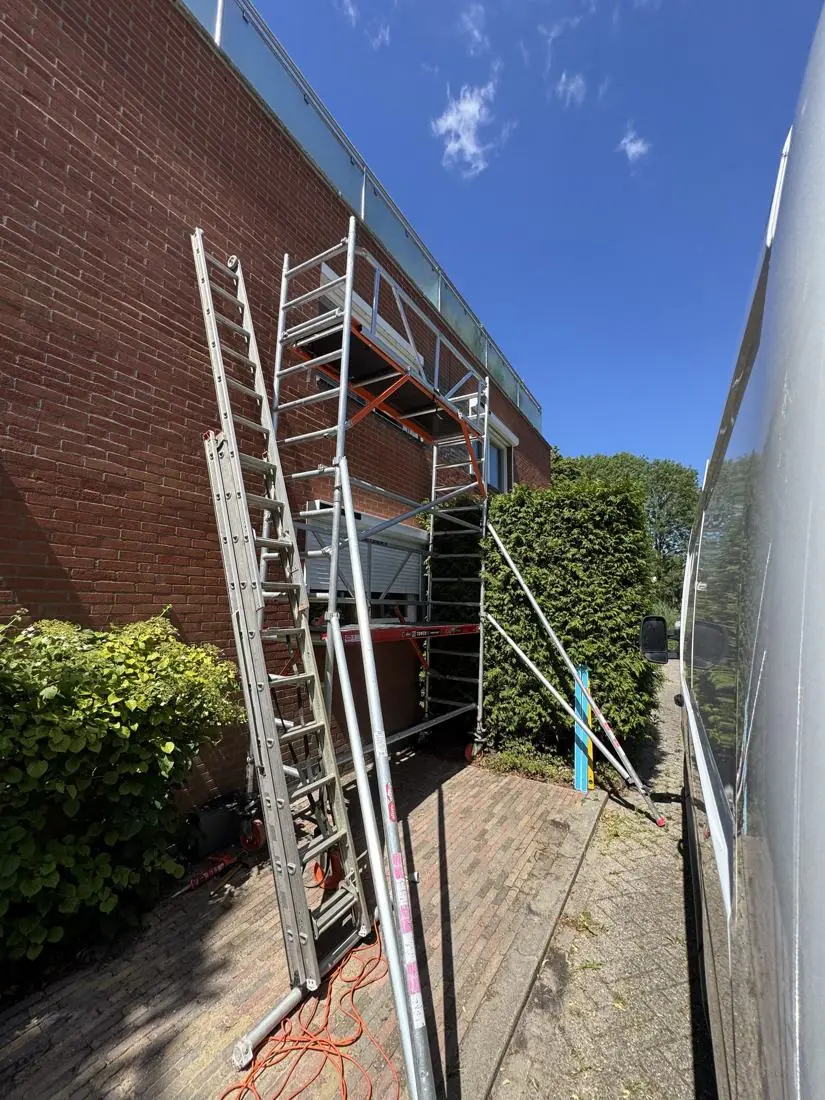
A mobile scaffold is an aluminium tower on castors that you assemble, lock and roll yourself. Our equipment comes from Altrex and complies with EN 1004. The platforms are in load class 3, which means 200 kg per square metre, so tools, paint and a stack of material can go up with you. Guard rails and toe boards run around the platform, so you work with both hands instead of holding on. The basics are set out in what a mobile scaffold is.
The dimensions are easy to remember. The RS51 is the narrow version at 75 cm wide, the RS52 the wide one at 135 cm, and both have a platform length of 245 cm. That 245 cm decides how much facade you finish per set-up before you have to roll on. The range covers working heights from 4.2 to 14.2 metres, from a garage wall to a four-storey facade. All sizes are listed in mobile scaffold dimensions.
Working height is platform height plus 2 metres, the reach of an adult standing on the platform. At a platform height of 6 metres you work at 8 metres. So do not calculate with the height of the tower itself, but with the point where your hands need to be. On the working height page you pick the size that matches your gutter or roof edge without converting anything.
Key facts
| Feature | Value |
|---|---|
| Core answer | Mobile work: rolling scaffold; weeks on one facade: fixed facade scaffold |
| Available working heights | 4.2 to 14.2 metres |
| Assembly time | 15 to 45 minutes, no tools needed |
| Standard | EN 1004 |
| Delivery | Ordered before 3 pm, delivered next working day |
What makes a facade scaffold different
A facade scaffold, also called a fixed or system scaffold, is built around a building by scaffolders and tied into the facade. It has continuous decks across the full width and several lifts above each other. You walk from one corner to the other without moving anything, with several people at once and with material that simply stays on the deck. That is the heart of the difference: capacity and reach instead of mobility.
In return, erection, dismantling and transport are done by a specialist company, you often need permission for the pavement or the public road, and the scaffold stands there on days when nobody is working. For one gutter, a dormer or a side wall that is a lot of apparatus for very few metres. The trade-off is worked out further in hiring a mobile scaffold or having a scaffold built.
Who assembles the scaffold and how much work that is
At Steigertaxi you assemble the mobile scaffold yourself. We do not deliver it assembled and we do not put it up for you. You receive the complete set with a manual, and an instruction video shows the sequence: level the base, add the frames, fit the diagonal braces, place the platforms with hatch, then the guard rails and toe boards, and finally the stabilisers. The step-by-step assembly guide follows that order in detail.
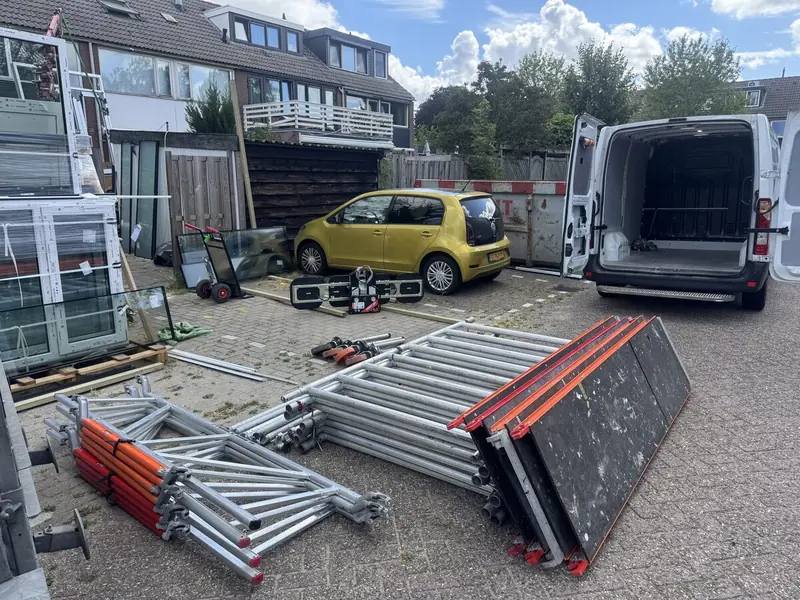
Assembling it yourself is lighter work than it sounds. The parts are aluminium and click together without tools, although two people make it considerably easier than one. It is worth thinking in advance about where you lay the parts out: a set for 10 metres of working height needs a decent stretch of garden, driveway or pavement. Indoors, clear a route from the front door to the work area first.
With a facade scaffold the opposite applies. You have nothing to do with the erection, but you are tied to the scaffolder planning, to an erection day and to a dismantling day. If you do want a fixed scaffold including assembly and dismantling, we arrange that through our partner GoedkoopSteigerHuren.nl. For the large majority of domestic jobs that step is unnecessary.
Rolling along the facade or reaching everything at once
With a mobile scaffold you work in bays. You finish the stretch of facade you can comfortably reach from a 245 cm platform, climb down, release the brakes, roll on and lock and level the tower again. On a low set-up that takes a few minutes. The higher the tower, the more the move involves, because the stabilisers travel with it and the ground has to stay flat enough along the whole route.
That rhythm suits painting, pointing, cleaning and maintenance, where you work per bay anyway and regularly wait for drying or curing time. It suits you less well if you spend the day moving between the front and the rear elevation, or if three people are working on different parts of the building at the same time. Then you lose in moving what you save on hire.
Look at what lies under the castors as well. A driveway or paved path rolls nicely, gravel, lawn and a sloping garden do not. Base plates and adjustable feet absorb a lot, but not everything. How to deal with that is covered in mobile scaffold on uneven ground. With a facade scaffold the ground matters only once: the scaffolder sets the base jacks on sole boards and after that nothing moves. Walk your route with a wheelbarrow beforehand and you know at once whether the castors will run.
Mobile scaffold and facade scaffold point by point
The table below sets out the properties that make the difference in practice: who erects the scaffold, how you move, which dimensions are fixed and how quickly you can start. The mobile scaffold column holds the fixed data of our equipment. The facade scaffold column describes how a fixed scaffold generally works, since that is designed and calculated per building.
Read the rows with your own job in mind. Usually one line settles the question straight away, for instance the width of your gate or the number of people who have to stand on the deck at once. What hiring a mobile scaffold involves is broken down further on the prices page. If you are still torn between the narrow and the wide version, look first at what has to lie on the platform per set-up.
| Feature | Mobile scaffold | Facade scaffold |
|---|---|---|
| Assembly | By you, with manual and instruction video | By scaffolders on site |
| Moving | On castors, bay by bay along the facade | Stays up until the work is finished |
| Width | RS51 75 cm or RS52 135 cm | Continuous deck across the facade width |
| Platform length | 245 cm per set-up | Several lifts above each other |
| Working height | 4.2 to 14.2 metres | Designed per building |
| Standard and load | EN 1004, class 3, 200 kg per m2 | Calculated per project |
| Availability | Order before 15:00, delivered the next working day | According to the scaffolder planning |
Space around the house: what fits where
The space around your house decides the question more often than the job itself. A facade scaffold needs a strip along the entire elevation, including room for the lorry and the erection crew. A mobile scaffold only needs a route it can pass through and a level spot to stand on. So measure the narrowest passage on your property first, usually the gate or the alley beside the house.
Indoors the dimensions are different. The RS44 room scaffold is built for that: it passes through a standard interior door from roughly 70 cm, so you can move from the hall to the stairwell or the living room without dismantling. If you work alone on a job up to 6 metres of working height, the MiTower is a one-person tower made exactly for that. For indoor work you will find the room scaffold in the range.
If your facade sits right on the pavement, public space comes into play. A mobile scaffold goes up and comes down at the end of the day, while a facade scaffold stands for weeks and therefore needs barriers and arrangements with the council. That difference weighs heavily in a narrow street or at a shop front. On a terraced house with a narrow rear access it also matters whether the parts pass the gate and the corner without being taken apart.
- Gate or alley narrower than 90 cm: choose the RS51 at 75 cm wide
- Indoor work behind an ordinary interior door: the RS44 room scaffold fits from about 70 cm
- Working alone up to 6 metres working height: the MiTower is a one-person tower
- Soft garden, lawn or gravel: put base plates under the castors
- Facade on the public road: expect barriers and coordination with the council
- Two people and plenty of material: choose the RS52 at 135 cm wide
Hire period and what drives the cost
With a mobile scaffold you pay the full rate for the first hire day and only 5 percent of that day rate for every following day. That makes the sum different from what you may expect: two weeks costs nowhere near double one week. What a specific set-up involves is shown on mobile scaffold hire costs, where the rate is broken down per working height.
That declining rate makes a longer hire attractive if your job runs across several weekends or if the weather turns against you. You do not have to return the scaffold in between to keep the cost down. The comparison between separate days and a longer period is on mobile scaffold hire per week. Extending is arranged in consultation, as long as the set is not already booked for someone else. What separate days do is set out on mobile scaffold hire per day.
With a facade scaffold the money sits in other items: transport, erection, dismantling and a rate for the period the scaffold remains standing. So always ask for an itemised quote and compare what is and is not included. What to look for is set out in what to check in a quote. Pay particular attention to the item covering the weeks the scaffold stays up, because that runs on through holiday weeks and rainy days.
Delivery, collection in person and deposit
Order before 15:00 and the mobile scaffold is at your door the next working day, anywhere in the Netherlands. Delivery and collection together sit in a fixed amount per province, so you know in advance where you stand. The amounts per province are listed on delivery costs. We put the scaffold down at an agreed spot; the assembly is yours.
You can also collect it yourself, free of charge and by appointment, at Zeeburgerpad 89 in Amsterdam. That saves the delivery cost and you can start straight away, but you need a van or trailer and the deposit is higher for collection. All deposit conditions are gathered on scaffold hire deposit. Count on a long van or a trailer, since frames and 245 cm platforms do not fit in a car. Make the appointment in advance and the set is ready when you arrive.
- Delivery: RS51, RS52 and MiTower 500 euro deposit
- Delivery: room scaffold 150 euro deposit
- Collection in person: RS51 and RS52 1000 euro deposit
- Collection in person: MiTower 750 euro deposit
- Collection in person: room scaffold 150 euro deposit
- The deposit is back in your account within 1 working day after return
Jobs a mobile scaffold covers comfortably
The large majority of domestic jobs are bay work: you finish a stretch of facade, roll on and continue. Think of painting a facade, sanding and lacquering window frames, touching up fascia boards and replacing gutter brackets. On a 245 cm platform your paint tin, sander and material stay within reach, which cuts down how often you climb down. That helps most on work where you want a lot of small tools within reach, such as sanding, filling and masking.
Roof maintenance belongs in this category too, as long as you work from the scaffold and do not step onto the roof surface. Cleaning the gutter, removing moss from the lowest tiles and painting a dormer are all fine from a mobile scaffold at the right height. Choose the working height based on the gutter or roof edge, not on the ridge.
- Painting or touching up a facade in bays of 245 cm
- Cleaning gutters and checking gutter brackets
- Sanding and painting fascia boards and barge boards
- Painting a dormer or replacing a roof window
- Maintaining window frames on the first and second floor
- Fitting an outdoor light, camera or house number at height
When a fixed scaffold is the better answer
As soon as several people work on different parts of the same building at once, a facade scaffold wins. The same applies when heavy material has to sit on the deck for weeks, for example when replacing window frames, doing brickwork or fitting facade insulation. A mobile scaffold carries 200 kg per square metre, but you take that load with you every time you move.
The shape of the building counts as well. A bay window, an extension, a conservatory or a deep roof overhang makes it hard to place a mobile scaffold close enough to the wall. Sometimes tying in solves it, as described in stabilising and tying a mobile scaffold, and sometimes a purpose-built scaffold is simply the calmer solution. Measure the distance between wall and scaffold at the point where the overhang projects furthest, because that is your bottleneck.
The third point is height. Our range reaches 14.2 metres of working height, which covers houses, town houses and most apartment buildings. If you need to go above that, a fixed scaffold is the way. What else limits the height of a mobile scaffold is explained in how high a mobile scaffold may go. On an ordinary terraced house the sizes in our range take you well past the gutter, even if you touch up a dormer above it.
Bringing the choice back to five questions
If you are still weighing it up, run through the questions below. They usually clear the doubt within minutes, because they touch exactly the points where the two types diverge: reach, duration, occupancy, height and space. Answer three or more of them in favour of the mobile scaffold and the decision is made. The doubt usually sticks on one point, and that is nearly always the duration of the job or the number of people going up.
If you would rather settle it with someone who handles the equipment daily, send a message on WhatsApp with your gutter height and a photo of the situation. Other practical points are covered in the frequently asked questions, and through contact you can simply reach us by email. Include the width of your gate and the surface along the facade in that message, and we can name a suitable model straight away.
- Are you working on one elevation or around the whole building?
- Does the job run for days or rather for weeks?
- Do you stand on the scaffold alone or with several people?
- Do you get there within 14.2 metres of working height?
- Is there a level route to roll the tower along the facade?
Frequently asked questions
Can I finish a complete facade with a mobile scaffold?
Yes, you work the facade in bays. Each set-up covers the stretch that falls within a 245 cm platform, after which you roll the tower on and lock it again. For an average house facade that is a handful of set-ups per day.
Do you assemble the mobile scaffold for me?
No, you assemble the scaffold yourself. We deliver the complete package with a manual and there is an instruction video showing the sequence. Fixed scaffolds including erection and dismantling run through our partner GoedkoopSteigerHuren.nl.
How high can a Steigertaxi mobile scaffold reach?
The range runs from 4.2 to 14.2 metres of working height. Working height is platform height plus 2 metres, the reach of an adult. Choose the size based on the highest point your hands need to reach, usually the gutter or the roof edge.
Does a mobile scaffold fit through a gate of 80 cm?
Yes, with the RS51 at 75 cm wide. The RS52 is 135 cm wide and will not pass. Measure the narrowest passage on your property before you order, including the latch or lock on the gate.
Do I need permission to put up a scaffold?
On your own property you simply put a mobile scaffold up. If the scaffold stands on the pavement or the public road, check with your council which rules apply. With a fixed facade scaffold that stays up for weeks, the scaffolder usually arranges that as part of the job.
How quickly can I have a scaffold on site?
Order before 15:00 and the mobile scaffold is delivered the next working day, anywhere in the Netherlands. If you need it sooner, you can collect it free of charge by appointment at Zeeburgerpad 89 in Amsterdam.
What happens to the deposit afterwards?
You get it back within 1 working day after return. The amount depends on the model and on delivery or collection: on delivery the deposit is 500 euro for the RS51, RS52 and MiTower and 150 euro for the room scaffold. For collection in person those amounts are higher.