
Knowledge base · reading time 11 min
Hire a mobile scaffold or have a scaffold built: how to choose
The choice is not about safety or height, but about who puts the structure up and how long it stays there. You hire a mobile scaffold and assemble it yourself using the manual and the instruction video, then roll it along the facade. An erected scaffold is placed by a crew and stays up until the project is finished. Below is what that means point by point for your planning, your reach and your cost.
- Hire and assemble a mobile scaffold yourself, or have a scaffold erected? Compare reach, assembly time, planning and cost per situation.
- No, you assemble the mobile scaffold yourself.
- That depends mainly on the height and on how many people are working.
- Yes, but you reposition strip by strip.
What the two options mean in practice
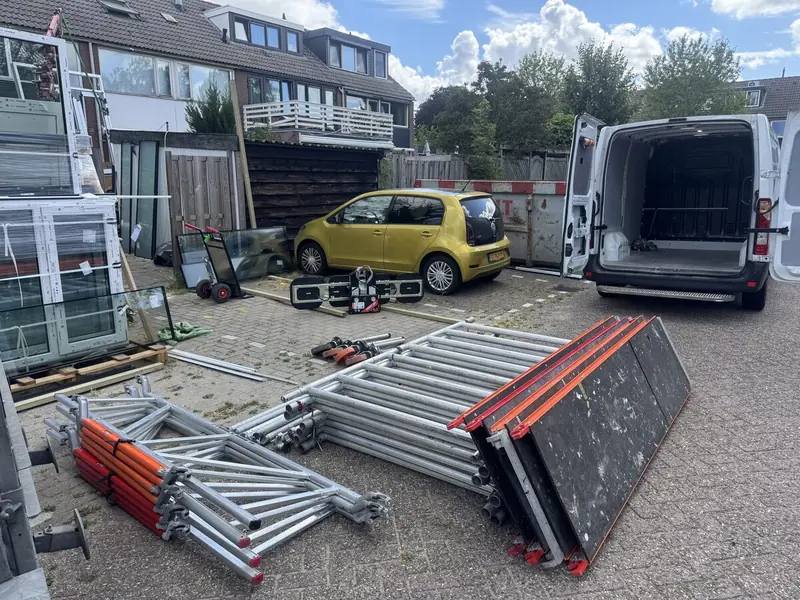
When you hire a mobile scaffold, the equipment arrives dismantled and you put it up yourself. With a scaffold that is erected for you, a crew from a scaffolding company comes out, builds the structure against the facade and takes it down again afterwards. That is the real difference: not the height and not the safety, but who puts the structure up and how long it stays there.
Steigertaxi hires out mobile scaffolds that you assemble yourself. Every hire comes with a manual, and an instruction video shows the sequence step by step. We do not deliver the equipment assembled and we do not dismantle it for you either. Anyone who does want that ends up with a scaffolding company that builds the structure on site. There is no middle form: either you build it yourself, or a crew comes and does it for you.
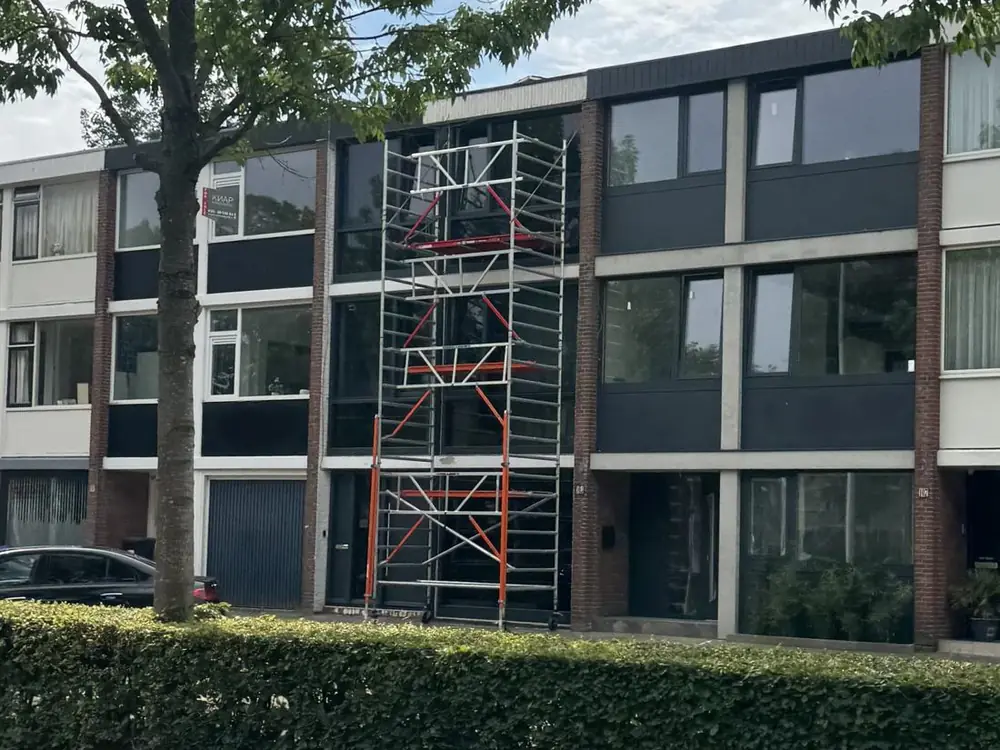
For the great majority of jobs on a house that choice is quickly made. A mobile scaffold covers a strip of facade, you roll it to the next position and you are finished without anyone having to come out. An erected scaffold enters the picture as soon as you want a whole building in scaffolding, or you work on the same facade for months.
Key facts
| Feature | Value |
|---|---|
| Core answer | Self-assembly takes 15 to 45 minutes without tools |
| Assembly time | 15 to 45 minutes, no tools needed |
| Delivery | Ordered before 3 pm, delivered next working day |
| Each extra day | 95% off: €2.50 to €16.25 a day |
| Standard | EN 1004 |
Assembling it yourself: what that actually involves
You build a mobile scaffold from the bottom up. You start with the base section level on its castors, extend the stabilisers, and then work upwards section by section with frames, braces and platforms. The manual shows which components belong where at each height, and the instruction video demonstrates the matching sequence. Every component comes with the delivery. Lay the components out in order beforehand, so you are not hunting for parts during assembly.
What most people underestimate is the time for the base. As long as that is not level, every section above it runs out of true with it, and you only notice halfway up. So take your time over it and check again after you have extended the stabilisers. The step-by-step assembly guide sets out the order in writing. A base that is out of true by a centimetre becomes a real problem three sections higher up.
On a low set-up you do this alone. Once you go higher you are faster with two people and the work is more comfortable, if only because someone can hand components up. On a tall scaffold, allow assembly time inside your hire period, because that day counts as a hire day as well. For a one day job that often means you want to start assembling the day before.
What an erected scaffold does give you
A scaffold put up by a crew stays where it stands. That gives you a whole facade at once, including corners, bay windows and roof edges that a mobile set-up would reach only from extra positions. For large renovations where several trades work on the same facade one after another, that is a practical advantage: everyone works from the same structure.
It also weighs heavily on work that runs for weeks or months. The structure is anchored to the facade and stays there until the project is finished, without anything being assembled and dismantled daily. That saves time on every working day and makes the work independent of whether anyone feels like repositioning today. On a single house facade that advantage is small; on an apartment block it is considerable.
Against that, you depend on the crew schedule, both at the start and at the end. If your project overruns or finishes early, that has to be rescheduled. With a mobile scaffold you decide, because the equipment is already there and you can reposition or dismantle at any moment. That freedom is exactly why a mobile scaffold is so often the practical choice for maintenance.
Working height and reach: where the limit sits
Working height is platform height plus 2 metres, because an adult reaches roughly two metres above the platform they stand on. The mobile scaffold range covers working heights from 4.2 to 14.2 metres. On a house that gets you to the gutter, the roof edge, the fascia boards and the roof surface, and on many commercial buildings to the top floor as well.
So calculate your height from the highest point your hands have to touch, not from the ridge. The working height page lists the set-ups per metre, and each floor level shows the matching height. If your job falls within that reach, whether to have a scaffold erected is mainly a question of convenience. Measure that point from the ground with a tape, rather than judging it by eye from the pavement.
If you go above it, or the set-up has to connect at several levels of a building, an erected structure is the logical route. The same applies to facades where there is nowhere level and load-bearing to stand. The comparison in mobile scaffold or facade scaffold works that out further. Look at what stands beneath the set-up as well, such as a conservatory or an extension.
The two options side by side on the points that matter
The overview below lists the practical differences. It is not about which option is better, but about which suits the size and duration of your work. Run through the rows with your own job in mind and the choice usually falls into place within a minute. Work from your own facade rather than from the average project in a brochure.
Pay particular attention to the row about repositioning. That is where the two options differ most, and at the same time the point people most often overlook when planning. On a wide facade the number of set-up positions decides how many days you need. So count your positions before you choose a period, because they set your pace at the facade.
| Point | Mobile scaffold you hire yourself | Scaffold erected for you |
|---|---|---|
| Assembly | You assemble it with the manual and instruction video | A crew builds the structure on site |
| Delivery | Ordered before 15:00 means delivery the next working day | Depends on the schedule of the erecting crew |
| Reach per position | Platform length of 245 cm on the RS51 and RS52 | The structure can run along the entire facade |
| Repositioning | You roll the scaffold to the next position yourself | The structure stays where it was erected |
| Working height | 4.2 to 14.2 metres, platform height plus 2 metres | Built to measure for the building |
| Dismantling | You dismantle it and return it complete | The crew returns to take it down |
| Suits | Maintenance and jobs on a house or commercial unit | Large renovations and work running for months |
When repositioning along the facade works perfectly well
The platform length of the RS51 and RS52 is 245 cm. That is the strip of facade you work comfortably from one position, with a little reach to the left and right. On an average house facade that means two to three positions, and each move costs you retracting and re-extending the stabilisers. Allow for levelling the base again at every position before you climb back up.
That is entirely manageable as long as you can roll along the facade at ground level. A flat tiled path, a driveway or a pavement are ideal. Grass, gravel or a slope make it harder, and then levelling carefully at each position matters more than moving quickly. For most jobs on a house that still does not outweigh having a structure erected.
- The facade is reachable over level, load-bearing ground along its whole length.
- Your job runs for days or at most weeks, not months.
- You work on one strip of facade at a time, such as gutter, fascia boards or frames.
- You want to decide yourself when you start and when the equipment leaves again.
- The working height you need falls within 4.2 to 14.2 metres.
- There is no second trade that has to work from the same structure at the same time.
The models you can hire and assemble yourself
The RS51 is the narrow mobile scaffold at 75 cm wide, the RS52 the wide one at 135 cm. Both have a platform length of 245 cm. On the wide version you set material down beside you without stepping over it constantly; you choose the narrow version when the space along the facade forces it, beside a path or in an alley. Compare them on mobile scaffold hire.
For interior work there is the room scaffold, the RS44, which fits through a standard interior door from around 70 cm. That lets you assemble it in the room where the work is instead of in the hallway. For one person and work up to 6 metres working height, the MiTower is the lightest option in the range. For ceilings, stairwells and high interior walls those are the two models that remain.
All equipment is made by Altrex and complies with EN 1004, in load class 3. That means 200 kg per square metre of platform, so you can take tools and material up without approaching the limit. What that standard covers exactly is set out in the explanation of EN 1004. The standard says nothing about your own set-up, so assembling to the manual stays your job.
Lead time and planning on the two routes
A mobile scaffold ordered before 15:00 is delivered the next working day, anywhere in the Netherlands. You therefore plan your job on the day that suits you, without a crew having to be scheduled. If you want to start even sooner, or at a moment of your own choosing, you can collect free of charge by appointment at Zeeburgerpad 89 in Amsterdam.
Delivery and collection sit in a fixed amount per province, so you know where you stand in advance. The delivery cost page shows what applies to your address. That fixed amount keeps planning simple: you pick a period, you know the amount, and nothing is added if you carry on a day longer. That way you know at the moment of booking what the final figure will be, with no recalculation.
With an erected scaffold the planning runs through the diary of the company that places it, both for building and for taking down. On a large project that is no obstacle, because you plan weeks ahead anyway. For a weekend job on the gutter it is impractical, and hiring and assembling yourself is arranged far more quickly. And if a job overruns, nobody has to be rescheduled, which saves a good deal of phoning.
Where the cost difference between the routes comes from
The largest part of the difference is labour. With an erected scaffold you pay for the hours of the crew that puts it up and takes it away again. With a mobile scaffold you do that work yourself, so that item disappears. What remains is the hire rate, delivery and collection, and the deposit you tie up temporarily. All three of those items can be calculated exactly in advance, which makes budgeting far simpler.
The hire rate works with a full rate on the first day and 5 percent of that day rate for every following day. Working on longer therefore costs little extra, which is welcome on outdoor work with drying times. Current amounts per model are listed on the prices page, so you can work your period out in advance. That matters most on facade work where you have to wait a day between two coats.
The deposit is separate from the hire. On delivery it is 500 euro for the RS51, the RS52 and the MiTower, and 150 euro for the room scaffold. On self-collection the deposit is higher. After return the amount is back within 1 working day; every figure is listed on the scaffold hire deposit page. Include that figure in your planning, because it stays committed for the length of the hire.
Working safely on either choice
A mobile scaffold assembled according to the manual, with the stabilisers extended and a level base, is a stable place to work. The equipment is made by Altrex and complies with EN 1004 in load class 3. That means the structure itself is sound; what you add is correct assembly and a check before you climb. So walk round the set-up before you carry material up, even on a low scaffold.
On taller set-ups, anchoring to the facade comes into play, just as it does on an erected scaffold. How that works and where the attention points sit is covered in stabilising and anchoring. Read it before you start on a tall set-up, because adding an anchor afterwards is harder than placing it correctly straight away. Check in advance where you can fix into the facade, because not every surface is suitable.
Beyond that, the same practical rules apply on both routes: do not work in strong wind, do not climb up the outside, and do not move a scaffold with someone on it. The guide on working safely at height lists those points, including what you check before climbing. Go through those points with everyone who will use the scaffold, not only the person assembling it.
Making the choice for your own project
Start with duration and size. If you are working for a few days to a few weeks on a strip of facade on a house, hiring and assembling yourself is almost always the practical route. If it concerns a whole building, several trades following one another on the same facade, or months of work, an erected structure is more logical.
Then weigh accessibility. If a mobile set-up can travel along the whole facade, repositioning is a matter of minutes each time. If it cannot, because of a conservatory, an extension or an embankment, every position becomes a puzzle. In that case also compare with a mobile scaffold or a cherry picker. Walk the route along the facade once on foot before you order the scaffold.
If you are still unsure, look at what you want to do with the equipment rather than at the height alone. For facade maintenance and painting a facade the attention points are described per job. If you cannot settle it, ask for advice over WhatsApp before you commit. A short question up front prevents hiring a model that turns out not to fit the job.
- Choose hiring and self-assembly for house maintenance within 4.2 to 14.2 metres working height.
- Choose hiring when you want to decide yourself which day you start and stop.
- Choose an erected scaffold for a project running for months on a whole building.
- Choose an erected scaffold when several trades work from the same structure at once.
- Choose an erected scaffold when there is nowhere level and load-bearing to set up.
- If the height is unclear, work out platform height plus 2 metres first.
Frequently asked questions
Does Steigertaxi assemble the scaffold for me?
No, you assemble the mobile scaffold yourself. Every hire comes with a manual and an instruction video showing the sequence step by step. If you want a structure put up by a crew, you need a scaffolding company. The guide on hiring a scaffold including assembly explains what that difference means.
How long does assembling a mobile scaffold take?
That depends mainly on the height and on how many people are working. A low set-up you put up alone; on a tall set-up two people are faster and more comfortable. Always count assembly time inside your hire period, because the assembly day counts as a hire day.
Can I do a whole facade with a mobile scaffold?
Yes, but you reposition strip by strip. The platform length of the RS51 and RS52 is 245 cm, so an average house facade means two to three positions. As long as you can roll along the facade over level ground, that is straightforward.
Is a mobile scaffold as safe as an erected scaffold?
Assembled according to the manual and with the stabilisers extended, a mobile scaffold is a stable place to work. The equipment is made by Altrex and complies with EN 1004 in load class 3, so 200 kg per square metre. On taller set-ups anchoring to the facade is part of the job.
What happens if my project runs longer than planned?
With a hired mobile scaffold you simply extend your period, and every extra day costs 5 percent of the day rate. Nobody has to be rescheduled, because the equipment is already on site. Pass on the new return date so your order is correct.
Do I need to supply tools for the assembly?
All the components belonging to the set-up come with the delivery. Arrange something yourself to level the ground if it is not quite even, and a second person for a tall set-up. The manual shows which component belongs where.
Can I collect the equipment instead of having it delivered?
Yes, self-collection is free by appointment at Zeeburgerpad 89 in Amsterdam. You do need transport that fits the longest components, and the deposit is higher on collection than on delivery. With delivery, an order placed before 15:00 arrives the next working day.