
Knowledge base · reading time 9 min
Which scaffold for painting a facade?
Painting a facade means standing in one place for hours and then moving along a stretch. You need both hands for brush and roller, you want paint and tools within reach and you do not want to climb down halfway through a bay to fetch something. That is why a mobile scaffold beats a ladder for this work almost every time. What remains is the height you need and whether you take the narrow or the wide model.
- Which scaffold for painting a facade? Work out the working height, choose between the narrow RS51 and wide RS52 and paint in bays along the wall.
- Often six to eight metres, depending on where the roof edge sits.
- Yes, the platform is 245 centimetres long and the load class allows two people with material comfortably.
- Work each bay from the top down and keep the wet edge going until the bay is finished.
What painting asks of your setup
Painting is two handed work with a rhythm. You set out a bay, roll it off and lay it off before the paint starts to pull. Every interruption to climb down or to steady yourself costs you that bay. On a mobile scaffold your paint sits beside you on the platform, the roller stands in the tray and a guardrail runs all round, so you can lean into the work with your full weight.
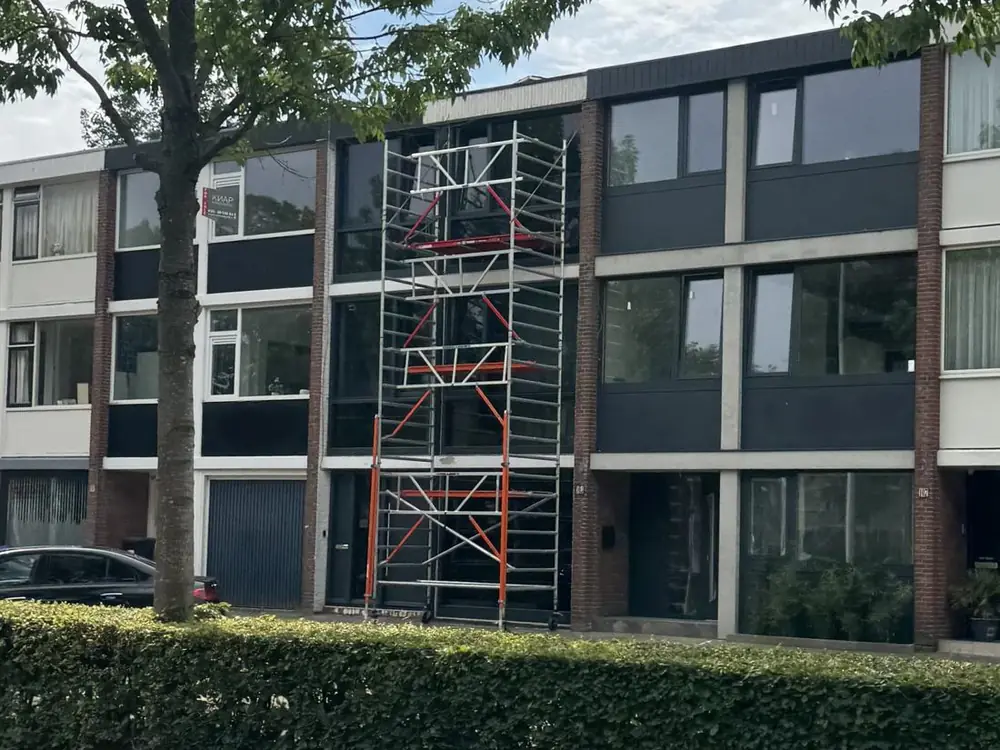
The platform length is 245 centimetres, which suits painting well. You cover a bay of more than two metres before you have to move, which means you can keep a wet edge going instead of running into a dried overlap every few minutes. On a terraced house facade that gets you through a decent stretch per setup, especially working from the top down.
The weight you take up is limited but not nothing: tins, a bucket of water, abrasives and sometimes a filling knife and a heat gun. Our scaffolds are in load class 3, which works out at 200 kilos per square metre of platform, so two people with material stay well below it. More on that is at loading and weight on a mobile scaffold.
Key facts
| Feature | Value |
|---|---|
| Core answer | Narrow side path: RS51 (75 cm); spacious facade: RS52 (135 cm) for extra workspace |
| Platform width | 75 cm (RS51) or 135 cm (RS52) |
| Working height | Platform height + 2 metres |
| Available working heights | 4.2 to 14.2 metres |
| Each extra day | 95% off: €2.50 to €16.25 a day |
Measure to the highest point you still have to paint
Measure from the spot where the castors will stand up to the highest point your brush has to reach. On a flat facade that is the underside of the roof edge, on a gable the point below the ridge, and on a facade with fascia boards the top of that board. Subtract two metres and you have the platform height you need, because working height is platform height plus two metres.
Those two metres are the reach of an adult standing on the platform. Do not count them twice and do not add extra margin on top, or you end up too high and spend the day working below your knees. Half a metre of play upwards is comfortable; a full metre becomes awkward at the bottom of the bay. Note the measured figure down before you open the configurator, so the choice is a check rather than a guess.
If you prefer to think in storeys, see working on the first floor or the second floor for a reference point. The general explanation and the conversion sit on the working height page, including the difference between platform height and working height that people mix up most often. If you prefer metres, use the separate height pages to place your own measurement between two setups.
Narrow RS51 or wide RS52 along the facade
The narrow RS51 is 75 centimetres wide, the wide RS52 is 135 centimetres wide, and both carry a 245 centimetre platform. For the facade itself that width changes nothing, because you cover the same stretch per setup. The difference is the room you have on the platform and the room the tower takes up on the ground, and it is that second point that usually decides.
Along a front facade on the street, in a back garden with a path or between two houses, often only the RS51 gets through. In a spacious garden, on a driveway or along a detached wall there is room for the RS52, and then the work is more comfortable: more platform to set down paint, roller and abrasives, and enough space for two people to stand side by side.
Count the stabilisers on both, because they stick out at the sides and decide whether your setup still clears a shed or a hedge. Walk the route once with a tape measure and watch the gate, the corner of the house and any downpipe. Full dimensions per model are at mobile scaffold dimensions. A hedge that has grown out over the summer counts as an obstacle too, even if it looks soft.
| Point | RS51 (narrow) | RS52 (wide) |
|---|---|---|
| Width | 75 centimetres | 135 centimetres |
| Platform length | 245 centimetres | 245 centimetres |
| Along a path or through a gate | Usually gets through | Often too wide |
| Room for paint and tools | Enough for tin and roller | Also room for bucket and abrasives |
| Working with two people | Tight | Comfortable |
| Working heights | Within 4.2 to 14.2 metres | Within 4.2 to 14.2 metres |
| Deposit on delivery | 500 euro | 500 euro |
Paint, roller and material on the platform
What you put on the platform decides how often you have to climb down. Take up the tin you are working from and leave the stock at ground level, because a full tin tipping over at ten metres is a problem for anyone walking below. Stand the tray somewhere stable and use a bucket you can hook onto the guardrail rather than leaving it loose on the deck.
Keep the platform clear otherwise. Abrasive paper, filling knives and screwdrivers slide off during a move, and an open hatch is a hole you step into the moment you back up to lay off a bay. Close the hatch once you are up and keep small tools in a container. The remaining rules of use are in the mobile scaffold hire checklist.
- Take up only the tin you are working from at that moment
- Hang the bucket on the guardrail instead of leaving it loose
- Close the hatch as soon as you are on the platform
- Keep abrasives and small tools in a container
- Sheet the ground under the scaffold against splashes and drips
Working in bays and shifting the tower
You paint a facade in vertical bays one platform length wide. Start at the top, work down and keep the wet edge going so no visible overlap forms. Once the bay is finished you come down, push the scaffold along and start at the top again. That order is not only practical; it decides how the paintwork looks once it has dried.
While moving, the rules are fixed: nobody on the scaffold, no tins or tools on the platform, and the castors locked again once it is in place. Stabilisers are reset each time, and above a certain height anchoring comes with it. How that works is at stabilising and anchoring, including the height at which it applies. After every move, check that the stabilisers stand out as far as they did before.
Plan your bays before you start. A downpipe, an extension, a conservatory or a carport under the facade can block the way, and then it is smarter to begin at the other end. Watch where the sun sits as well: on a wall in full afternoon sun, paint dries faster than you can finish a bay. Marking the bays with chalk before you start keeps the order clear once you are up there.
Taking in frames, shutters and fascia boards
Painting a facade rarely stops at the brickwork or the render. Window frames, shutters, fascia boards and a roof edge usually come with it, and those parts decide what height you want to stand at. For a window frame you want to be level with its middle; for a fascia board slightly lower, so you brush upwards from below. Standing at the wrong height for a frame shows up in the finish soon enough.
That means you sometimes use two platform heights within one bay. On a mobile scaffold that is easy enough: you move the platform by one section and finish the next part. For the separate elements there are dedicated pages, for example painting window frames and painting fascia boards, each with the usual setup. Allow for that extra section when you order, because swapping afterwards costs you a day.
Shutters and roller shutter boxes ask for something else again. A shutter you want to lacquer usually comes off the wall and is treated at ground level, while the box itself stays put and therefore has to be done from the platform. Agree that beforehand, because a shutter that has to come off halfway through the day costs you a move you had not planned. For woodwork in general, see painting woodwork.
Preparation work from the scaffold
Most of the work on a facade is not the paint but what comes before it. Washing down, sanding, cutting out rot, filling, priming and masking together take more time than the finishing coat. All of it happens from the same scaffold, so when planning your hire period allow for several passes along the same wall. On a facade untouched for ten years, that preparation easily takes twice as long as the painting.
In practice that mainly means the scaffold stays where it is until a bay is completely finished. If you sand today and paint tomorrow, you do not want to move it twice. When to schedule facade maintenance and in what order is set out at when to carry out facade maintenance. So leave the scaffold in place until the last coat is on that bay, even if that means waiting a day.
Sanding dust and old paint flakes end up everywhere on this kind of work. Sheet the ground under the scaffold and think about the neighbours' garden if you stand on the boundary. If you use a sander with extraction, bring an extension lead you can tie off to the frame rather than letting it run loose across the platform, because that is what you trip over while working backwards.
- Wash the facade down and let it dry before you start sanding
- Cut out rot and fill before the primer goes on
- Mask frames and glazing from the platform, not from a ladder
- Finish bay by bay so the scaffold moves only once per bay
- Keep a day of slack for drying times and an unexpected shower
Weather, wind and drying times
Outdoor work depends on the weather, and that feeds straight into your hire period. Paint needs drying time and a facade still damp from the night cannot be treated straight away. Allow a few days more than the painting itself takes, certainly in spring and autumn when a wall is only dry by mid morning. Look at the night temperature as well, since it decides whether today's coat can be recoated tomorrow.
Wind is the second point. In strong wind, working at height is unpleasant and paint sprays in every direction. The scaffold can simply stay up, but you will get little done that day. What else changes in the cold season is covered at hiring a scaffold in winter, including frost and application temperatures. A scaffold left standing in wind should be anchored, exactly as it is while you work on it.
A third point is the temperature of the wall itself. A facade that has stood in the sun all afternoon is warmer than the air by the end of the day, and paint soaks into it faster than you want. On days like that, start on the shaded side and follow the sun round, and the working time stays roughly the same across the whole wall.
Front, back and side facades
The three walls of a house each ask for something different. At the front you deal with the pavement, with parking spaces and sometimes with a garden a metre deep. At the back there is more room, but the scaffold has to come through the gate or through the house. The side wall of a terraced house is often not accessible at all, which changes the question.
Look at each wall to decide which side you do first and whether the scaffold can stay up in between. For the separate situations there are pages such as painting a front facade, painting a rear facade and painting a side facade, each with its own points to watch. Walk the route to each wall once with a tape measure before ordering, watching the gate and the corner of the house.
When a mobile scaffold is not the right answer
There are situations where a rolling tower does not fit. A facade that has to stay scaffolded for months, a building wrapped in sheeting, or a wall you can only reach from the water or from a roof calls for a fixed structure erected by a scaffolding firm. The difference between those two routes is at mobile scaffold or facade scaffold.
It can also go the other way. For a low wall, a garden wall or a shed under four metres the MiTower is often enough: a one person scaffold up to 6 metres working height that you put up alone. If two of you work together, or you need to go higher, you end up with a mobile scaffold after all.
Hire period, delivery and deposit
Painting runs over more often than other jobs, so the hire period matters more here than on a one day task. The first hire day is charged in full and every following day costs 5 percent of that daily rate, which keeps a full week manageable. Worked examples are at hiring a mobile scaffold per week. Rather than extending at the last minute, count those spare days into the configurator straight away.
Order before 15:00 and the scaffold is at the agreed spot the next working day, anywhere in the Netherlands. Delivery and collection sit in a fixed amount per province, shown on the delivery costs page. Collecting it yourself is free by appointment at Zeeburgerpad 89 in Amsterdam. Current rates per model and height come from the configurator on the pricing page.
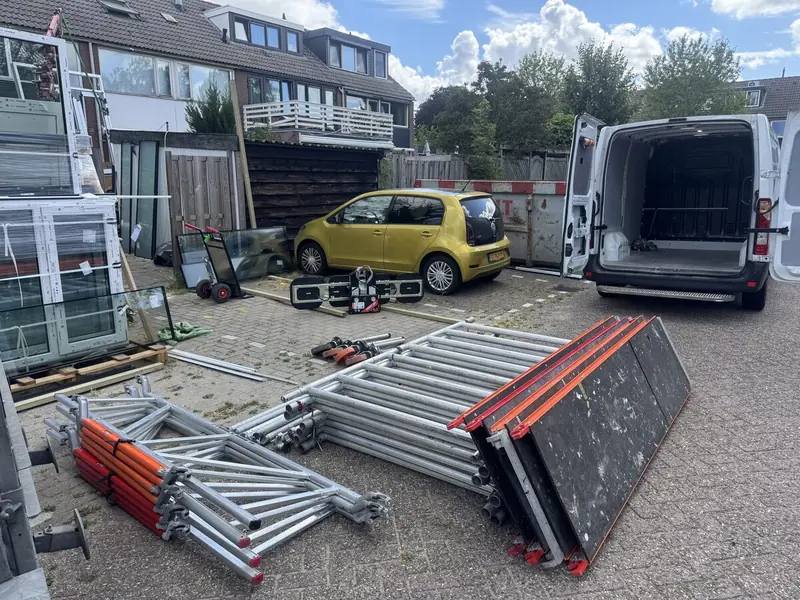
We do not assemble for the customer and never deliver a ready built scaffold. You get the parts with a manual and an instruction video showing the sequence step by step. On delivery the deposit is 500 euro for the RS51, the RS52 and the MiTower, with the conditions at the scaffold deposit page. Unsure about the setup? Send a photo on WhatsApp.
Frequently asked questions
What working height do I need for a terraced house facade?
Often six to eight metres, depending on where the roof edge sits. Measure from the spot where the castors stand to the highest point you still have to paint and subtract two metres for the platform height. A gable or a dormer pushes that height up further.
Can two people paint from the scaffold at once?
Yes, the platform is 245 centimetres long and the load class allows two people with material comfortably. On the wide RS52 you stand beside each other more easily than on the narrow RS51. Do spread the weight and keep the platform free of loose tins.
How do I avoid visible overlaps between bays?
Work each bay from the top down and keep the wet edge going until the bay is finished. Only move the scaffold once that bay is complete. On a wall in full sun the paint dries faster, so make the bays narrower there or start on the shaded side.
Can paint and tools stay on the platform while I move the scaffold?
No, the platform must be empty before you push the tower along. Tins and trays slide off and fall. Take everything down, move the scaffold, lock the castors and then bring the material back up.
How many days should I hire for a whole facade?
Allow more days than the painting itself takes, because washing, sanding, filling, priming and drying times all add up. Every day after the first costs 5 percent of the daily rate, so building in slack is cheaper than extending at the last minute.
Does a mobile scaffold fit in a back garden with a narrow gate?
The RS51 at 75 centimetres gets through most gates; the RS52 at 135 centimetres usually does not. Measure the gate and the narrowest point on the route before you order, and allow for the stabilisers that stick out at the sides.
Is a ladder enough for a small patch of facade?
For a single spot perhaps, but not for painting an area. You need both hands, you have to keep a wet edge and you move constantly. That is exactly where a ladder falls short and a mobile scaffold is both faster and safer.