
See your price
Application

Painting a side facade? Choose the right scaffold.

A side wall is usually the one nobody looks at: no windows, no doors, just brick or render carrying on from the ground to the roof edge. Coating it goes quickly, provided you can actually get at it. The pinch point sits at the bottom, in the strip between your house and next door or the path running along it. So measure that strip first, and only then hire the wide RS52 with its 135 cm base and a build heading for ten metres of working height.

  • Order before 3 pm, delivered tomorrow
  • Professional Altrex scaffolds
  • Up to 14.2 metres working height
  • Easy to assemble yourself
4,2 tot 14,2 mWorking heights available
12Provinces served
7Days a week
200 kg/m²Load class 3
In short
  • For painting a side facade we recommend the Wide mobile scaffold.
  • Painting a side facade is RS52 work: a base of 135 cm, in a build somewhere across the eight to twelve metre range.
  • Measure the strip along next door before hiring anything, since the base and the stabilisers together have to sit inside it.
  • Two or three days on hire cover a closed plane like this, as long as each round of paint gets time to dry off.
  • First 24 hours from €175 incl. VAT and delivery; every day after that 95% off.
Key facts for this job
FeatureValue
Recommended scaffoldWide mobile scaffold (Altrex RS TOWER 52)
Working height for this job8 to 12 metres
Available working heights4.2 to 14.2 metres
StandardEN 1004, load class 3 (200 kg per m²)
DeliveryOrdered before 3 pm, delivered next working day
Each extra day95% off, from €8.75 a day
Why a mobile scaffold for painting a side facade?

Safe, stable and professional work at height

On a side wall the ground below dictates what is possible. At the front there is pavement and at the back a garden, but down the flank you are often on less than two metres between two buildings, or on a shared path the neighbours still need to use. A base of 135 cm has to fit in there, along with the stabilisers and you with a bucket. At the same time painting a side facade is the easiest wall work going once the tower stands: no frames, no sills, no masking round glass, just a plane worked from the top down. Hiring here is about fitting in and about squaring things with next door.

  • A blind plane with no windows to work round
  • Measure the strip between the two buildings first
  • Boundary and the neighbours' passage kept clear
  • Painting a side facade up past ten metres
Read more about working safely →

Which mobile scaffold to hire for painting a side facade

On a blind wall you work in columns: start at the top and roll your way down, with nothing to cut in around. Everything you need therefore stands on the deck with you, which is why the RS52 with its 135 cm base is the tower to hire. A bucket, a roller on a pole and a brush for the edges lie side by side rather than in your walking line. Sizes currently going out are listed under the mobile scaffolds available to book.

That width is also the first question you have to answer. Measure the gap between your masonry and the boundary at its tightest point, since a downpipe, a meter cabinet or a projecting plinth decides what is genuinely left. If 135 cm will not go in, the narrow RS51 on its 75 cm base is what remains and you give up deck. A MiTower stops at 6.2 metres and gives out halfway up a side wall of two full storeys.
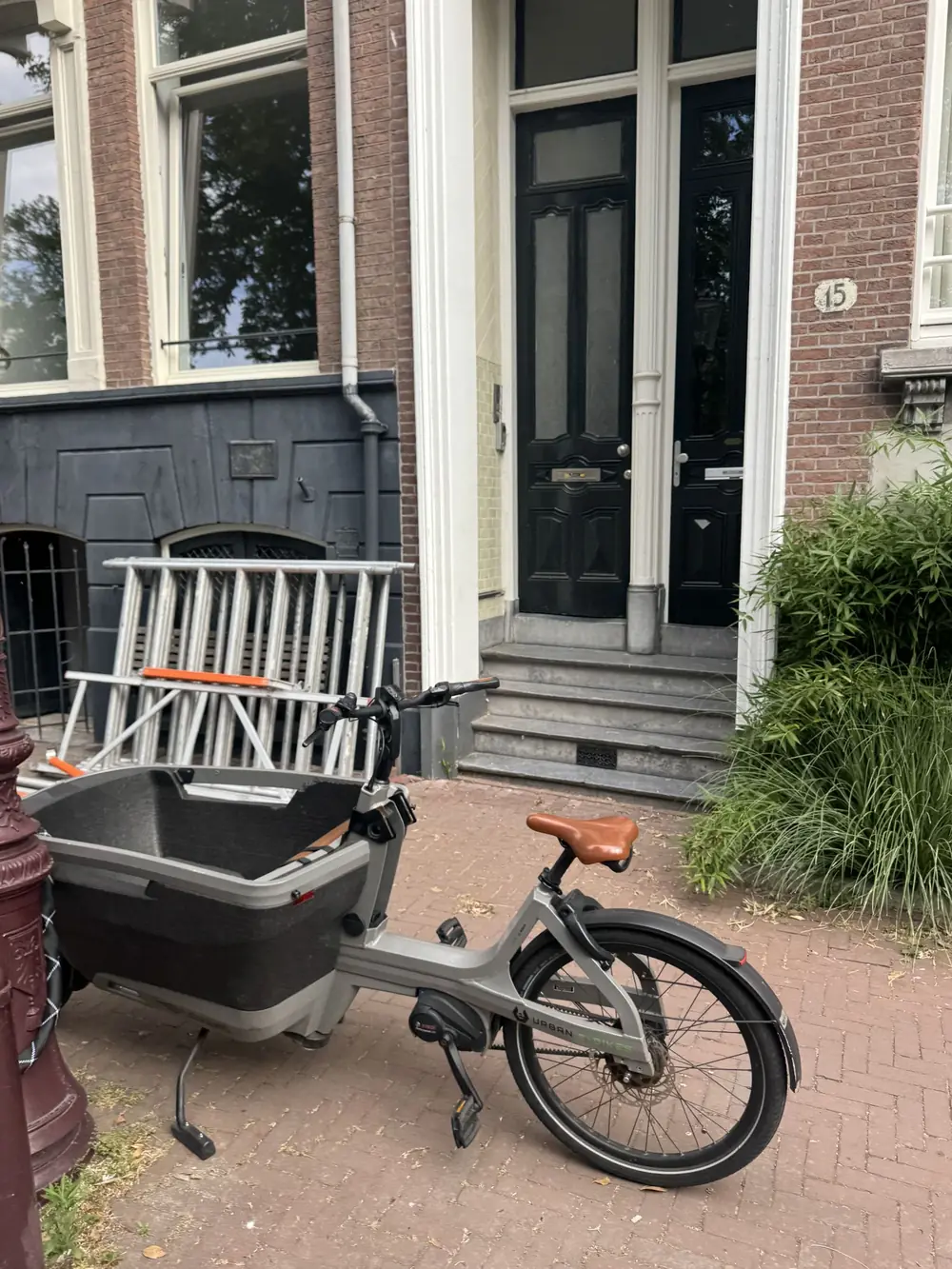
Scaffold frames and orange braces stacked against the front of a brick house, with a cargo bike parked in front

Remember that the tower has to travel through the passage as well. The parts come in loose, but once it is standing you roll it along the whole length of the wall, and there still has to be room for a foot beside the castors. Before you hire a mobile scaffold for a flank that opens onto a path, measure the gate and the fence panel everything must pass. A room scaffold is no substitute here at all, since it belongs indoors and comes nowhere near ten metres of height.
Hiring the working height a blind side facade needs

On a flank you measure up to the underside of the roof edge, because that is where the painted plane stops. On a terraced or semi detached house of two storeys that point sits around eight metres; with three storeys or a tall pitched roof it runs to twelve. Take the measurement from the path the castors will stand on and not from the pavement at the front, because a side passage frequently lies a step lower. That single step sometimes decides whether an extra platform is needed.

The height you enter is not the height of your boots. Roughly 2 metres of reach is added to the platform height, since a roller on a pole takes you a fair way above the decking. For a windowless flank that lands you on a build between 8 and 12 metres. What such a tower looks like, and how many platforms belong to it, is set out at ten metres of working height. Work that out before the order goes in.

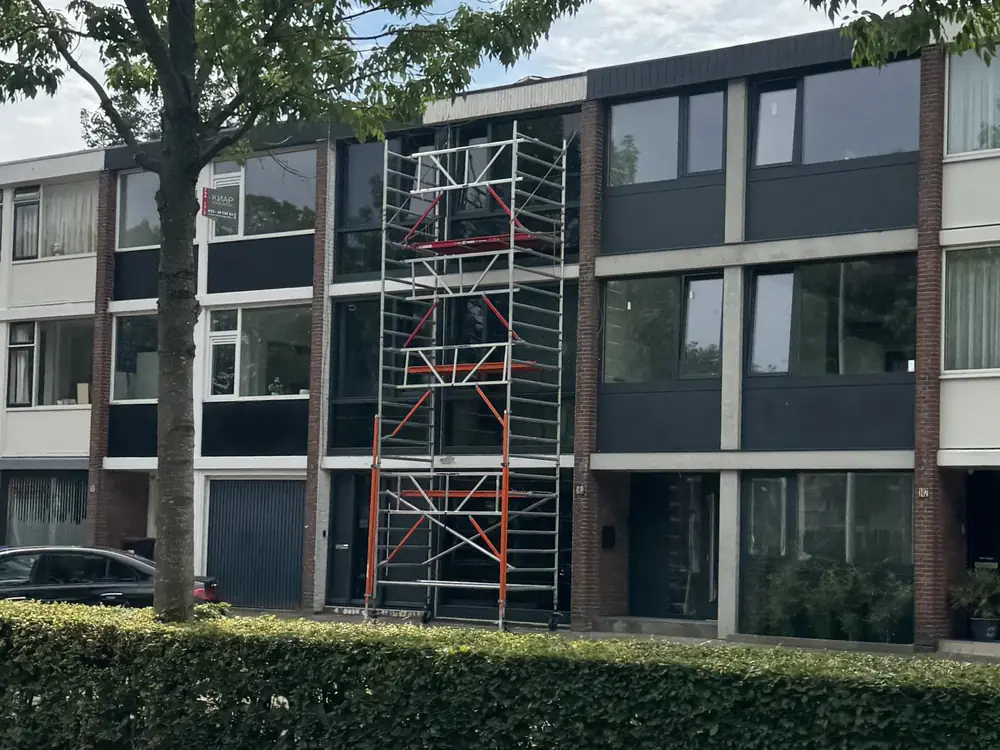
Slim tower assembled against a three storey block, decking stacked up to the height of the top floor windows

Hire too little height and a band survives up top that no roller will reach from the decking, and that band is precisely what the street sees best. A side wall is a closed plane with no openings to give the eye a break, so a slight shift of shade across the top metre stands out at once. Hiring a build with one more platform adds very little at the booking stage, while a second rental period for one band costs you a whole day.

Hiring a tower for the strip between two houses

The strip along a flank is seldom yours alone. Sometimes the boundary runs down the middle of the path, sometimes both houses own it together, and sometimes it is council ground finished with a kerb. Find out which before you reserve a tower, because what you are putting there stands for days. A short word with next door, and where the ground is public a note to the council, saves you grief halfway through the work. Ask whether anybody needs a trailer past that week.

Keep the passage open. The stabilisers reach out at an angle and take a slice of path on either side, which does not leave much of a metre and a half. They do have to come out fully: if they cannot, that is a reason to hire a narrower build rather than to push them halfway in. Lay a board or a mat over the feet so nobody trips, and put a lamp at the entrance where the alley runs dark.

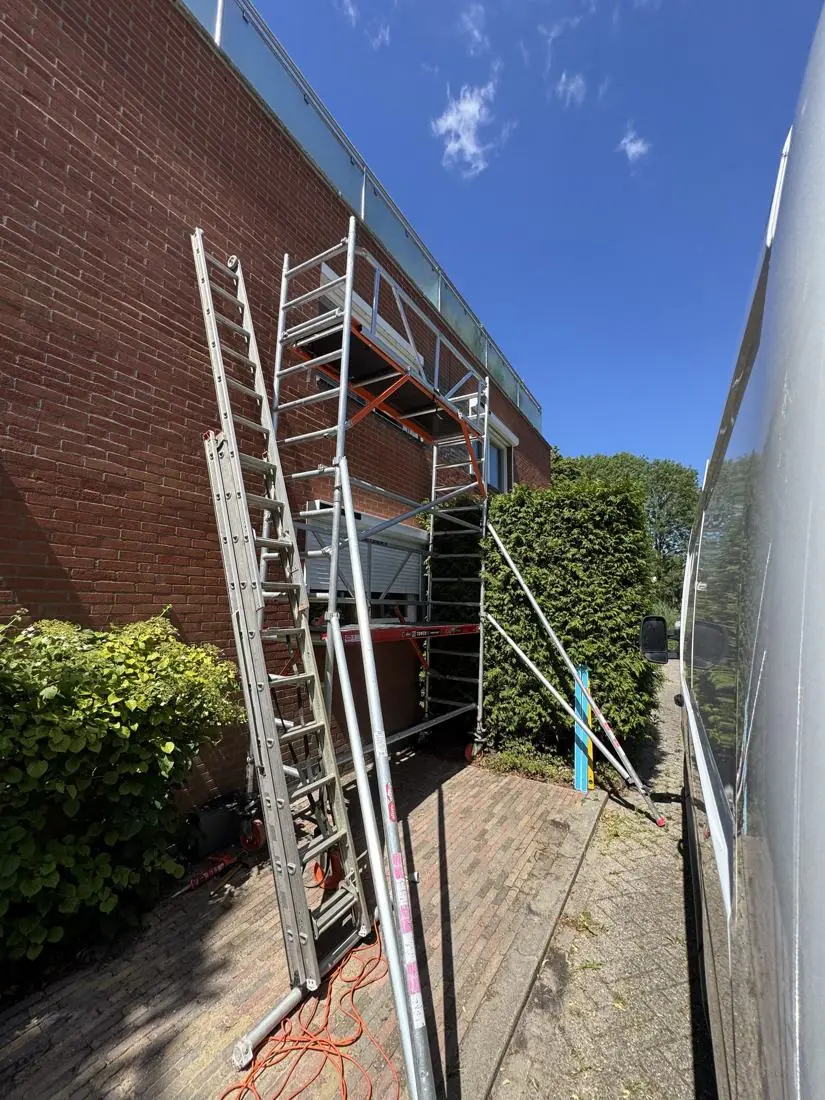
Tower erected in a slim gap between a brick wall and a white panel, ladder propped alongside on the paving

Then look at what lies under the castors. A side path has often sunk over the years around the roots of a hedge, or falls towards the street to shed water. Level the tower on the spindles and check it again every time you move, because each metre along the wall can behave differently. Painting a side facade means repositioning often, so that check becomes routine rather than a one off. How to handle it is covered in standing a tower on ground that slopes.

How many hire days painting a side facade takes

A blind flank is large but straightforward. There is nothing to mask and no sills to touch in, so once the washing down and the patching of loose areas are behind you, each round of paint moves fast. For a terraced house, count two or three days on hire: one for building, washing down and repair, one for the first round of paint, and half a day for the second. A corner plot with a long wall soon adds another day to that.

Those days are not billed as equals. The opening twenty four hours carry the rate, and everything you hold on to afterwards comes with ninety five per cent off, so letting the booking run a day longer barely alters the figure. The rental price attached to your build appears while you reserve, and the rate per model sits on the page listing what each tower costs. That matters here, because you do not want to break off a second round because the van has arrived.

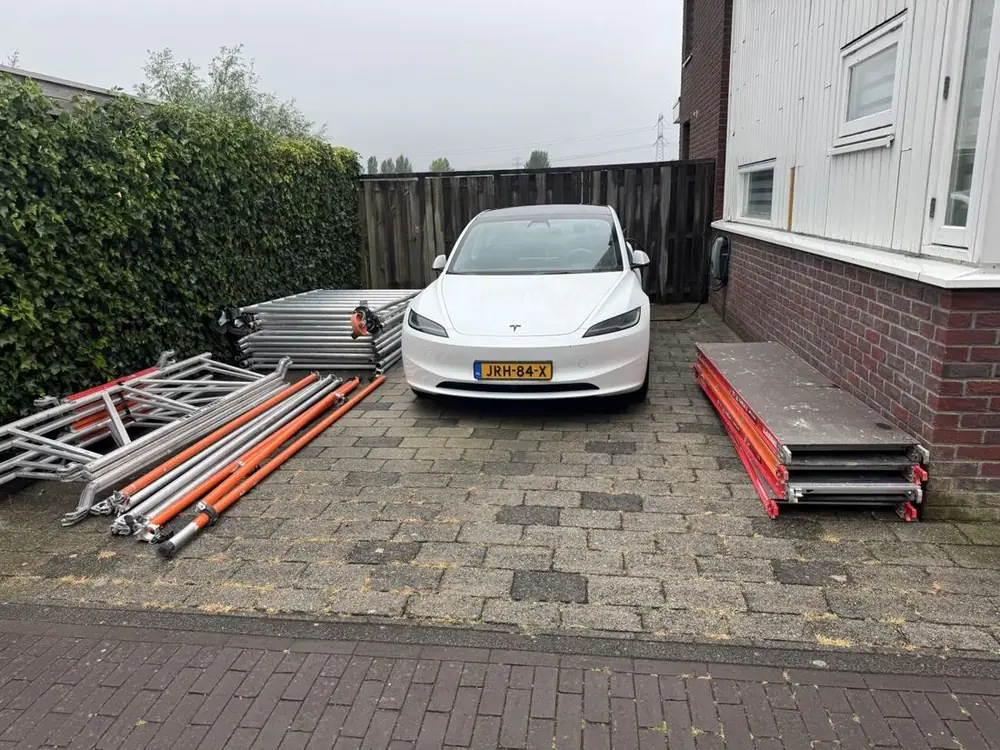
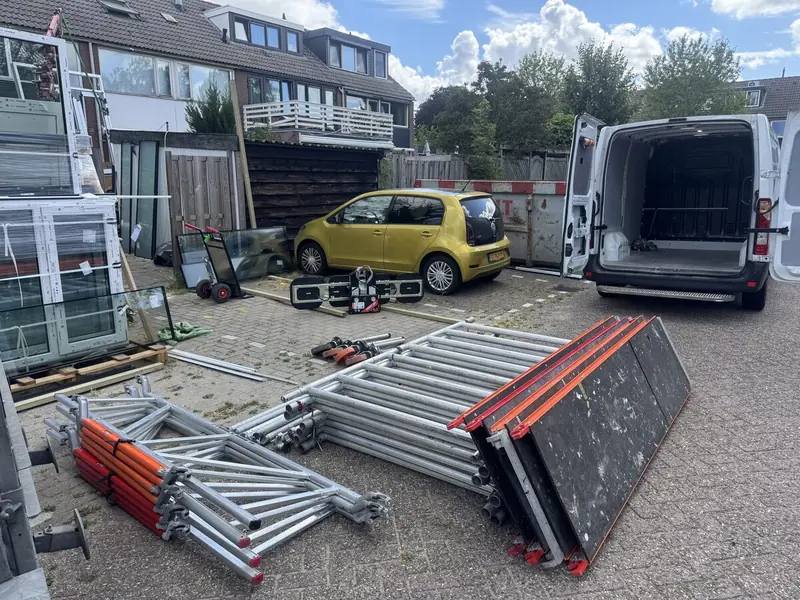
Loose frames, orange braces and stacked decking put down on a driveway next to a car, waiting through the whole job

Weather steers the rest of the planning. A north facing flank holds damp for hours after a shower, and paint on a damp ground will not bond. A flank facing south takes the full afternoon sun in summer and dries away under the roller before you have laid it off. So look at which way your wall faces and place the hire days around it. If it turns out differently, move the collection date, which is yours to set.

Which mobile scaffold suits painting a side facade?

Kamersteiger RS44
  • Working height up to 4 metres
  • Compact and narrow
  • Great for indoor and small jobs
View and calculate →
Smalle rolsteiger RS51
  • Working height up to 14.2 metres
  • Narrow (75 cm)
  • Ideal for narrow passages
View and calculate →
Most chosen
Brede rolsteiger RS52
  • Working height up to 14.2 metres
  • Wide platform (135 cm)
  • Extra stability and workspace
View and calculate →
1-persoons steiger MiTower
  • Working height up to 6.2 metres
  • Very compact
  • Quick and easy to assemble
View and calculate →

Painting a side facade in bays from a 245 cm deck

Your bay is as wide as the platform, and that measures 245 cm. Each position finishes a strip of a little over two metres, from the guardrail up to as far as the roller reaches, and then you shift along to the next piece. On a closed plane every join shows, so keep the edge wet: two people following one another beat one person breaking off in the middle of a bay. That pace decides how often the tower moves during the day, and therefore how many positions you get through.

Moving along a narrow strip calls for discipline. Clear the deck completely, check the passage is free, lock the castors the moment you are on the new spot and set all four stabilisers out again. Because the path runs straight you can push the tower along in a line without ever turning it. Chalk where each position begins, and on the following round your bays meet up again exactly as they did, which saves hunting about once a second colour goes on.

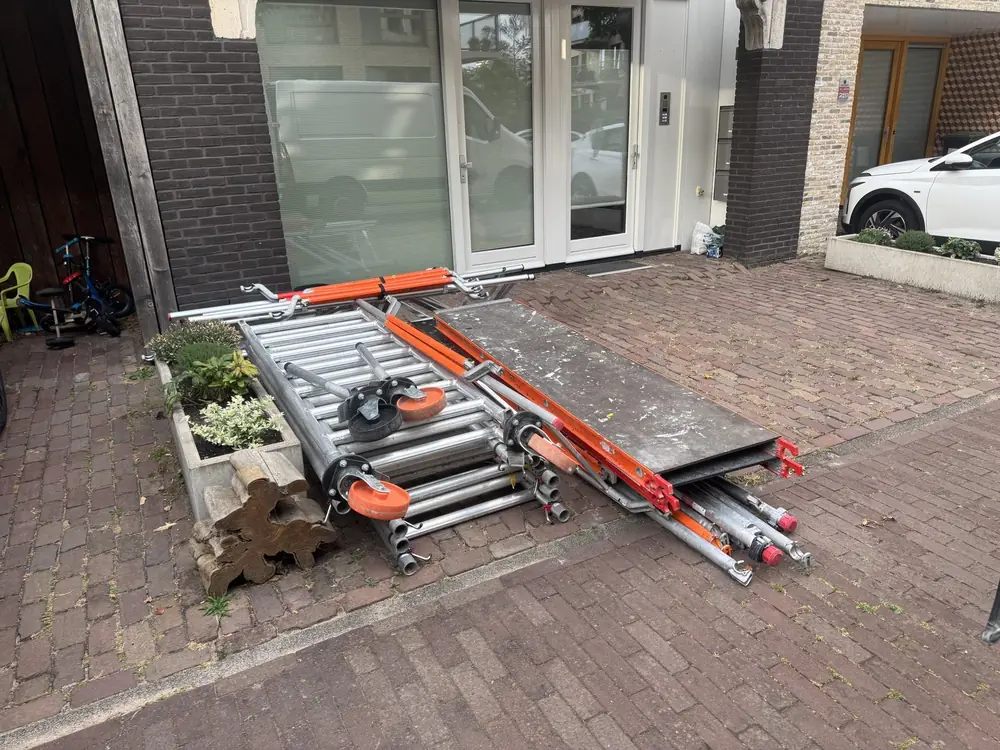
Platform decks, castor frames and adjustable legs lying on paving in front of a house, the parts a set contains

What people misjudge is the height rather than the width. A flank of ten metres is just as wide four metres up as it is at the bottom, so every band you hang a platform higher costs the same number of positions all over again. Work out the total number of bays before you settle a rental period: wall length divided by two and a half, times the number of levels you must stand at. That figure explains why a blind wall wants more days than it looks.

Scaffold hire and delivery past a narrow side passage

The parts reach your address counted and complete, and with a flank that is immediately the first puzzle: where do you put them down. Not on the path itself, since that is where you build and where the neighbours have to walk. The front garden, the drive or a piece of verge answers better, and it keeps the passage itself open for the neighbours. Send the booking through by 15:00 on any weekday and the parts follow one working day later, which leaves the morning after that free for assembly.

Building it yourself is part of the deal, and on a flank that starts with carrying. Every frame, every platform and every brace has to go through the gate or round the house to the spot where the tower will stand. Take your time over it and lay the parts down in the order you will want them, uprights first and decking last. A manual travels with the set and there is film online covering the sequence; two people need a couple of hours for a build of this height.

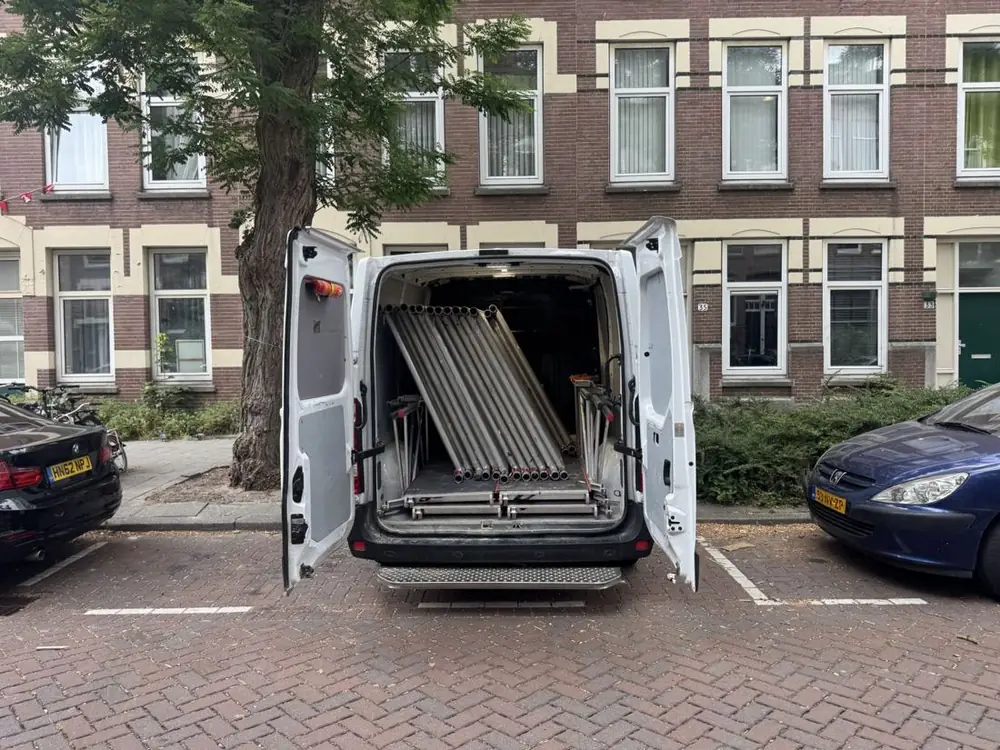
Van backed into a bay on a terraced street with rear doors open and scaffold frames stacked inside it

After the last round, painting a side facade ends with dismantling: the parts go back into one stack on the spot where they were dropped, and on your chosen date we call round to load them. Keep the path clear that morning, because no van gets round the back. The charges for the journey out and back are fixed per province and shown with VAT under delivery costs by province, so that figure can go into your budget in advance.

Safe work on a tower against a windowless wall

A platform carries 200 kg per square metre, the ceiling that EN 1004 records as load class 3. Painting a side facade fills that sooner than you might think: two decorators, a ten litre tub of masonry paint, a second bucket for the cleaner and a box of tools mount up nicely. Spread the weight across the decking rather than piling it all beside the hatch, and take empty tubs down with you rather than letting them gather up there. There is more in the article on this standard for mobile towers.

The standing rules hold here as well. Lock the castors as you step on, keep the tower empty of people and kit whenever it travels, and stop painting a side facade once the wind gets too strong for control. Between two houses the wind can actually pick up speed, so do not be fooled by the calm out on the street. Where a path runs past, allow for somebody walking underneath without your noticing. Tape or a sign at the mouth of the alley settles that.

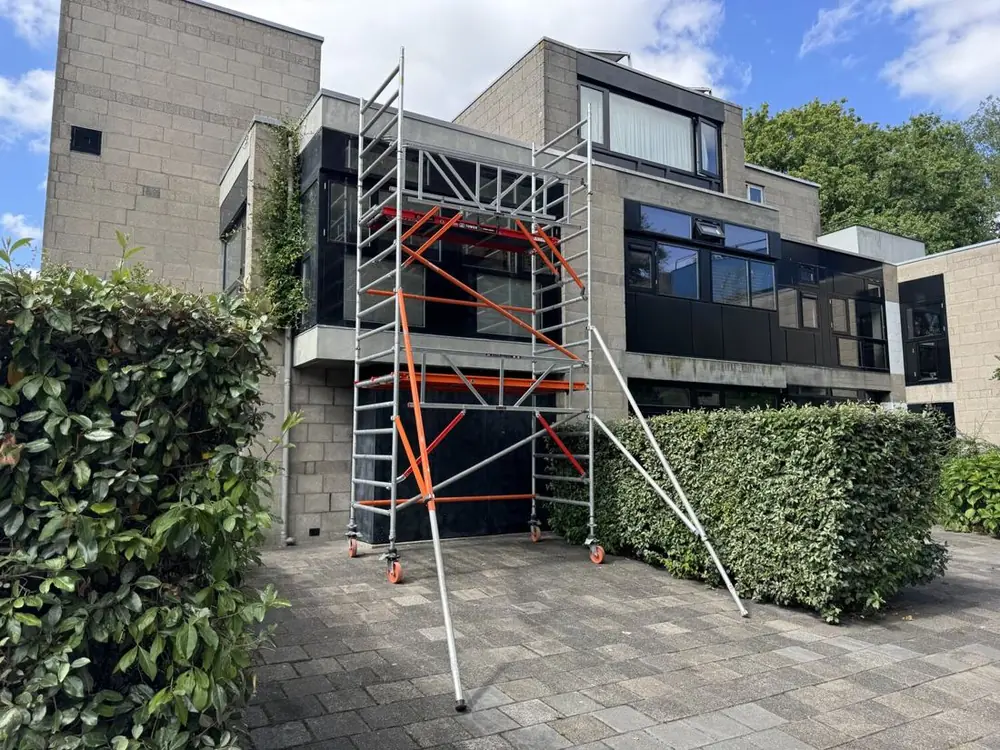
Assembled tower on block paving between hedges, four stabiliser legs angled outwards and bearing on the ground

The risk that belongs to a blind wall is that there is nothing to steady yourself on. A front elevation gives you frames and sills to lean against; here you have ten metres of bare masonry. So stay inside the guardrails, never stretch sideways for one last patch but roll the tower half a metre instead, and hang your bucket from a hook rather than perching it on the rail where a sleeve will catch it. More sits on the page about safe work at height.

In 5 steps

How hiring a mobile scaffold works

1
Choose working height

Pick the height that suits your job.

2
Book online

Sorted in 60 seconds, price shown instantly.

3
We deliver

At the agreed spot the next working day.

4
Assemble safely

Assembled by you, with a manual.

5
We collect

One call and we collect the scaffold.

Good to know

Practical tips for painting a side facade

1

Measure the passage at its narrowest point and not at the gate. A downpipe, a meter cabinet or a projecting plinth decides whether the 135 cm base really gets past without scraping anything.

2

Ask the neighbours before you reserve and agree how many days the tower will occupy the path. A flank nearly always adjoins their ground, and shifting things later is not an option once it stands.

3

Wash the wall down on the day you build and let it dry overnight. Masonry paint on damp brick lets go after a winter, and then you are back on the very same spot a season later.

4

Work with two on the deck where the wall is wide. On a blind plane the edge has to stay wet, and alone you rarely carry a ten metre band without leaving a visible join.

5

Lay a run of boards beside the tower wherever the neighbours' path is soft or loose underfoot. That keeps the passage walkable for them and stops the castors from digging themselves into gravel.

6

Chalk the paving at every position. On the second round you roll the tower back to precisely the same place and your bays line up again, with no measuring, no fitting and no guessing where the last one stopped.

Frequently asked questions

Frequently asked questions about painting a side facade

Which mobile scaffold suits a hire for a blind side wall?+

That is the RS52, 135 cm across the base, provided it fits between your masonry and the boundary. On a blind flank you work in continuous bays with no frames in between, and you want the bucket, the roller and the brush on the deck together. If the passage turns out narrower, you move across to the slim RS51 and keep less working room. So measure the tightest point of the strip before reserving a tower.

How does hiring a scaffold for side wall work actually go?+

Reserving happens online. You assemble the build, name the day the van comes out and the day it returns, then settle up beforehand with VAT included. The scaffold parts are dropped at your place, you carry them through the passage, raise the tower and coat the wall bay by bay. On the agreed day everything stands dismantled and ready. All you do is show the driver where the parts may go, since the path stays clear for building and moving.

How many days on hire are enough for a two storey flank?+

For a terraced house, two to three days of hire will do. Building, washing and making good the loose areas fill the first day between them, after which each round of paint takes roughly a day. A corner plot with a wall of ten metres or more wants an extra day, and so does a third storey. Since the collection day belongs to you, being generous with the booking hardly changes what you pay for the tower.

What am I paying to hire a scaffold for painting a side facade?+

The rental price depends on the build and on the province the van drives to; you see the total with VAT before confirming. What counts on this job is that most of the rate sits in that first day and that whatever you add behind it hardly registers. A flank is seldom coated in one go, so reserve one day too many instead of one too few. Handing the tower back early is always allowed; we simply collect it before the date you named.

What working height do I hire for a side wall of two storeys?+

Measure from the path to the underside of the roof edge; two storeys usually comes out around eight metres and three storeys nearer twelve. Your feet stand lower than the highest point you can still touch in, so the build need not carry all the way to the eaves. Enter that measured figure when hiring, and if in doubt take the taller build. The variants sit side by side on the working height overview.

Delivery or collecting it myself: which is easier for this hire?+

Delivery is usually the practical answer on a flank. The van leaves your hired tower at the kerb on the day you picked, at a provincial figure known in advance, and you carry the parts through to the back yourself. Would you sooner drive out for it? Then by arrangement the scaffold waits for you at no cost at Zeeburgerpad 89 in Amsterdam. A ten metre build is a great many tubes and platforms, so measure your load space before setting off.

Does Steigertaxi stand the tower up, or do I build it after hiring?+

You raise it yourself and you strip it yourself. We deliver the parts; the rest is your work: building from the bottom, checking everything sits level and taking it all apart once the final round is on. Steigertaxi puts up no towers and keeps neither facade scaffolds nor cherry pickers for hire. When painting a side facade that is no obstacle, because a mobile tower slides along the path in a straight line and never has to be turned round.

What if painting a side facade overruns and the hire has to run on?+

Give us the new end date in good time and the collection moves with you, unless the tower is already promised to somebody else. On a flank the delay is usually rain or patches that must be repaired first. Anyone who sees that coming books a spare day at the outset, and thanks to the discount rule it costs almost nothing. Bringing it back sooner is fine, so nothing about the rental ties you down.

How much clear space beside the wall does a hired tower want?+

At the least the width of the base plus what the four stabilisers claim on either side, and then a little margin to walk past. In practice that comes to a strip of a good two metres. If your path is tighter, hire a narrower base or talk to the neighbours about the metre on their side. Measure the point where the tower has to get onto the path as well, because that gateway is very often the real limit rather than the wall itself.

Can I carry on hiring if the wall stays too wet to coat?+

The tower is welcome to stand; only the coating waits. Masonry paint on a damp flank bonds poorly and bleeds through later, so holding off costs less than pressing on. Use a day like that to wash the wall, fill cracks or tape off the roof edge. Because the collection day belongs to you, the delay adds at most a single day to the rental. Touching in can carry on the next morning.

Do I get the deposit back after hiring the tower?+

A deposit goes down when you hire the tower and returns within 1 working day of the parts coming back and being counted. On wall coating, masonry paint dried onto the platforms is the usual cause of bother, so put a sheet on the deck before the first tub is opened. Hand back every component you received; a brace left on the path gets noticed. There is more in how the deposit and the return work.

Do I need the neighbours' consent to hire a tower for the path?+

Frequently, yes. A flank regularly borders ground that belongs to next door or that you share, and a mobile tower stands there for several days. Say beforehand how long it will be up, where the stabilisers will land and which days paint will be in the air. Where the strip is council land beside a public path, ask the council what is permitted there. Settle all of that before you hire the tower rather than afterwards, when it is already standing on the path.

Hire a mobile scaffold for painting a side facade today?

Calculate your rental price now or ask for free advice.

Rolsteiger van SteigerTaxi geleverd op locatie
Book it online

Your scaffold sorted in 2 minutes.

Choose your scaffold and working height, see the price instantly and book online.