
Knowledge base · reading time 12 min
Working safely at height: the key rules
Most accidents at height are not caused by spectacular mistakes, but by small things nobody checked that day. A castor left unbraked, a brace skipped, a bucket resting on the guardrail. Below are the rules that genuinely matter in practice, in the order you meet them: from the ground and the assembly through to moving the scaffold, the weather and the checks you run before you climb.
- Working safely at height on a mobile scaffold: ground, assembly order, guardrails, load, stabilisers, moving, weather and the checks that matter.
- When strong wind or a storm is forecast, you do not carry on working on a tall mobile scaffold.
- Yes.
- A correctly assembled mobile scaffold has guardrails and toe boards all round, and those form the fall protection.
Judge the ground before you put anything down
The safety of a mobile scaffold starts underneath the castors. The whole weight of the structure, the people and the material lands on four points, and all four have to stand equally firm. Paving, block paving, asphalt and concrete are fine. Grass, sand, fresh soil, a border and a newly laid garden path are not, because a castor sinks in as soon as load comes onto it.
On soft or irregular ground you put base plates under the castors to spread the pressure. On sloping ground you level the scaffold with the spindles, and every leg has to make genuine contact. A spindle hanging just clear of the ground carries nothing and lets the scaffold settle later. How to handle that is covered in a mobile scaffold on uneven ground.
Also consider what you cannot see. A manhole cover, a crawl space, a basement roof, a freshly dug trench or a timber floor indoors each have their own load capacity. If in doubt, position the scaffold above a load bearing wall or a beam, and ask if you do not know the building. That costs a few minutes and prevents damage you cannot undo.
- Level, load bearing ground at all four castor positions
- Base plates on grass, sand, loose soil or a soft verge
- Spindles adjusted until every leg makes contact
- No manhole covers, gratings or loose slabs under the castors
- Enough room all around for the stabilisers
- Clear access to the set-up spot for the longest parts
Key facts
| Feature | Value |
|---|---|
| Core answer | Work to EN 1004 and the Altrex manual; source: the Dutch Arboportaal |
| Standard | EN 1004 |
| Load class | Class 3: 200 kg per m² |
| Wind | Work up to wind force 6 |
| Castors | Swivel castors with brakes, locked while in use |
The assembly order you always follow
Start with the base level and then set every castor brake, including the ones you think you will not need. Build up level by level and fit the diagonal braces as you rise. Those braces keep the structure square and are not an optional extra to add later. The full assembly step plan takes you through the order. Set every brake before you place the first frame, not afterwards.
Work upwards from a finished level, never from a half finished one. That means laying the deck on each level, checking the hatch and fitting the guardrails before you go higher. That way you never stand somewhere the fall protection is still incomplete. On the taller builds that is the difference between working steadily and improvising halfway up. Only then does the next level become a safe place to stand and work from.
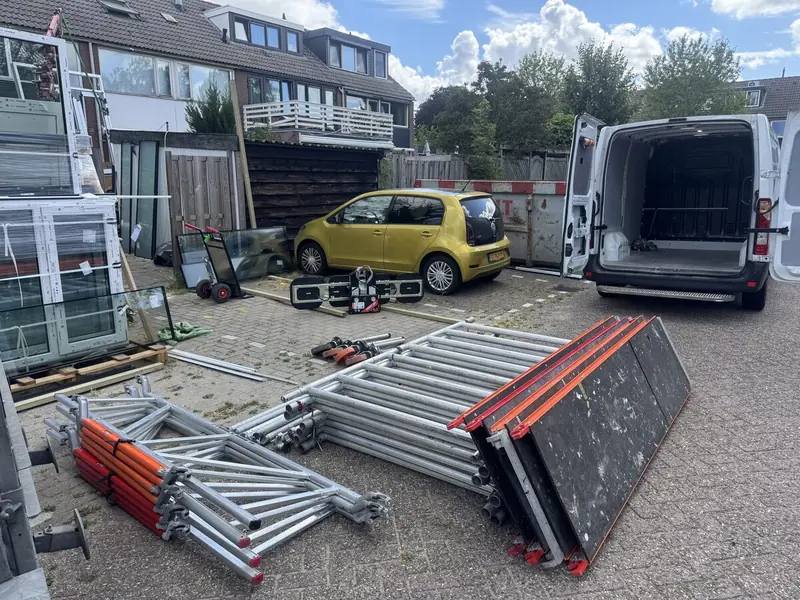
Do it with two people if you can. One below handing up and one above fitting is faster and safer than hauling parts up on your own. We do not assemble for the customer and we do not deliver the scaffold ready built, so plan that time into your schedule. What the scaffold itself involves is set out in what a mobile scaffold is.
Guardrails, toe boards and the hatch
The guardrails around the deck are the first layer of fall protection and belong on every side, including the wall side. The idea that you need no rail against the building because the wall stops you does not hold: there is always a gap between the scaffold and the facade, and it is wide enough to step through. So fit the rail all round, even if you are only working on one side.
Toe boards run all around the edge of the deck. They are not there for you but for everything that rolls, slides or topples: a drill, a sealant tube, a bucket. People walk past below, and a tool falling from eight metres does damage. Fall protection on a mobile scaffold explains how those parts work together. Fit them on the short ends too, because material rolls off there just as easily.
Close the hatch in the deck after every passage. An open hatch in a deck you are working on is a hole you step into the moment you walk backwards or concentrate on the job. Never lay material over it to close the gap either, because then you cannot get through it on the way down. Check that it drops shut properly each time rather than resting on its frame.
Climb on the inside, always
You climb using the built in ladder on the inside, through the hatch in the deck. Climbing up the outside along the frames feels quicker, but there is no guardrail, no hatch and no toe board there, and you pull the scaffold out of balance while you do it. It is one of the few things that genuinely goes wrong on a correctly assembled scaffold.
Climb with two free hands. Tools, buckets and material get handed up or hoisted on a rope. Anybody climbing with a full bucket in one hand has no hand left to hold on with if a foot slips. On wet rungs that risk is greater, so wipe your shoes before you start. Agree who stays below to hand things up, so you never have to wait. Climb steadily and facing the scaffold.
On the deck you stay inside the guardrails. Do not stand on the rail, do not put a crate or a board on the deck to gain height and do not reach far over the edge. If you cannot reach, move the scaffold or choose a different platform height. The comparison with a ladder is set out in ladder or mobile scaffold.
What may stand on the deck
Our equipment is made by Altrex and built to EN 1004 in load class 3, which works out at 200 kg per square metre of deck. That is enough for two people with tools and material, provided you spread the weight. Put heavy stacks against the wall side and keep the walking route across the deck clear. There is more on this in mobile scaffold load and weight.
Rest nothing on the guardrail and hang no buckets from the rail tube. The guardrail carries you, not a load. Long sections such as fascia boards or panels lie flat on the deck rather than upright against the rail, because upright sections catch wind and topple. What the standard actually covers is explained in EN 1004 explained. Do not leave a jerrycan or bucket loose in a corner where you will walk into it.
Clear the deck at the end of the day. Material left lying takes up walking room, adds to the load and blows away or falls over as soon as the wind gets up. An empty deck is also the starting point for the check you run the next morning before you climb again. Take tools you will not need tomorrow down with you. An empty deck also catches less wind overnight.
Stabilisers and tying in
Stabilisers splay outwards and widen the base of the scaffold. They are not an accessory: at the heights you hire a mobile scaffold for, they are what keeps the structure upright. All of them belong in firm contact with the ground. On sloping ground you adjust them one by one until that is genuinely the case. They also belong in the position that matches the build height, not half retracted.
At greater heights, and on a scaffold that stays up for several days, tying it to the building comes into play. A tie takes the sideways forces and holds the scaffold against the structure. Where and how to place them is covered in stabilising and tying in. Check the ties again for tension after a windy day. A tie that has gone slack no longer does what it is there for.
Never build higher than the configuration the scaffold was supplied for and never add parts of your own. A frame from another brand, a loose board as an extra deck or a ladder standing on the platform are exactly the improvisations that make correct equipment unsafe. If a part is missing, report it before you start. We deliver complete for the height ordered, so everything you need is in the package.
Moving it without risk
You always move a mobile scaffold empty. Nobody on the scaffold, no tools on the deck and no buckets on the guardrail. That sounds obvious until you work along a long facade and the scaffold has to shift a metre ten times over. Precisely then the temptation to stay on board while somebody pushes is strongest, and precisely then it goes wrong.
Look at the route before you roll. A cable, a hosepipe, a threshold, a manhole cover or a step can block one castor while the rest keeps going, and that twists the structure. Roll steadily and lengthways, and push at base level rather than high against the structure. After moving, set every castor brake again. Look up before you roll as well, because a branch or a cable over the route matters as much as a threshold on the ground.
Then check once more that the scaffold stands level and that the stabilisers still make contact. On sloping ground that changes with every metre you move. There is more on the castors and their brakes in stabilising and tying in. If the scaffold was tied in, release the tie first and refit it immediately at the new position. On taller builds, dismantling and rebuilding is sometimes wiser than rolling a long distance.
- Deck empty, nobody on the scaffold
- Route cleared in advance of cables, hoses and obstacles
- Roll steadily, lengthways along the scaffold
- Push at base level, not high against the structure
- All castor brakes set again afterwards
- Level position and stabilisers checked once more
Wind, rain and frost
Wind is the weather factor that matters most for a mobile scaffold. An assembled scaffold presents surface area, and with material or sheeting on it it catches a great deal. When strong wind or a storm is forecast, either leave a tall scaffold tied in or take it down a few frames. Clear everything off the deck in any case, including sheeting and loose boards.
Do not hang a sheet, tarpaulin or advertising banner on the scaffold without allowing for it. A closed surface acts as a sail and changes the forces on the structure entirely. What hangs perfectly well on a still day becomes a problem at the first gust, and the stabilisers were not calculated for it. Ask us before you fit a sheet or a banner and we will think the set-up through with you.
Rain and frost mainly make the deck and the rungs slippery. Wipe your shoes before you climb, do not work on a frozen deck and remember that paint, moss and mud on aluminium are extremely slick. For working in the cold season the practical side is covered in hiring a scaffold in winter. In frost, work with gloves that grip cold aluminium, and remember that you feel a slip starting far later than you would expect.
The checks before and during the job
There are a few fixed moments at which you look the scaffold over. Each takes a minute or two and catches exactly the things that shift during a job: a brace worked loose, a deck no longer seated in its rebate, a stabiliser that has settled into soft ground. The table below sets those moments out. Run them in the same order every time so none of them gets skipped on a busy morning.
Run the check before you climb, not from the deck. Walk a circuit around the scaffold, look up along the standards and take hold of a frame to feel whether there is play in it. Our scaffolds are inspected between hires, but the build on your job is and remains your own check. Check as well that the decks still sit properly in their rebates and that the hatch drops shut.
If you notice something wrong, you do not carry on until it is resolved. A missing brace or a damaged part is not a detail you can leave for a day. Questions about equipment and delivery are answered under frequently asked questions, and otherwise call or message us. We inspect the equipment between hires, so a damaged or missing part is useful information for us too.
| Moment | What you check | What you look for |
|---|---|---|
| Before assembly | ground and set-up spot | level, load bearing and free of obstacles |
| During assembly | castors and spindles | every brake set, spindles adjusted level |
| After assembly | guardrails, toe boards and hatch | fitted all round, hatch closes properly |
| Before each working day | braces and decks | everything tight, nothing shifted or worked loose |
| After wind or rain | stabilisers and ties | contact with the ground, ties still under tension |
| Before moving | deck and route | empty deck, clear route, nobody on board |
Indoor work asks for different attention
Indoors the wind plays no part, but other points come in. The floor has to carry the point load of the castors, and on a lacquered or polished floor you want to be sure the brakes bite. Put something under the castors if the floor could be damaged. What else is involved is covered in using a mobile scaffold indoors.
Indoors, also watch what hangs above you: a light, a smoke alarm, a pipe bracket or a ceiling beam. Build too close under the ceiling and you end up working bent over, which leads to stretching. Measure the clear height before you decide which platform height to stand on. So stand the scaffold in position and look up before you build the last level. That saves dismantling and starting again.
For rooms and stairwells there is the RS44 room scaffold, which fits through a standard internal door from around 70 cm. If you work alone and no higher than 6 metres working height, the MiTower as a one person scaffold is often handier, because you move it yourself without dismantling. For a hallway, a void or a stairwell, look above all at the width of the opening and the clear height over the stairs.
Who is responsible for what
We supply inspected and complete equipment, made by Altrex and built to EN 1004, and we check it between hires. What we do not do is assemble it: you build the scaffold yourself using the manual and the instruction video supplied with it. That places the assembly and the use on site with the person working on it. That is not a formality: whoever assembles it effectively sets how safely the week is worked.
It also means counting the parts when the delivery arrives. Frames, braces, decks, guardrails, toe boards and stabilisers should all be in the package for the height you ordered. If something is missing or damaged, report it before you start assembling rather than halfway up. Count the braces and guardrails too, because those are the parts you only miss halfway through the build.
If you work with several people, agree who runs the final check and who decides whether work continues in bad weather. One person holding that line works better than assuming everybody will notice. Run through the mobile scaffold hire checklist once more before the delivery day. For the mobile scaffold that matches your working height, use the configurator. Say that agreement out loud at the start of the job and nobody has to argue about it later.
Frequently asked questions
Can I keep working when it is windy?
When strong wind or a storm is forecast, you do not carry on working on a tall mobile scaffold. Clear the material off the deck, leave the scaffold tied in or take it down a few frames. An assembled scaffold catches a lot of wind, certainly with material or sheeting on it. Waiting a day beats improvising.
Do I have to check the scaffold myself before using it?
Yes. We supply inspected equipment, but the build on your job is yours to check. Walk around the scaffold, look at whether all braces, guardrails and toe boards are in place and whether the decks are seated properly. Run that check from the ground, before you climb.
Do I need a harness on a mobile scaffold?
A correctly assembled mobile scaffold has guardrails and toe boards all round, and those form the fall protection. So make sure they are complete and keep working inside the guardrails. Do not stand on the rail and do not use a crate or board to gain height. If you cannot reach, the platform height was chosen wrongly.
How many people may be on it at once?
That depends on the model and on the load. The wide RS52 gives two people room to work side by side, the narrow RS51 is tighter. The MiTower is a one person scaffold. In every case the people plus their tools count together within the permitted load of 200 kg per square metre.
May I move the scaffold with somebody on it?
No, never. Moving is done with an empty deck and nobody on the scaffold. Clear the route first, release the brakes, roll steadily lengthways and then set every brake again. After that, check once more that everything stands level.
Will you assemble the scaffold if I ask?
No, assembly is done by you. We deliver the scaffold complete with a manual and an instruction video so you can follow the fixed order. With two people it goes faster and more safely than alone. Plan that time into the job, for taking it down as well as putting it up.
What do I do if a part is missing or damaged?
Do not start assembling and report it to us. A scaffold built with a missing brace or a damaged frame is missing exactly the part that keeps the structure rigid. Never substitute a part from another brand or a loose board of your own.