
Knowledge base · reading time 12 min
Ladder or mobile scaffold: which should you use?
A ladder is up in seconds, but the moment a job runs longer than a few minutes or needs tools in hand, you hit its limits. A mobile scaffold costs you some assembly time and then gives you a flat platform with guardrails. Below, ladder and mobile scaffold sit side by side on safety, reach, ground conditions, indoor use and what hiring means in practice.
- Ladder or mobile scaffold? Compare safety, reach, ground conditions and cost, and see when a mobile scaffold is the faster and safer choice.
- Yes, and along a facade it is easier, because you roll it on its castors.
- For self collection you need transport space, because the parts are longer than an average car boot.
- That depends on the model and on what else you take up.
Why a platform behaves differently from rungs
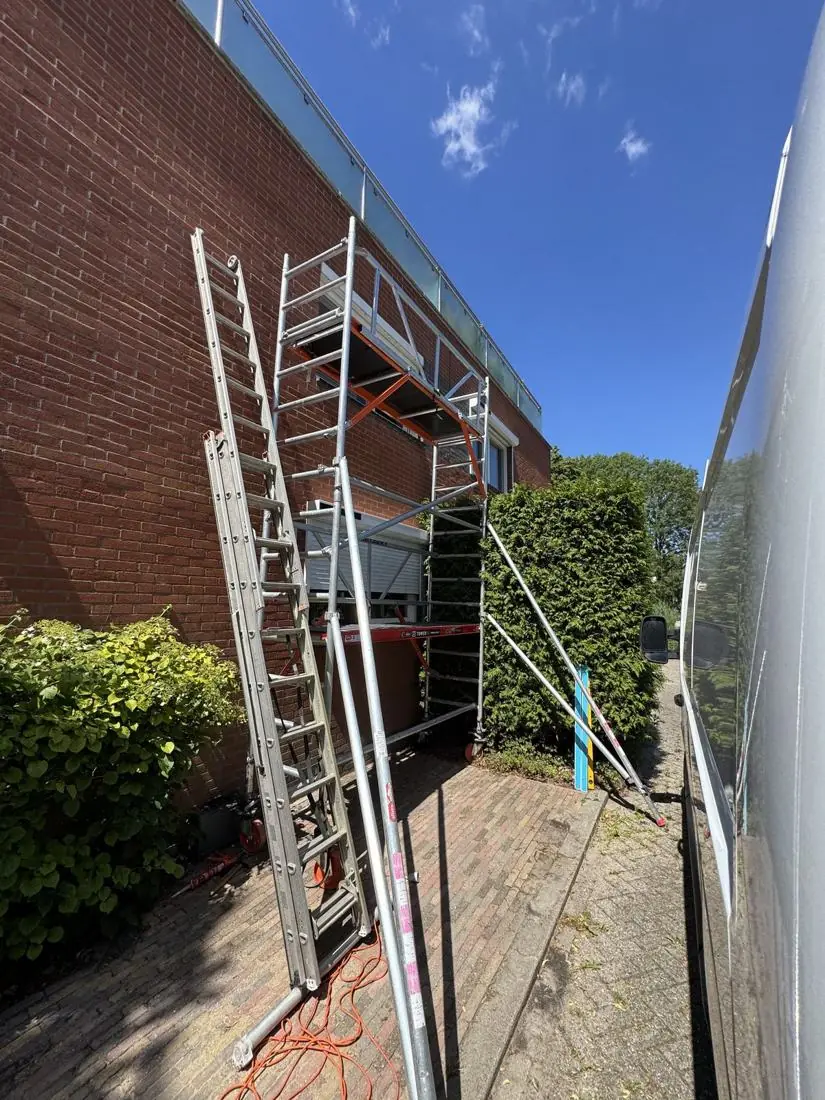
On a ladder you stand on two narrow rungs and hold on with at least one hand. Reach further to the left or right and your centre of gravity moves towards the stile, which is exactly when things go wrong. A mobile scaffold removes that temptation with a closed platform, guardrails all round and toe boards along the edge. You stand inside the structure rather than leaning against it, and instead of overreaching you simply roll the tower along.
With both hands free the work itself changes. You hold a caulking gun and a scraper at the same time, you put a drill down without climbing off first, and you turn your upper body instead of your whole frame. That saves time, but above all it removes the small awkward movements that cost you your balance on a ladder. Anyone reading up on fall protection on a mobile scaffold soon notices that the guardrail already does most of that job.
Toe boards look like a detail until someone walks underneath. They stop a paint tin, a screwdriver or an offcut that would otherwise roll off the edge. A ladder offers no such protection, so tools end up balanced on a rung or hanging in a bucket. The rules for working at height cover this in detail, because falling material and falling people share the same causes.
Key facts
| Feature | Value |
|---|---|
| Rule of thumb | Above 3 metres working height or for longer jobs: mobile scaffold |
| Standard | EN 1004 |
| Load class | Class 3: 200 kg per m² |
| Available working heights | 4.2 to 14.2 metres |
| Each extra day | 95% off: €2.50 to €16.25 a day |
How much facade you cover per set-up
From a ladder you cover a strip roughly as wide as your arms reach. Anything beyond that means climbing down, lifting the ladder, repositioning it and climbing back up. On a six metre wide facade that happens five or six times per height band, and every move is a chance to end up at the wrong angle. On a mobile scaffold you stand on a platform 245 centimetres long and finish a substantial stretch in one go.
The width mainly decides how you get onto the site. The RS51 is 75 centimetres wide, which takes it through most garden gates and between a shed and a fence. The RS52 is 135 centimetres wide and gives room to put material down beside you or to work in pairs. Which variant fits where is set out in the guide on mobile scaffold dimensions.
Walk the route before you book: gate width, a bend in the path, a car on the drive. A tower you cannot get round the back has to be carried through the house or lifted over the fence, and that is exactly the surprise that derails a working day. Measure the narrowest passage at its narrowest point rather than in the middle, because a gate post or a downpipe easily takes ten centimetres.
What you can take up with you
Our equipment is load class 3, which works out at 200 kilos per square metre. That figure includes you, so count your own weight and that of a colleague before stacking material. Spread the load across the platform instead of putting everything in one corner, and place heavy items above an upright where possible. What that means day to day is worked out in the guide on scaffold loading and weight.
That gives you room for the kit you would otherwise carry up and down five times, which on a day of facade work adds up to dozens of climbs. Lay it out beside the tower while you assemble, so it goes up in one pass instead of in five trips. A day of facade painting usually means roughly this load:
What you should not do is lean material against the guardrail or balance it on the toe board. A toe board is there to stop something that is already sliding, not to serve as a shelf. Lay long items such as fascia boards or trim flat on the platform with the ends inside the guardrail, so you do not trip over them when you turn around.
- a bucket with brushes, rollers and a paint tray
- a tin of paint or stain, plus a sealed spare
- a cordless drill with the second battery charging at ground level
- sealant tubes, cloths and abrasive paper within reach
- a work light for under a roof overhang or on the shaded side
- the assembly manual, so you can check what may be moved
Set-up time against the time you win back
A ladder is in place in twenty seconds. A mobile scaffold you assemble yourself, using the manual and the instruction video supplied with your booking. We deliver the equipment in parts and do not build it for you, so plan that assembly into your day before you start. On any job of half a day or more you recover that time within the first working hour, simply because you stop climbing down every metre.
The step by step assembly guide follows a fixed order: base frame with adjustable feet, castors on the brake, first platform, braces, and only then higher. Working in pairs is noticeably quicker from the second platform level onwards, because you can hand parts up instead of descending each time. Dismantling follows the reverse order and usually takes less time than building up.
Calculating working height before you book
Working height is platform height plus two metres, because an adult reaches roughly two metres above the surface they stand on. If the gutter sits at six metres, you need a platform height of four metres. Always measure from the point where the tower will actually stand rather than from the front door, because a sloping garden or a sunken light well easily changes the sum by half a metre.
Our range covers working heights from 4.2 to 14.2 metres, which spans a garage roof up to a four storey facade. The working height page lets you choose metre by metre, and there is an indication per storey from the first floor up to the fifth. The guide on how high a mobile scaffold may stand covers the limits that apply indoors and outdoors.
A ladder works to a different sum. You stand several rungs below the top, because the upper rungs are what you hold on to. The higher you go, the narrower the strip of facade you can still reach safely, since every sideways centimetre tilts the ladder with you. A mobile scaffold gives you the same working area at ten metres as at four, so the gap widens with every storey. That is also why the two options sit close together on low work and far apart on high work.
Ladder and mobile scaffold side by side
The decision almost always comes down to three things: how much you carry up, how long you stay up there, and how wide the surface is that you have to finish. The table below sets out the practical differences as you meet them on site, without the theory around them. Use it to work out whether your job belongs in the left column or the right one.
If your job sits in the left column, a ladder is a perfectly good tool and there is nothing to hire. As soon as two or more rows pull you to the right, the mobile scaffold is the sensible choice. The individual topics in this table are covered separately in the knowledge base, from moving a tower to anchoring one.
| Point | Ladder | Mobile scaffold |
|---|---|---|
| Working surface | two narrow rungs | platform 245 cm long |
| Hands | one hand holds on | both hands free |
| Edge protection | none | guardrails and toe boards |
| Material | only what you carry | load class 3, 200 kg per m2 |
| Moving | lift and reposition | roll on castors with brakes |
| Getting ready | set down and climb | self assembly with manual and video |
| Height range with us | not applicable | working height 4.2 to 14.2 metres |
Ground conditions: where both run into trouble
A ladder on slightly settled paving stands crooked, and on grass a foot sinks in the moment you shift your weight. You often notice halfway up, when you are already committed. A mobile scaffold has adjustable feet to absorb differences in level and to set the structure level before you climb. Check that with a spirit level on the first platform rather than judging it by eye from the pavement.
On soft or loose ground put base plates or track mats under the feet so the pressure is spread. How to handle grass, sand or a sloping path is covered in the guide on a mobile scaffold on uneven ground. After that, remember to lock the castors, because a tower that rolls a few centimetres while you work is no longer standing level.
Above a certain height stabilisers belong on the tower, and sometimes an anchor to the facade as well. That is not an optional extra but part of the configuration as it was calculated. Which measures apply when is set out under stabilising and anchoring. A ladder has no such chapter, which sounds convenient until you realise there is nothing to get wrong because there is nothing protecting you either.
Working indoors: doors, hallways and stairwells
Indoors a ladder is at its most tempting and least suitable. On a smooth floor, a tread or a stair runner it rarely stands stable, and in a stairwell you often cannot set it at the right angle at all. The RS44 room scaffold exists for exactly this: it passes through a standard interior door from around 70 centimetres, so you roll it from room to room without dismantling. Take a look at the room scaffold.
If you work alone in a normal ceiling height or a hallway, the MiTower is often more practical. It is a one person tower that you assemble on your own and that reaches up to 6 metres working height, ample for a stairwell, a void or a tall hall. Because it is narrow and light, you can roll it down the corridor without asking anyone for help. The MiTower page shows where it does and does not fit.
Indoors, pay extra attention to what goes under the feet. A parquet or poured floor benefits from a board or sheet, and a threshold decides whether you roll straight through or have to lift after all. Look up as well: a pendant light, a smoke alarm or a beam limits the height at which the platform still fits. The practical points for interior use are gathered in the guide on using a mobile scaffold indoors.
Jobs where the ladder should stay in the shed
Some jobs simply cannot be finished from a ladder without overreaching or improvising. They usually involve two hands at once, material held above your head, or a long horizontal line you have to follow across the width of the house. Those three markers are visible before you start, so you do not have to discover the problem halfway through with a wet brush in your hand and the light going.
The following jobs take noticeably less time and effort from a mobile scaffold, because each of them needs both your hands and a flat surface to put things down. They also rarely come alone: anyone clearing the gutter usually does the fascia boards in the same go, which turns an hour aloft into a full day. If two or more of these are on your list, hiring is the sensible step:
For facade work across the full width, such as painting a facade, each set-up covers a strip of more than two metres and lets you keep a wet edge. When cleaning a gutter you need a bucket, a scoop and a hose at the same time, and a platform holds all three where a ladder offers only a hook. You notice the difference most at the end of the day, when you carry on instead of packing up.
- painting fascia boards and barge boards along the whole roof edge
- scooping out a gutter and flushing it in the same pass
- sanding and repainting first or second floor window frames
- raking out and repointing brickwork
- cleaning solar panels or replacing an optimiser
- fitting exterior lighting or a camera with cable and drill in hand
Delivery, collection and the deposit
Order before 15:00 and we deliver the next working day, anywhere in the Netherlands. Delivery and collection are covered by a fixed amount per province, so you know the figure in advance and there is no per kilometre calculation afterwards. What that means for your area is shown on the delivery costs page. We drop the equipment at the agreed spot and collect it once you are done.
Collecting it yourself is free by appointment at Zeeburgerpad 89 in Amsterdam. For delivery the deposit is 500 euro for the RS51, the RS52 and the MiTower, and 150 euro for the room scaffold. If you collect the equipment yourself the deposit is 1000 euro for the RS51 and RS52, 750 euro for the MiTower and 150 euro for the room scaffold. It is returned within one working day, as explained under the scaffold deposit.
The hire period counts differently from what most people expect. The first hire day is charged at the full rate and every following day costs 5 percent of that day rate. A job that runs into the weekend is therefore rarely a problem. The comparison between a short and a long period is set out under the weekly rate, and current rates are on the prices page.
Making the choice for your own job
Start with the highest point you need to reach and subtract two metres: that is your platform height. Then look at the narrowest passage on your property, because that decides between the RS51 and the RS52. Finally estimate how long the job takes. Anything longer than an hour aloft, or anything where you swap tools, falls into the range where a tower pays for itself.
If you are stuck between two heights or two models, a short conversation is faster than working it out alone. Send a photo of the facade and the width of your gate through WhatsApp, or use the form on the contact page. With those two details we can usually settle it in a single message. Many practical points about delivery, assembly and return are answered separately under frequently asked questions.
Frequently asked questions
Can I move a mobile scaffold as easily as a ladder?
Yes, and along a facade it is easier, because you roll it on its castors. Nothing has to be lifted and the assembly stays intact. Lock the castors before you climb and never move the tower with a person or loose material on the platform.
Do I need a trailer to collect a scaffold?
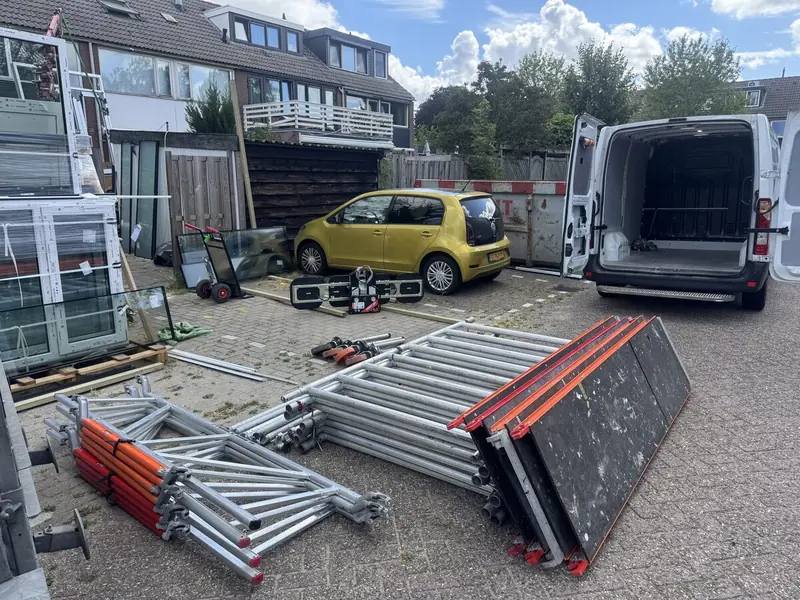
For self collection you need transport space, because the parts are longer than an average car boot. If you choose delivery it does not come up at all, since we bring and collect the equipment. The options are set out in the guide on hiring without a trailer.
Can two people stand on a mobile scaffold at once?
That depends on the model and on what else you take up. Load class 3 means 200 kilos per square metre, including people, tools and material. The wider RS52 is more comfortable for two than the narrow 75 centimetre RS51.
Is the scaffold delivered ready assembled?
No, you assemble the scaffold yourself. The parts arrive with a manual and an instruction video that walks through the order step by step. That also shows you how to take it down again at the end of the job.
How does hiring compare with buying a ladder?
It varies by job and by period, so work it out in the configurator or check the prices page. Remember that the first day is charged at the full rate and every following day costs 5 percent of it. A ladder is a one off purchase, but it also stands idle most of the year.
Which mobile scaffold suits a terraced house?
Most terraced houses call for a working height between four and eight metres. The 75 centimetre RS51 fits through nearly every garden gate to reach the back, while the 135 centimetre RS52 gives more room at the front. Measure your gate before choosing.
What happens if it rains during the hire period?
The scaffold can stay outside, but a wet platform is slippery and in strong wind you stop working. Do not partly dismantle the tower, because a half built structure is less stable than a complete one. After a wet night, check that the adjustable feet are still level.