
Knowledge base · reading time 11 min
Hire or buy a scaffold: which is cheaper?
Hiring versus buying is a usage question rather than a price question. If you work at height a few times a year, buying mostly pays for standstill, storage and maintenance. If you are up there weekly, the sum looks different. Below are the costs that only surface after a purchase, and the situations in which each option wins.
- Hire or buy a scaffold? Compare purchase, storage, inspection, transport and how often you use it, and see when hiring beats buying.
- Only once you are structurally on it every week.
- Yes, every set leaves complete with frames, platforms, guardrails, toe boards, braces and stabilisers.
- Order before 15:00 and it is delivered the next working day, anywhere in the Netherlands.
How many days a year do you use a scaffold?
The first question is not what a scaffold costs, but how many days a year it is actually in use. If you paint your window frames once every four years, clean the gutter annually and hang lights in December, you end up with a handful of days. A scaffold you own stands still in the shed for the rest of the year. When hiring you pay only for the days you are genuinely standing on it, and only the first hire day carries the full rate.
So start by listing the jobs you expect over the coming years. Painting a facade, replacing a gutter, fitting a dormer, laying solar panels: each of those is a job of one or a few days. If that keeps you under twenty days of use, no further sums are needed. If you are structurally above that because this is your trade, then hiring or buying for businesses is the comparison that fits you.
Spread matters too. Twenty days across four years feels different from twenty days in one month. A scaffold standing for a month on end is easy to cover with a longer hire period, because every day after the first costs only five percent of that day rate. That tapering is what makes longer jobs attractive to hire rather than buy.
Key facts
| Feature | Value |
|---|---|
| Core answer | Occasional use: hiring is cheaper, with no storage or maintenance |
| Each extra day | 95% off: €2.50 to €16.25 a day |
| Delivery | Ordered before 3 pm, delivered next working day |
| Deposit | Refunded within 1 working day of return |
| Models | Altrex RS Tower 51/52, RS44 and MiTower |
What you pay beyond the scaffold itself when buying
The purchase price is the visible figure, but rarely the whole bill. Owning a scaffold brings costs that arrive after the sale: space to keep it dry, time to keep it clean, transport to every job and replacement of parts that go missing or get damaged. A frame with a bent upright or a platform with a broken hatch is out of service, and single parts have to be ordered individually.
With hiring all of that sits on the other side of the line. You receive a complete, checked set, use it and return it. Whatever is worn is no longer your concern. On the prices page you can see which items are and are not part of the hire rate, so the comparison stays honest.
- Dry, lockable storage for frames, platforms and braces
- Periodic checks and inspection for commercial use
- Replacing damaged or missing components
- Transport to and from every job, by van or trailer
- Cleaning after jobs involving paint, dust or moss
- Buying a second size as soon as a job runs higher or narrower
The room a scaffold takes up in your shed
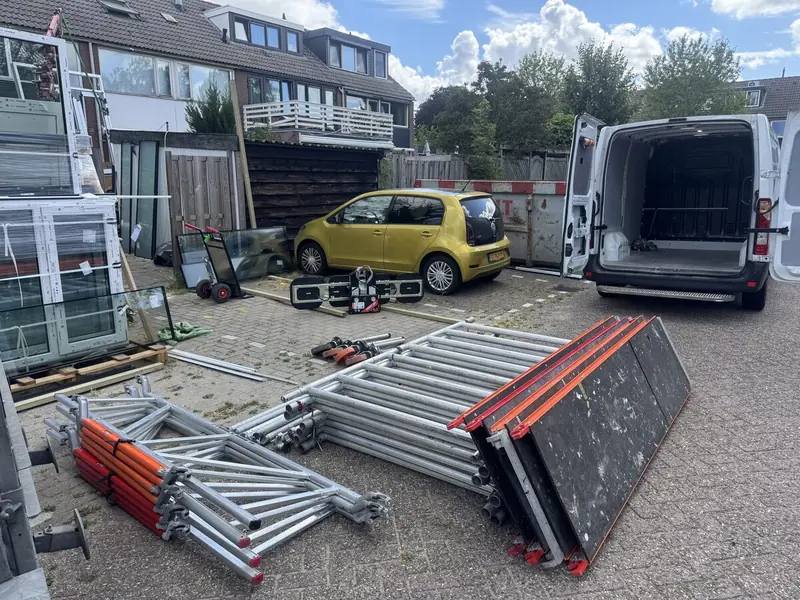
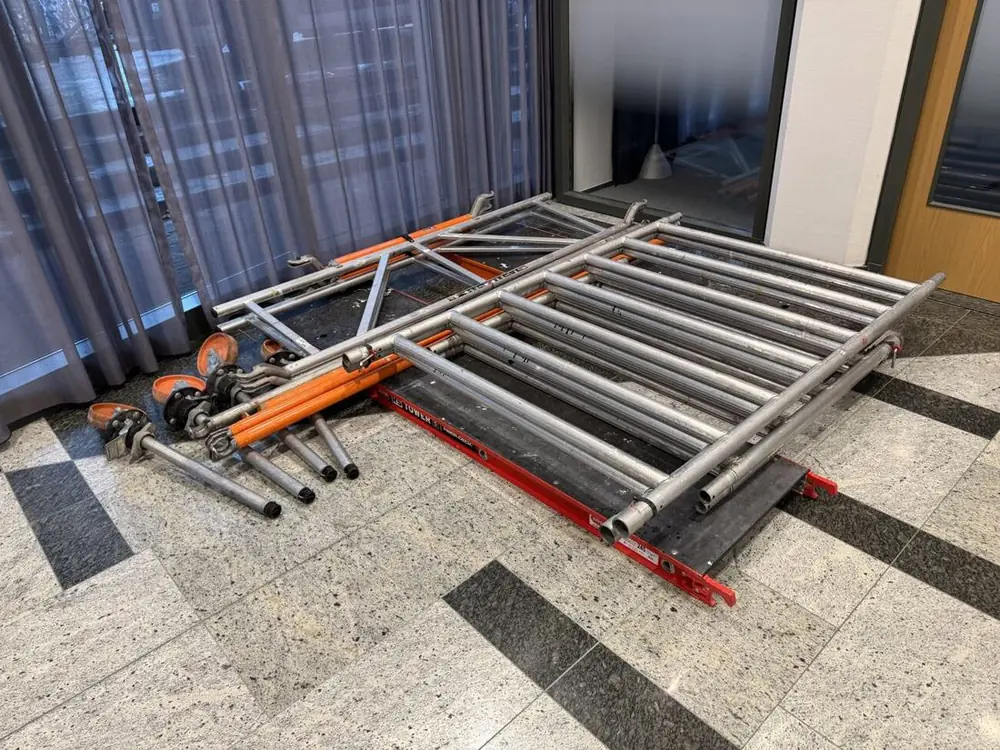
Taken apart, a mobile scaffold is not a small package. The platforms of the RS51 and the RS52 are 245 centimetres long, and that length decides how much wall you lose. Add frames, guardrails, toe boards, braces and stabilisers to that. In a standard garden shed it means an entire wall, or a loft space you cannot use for anything else, year after year.
Damp is the second factor. Aluminium does not rust, but wooden platform sections, castor tyres and hinges dislike a wet shed floor or a garden where the parts live under a tarpaulin. Without a dry, lockable spot, components deteriorate faster than expected and after a few years you are working with hatches that stick and catches that jam. Mobile scaffold dimensions and sizes sets out what each model measures, so you can check beforehand whether it fits.
Inspection, checks and wear on your own equipment
A scaffold you own is a scaffold you check yourself. Every assembly deserves a look at cracks, bent tubes, worn castors and the locking mechanism of the platforms. Commercial use adds a periodic inspection and the paperwork that goes with it. None of that is heavy work, but it is work you have to keep doing, and it surfaces exactly when you wanted to start.
Steigertaxi equipment is Altrex and complies with EN 1004, in load class 3, which means 200 kilos per square metre of permitted load. Every set is checked and completed between hires, so you never start a job with half a scaffold. What that standard covers, which components it makes compulsory and why it dictates how a scaffold is built, is explained in EN 1004 explained.
If a part looks doubtful, hiring gives you a simple route: report it and swap it. With your own scaffold you face the choice of carrying on with something that does not look right, or waiting for a replacement part you still have to order. For anyone standing ready on a Saturday with a tin of paint, that is a very real difference in planning.
What you actually hire from Steigertaxi
You hire a complete set: frames, platforms, guardrails, toe boards, braces and stabilisers, plus the manual and an instruction video. What you do not hire is an assembly crew. Steigertaxi does not build the scaffold for you and does not deliver it assembled, you put it together yourself. That is lighter than it sounds: with the manual and the video, a mobile scaffold goes up briskly with two people.
Order before 15:00 and the scaffold arrives the next working day, anywhere in the Netherlands. Collecting it yourself is possible too, free and by appointment, at Zeeburgerpad 89 in Amsterdam. Delivery and collection together are covered by a fixed amount per province, so you know exactly where you stand before you order and have nothing to recalculate afterwards.
The assembly sequence is described step by step in the assembly step plan, from base pads and locked castors through to the final guardrail. Anyone who has done it once is noticeably quicker the second time, and that applies to a hired scaffold just as much as to one you own. The experience sits in your hands, not in the ownership.
Hiring and buying compared point by point
Put the two options side by side and buying mostly produces fixed costs while hiring produces variable ones. That is exactly why frequency of use decides the outcome: fixed costs are divided across days of use, and with few days that division turns unfavourable. A scaffold that runs two days a year still carries storage every month and a check every year, even untouched.
The table lists the items that come up in both choices, so you can take them in at once rather than gathering them from separate pages. What hiring costs per day and per week is shown in the configurator and on the mobile scaffold hire cost page, so you can work with real figures instead of a rough estimate carried in your head.
| Item | Buying your own | Hiring from Steigertaxi |
|---|---|---|
| Purchase | One-off investment up front | No purchase, a rate per hire day |
| Extra hire days | Not applicable | Every day after the first at 5 percent of the day rate |
| Storage | Dry space at least 245 cm long | None, material goes back after the job |
| Maintenance and inspection | Arranged and recorded by you | Included, sets are checked between hires |
| Transport | Your own van or trailer | Delivery and collection at a fixed amount per province |
| Different size needed | Buy a second scaffold | Choose a different model per job |
| Deposit | Not applicable | 500 euro on delivery for RS51, RS52 and MiTower |
| Availability | Always, if complete and sound | Ordered before 15:00 is delivered the next working day |
Hiring lets you pick a different size per job
Buy once and you are committed. That pinches as soon as the next job is slightly different. An RS51 is 75 centimetres wide and gets past almost anything, an RS52 is 135 centimetres wide and gives far more working room and storage on the platform. Both have platforms of 245 centimetres. For indoor work there is the RS44 room scaffold, which fits through a standard interior door, and for one-person work up to six metres working height there is the MiTower.
The range runs from 4.2 to 14.2 metres working height. Working height is platform height plus two metres, the reach of an adult. Stand on a platform at four metres and you reach six. On the working height page you pick the size that matches your facade, and indoor options are listed at room scaffold hire and MiTower hire.
That flexibility comes free with hiring and costs a second investment when buying. This is where comparisons often go wrong: people cost out buying with the smallest size, while half their jobs actually need a taller or wider scaffold. Anyone whose own scaffold is too short ends up on a step stool on the platform, which is precisely what a scaffold was meant to avoid.
Transport is the item buyers underestimate
A scaffold you own has to be moved twice for every job, out and back. Loose frames and 245 centimetre platforms rarely fit in the back of a car, so you need a van, a trailer or a friend with one of the two. For a job in your own garden that is manageable and you simply carry the sections round the house. For a job at a relative's place a province away it costs half a day of driving and lifting that appeared nowhere in your budget.
With hiring it is a fixed amount per province covering delivery and collection together, regardless of how many components the set contains. What that means per region is set out on the delivery cost page. If you would rather drive yourself and have no trailer, hiring a scaffold without a trailer covers the options, or collect free of charge at Zeeburgerpad in Amsterdam.
Deposit, delivery and return when hiring
Hiring does mean putting down a deposit for the duration. On delivery that is 500 euro for the RS51, the RS52 and the MiTower, and 150 euro for the room scaffold. If you collect yourself the deposit is higher: 1000 euro for the RS51 and the RS52, 750 euro for the MiTower and 150 euro for the room scaffold. That amount is not a cost, it is parked briefly.
After return the deposit comes back within one working day, provided the set is complete and undamaged. What counts as complete, and how to make sure nothing is left behind, is covered in getting your deposit back and on the deposit page. So do not count the deposit as a cost in your comparison with buying.
When buying really is the better choice
There is a clear tipping point. If you are on a scaffold week in week out, at roughly the same height each time, and you have a van and a dry store, owning the equipment becomes logical. You no longer depend on ordering deadlines, you build with material you know intimately, and you can overrun a job without extending anything.
Even then, hiring alongside stays common. As soon as a second team is on site, or a job runs higher than your own set can handle, you hire a set in rather than buy a second scaffold that will stand idle afterwards. If you are chasing the lowest total cost for occasional use, the practical tips are in hiring a scaffold cheaply.
Working the trade-off out for your own situation
Go through the points below one at a time and note your answer. If three or more fall on the hiring side, there is no need to look up a purchase price at all and you can move straight on to choosing a size. If you are still hesitating, for most people the difference sits in storage and transport rather than in the rate itself. Both of those you can judge today by looking in your shed and on your drive.
If you cannot settle it, put your situation to us with the height of your facade and the number of days you expect to need. Via WhatsApp you get advice on the size that suits, and the contact page lists the other ways to reach us. A short description of the job is usually enough for us to land on a model together.
- How many days a year are you genuinely standing on a scaffold?
- Do you have dry space at least 245 centimetres long to spare?
- Can you transport frames and platforms yourself, or would you hire for that?
- Does the working height you need vary per job, or is it always the same?
- Do you use the scaffold commercially, with inspection obligations?
- Do you want to swap a faulty part without stopping the job?
Frequently asked questions
From how many days of use per year does buying become interesting?
Only once you are structurally on it every week. For a few jobs a year, storage, maintenance and transport outweigh the hire rate. Firms working at height daily often buy a base set and hire the rest in.
Do I always get a complete scaffold when hiring?
Yes, every set leaves complete with frames, platforms, guardrails, toe boards, braces and stabilisers. The manual and an instruction video are included. You assemble the scaffold yourself, Steigertaxi does not deliver it assembled.
How quickly can I have a hired scaffold on site?
Order before 15:00 and it is delivered the next working day, anywhere in the Netherlands. Collecting it yourself is free by appointment at Zeeburgerpad 89 in Amsterdam. That saves a day if you want to start urgently.
Does a scaffold I buy need to be inspected?
Commercial use brings inspection obligations and you keep the records yourself. For private use you should at least check for damage and wear before every assembly. With hiring, the set is checked between hires.
Can I keep a hired scaffold longer if the job overruns?
Yes, extending is possible. Only the first hire day counts at the full rate, every following day costs five percent of that. Let us know and we adjust the collection date.
What happens if a part gets damaged?
Report it and we will see what is needed. The deposit exists for exactly this and comes back within one working day after return, once the set is in complete and undamaged. Swapping parts during the hire period is open to discussion.
Is a second-hand scaffold a good alternative?
Only if you can inspect it fully. Missing braces, bent frames or a platform hatch that no longer closes make a scaffold unusable, and ordering single parts takes time. If you do not know what to look for, hiring is the safer route.