
Knowledge base · reading time 10 min
Hire or buy a mobile scaffold for businesses?
For a painting firm, an installer or a maintenance crew, hire versus buy is not a matter of principle but a sum about utilisation. A scaffold that goes out twice a month mostly costs you storage space and driving time. A scaffold that stands on a project every working day pays for itself. Below is what each route actually involves, so you can settle the question against your own diary rather than a hunch.
- Hire or buy a mobile scaffold as a business? Utilisation, storage, transport, maintenance and flexibility compared, plus when a mixed fleet works better.
- Only when the equipment is in near-continuous use and you already have the storage and transport.
- Yes, for larger facades or multiple crews you simply book more than one.
- Yes, business hire runs through an invoice in the company name so you can pass the job on.
What the decision really turns on
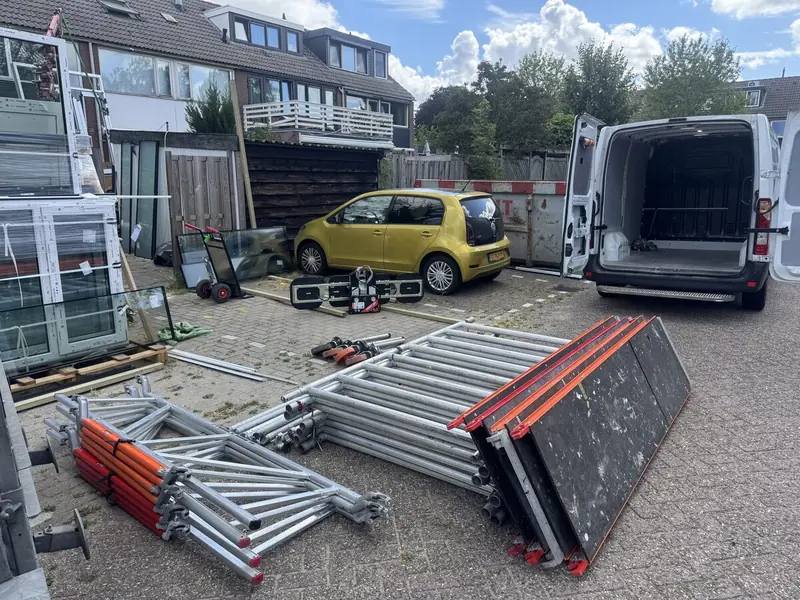
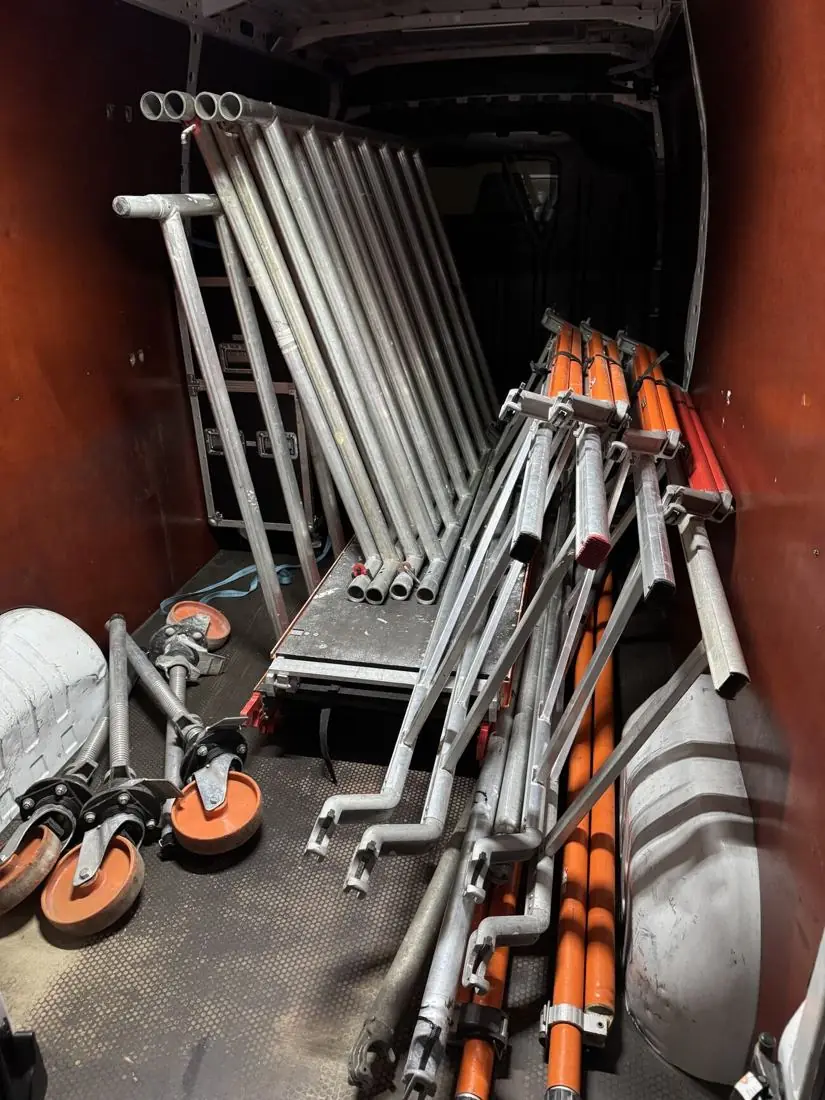
The question looks financial, but in most firms it is about space and logistics. A complete ten-metre mobile scaffold is a substantial stack of frames, platforms and braces. That stack has to stand somewhere dry, has to fit on something when it goes to a project, and somebody has to load and unload it. Do that three times a week and it becomes routine. Do it once a month and it is an obstacle every single time.
The second factor is variation. Maintenance work rarely offers two identical facades. One week you are on a ground floor in a back garden, the next on the front of a three-storey building. Our range covers working heights from 4.2 to 14.2 metres, and you do not get that spread from one purchased set. Buying means buying a height and fitting the rest of the year's jobs around it. For the outliers you end up hiring anyway.
The third factor is planning. Equipment you own is always there, but it also stands idle when a project overruns or finishes early. Equipment you hire is paid for over the period it stands on site. Which works out better depends entirely on how full your diary is. The general comparison is set out in hiring or buying a scaffold. For a business the emphasis differs from a private customer, because your own crew's hours are part of the sum.
Key facts
| Feature | Value |
|---|---|
| Core answer | Hiring avoids storage, inspection and maintenance; each Every day after that has 95% off |
| Each extra day | 95% off: €2.50 to €16.25 a day |
| Delivery | Ordered before 3 pm, delivered next working day |
| Load class | Class 3: 200 kg per m² |
| Models | Altrex RS Tower 51/52, RS44 and MiTower |
What hiring takes off your hands
Hiring means you use the equipment and leave the rest to us. The scaffold arrives complete and ready to use, in components you assemble yourself with the supplied manual and the instruction video. We handle transport in both directions, keep the equipment in order and replace what wears out. Your crew starts on the job rather than on preparing the kit. That saves half an hour at the start of every working day that you never see back anywhere.
That pays off most on the busy days. You are not checking whether last week's set is still complete, not hunting for the toe boards somebody left in another van, and not spending half a morning working out which frames belong together. What is worth checking on arrival is listed in the mobile scaffold hire checklist. That check takes a few minutes and stops you finding a component missing halfway up.
- Storage between projects, including a dry and lockable space
- Transport to and from site, covered by a fixed amount per province
- Maintenance and replacement of worn or damaged components
- Keeping the set complete, down to the clamps and toe boards
- Choosing height and model per project rather than years in advance
What ownership brings with it
A purchased scaffold is not a one-off decision, it is a recurring item. You need storage where the components stay dry and sorted, because a set lying loose in a workshop inevitably loses parts. You need transport that handles the lengths: a 245 cm platform does not fit in every van. And you need somebody keeping track of whether the set is still complete. None of that is difficult, but all of it lands on somebody's desk.
It also changes the character of your planning. Equipment you own, you want to keep busy, and in practice that leads to fitting jobs around your kit rather than the other way round. For firms with a fixed round and repeat work that is fine. For firms working mainly on request, it costs more flexibility than it returns. The set then helps decide which jobs you take on, which is rarely the point of an investment.
- A dry, lockable storage spot for each complete set
- Transport that handles 245 cm lengths and a full set
- Maintenance, repair and reordering individual components
- Somebody counting the set back in after every job
- A fixed height that your jobs have to accommodate
- Extra sets as soon as two crews need to work at height at once
How many days a month does it actually stand up?
The most honest way to settle this is to look back at your own diary for the past year. Count not the projects but the days on which a scaffold genuinely stood at height. Maintenance firms almost always overestimate this, because a two-week project often contains four or five days of scaffold work, with the rest being preparation, drying time and finishing. Count in scaffold days rather than project weeks.
Then look at how those days are spread. Twenty separate days across the year is a different picture from twenty consecutive days in spring. With separate days you pay the transport each time; over one continuous period you pay it once and the hire then runs on at five percent of the daily rate for each extra day. Scattered use therefore weighs more heavily than the raw number of days suggests.
That structure makes longer periods proportionally favourable. How it works out over a week or more is set out on the weekly price page, and the comparison between separate days and a weekly period is in hiring per day or per week. If you want the figure for a single day, look at the daily price and set it against a full week.
Storage and transport are the items that get forgotten
Storage is the item that rarely reaches the calculation and yet runs on every month. A complete ten-metre set needs several square metres of dry, lockable space, and that space cannot be used for anything else. In a rented unit that carries a price; in your own unit it comes at the expense of benches, materials or a second van. Floor space is also the hardest thing to add at the moment your firm grows.
Transport is the second. Loading and unloading costs time at both ends of every project, and that time sits in your crew's hours. With hiring the scaffold travels with us and that transport is covered by a fixed amount per province, so you know in advance where you stand. What that means for your region is shown on the delivery costs page. Because the amount is fixed per province, it does not change when the next project is a street further along.
If you are near Amsterdam there is a third option: collecting from Zeeburgerpad 89 yourself, free and by appointment. That saves the delivery charge, but you do the driving and the deposit is higher on collection. For firms with a trailer and a short run it is a real option; for a crew on the other side of the country it rarely is. Count the driving time both ways as crew hours before you make that call.
Maintenance, wear and missing components
Scaffold material does not wear out quickly, but it does become incomplete. Toe boards, clamps and loose castors are the parts that disappear after a few projects, and a set without them is no longer what it should be. With ownership that means reordering, checking the replacement suits your type and bringing the whole set back up to standard. None of it is a big job, but it happens between projects and therefore tends to end up at the bottom of the list.
Our equipment is made by Altrex and built to EN 1004, with platforms in load class 3, so 200 kg per square metre. What that standard covers in terms of guardrails, toe boards and how you climb is explained in the guide to EN 1004. With hiring the set arrives complete and goes back complete, which keeps the checking on your side short. You also do not need to hold a stock of spare components in case something gets damaged.
Hiring and buying point by point
The differences are individually small, but they add up to two different ways of working. Hiring is equipment that arrives when you need it and leaves when the job is done. Buying is equipment that is always there and that you maintain, store and transport yourself. The table lists the points you notice in daily practice, not the ones that exist only on paper. Each row is a decision somebody in your firm makes anyway.
What a table cannot show is how your firm grows. Two crews needing height at the same time means a second set with everything attached to it if you own, and a second scaffold on the booking if you hire. For firms whose size swings with the season, that difference matters more than all the others combined. A second set stands idle through the quiet months while the storage cost runs on regardless.
| Part of the decision | Hiring | Buying |
|---|---|---|
| Upfront investment | None, you pay per hire period | One-off purchase of a complete set |
| Storage | Not needed, the set goes back after the job | Dry, lockable space per set |
| Maintenance and topping up | Handled by the hire company | Your own task, including reordering |
| Transport | Fixed amount per province, or collect yourself | Own van or trailer plus driving time |
| Height per job | A different height or model per project | Tied to the height you bought |
| Two crews at once | An extra scaffold on the booking | Buy a second set |
| Cost while idle | None, you hire only when you work | Storage and capital keep running |
One purchased height rarely covers every job
Most firms that buy pick a middle height that suits the majority of their work. That holds up until a three-storey building comes along, or a low extension in a narrow back garden. Working height is platform height plus two metres, so reaching ten metres means a platform at eight. A set that will not reach is simply unusable for that job. Hiring in for that one facade then becomes the answer anyway.
Width matters just as much. The RS51 is 75 cm wide and passes through gates and along narrow paths where the 135 cm RS52 gets stuck. In return the RS52 gives you what you want on a facade: more room to work and more stability. Both have a platform length of 245 cm, so you cover a decent stretch of wall in one setup. Which of the two you need depends more often on the access to the rear than on the facade itself.
There are also jobs where a mobile scaffold is the wrong tool. Indoor work in a house calls for the RS44 room scaffold, which passes through a standard internal door from around 70 cm. A short one-person job up to six metres is work for the MiTower. Which height you need can be looked up on the working height page. It sets out which configuration belongs to each height within the 4.2 to 14.2 metre range.
Peak periods, multiple crews and overruns
Exterior work peaks. In spring and summer painters, pointers and roofers are all outside at once, and that is exactly when you do not want your capacity tied to the number of sets in your unit. For many firms hiring extra in those months is the only way to run two or three projects at once without crews waiting on each other. Outside the season that demand falls away again, and then you do not want three sets sitting in your unit.
Overruns work the same way. Rain, an unexpected surface or a delivery arriving a day late extends a project by a few days. With hiring the period simply runs on at five percent of the daily rate per extra day, so extending costs little and is a matter of letting us know. What makes a sensible hire period is covered in how many days to hire a scaffold. With ownership the same overrun shows up as a set that cannot reach the next project on time.
Many firms therefore choose neither hiring nor buying but both. They buy the height they need weekly and hire alongside it as soon as a second project or a larger facade appears. That keeps fixed costs low and capacity elastic. The line usually falls at height: the standard height in house, the outliers hired. That limits the investment to equipment that genuinely goes out every week.
Delivery, planning and short notice
For a planner, what counts is how fast something can stand. Order before 15:00 and the scaffold is delivered the next working day, anywhere in the Netherlands. A project confirmed on Tuesday afternoon can be manned on Wednesday. For firms working on call, that lead time is often the deciding argument. A scaffold that is only available in a week shifts your whole planning, including that of the subcontractors.
On an urgent job the gap widens, because your own set may sit in your unit but still has to be loaded, driven and unloaded by people you need on a roof that day. How to handle a short lead time is covered in hiring a scaffold at short notice. With delivery the equipment also arrives at the project address itself rather than at your unit first.
Do bear in mind that you assemble it yourself. We deliver the scaffold in components and do not erect it on site. For a crew that handles equipment daily that is no obstacle: the components click together without tools and a manual and instruction video come with them. We do not erect on site and we do not deliver a scaffold ready assembled.
Deposit, invoicing and cash flow
Alongside the hire and the delivery charge, a deposit appears on your booking. On delivery that is 500 euro for the RS51, the RS52 and the MiTower, and 150 euro for the room scaffold. If you collect yourself, the deposit is 1000 euro for the RS51 and the RS52, 750 euro for the MiTower and again 150 euro for the room scaffold. It comes back within one working day of the return.
For your bookkeeping that distinction matters: the deposit is not a cost and does not belong in a project calculation. Count the hire and the delivery charge and leave the deposit out, otherwise a job looks dearer than it is. The amounts per model are on the deposit page, and the rates are on the prices page. Put the deposit on its own line in your bookkeeping and your project margin stays correct.
Frequently asked questions
When is buying cheaper for a business than hiring?
Only when the equipment is in near-continuous use and you already have the storage and transport. Count the days a scaffold genuinely stood at height, not the number of projects. With scattered use, storage, transport and keeping the set complete weigh more heavily than the purchase itself.
Can we hire several scaffolds at once?
Yes, for larger facades or multiple crews you simply book more than one. Let us know the models, heights and dates you need and we will check availability. You can reach us through the contact page.
Do we get an invoice in the company name?
Yes, business hire runs through an invoice in the company name so you can pass the job on. Include only the hire and the delivery charge in your calculation. The deposit sits separately and comes back after the return.
How quickly can a scaffold be on site?
Order before 15:00 and it is delivered the next working day, anywhere in the Netherlands. Collecting it yourself is free by appointment at Zeeburgerpad 89 in Amsterdam, which suits firms nearby that have a trailer.
What does it cost when a project overruns?
The first hire day is the full rate and every following day costs five percent of that daily rate. A project that runs a few days over therefore adds relatively little. Do let us know, so the collection stays correctly planned.
Should we collect the scaffold or have it delivered?
Either works. Collection is free by appointment in Amsterdam and saves the delivery charge, but the deposit is higher and you do the driving. Delivery is a fixed amount per province and costs your crew no hours. See the cost of delivery.
Does our crew assemble the scaffold?
Yes, the scaffold is delivered in components and you assemble it yourself. No tools are needed, the parts click together and a manual and instruction video are included. The full sequence is in assembling a mobile scaffold.