
Knowledge base · reading time 11 min
Mobile scaffold or aerial lift: which should you hire?
You need to get up high, and you have a choice. A mobile scaffold gives you a fixed platform to stand on for hours, an aerial lift gives you a basket you steer from above. Which one works best depends on the facade, the ground, the length of the job and how much material you take up with you. Below are the differences that actually matter on site, including the dimensions and working methods of our own equipment.
- Mobile scaffold or aerial lift for your job? Compare working height, set-up space, deck size, assembly and hire duration to pick the right one.
- No, no operator certificate is required for a mobile scaffold.
- No, assembly is done by you.
- Our range covers working heights from 4.2 to 14.2 metres.
The essential difference between the two
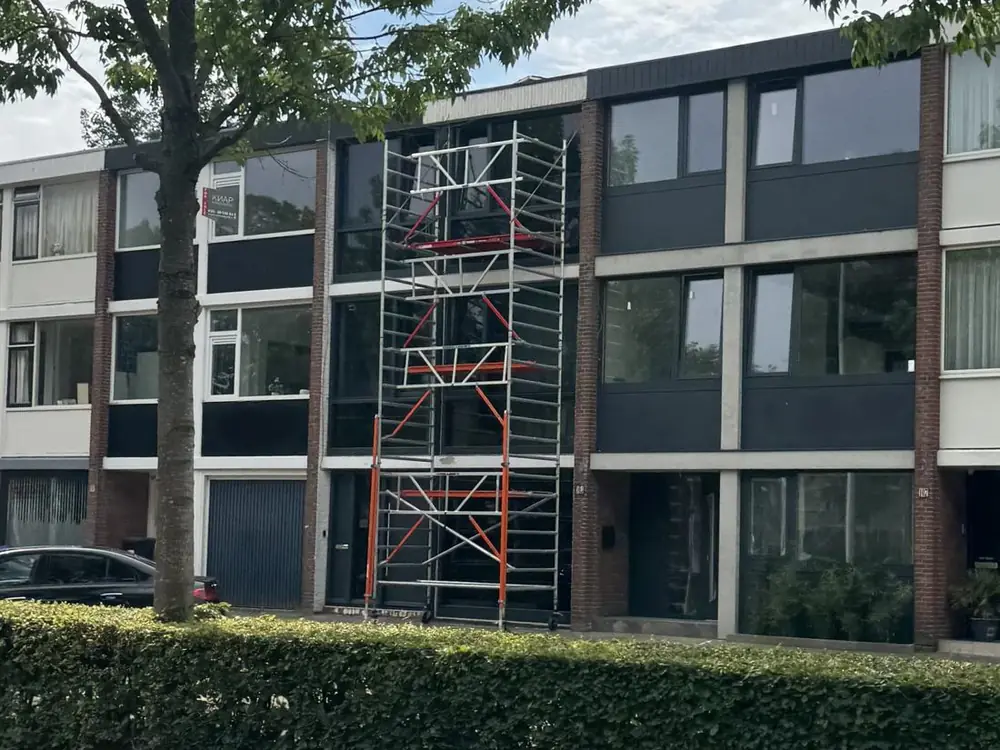
A mobile scaffold is an aluminium structure you assemble yourself: frames, diagonal braces, decks with a hatch, guardrails and toe boards, all on castors with brakes. Once it stands, it is a stationary workplace. An aerial lift is a machine with a drive unit and a basket that you steer up and sideways from inside that basket. That difference in nature determines almost everything that follows: how much room you need, how long you stay in one spot and how material reaches you.
With a scaffold, all the movement sits in the assembly. You decide in advance which working height you need, build up to it and then work from a stable surface. With a lift, the movement sits in the use: you steer yourself to the point you need and keep correcting. That is pleasant if you have twenty separate points across a facade, and awkward if you spend an hour sanding or sealing in the same spot.
What people often underestimate is deck space. On a platform you can put tools down, keep a bucket beside you and have a colleague standing next to you. A basket is tight and limits you to what fits in it. For maintenance work on houses that comparison usually favours the scaffold. If you want the basics first, read what a mobile scaffold is.
Key facts
| Feature | Value |
|---|---|
| Core answer | Up to 14.2 metres working height a mobile scaffold is usually cheaper |
| Available working heights | 4.2 to 14.2 metres |
| Load class | Class 3: 200 kg per m² |
| Delivery | Ordered before 3 pm, delivered next working day |
| Each extra day | 95% off: €2.50 to €16.25 a day |
How high each option takes you
Working height on a scaffold is simple arithmetic: platform height plus 2 metres, because that is how far an adult reaches from the deck. Stand on a platform at 4 metres and you work comfortably up to 6 metres. Our range covers working heights from 4.2 to 14.2 metres, which covers everything from a garage door and a single storey extension to the gutter of a four or five storey building. If you are unsure about your own measurement, how high a mobile scaffold may go helps you along.
With an aerial lift, what counts is the maximum working height of the machine and its sideways outreach. That outreach is the reason to choose one anyway: getting over a conservatory, an extension or a garden to reach a facade you cannot approach from the ground. If the scaffold base simply fits against the wall, that outreach earns you nothing and you pay for something you never use.
Set-up space, ground conditions and obstacles
A mobile scaffold needs a compact footprint plus the space the stabilisers take up around it. The narrow RS51 is 75 cm wide and the wide RS52 measures 135 cm, both with a deck length of 245 cm. That gets you through a gate, past a garden shed and up a driveway a machine would never manage. The ground must be level and able to carry the load, and where it is not you place base plates under the castors.
An aerial lift asks for more from the outset: access to get the machine into position, ground that carries the weight of the machine itself and enough clear surface to set the outriggers. In a narrow back garden with a fence and a shed that is often simply not workable. On the street side, with a driveway or a parking bay alongside, the picture changes and a machine becomes realistic.
Also look at what hangs above you. An overhanging roof edge, a canopy, low cables or a mature tree partly determine which solution works, and they are easy to forget when you plan from the ground. With a scaffold you can adapt the build by standing it slightly further from the wall or choosing another deck layout. With a machine you are tied to the fixed geometry of the boom and to the arc it needs to swing through.
Staying in one place versus moving constantly
For work that lasts a long time on the same square metre, a scaffold wins almost every time. Sanding, filling, painting, touching up pointing, taking out a window frame: these are jobs where you want tools beside you and where you regularly step sideways. The 245 cm deck length gives you exactly that room to move. You climb up once and stay up until that stretch is finished.
If instead you have twenty separate points to reach, checking fixings along a long facade for example, climbing down and rolling the scaffold each time wastes the day. Moving is always done empty as well: nobody and nothing on the scaffold, brakes off, roll, brakes back on. Across ten moves in a day that adds up. Then a machine that travels with you is the better choice, even at a higher rate.
What you can take up with you
Our scaffolds are made by Altrex and built to EN 1004 in load class 3, which works out at 200 kg per square metre of deck. That is enough for two people with tools and a stock of material beside them. You spread that weight across the deck and never rest anything on the guardrail. More on the calculation and the pitfalls is in mobile scaffold load and weight.
In a basket, the permitted load is fixed per machine and usually a good deal tighter, and the basket itself is smaller than a 245 cm deck. For a painter with a bucket and a roller that is fine. For a job where boards, gutter sections, insulation or a full tool chest have to come up with you, the limit arrives sooner than you expect.
- Tool chest and cordless tools, spread across the deck
- Paint buckets and sealant tubes, kept against the wall side rather than loose at the edge
- Boards, gutter sections or frame parts longer than the deck width
- A second person handing up material or working alongside you
- Waste material you want to lower down rather than drop
What hire duration does to the cost
With us you pay the full rate on the first hire day and 5 percent of that day rate for every following day. A scaffold that stays on site for two weeks therefore costs barely more than one you keep for three days. That changes the sum completely if you work evenings and weekends. The exact amount for your height and model appears in the configurator and on the page about the cost of hiring a mobile scaffold.
Machines are usually charged per day or per week, with every extra day counting in full again. For a half day job that can work out well. For facade maintenance spread across several weekends, the scaffold day structure is almost always the cheaper route. Count not only the days you actually work, but also the days the equipment simply stands there waiting for dry weather or for a supplier. Compare the structure on price per day and price per week.
Count the transport as well, because on short jobs it is often the largest single item. Delivery and collection sit in one fixed amount per province, regardless of how many days the scaffold stays on site. You will find that amount on the delivery costs page. With a machine, getting it there and taking it away is normally billed separately, sometimes within a time slot you have to be present for, and on a one day job that weighs heavily in the total.
Assembly, operation and who is allowed to work with it
You assemble a mobile scaffold yourself. We deliver it complete and supply a manual and an instruction video so you can follow the sequence step by step: base level, brakes on, frames up, braces in, deck with hatch, and only then the guardrails and toe boards. That also means you plan the assembly and dismantling time yourself, and that two people finish considerably faster than one. The full sequence is set out in assembling a mobile scaffold.
We do not assemble it for you and we do not deliver it ready built. That is a deliberate choice that keeps the hire simple: you decide when it stands, how high you build it and whether you drop it a few frames halfway through the job. No certificate is required, only common sense and the sequence from the manual.
An aerial lift works differently. Some types require an operator certificate, and the machine is brought in and taken away by the hire company at a moment that fits their planning rather than yours. If nobody in your crew holds those papers, or if you want to start on a Sunday morning, that option drops out before you even begin comparing rates.
The two side by side on the points that count
The table below sets out the practical differences the way you meet them on a job: setting up, work surface, load, ground conditions, moving, transport and how the hire price is built up. The scaffold column describes our own equipment, so the dimensions and the load class you actually receive on delivery, rather than an average taken from the market as a whole.
Read the rows with your own job in mind and mark the ones that cause a problem for you. Usually two or three lines stand out as the ones that genuinely decide it, the ground in a back garden for instance, or the number of times you would have to move. Those lines settle the choice and the rest becomes secondary.
| What it comes down to | Mobile scaffold | Aerial lift |
|---|---|---|
| Setting up | You assemble it yourself with manual and instruction video | Brought in and set on outriggers on site |
| Work surface | Deck 245 cm long, 75 or 135 cm wide | Basket, smaller than a scaffold deck |
| Load | Class 3 to EN 1004, 200 kg per m2 | Fixed maximum basket load per machine |
| Ground | Level and load bearing, base plates where needed | Must carry the weight of the machine |
| Moving during the job | Rolled empty on its castors | Travels with you from the basket |
| Transport to site | We deliver, or you collect in Amsterdam | Delivered by the hire company |
| Every following hire day | 5 percent of the day rate | Usually a full day again |
Indoor work, doorways and tight spaces
As soon as the job moves indoors, an aerial lift in a house is normally out. A stairwell, a void or a tall living room calls for something that fits through a door and may stand on a finished floor. That is what the RS44 room scaffold is for: it passes through a standard internal door from around 70 cm, so you move it from room to room without dismantling each time.
If you work alone, indoors or out, and need no more than 6 metres of working height, the MiTower is often the most practical choice. It is a one person scaffold you assemble and move on your own. For a ceiling, a stairwell or a single light fitting that is quicker to arrange than any machine, and you simply wheel it down the hall to the next room.
Delivery, collecting it yourself and the deposit
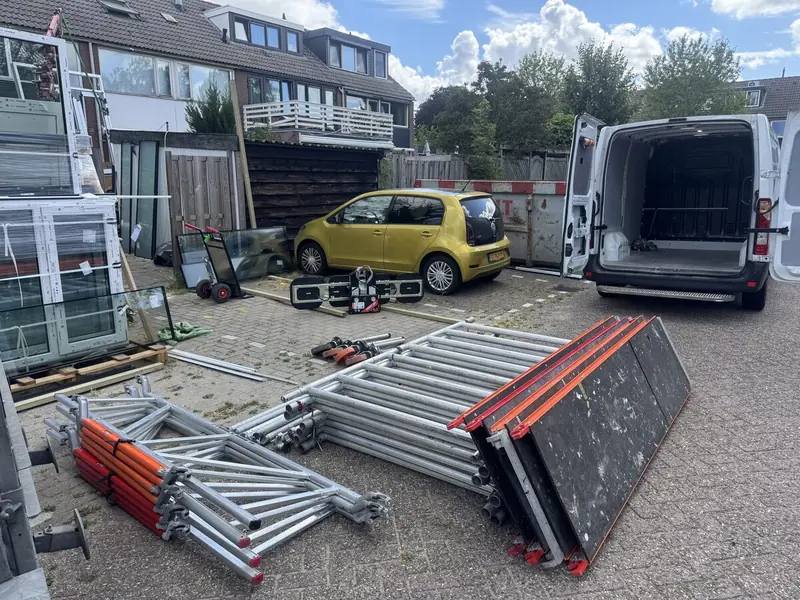
Order before 15:00 and we deliver the next working day, anywhere in the Netherlands. You do not need a trailer or a van for that: the complete package arrives at your address and is collected again afterwards. Put the parts somewhere dry and out of the way of the work and the assembly goes faster. How that works in practice is explained in hiring a mobile scaffold without a trailer.
You can also collect it yourself, free of charge and by appointment, at Zeeburgerpad 89 in Amsterdam. That saves the delivery amount, but you do need enough load space, because the frames and decks are long and you have to unload them again at the other end. For most private customers the convenience of delivery outweighs the saving, certainly on the taller builds with more parts to move.
Deposits are fixed amounts. On delivery that is 500 euro for the RS51, the RS52 and the MiTower and 150 euro for the room scaffold. If you collect it yourself it is 1000 euro for the RS51 and RS52, 750 euro for the MiTower and 150 euro for the room scaffold. After return, the deposit is back within 1 working day. There is more detail at deposit for scaffold hire.
Making the choice in a few minutes
Start with the location, not with the machine. Measure from the ground to the highest point you need to reach, subtract 2 metres and you have the platform height you are looking for. Then check whether you can get a 75 or 135 cm wide base into that spot and stand it there. If you can, the scaffold is almost always the cheaper and calmer solution.
If you cannot, because a conservatory, a ditch or a densely planted garden sits in the way, or because you have to reach dozens of points in half a day, a machine is worth considering. Still unsure, send a photo of the situation via WhatsApp. We look at facades like yours daily and we will also say plainly when a scaffold is not the right answer.
- Measure the height of the work point and subtract 2 metres for the platform height
- Check that a 75 or 135 cm wide base fits the spot, stabilisers included
- Decide whether you stay in one place or move constantly
- Count the days you need, evenings and weekends included
- Confirm the ground is level and load bearing
- Check whether you can assemble it yourself or need a second pair of hands
Frequently asked questions
Do I need a certificate for a mobile scaffold?
No, no operator certificate is required for a mobile scaffold. You assemble it yourself using the manual and the instruction video supplied with it. Some types of aerial lift do require an operator certificate. For many jobs that is the point where the choice is already made.
Do you assemble the scaffold for me?
No, assembly is done by you. We deliver the scaffold complete, with a manual and an instruction video so you can follow the sequence step by step. With two people it goes considerably faster than alone. It also means you decide when it stands and how high you build it.
How high can I get with a mobile scaffold?
Our range covers working heights from 4.2 to 14.2 metres. That is ample for family homes, town houses and most commercial buildings. Working height is platform height plus 2 metres, so your deck sits lower than the point you can reach. When in doubt, size up one step.
Can a mobile scaffold reach over a conservatory or extension?
Only if you can set it up beside or on top of it on level, load bearing ground. A scaffold does not reach sideways over an obstacle the way a boom does. If a conservatory or extension is in the way, send a photo of the situation and we will look at it with you. Sometimes a different set-up position is all it takes.
What does an extra hire day cost at Steigertaxi?
Every day after the first costs 5 percent of the day rate. The first hire day is charged at the full rate. That makes a longer hire period proportionally cheap, even if you only work at weekends. The amount for your height and model is calculated in the configurator.
How quickly can the scaffold be at my address?
Order before 15:00 and we deliver the next working day, anywhere in the Netherlands. Delivery and collection together sit in one fixed amount per province. So you do not need to arrange a trailer or a van. Collecting it yourself is free of charge by appointment in Amsterdam.
How much may I put on the deck?
Our Altrex scaffolds are built in load class 3 to EN 1004, meaning 200 kg per square metre. Spread that weight evenly across the deck and account for the people standing on it. Never rest material on the guardrail. Heavier items are best placed against the wall side.